The Unintended Consequences of Indoor Water Conservation

High rates of water conservation helped California manage limited supplies during the 2012–16 drought. But conservation can have a downside. New research shows that indoor water conservation can reduce the quality and quantity of wastewater, making it harder for local agencies to use treated wastewater to augment their water supply.

We talked to two members of the research team about their findings: David Jassby, associate professor of civil and environmental engineering at UCLA; and Kurt Schwabe, professor of environmental economics and policy at UC Riverside and an adjunct fellow at the PPIC Water Policy Center.

Jassby summarized the problem: “In general, as people conserve water inside their homes, the concentration of contaminants in the wastewater goes up—organic matter, nitrogen, detergents, and more. All of these things have to be treated.”

Schwabe noted that in the past, recycled water was mostly used for irrigating nearby cropland and median strips—not drinking. But as treatment processes have improved and demand for water increased, recycled water has become an integral part of the drinking water supply in some areas, where it is used to replenish groundwater basins. In many communities, treated wastewater is discharged into rivers and streams and used by downstream entities that treat the water again.

Salinity is a particular challenge. “Most wastewater treatment plants can treat higher levels of nutrients, but they’re not designed to treat higher levels of salinity,” Schwabe said. “What this means is the water that is discharged into streams or to farms or into aquifers for groundwater recharge will be saltier, which reduces water quality and crop yields.”

Schwabe noted that while utilities can employ technical fixes to address drought-related wastewater quality issues, this doesn’t address the problem of quantity. Indoor conservation results in less treated water flowing into streams or available for reuse.

On average, only about 10% of municipal wastewater is reused in the US. Israel reuses 85–90% of its wastewater—perhaps the highest rate in the world, Schwabe said. California is adopting new rules on “direct potable reuse” of treated wastewater, which would enable cities to add treated wastewater directly into their water supply.

“Farmers in some parts of California are becoming increasingly reliant on treated municipal wastewater from neighboring urban areas. This is an effective strategy for dealing with water scarcity. But it also reveals that conservation—another effective drought strategy—might in some instances work at odds with wastewater reuse.”

Urban areas are also affected. For example, recycled wastewater is a significant portion of stream flow in the Santa Ana River in Southern California. Indoor conservation reduces water supply for communities in downstream reaches of the river.

Does this mean that people abandon conservation? The researchers say no. “Our results are intended to illustrate how different drought mitigation actions are related so agencies can plan, communicate, and coordinate in the most informed and cost-effective manner possible,” said Schwabe. “Conservation mandates that don’t recognize these linkages can have significant and negative consequences on the effort to reuse wastewater.”

Jassby noted that the place conservation happens is key: “When people are asked to conserve water, they should be encouraged to conserve water outside the home.”

More broadly, having water supply and wastewater treatment agencies cooperate in how they manage their systems can also help, Schwabe said.

The State of Groundwater Recharge in the San Joaquin Valley

When strong winter rains finally ended the recent five-year drought, many water districts seized the opportunity to recharge depleted aquifers. How did they do, and what barriers did they face? A public forum brought more than 30 experts together to discuss the benefits, opportunities, and barriers to groundwater recharge. The event was hosted by the California State Board of Food and Agriculture and the state Department of Water Resources.

My presentation focused on recharge in the San Joaquin Valley—a region that is home to more than four million people, half the state’s agricultural output, and most of its critically overdrafted groundwater basins, where pumping exceeds replenishment. Consequences include dry wells, sinking lands, and reduced supplies to weather future droughts.

As part of our ongoing work to explore practical and effective solutions to the region’s water challenges, the PPIC Water Policy Center recently surveyed local water districts about their groundwater recharge efforts. Although such efforts have been underway for decades in some parts of the valley, the state’s 2014 groundwater law has increased interest in using recharge to bring basins into long-term balance.

About 75% of respondents to our survey said they were actively recharging this year. Large water districts with formal recharge programs are doing the lion’s share of recharge, but there’s lots of interest from smaller agencies in getting in on the act.

Agricultural districts are already employing a broad mix of recharge tools, and many see potential for expansion. In contrast, urban districts—most of which rely heavily on groundwater—are much less active. The most widespread methods—used by two-thirds of agricultural districts surveyed—include allowing water to seep through unlined canals and irrigating crops with surface water instead of groundwater, which enables basins to recharge naturally (a method known as “in-lieu” recharge). Other popular options—used by half of agricultural districts—include directing water to dedicated “recharge basins” and applying extra water on irrigated cropland. Some districts also spread water on fallowed land and open space. Of these tools, recharge basins are being used most intensively, storing more than half of total recharge reported (roughly four maf). One caveat to this last finding is that many districts have been using some popular methods (cropland irrigation, in-lieu recharge, and unlined canals) without formally accounting for how much recharge occurs.

Kern County is “recharge central,” accounting for more than half of total recharge volumes reported. It is also the hub of recharge partnership programs that enable water users to store water off-site, by districts that have especially good recharge conditions.

Survey respondents also noted the biggest barriers for their districts. Perhaps reflecting the very large volumes of surface water available this year, respondents were much more likely to flag problems related to infrastructure (72% of respondents) than to regulatory issues (30%). Infrastructure challenges included capacity constraints in several areas: recharge basins, “system” conveyance to get water to the district (e.g., through the Friant-Kern Canal or the California Aqueduct), and conveyance within the district to deliver water to good recharge lands. Many respondents also noted problems with the timing of water availability—a big issue in this very wet year, when storms brought large amounts of water all at once. Other constraints include challenges of expanding recharge on croplands because of farm-related issues (42%)—including unsuitable irrigation systems and uncertainties about the impacts on crop health—and difficulties raising funds for recharge projects (23%).

Survey findings also highlight the opportunities to expand recharge to help close the valley’s water deficit. In particular, the new groundwater sustainability agencies will need to develop better water accounting—which can help improve incentives and funding opportunities for recharge. And as water districts and water users work together to develop basin-wide sustainability plans, there’s potential to develop joint programs between surface water “haves” and “have nots.” Importantly, this includes opportunities to involve more cities and towns in groundwater banking projects and to encourage partnerships to expand off-site recharge.

For more details on these preliminary findings, see the slides linked below. And stay tuned for a report with complete survey findings in early 2018.

Videos: Priorities for California’s Water

This past year brought drought-busting rain and snow and severe wildfires—extremes that tested California’s systems for managing water supply and the natural environment and foreshadow conditions of a changing climate. In light of these challenges, a PPIC Water Policy Center event in Sacramento last week brought together experts to discuss ways forward in three areas: legislative priorities for cities, farms, and rural communities; partnerships that improve the health of ecosystems; and decisions for the Colorado River and Sacramento–San Joaquin Delta.

Ellen Hanak, director of the PPIC Water Policy Center, began the program by summarizing priorities for California water outlined in a new PPIC report. These include California’s ability to recharge aquifers, maintain dams and levees, manage headwater forests and aquatic ecosystems, and provide safe drinking water to rural communities.

The first panel examined a host of proposed, passed, and pending water bills, covering topics as diverse as funding water infrastructure, improving water-use reporting, and addressing safe drinking water problems.

The lack of safe drinking water in disadvantaged communities prompted a lively conversation on how to pay for a lasting solution to the problem. Laurel Firestone, codirector of the Community Water Center, noted that while California has passed a resolution declaring a human right to water, the state’s drinking water crisis—which she said dwarfs that of Flint, Michigan—will take a more concerted effort to resolve.

One possible funding solution the panel discussed is a tax on fertilizers to pay for cleaning up groundwater contaminated by nitrate, which can cause health problems. “This is a legacy problem that stems from the over-application of nitrogen fertilizer for many, many decades,” said Dave Puglia, executive vice president of Western Growers.

The second panel tackled a problem even longer in the making: the crisis in California’s aquatic ecosystems. “We spent 150 years fundamentally changing the ecosystem… We’ve spent about 40 years actively failing to do something about it,” noted Lewis Bair, a water resource engineer with Reclamation District No. 108. “Our system is so modified, and there’s so much work to do, it will probably take a generation to make significant change.” The panelists discussed innovative projects and partnerships that are providing multiple benefits while also improving habitat for aquatic species—and how to scale them up to get broader effects at the ecosystem level.

The final panel looked at two watersheds that have outsized importance to California’s water supply: the Sacramento–San Joaquin Delta and the Colorado River. While the multi-state effort to improve management of the Colorado River has become a model of cooperation, efforts to make progress in the Delta have been more contentious.

Much of the conversation focused on WaterFix, the state’s proposal to modernize the Delta’s water export infrastructure with a pair of tunnels. Grant Davis, the new director of the California Department of Water Resources, called the Delta “the heart of the state’s water supply delivery,” and said that “the status quo will take us into unreliability and ultimately a crisis—and no one wants to manage water in a crisis.” The conversation turned to the long and difficult history of trying to resolve water conflict in the Delta, the need for reliable water supplies for agriculture, and the costs of the tunnels project.

We invite you to watch the videos from this event and hope you find the discussions illuminating and useful:


Learn more

Visit the Policy Priorities for California’s Water YouTube playlist
Visit the PPIC Water Policy Center

New Laws Ease Funding and Improve Accounting for Water

This was a busy year for water policy in the California Legislature. Governor Jerry Brown signed more than a dozen bills affecting the way we manage water. The bills cover a wide range of issues, from funding water infrastructure to reporting on new groundwater wells in overdrafted basins.

Paying for water emerged as a major theme in this year’s crop of water bills. Here’s a summary of newly signed bills:

  • Stormwater: SB 231 gives the courts guidance on how to interpret Proposition 218, which requires that a majority of landowners or a two-thirds majority of all local voters approve new stormwater drainage fees—making it difficult for agencies to pay for needed improvements to their systems. SB 231 defines stormwater as part of the sewer system. This puts stormwater services on par with water, sewer, and trash collection, none of which are subject to direct voter approval of new fees. If the courts uphold SB 231’s interpretation, this will give stormwater agencies more flexibility to raise funds.
  • Safe drinking water: AB 560 and AB 339 expand funding options for projects that enhance drinking water quality in poor communities and meet emergency water supply needs. AB 560 will make it easier for some disadvantaged communities to access grants and get more affordable terms on loans for safe drinking water projects through the Drinking Water State Revolving Fund. And AB 339 makes permanent a temporary authorization to use the State Cleanup and Abatement Account for emergency drinking water supply problems such as shortages or impaired quality.
  • Water and parks bond: SB 5 (the California Drought, Water, Parks, Climate, Coastal Protection, and Outdoor Access for All Act of 2018) is a $4 billion general obligation bond for improving outdoor open spaces and parks, protecting rivers and coastlines, and supporting solutions to a range of other water management issues such as groundwater sustainability and flood protection. This will go before voters in June 2018.

Two bills improve water use accounting:

  • AB 589 creates standards for water use measurement techniques. This addresses the relatively recent requirement that surface water diverters measure and report water use to the state.
  • SB 252 specifies types of information that groundwater users must report to their local jurisdictions when they apply to dig new wells in critically overdrafted basins. Reporting includes characteristics such as well location and depth, distance from surface water areas, estimated volume to be pumped, and category of use. The bill, which sunsets on January 30, 2020, is aimed at filling a critical data gap until groundwater sustainability plans are adopted under the Sustainable Groundwater Management Act.

Other pending water policies that did not make it to the governor’s desk this year are likely to return in 2018. To pay for safe drinking water projects in disadvantaged communities, SB 623 would create a Safe and Affordable Drinking Water Fund, to be funded by fees on agricultural chemicals and urban water use. And AB 1668 (in conjunction with SB 606) would authorize state agencies to establish long-term urban water use efficiency standards. The bill also proposes additional components to agricultural water management planning and reporting. SB 606 proposes changes to urban water shortage planning policies.

The new laws are designed to improve access to funding and strengthen existing tools for improving the way California manages water. We will keep track of updates and new proposals in 2018.

Storing Water for Dry Days

Where would California be without the ability to store water? We talked to Jay Lund―an adjunct fellow at the PPIC Water Policy Center and director of the Center for Watershed Sciences at UC Davis—about the often contentious and always complex topic of water storage.

Jay LundPPIC: What should every Californian know about storing water?
Jay Lund: Thanks to our Mediterranean climate, California has a very long dry season, which is when we use most of our water, and a fairly short wet season, when we try to gather and store water. To put water storage in perspective, California every year has a worse drought–in the form of a long dry season—than most of the country has ever seen. California has always relied on water storage, and in droughts today we rely on it even more. Almost all the water people use in summer has been stored someplace—either in a reservoir or groundwater. The state’s natural storage system of groundwater and snowpack is now augmented with reservoirs, pipelines, and groundwater pumping. This storage and conveyance system has been critical to California’s prosperity, particularly to its agricultural economy.

You often hear calls for more storage, and of course we do have some limitations in water storage capacity. But no matter how large a reservoir you build, you’ll never be able to reliably get more water out than that stream’s average flow into it. In much of the state the problem is that there’s not enough water available to store or that we can’t get water to the places where it’s needed most. The bottlenecks are often inadequate conveyance rather than storage.

PPIC: What did we learn about water storage from the recent drought and subsequent record-breaking wet winter?

JL: The drought highlighted the importance of groundwater storage. Surface storage in reservoirs is very important in the first couple years of a drought, but with longer droughts we rely more and more on groundwater storage. Groundwater will always be our primary storage for long droughts. California has 400–500 million acre-feet in groundwater storage, compared to about 42 million acre-feet in total surface reservoir capacity. Water quality is a bigger challenge with groundwater than with surface water, since pollutants can be washed into aquifers and accumulate there.

California’s geography is fortunate—we have huge aquifers under the Central Valley. Farmers made up for about 70% of reduced water supply during the drought by pumping groundwater. The longer the drought, the more important groundwater becomes. If we don’t manage to recharge enough water during wet years, there won’t be enough in drought years.

The wet year brought us the Oroville Dam spillway crisis. All of the dam’s outlet structures were compromised or broken for much of the winter. It was a good reminder that we have to maintain these structures and systems, and find funding for maintenance and independent inspections. Good inspectors will always find some concerns and problems, but few problems rise to the level of crisis. With California’s extensive water infrastructure system, if you’re not finding any problems you’re not looking hard enough.

PPIC: What will it take to made good use of groundwater recharge and storage?

JL: You need three things to recharge groundwater: porous land above an aquifer, enough water available above that land, and enough empty space under that land to store it. While local conditions are important, the big limitation for the areas of California experiencing groundwater problems is lack of surface water available for recharge. During this wet winter, people were trying to recharge as much as possible and being very creative about it. But this was a record wet year. We often lack enough water to get good recharge.

To improve recharge locally, we need a better accounting system to improve incentives. We also need more legal protections for local agencies that want to do recharge, and faster authorizations to recharge in wetter years.

Learn moreRead Dams in California (PPIC fact sheet, September 2017).
Read California’s Water: Storing Water (from the California’s Water briefing kit, October 2016).
Read “Expanding Water Storage Capacity in California” (California Water Blog, February 22, 2012).
Visit the PPIC Water Policy Center.

Fellow to Explore Central Valley Groundwater Problems

Josué Medellín-Azuara headshotI am pleased to announce the appointment of Josué Medellín-Azuara, a member of the PPIC Water Policy Center’s research network, as the 2017 Steyer-Taylor Fellow. This is the second year of a three-year fellowship―supported with funding from the TomKat Foundation, established by Tom Steyer and Kat Taylor―to explore solutions to some of California’s toughest groundwater policy challenges.

Medellín-Azuara is associate professor at the UC Merced School of Engineering. He focuses on water resources economics with expertise in water management for agricultural, environmental and urban uses, and farm adaptation to drought and climate change, among other topics.

This fellowship not only advances the water center’s work, it also adds to the state’s body of knowledge on how to address many of the challenges of sustainable groundwater management.

Medellín-Azuara will explore how California agriculture can adapt to future challenges of managing groundwater—especially in the stressed groundwater basins of the San Joaquin Valley, which is the state’s most important agricultural region and largest water user.

“We’ll be looking at future scenarios involving a changing climate, urbanization, technological advancement, and water scarcity, which will shape California’s agricultural mosaic,” said Medellín-Azuara.

The state’s groundwater law requires the valley’s water users to develop sustainable groundwater management plans by 2020.  Medellín-Azuara is part of a team of PPIC Water Policy Center researchers working on a comprehensive analysis of possible sustainable water management solutions for the region.

Learn more
Read the report Water Stress and a Changing San Joaquin Valley (March 2017)
Read “Groundwater in California” (PPIC fact sheet, May 2017)
Visit the PPIC Water Policy Center

Groundwater Quality Is Key to Quantity

To improve groundwater management we need to focus on more than the quantity our aquifers can supply. We also need to focus on quality.

Groundwater levels have been dropping in many of the state’s major aquifers, especially in parts of the Central Valley. This chronic issue was made worse by increased pumping during the latest drought. Lower water tables have resulted in increased pumping costs, the need for deeper wells, land subsidence, and salt-water intrusion into groundwater.

But groundwater supply is also harmed by pollutants, particularly nitrate and salt. Nitrate is widespread in many rural areas. Its major source is nitrogen fertilizer and manure. Salt, one of the most common pollutants, is in fertilizers, manure, and treated urban wastewater, and also occurs naturally. Both pollutants can compromise and ultimately reduce drinking water supplies. Salty groundwater is damaging to crops. In some areas, other contaminants such as naturally occurring arsenic also pose problems for drinking water.

Recently passed regulations seek to address both aquifer depletion and contamination issues with the goal of protecting groundwater resources for the long run. A suite of policies extended existing water quality protections to groundwater: the Central Valley Dairy Order, the Irrigated Lands Regulatory Program (ILRP), and the Central Valley Salinity Alternative for Long-Term Sustainability (CV-SALTS). More broadly, the Sustainable Groundwater Management Act (SGMA) directs agencies in charge of addressing groundwater depletion also avoid degrading water quality.

These regulations mark a historic shift in how groundwater is managed in California. They each provide distinct frameworks for addressing quality and quantity challenges. To reap the most benefits from their implementation, it will be important to coordinate management activities.

Under SGMA, more than 250 newly formed groundwater sustainability agencies will be in charge of managing groundwater resources. The jurisdiction and size of these agencies vary, and most groundwater basins have multiple  groundwater sustainability agencies. The ILRP, which regulates runoff from irrigated lands, includes 12 coalitions statewide and thousands of farmers with individual waste discharge permits. The most effective solutions will require coordination and collaboration beyond the boundaries of these individual entities.

For instance, one way to address groundwater depletion is through intentional groundwater recharge. Because groundwater doesn’t respect property lines, recharge is best managed at a larger scale than most farms―ideally at the scale of an entire basin. Groundwater recharge can also affect water quality.

Depending on the soil type and crop choices, intentional recharge can improve or degrade the underlying water quality. Recharging in ways that benefit groundwater quality will entail coordinating cropping patterns, irrigation systems, and agronomic practices. The ILRP coalitions have already taken steps to assess areas that could be vulnerable to groundwater quality problems, promote farm practices that reduce pollution, and improve water quality monitoring. There are likely to be opportunities for GSAs to benefit from sharing resources on monitoring and planning with entities that manage water quality, such as ILRP coalitions. Forming partnerships in the early stages of drafting groundwater sustainability plans would be a good next step.

Coordinated management has the potential to address some tough, persistent water quality and quantity challenges, but it will generally take years before the benefits become apparent. Since groundwater depletion and quality degradation affect poor rural communities most acutely, more expeditious approaches are also needed. The state has been working on solutions to address the urgent public health issues these communities face. The SGMA also brings new opportunities to coordinate with local institutions to distribute and prioritize available resources.

Learn more

Read “Groundwater in California” (PPIC fact sheet, May 2017)
Read “California’s Water Quality Challenges” (PPIC fact sheet, October 2015)
Visit the PPIC Water Policy Center

New Water Official’s Views on Salton Sea, Other Priorities

California’s State Water Board has a broad mandate to oversee our complex water system and balance all beneficial uses of water. Joaquin Esquivel―the newest member of the board and a member of the PPIC Water Policy Center’s advisory council―brings broad experience working on state and federal water issues, and personal and professional experience with the challenges of the Salton Sea. We talked with him about his priorities for California’s water issues.

PPIC: You’ll be engaged with the board’s effort to reduce environmental and public health problems at the Salton Sea. Why is this issue important?

JOAQUIN ESQUIVEL: The health and viability of the sea is important in many ways. It’s important to the health of our families and communities throughout the Imperial and Coachella Valleys. Many people who live there already struggle with poor environmental quality. It’s critical to the Pacific Flyway and the more than 400 bird species that use the sea. It’s key to the economies of surrounding communities, which could take an estimated $29–70 billion hit over the next few decades if the sea declines unchecked. And it’s important to California’s water future.

People sometimes forget how much water California gets from the Colorado River, which was significant to Southern California’s resiliency during the recent drought. There is a deep and abiding connection between the sea’s success and our success at better managing the Colorado River, which itself has been stressed by drought.

The issues facing the sea are not unlike other big challenges we face in many other watersheds in California: overlapping public health, economic, and ecosystem needs; limited resources; legacy challenges; and insufficient funding for the scope of work that needs to be undertaken.

Resolving the Salton Sea’s issues requires a tremendous amount of cooperation. The good news is that we’re at the right moment for decisive action. The California Natural Resources Agency has developed a common vision and plan with stakeholders on projects we need to undertake immediately and over the next 10 years.

PPIC: What are you most optimistic about regarding California’s water issues? And what are you most concerned about?

JE: I’m excited by the fact that the drought really focused Californians on water and brought forward communities, voices, and leaders with a passion to break through the old fights and work together to tackle the state’s most difficult water challenges. The drought has created incredible opportunities for collaboration. For example, we’re seeing collaborative efforts in the Central Valley to find solutions to the lack of safe drinking water in some of our poorest and most disadvantaged communities. There’s growing understanding of the importance of expanding and maintaining watershed health, along with growing partnerships between farmers—our greatest assets as stewards of our land—academia, and NGOs to rebuild and strengthen the resilience of our ecosystems. I’m excited that there’s a new generation of engagement on water policy, and it couldn’t come at a better time.

What keeps me up at night is the huge amount of work that needs to be done to resolve our greatest challenges and always feeling that we don’t have the dollars we need to undertake it all. Inadequate funding is always going to be a challenge, so we need to figure out how to better align local, state, and federal dollars, policies, and priorities. It’s really important that we solve the problem of underfunding our water systems and the ecosystems that underpin them.

PPIC: Talk about the governor’s new joint project with the governor of Maryland to develop a “water policy learning network” for other governors.

JE: The National Governors Association staff had been hearing from its members that states were interested in learning about managing water resources, and they approached Governor Brown and Governor Larry Hogan about co-chairing an initiative. I was fortunate to have been tapped as the advisory group co-chair, along with Maryland’s secretary of the environment. The first of two Water Policy Institutes was held earlier this week in Maryland. The second will be held next year in California. The initiative is an opportunity for states to share and discuss best practices in the management of water resources. While it will be useful to share the ways in which California has been a leader on conservation, recycling, and integrated water management, this is also an opportunity for us to learn from other states. We’re right to feel proud of the leadership California has shown on water, but we still have a long way to go in many respects. This initiative is the ideal opportunity to learn from the wealth of experience in other states.

Learn more

Read “Remaking the Salton Sea” (PPIC Blog, April 6, 2017)
Read California’s Water: The Colorado River (from the California’s Water briefing kit, October 2016)
Visit the PPIC Water Policy Center

Bringing Order to Groundwater Management

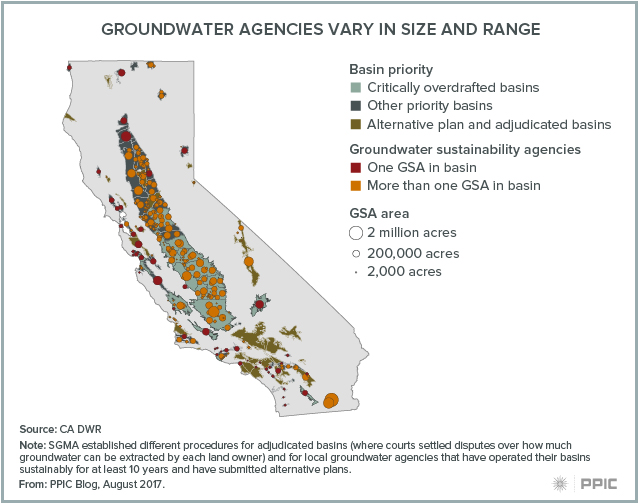
California’s water management is a complex stew with many cooks. At the local level, hundreds of irrigation districts and urban water agencies and a few thousand small drinking water suppliers are responsible for a wide variety of water-related issues. And it just got more complex: as of June 30, more than 250 newly formed Groundwater Sustainability Agencies (GSAs) were added to the mix.

The 2014 Sustainable Groundwater Management Act (SGMA) directed local agencies to develop institutions, plans, and implementation strategies to sustainably manage their groundwater resources for the long run. As a result, more than 250 local agencies have formed GSAs in 140 “priority basins” (those that account for most of California’s groundwater use). More than 70 percent of the new GSAs are in the San Joaquin Valley and the Sacramento Valley—regions whose large groundwater basins supply farms, cities, and small rural communities.

A variety of parties can form GSAs, though most are made up of local agencies such as counties, cities, and irrigation districts. A GSA can also be formed by a single entity, such an irrigation district—Westlands Water District has formed one. It can be formed by groups of agencies, as is the case with the Merced Subbasin GSA, which includes six public agencies with water management or land use authority. These parties vary widely in their interests and experience in groundwater management.

The first task of the GSAs will be to develop groundwater sustainability plans for their basins. In basins with multiple GSAs, the agencies will either have to create a common plan or have an agreement to coordinate plans. This is no small task, given the number of agencies and their institutional diversity. Anticipating some of these complexities, the Department of Water Resources has already published a set of documents to guide plan development.

Although GSAs and their local partners will have the lead responsibility for developing and implementing groundwater sustainability plans, the state can play a pivotal supportive role. Given the varying technical and institutional capacity at the local scale and the challenges of coordinating different plans, a number of tools could help GSAs implement effective programs in ways that reduce conflict and foster success.

Developing common accounting standards is a top priority. GSAs must speak the same language to ensure consistency in groundwater budgets across agencies and basins. Statewide standards are needed on matters such as units used and frequency of measurement to enable comparability, auditability, and consistent analysis and management. Accounting templates and modeling standards could help guide this process. The Department of Water Resources has developed online reporting standards for other water sectors—such as the templates for submitting Urban Water Management Plans that standardize basic information agencies must submit—which might be a good model to follow. This might also help bridge some chronic water data gaps that have made it more difficult to manage California’s water.

The state could also provide technical guidance on developing local monitoring and enforcement regulations, which will be key to implementing the plans. Critically overdrafted basins—where long-term pumping has exceeded the rate of replenishment—will need to develop strategies to increase recharge and reduce pumping. Doing this well will require measuring groundwater extraction, setting overall pumping limits, and establishing pumping allocations. These tasks will help to establish a water budget, and are also essential to implementing innovative mechanisms such as incentives for recharge, storing groundwater for later use, and trading, which can add flexibility in groundwater management. Making these tools available for every agency, no matter its size and capabilities, will help ease the transition to sustainable management with minimal economic disruptions.

Getting to groundwater sustainability might be the most challenging issue in California’s water management for the foreseeable future. But it also provides opportunities to overcome some chronic water management gaps and encourage stakeholders to work cooperatively in a basin-scale approach. Local leadership is key to defining the proper solutions for each basin. But state guidance will also be essential to coordinate efforts and to promote innovation and knowledge sharing across the intricate landscape of agencies.

Learn more

Read the report Accounting for California’s Water (July 2016)
Read the report Water Stress and a Changing San Joaquin Valley (March 2017)
Read “Groundwater in California” (PPIC fact sheet, May 2017)
Visit the PPIC Water Policy Center

Video: Building Bay Area Drought Resilience

As water supplies dwindled statewide during the recent drought, Bay Area cities struggled with the consequences—including dying trees and landscaping and reduced revenues to run water systems. But overall, Bay Area water districts weathered the drought remarkably well, according to local water experts—in part, thanks to planning, cooperative efforts among neighboring water suppliers, and enthusiastic conservation on the part of their customers.

These were some of the observations from experts gathered at a recent event at PPIC’s San Francisco headquarters. Speakers included John Marchand, the mayor of Livermore, in conversation with Ellen Hanak, director of the PPIC Water Policy Center. A panel discussion moderated by KQED public radio’s Lauren Sommer followed. Panelists were Alexander Coate of the East Bay Municipal Utility District, Peter Drekmeier of the Tuolumne River Trust, Ken Jenkins of California Water Service, and Steven Ritchie of the San Francisco Public Utilities Commission.

“There are two components to drought resilience,” said Hanak in her introductory presentation. “One is having supply investments that reduce the risk of extreme shortages, and the other is the ability to manage demand in the short term.”

Speakers discussed a range of supply and demand tactics they used to build resilience in their cities and additional ways to prepare for droughts. Topics ranged from the use of treated wastewater for recharging groundwater basins and potable uses; the use of different financial mechanisms to maintain revenue as water sales dipped; and unintended consequences that arose, such as the potentially permanent loss of street trees and other landscaping as water conservation took hold.

Some essential takeaways included:

  • Regional diversification of water supply is key to getting through dry times.
  • Mandated conservation from the state was a blunt instrument; targets based on utilities’ local water conservation plans are more appropriate for such decisions.
  • Planning for “conservation rates” is essential for water districts’ fiscal resilience and maintenance of reserves to pay for fixed costs.
  • Aquatic ecosystems took a hit during the drought. Even though Bay Area cities embraced water conservation throughout the drought, flows to the Tuolumne River and Delta were inadequate. Addressing this before the next drought hits is key to maintain ecosystem health and at-risk species.

Learn more

Read the report Building Drought Resilience in California’s Cities and Suburbs (June 2017)
Read California’s Water: Water for Cities (from the California’s Water briefing kit, October 2016)
Visit the PPIC Water Policy Center’s drought resource page