Video: 2020 Election Preview

Now that California’s presidential primary has been moved from June to March, how might the state’s electorate influence the 2020 election, and how are the major parties engaging with voters? At a lunchtime event in Sacramento last week, PPIC president Mark Baldassare provided an overview of voter participation in California and KQED’s Marisa Lagos moderated a lively, wide-ranging discussion of the upcoming election season.

Lagos, who covers California politics and government for KQED, noted that California has long been a “piggy bank” for presidential candidates in both parties. She asked whether the earlier primary date will increase the state’s influence. “Guess what? You’re still the piggy bank!” joked Tamara Keith, White House correspondent for National Public Radio.

More seriously, Keith noted that it isn’t clear whether “California will come into the process soon enough to make a difference or whether things will have started settling out after Iowa and New Hampshire.” She added that because it takes weeks for the state to count its absentee ballots, “there’s a chance that the race will have already advanced a lot by the time California’s results are fully in.”

Rusty Hicks, chair of the California Democratic Party, said that the earlier primary date offers opportunities for presidential candidates to engage voters across the state. “You have top-tier candidates going to the northern rural parts of the state. They’re going to the Central Valley, they’re going to the Inland Empire.” In his view, this is “a real opportunity to showcase the state . . . it’s more than the Bay Area and Los Angeles.”

From the Republican perspective, the early presidential primary doesn’t make a big difference. But Jessica Patterson, chair of the California Republican Party, sees opportunities on the state level. “We have the opportunity to change the entire makeup of the building across the street.” The party is focused on “making sure we’re engaged in communities . . . to talk about the things that are important to them, and really focus on fixing our state.”

While their perspectives differed in many ways, both Patterson and Hicks stressed the importance of working together to empower and represent all Californians. “I think we all have an interest in ensuring that we have an engaged and empowered electorate,” said Hicks. Patterson agreed, adding that “it’s better for all of us when we find ways that we can work together.”

 

Californians Favor Funds for School Construction

With little time to spare, the legislature last week passed a $15 billion school construction bond. A signature from Governor Newsom will place the bond measure—called the Public Preschool, K–12, and College Health and Safety Bond Act of 2020—on the March 2020 primary ballot. Given Californians’ general support for funding education, how do they feel about bond measures for school construction projects?

It’s important to note that the PPIC Statewide Survey has not yet asked Californians about this particular measure, which would provide funding across K–12 and higher education systems. However, we have consistently found that Californians are supportive of bonds for each system individually. (We did not ask about specific dollar amounts.)

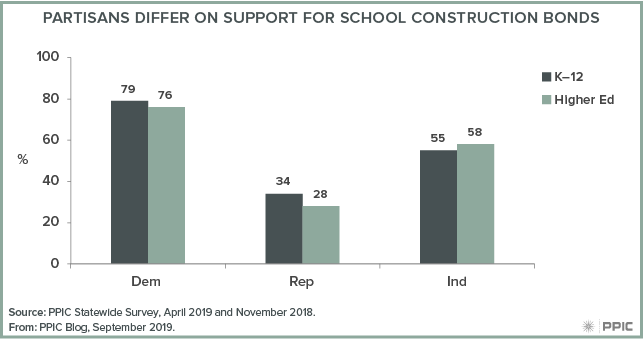
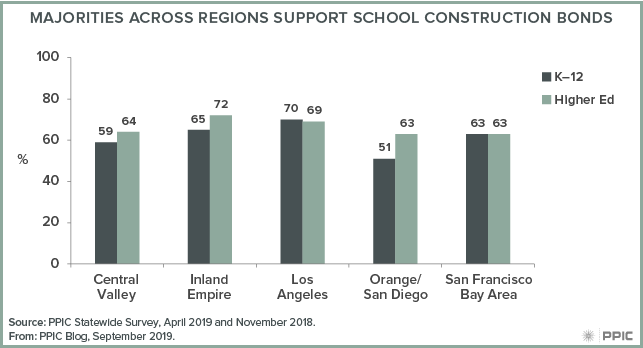
In our April survey, about six in ten adults (62%) and likely voters (57%) said they would vote yes on a bond for K–12 school construction projects, while in November 2018 two in three adults (66%) and about six in ten likely voters (57%) supported a bond to pay for construction projects in California’s public higher education system. In both surveys, there was majority support across regions and demographic groups—except among whites (47%) for the K–12 bond. For both types of bonds, support was lower among whites than other racial/ethnic groups, and support decreased as age and income levels rose.

figure - Majorities across Regions Support School Construction Bonds

Despite this widespread support for these bonds, we found a significant partisan divide. For both bond questions an overwhelming majority of Democrats as well as smaller majorities of independents have been in favor; far fewer Republicans have been.

figure - Partisans Differ on Support for School Construction Bonds

With California set to play a prominent role in the March Democratic presidential primary—potentially drawing large numbers of Democratic voters—this partisan divide could play a role in passing the bond.

We still don’t know how Californians will perceive this particular bond—in terms of the dollar amount or the joint funding of K–12 and higher education. Stay tuned for more from the PPIC Statewide Survey as we will track support for this bond, as well as many other important 2020 election issues.

Californians and the 2020 Election

This post is excerpted from my opening remarks at PPIC’s annual Sutton Family Speaker Series event, “2020 Election Preview earlier today, in Sacramento.

All eyes will be on California when voters make their choices in the upcoming presidential primary on March 3. Last year, California experienced a surge in voter registration and voting. On the heels of record low turnout in 2014, the 2018 election had the highest turnout for a midterm in California since 1982. Still, PPIC colleagues report that turnout is low compared to other states.

To help make sense of the state’s voting patterns, PPIC has just released a new report titled California’s Exclusive Electorate: A New Look at Who Votes and Why It Matters, which analyzes data from the last nine waves of PPIC Statewide Surveys and includes responses from nearly 15,200 California adults. These latest findings, built on a PPIC study that was first published in 2006 and then updated in 2016, help us to set the context for this 2020 election preview event. While much is changing in the electorate, many patterns stubbornly persist.

Growth in political participation has been strong in the wake of significant changes in our state’s election laws and because we live in such interesting times for national politics. However, it is noteworthy that about 5 million California adults are not eligible to vote, while about 5 million eligible adults are not registered and about 7 million registered voters did not cast a ballot in November 2018. If past trends are any indication, only about half of California’s approximately 31 million adults will vote in the November 2020 general election, and far fewer will cast ballots in the March 2020 primary.

Importantly, the demographic makeup of the electorate is not representative of the people of California. Voters in California tend to be white, affluent, college educated, and homeowners. Nonvoters are more likely to be younger, Latino, renters, lower income, less educated, and to self-identify as the “have nots” in society. While some gaps have narrowed, a wide gulf remains between voters and nonvoters.

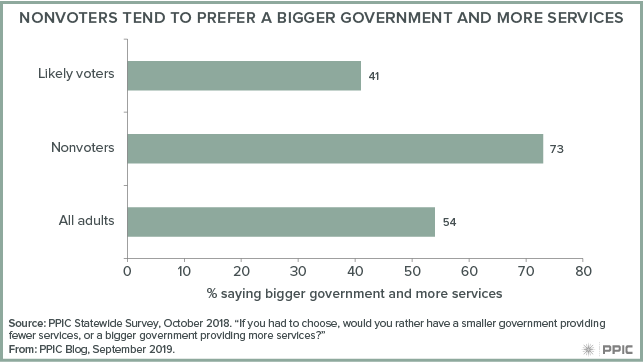
Because of their stark differences, voters and nonvoters are not aligned in their views of the role of government. For instance, only 41 percent of likely voters prefer a bigger government that provides more services, while 73 percent of nonvoters and 54 percent of all adults do so. Preferences vary in similar ways when asked if the government should be doing more to reduce the gap between the rich and the poor, or if the government should do more to make sure that all people have an equal opportunity to get ahead.

figure - Nonvoters Tend To Prefer a Bigger Government and More Services

What would change if more nonvoters turn out for the March primary and November election? Presidential candidates who favor a more expansive government role would get a boost, and so would proponents of state bond measures and citizens’ initiatives to raise taxes on the wealthy. President Trump’s approval rating here is much lower among nonvoters than likely voters (24% to 38%) and, thus, a higher turnout would also help the Democratic candidates in competitive US House races—as it did in 2018.

Expanding the electorate might also inject some idealism into the cynicism and divisiveness of politics today. Nonvoters are more optimistic about the prospect that Americans of different political views can still come together and work out their differences. California still has a long way to go, but the movement toward a more representative electorate that we are starting to see is a step in the right direction for a state that calls on voters to make decisions that impact all of its residents.

In the meantime, PPIC Statewide Surveys will continue to poll all adults so that elected officials can take into account the needs and wants of all of the people they were elected to represent, and not only the likely voters, in a consequential 2020 election year.

Democrats View Environmental Policy as Critical in Upcoming Primary

Climate change is becoming a defining issue for voters in next year’s presidential election. According to PPIC’s latest statewide survey on the environment, record-high shares of Californians are concerned about the impacts of global warming, overwhelming majorities disapprove of the way President Trump is handling environmental issues, and most likely voters say presidential candidates’ positions on the environment are important in determining their vote next year.

With California’s presidential primary a little more than six months away, eight in ten likely voters say that the candidates’ positions on the environment are important (44% very, 36% somewhat) in determining their vote. Democratic likely voters (64%) are far more likely than independents (34%) and Republicans (20%) to say candidates’ positions on the environment are very important. In addition to partisan divisions, there are significant generational differences—even within parties, Democratic likely voters age 18 to 44 (76%) are much more likely than those age 45 and older (58%) to say candidates’ environmental positions are very important.

With the environment critical for many Democrats, especially younger voters, whom do they support in the 2020 presidential primary? Among likely voters who are registered Democrats or are Democratic-leaning independents, and who say candidates’ environmental positions are very important, support is greatest for Kamala Harris (19%), Elizabeth Warren (18%), Bernie Sanders (12%), and Joe Biden (11%). (Candidates mentioned are those who polled 10% or higher). Notably, nearly a quarter (24%) of those who say the environment is very important are currently undecided. Here, too, there are differences across age groups. Likely voters age 18 to 44 concerned about the environment name Warren (23%), Sanders (20%), and Harris (15%) as their top primary choices, while those age 45 and older name Harris (22%), Biden (16%), and Warren (15%).

When asked about the Green New Deal, a policy proposal in Congress that aims to address climate change and stimulate economic growth, three in four likely voters who are registered Democrats or are Democratic-leaning independents say that candidates’ positions on the proposal are important in determining their vote (35% very, 39% somewhat). Among those who say positions on the Green New Deal are very important, 20% name Harris and Warren, 14% name Sanders, and 10% name Biden as their preferred candidate. Again of note, 20% of voters who say this is very important are undecided. Likely voters age 18 to 44 interested in the Green New Deal support Warren (27%), Sanders (24%), and Harris (15%), while among those age 45 and older support is greatest for Harris (24%), Warren (16%), and Biden (15%).

figure - Candidates’ Environmental Policies Matter to Democratic Likely Voters

These findings suggest that Californians will place high importance on environmental issues when making choices at the ballot in the coming year. With the next Democratic presidential debate and climate crisis town hall less than a month away, PPIC will be closely tracking the role of climate policies and other salient issues.


Video: Californians and Their Government

Less than a year before California’s presidential primary, likely voters who are Democrats or who lean Democratic are divided on strategy: is it more important for the party to nominate the candidate who seems mostly likely to defeat President Trump or the candidate whose positions align most closely their views? But almost all Californians see voting in the 2020 elections as very important. At a lunchtime briefing in Sacramento last Thursday, PPIC researcher Dean Bonner outlined these and other key findings from the latest statewide survey.

Two in three California likely voters say they will definitely or probably choose a candidate other than Trump. There is a huge partisan divide on this question: 93% of Democrats and 66% of independents would definitely or probably vote for another candidate if the election were held today, while 82% of Republicans would definitely or probably vote for Trump.

Most Californians say that the investigation by special counsel Robert Mueller did not clear the president of wrongdoing, and Californians are more likely that the nation as a whole to say impeachment proceedings should begin. But here, too, there is a partisan divide: 66% of Democrats say Congress should begin the process, compared to only 39% of independents and 9% of Republicans.

Other survey highlights:

  • A majority of Californians say their housing costs cause a financial strain; six in ten favor the governor’s plan to allocate $1 billion to address homelessness, and similar shares favor proposed new rules intended to create more affordable housing.
  • Three-quarters of Californians see participation in the 2020 Census as very important—but most have concerns about confidentiality.
  • An overwhelming majority are concerned about rising electricity bills in the wake of the PG&E bankruptcy.
  • Californians are concerned that the recent outbreak of measles could spread; most believe that vaccines are very safe and an overwhelming majority say vaccination against measles and other diseases should be required.

California 2020: Census and Elections Are Important to Californians

The 2020 Census is fast approaching. With political representation and billions in federal funds on the line, the importance of an accurate count cannot be overstated. Californians recognize this, according to our latest survey—but many have concerns about the confidentiality of the information they provide. Even more Californians say that the 2020 elections are important. Both are critical to the future of the state.

California has invested substantially in raising awareness and preparing local communities for what will be a monumental census effort. Governor Gavin Newsom has proposed adding another $54 million toward state census activities, on top of a previous allocation that was just north of $100 million. These funds—along with a sustained effort at building partnerships around the state—are meant to counter California’s particular vulnerabilities when it comes to ensuring an accurate census: large shares of immigrants and other hard-to-count populations.

With so much at stake, participation in the census is critical. Are Californians aware of the importance of being counted? Currently, three-quarters of all adults (75%) say it is very important to participate in the 2020 Census. Overwhelming majorities agree across regions, political parties, and all demographic groups—from age, income, and education level to racial/ethnic and citizenship status groups. Naturalized citizens are the most likely to say that participation in the census is very important (80%).

Later this month, the US Supreme Court is expected to rule on the legality of adding a question about citizenship status to the 2020 Census, as the Trump administration has proposed. This question has not been asked on the decennial census since 1950, and opponents argue that it would depress the count among immigrants who might be fearful about revealing their status.

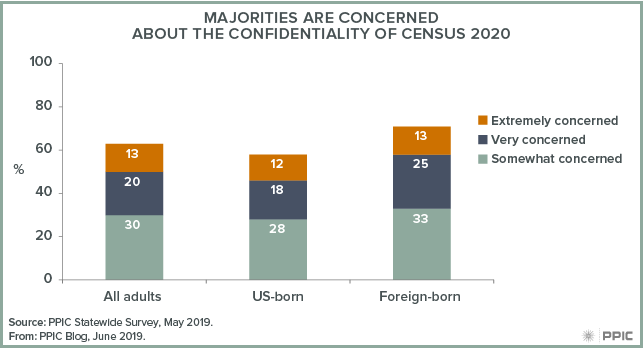
A solid majority of Californians (63%) are concerned that the Census Bureau will not keep 2020 Census answers confidential. This concern is highest among Latinos (74%) and African Americans (70%), followed by Asian Americans (64%) and whites (52%). US-born Californians (58%) are less likely than foreign-born residents (71%) to say that confidentiality is a concern.

figure - Majorities Are Concerned about the Confidentiality of Census 2020

The upcoming census will coincide with another pivotal event—the 2020 presidential election. Election outcomes will have additional lasting effects this cycle, as state legislators (or redistricting commissions) will use the new 2020 Census data to redraw district lines that will last a decade. Today, nearly all Californians recognize the importance of voting next year.

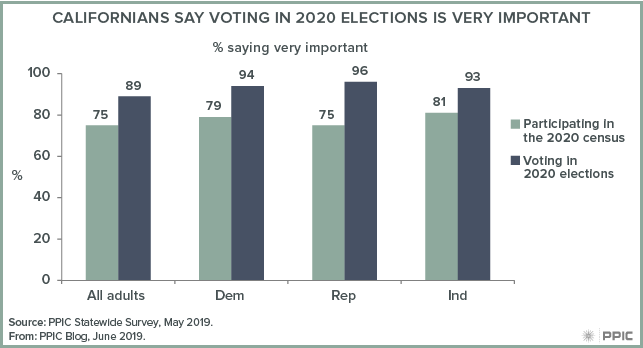
While three in four say it is very important to participate in the census, even more—nine in ten—say that it is very important to vote in the 2020 elections. More than nine in ten across political parties hold this view, as do more than eight in ten across regions and demographic groups.

figure - Californians Say Voting in 2020 Elections Is Very Important

With a presidential primary in California next March and the census in April, Californians are heading toward a consequential season—for the state and the nation. Efforts to boost participation in both of these essential civic events will be critical to ensuring that all Californians are heard—and counted.