The COVID-19 Crisis Is Affecting Low-Income Workers

As California responds to COVID-19, its low-income workers face particularly urgent difficulties. These Californians are not necessarily at high risk of health complications from COVID-19, but they will be deeply affected by the economic consequences of the steps being taken by cities, counties, and regions to contain the outbreak and protect public health.

About 12.3 million Californians in families headed by working age adults live in or near poverty; a majority (58%) are Latino, while 21% are white, 12% are Asian, 6% are African American. About 1.5 million live in deep poverty (with resources less than half of the poverty line), while 4.3 million are just below the poverty line and 6.5 million are just above it (within one and one and a half times the poverty line).

The largest number of poor and near-poor Californians live in Los Angeles County (about 4 million), followed by the Bay Area (about 2 million).
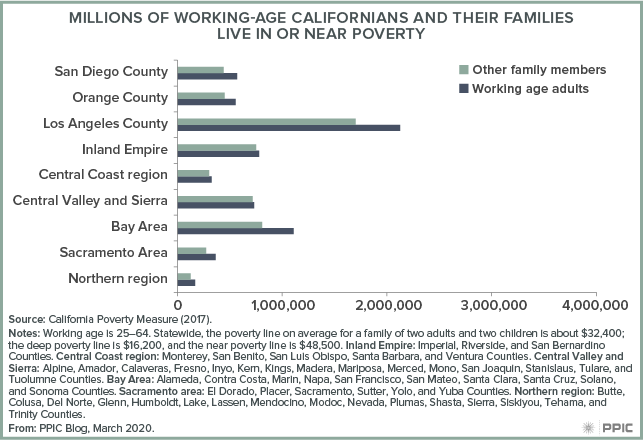
figure - Millions of Working-age Californians and Their Families Live in or Near Poverty

The federal and state governments have been developing a range of short-term measures that promise to bolster the resources of Californians who are economically affected by this public health emergency. These measures include the expansion of food assistance benefits, paid sick leave, and unemployment benefits.

Steps like these are important because 12.2% of California’s working adults live in poverty, and after-tax income from work makes up 72% of poor and near-poor family resources, on average. A loss of $500 in annual income would push an additional 215,000 Californians into poverty, while a loss of $1,000 would put an additional 425,000 Californians below the poverty line. In short, even a relatively small financial loss can make a big difference.

Communicating to California’s Seniors about Coronavirus

Older adults are especially vulnerable to the coronavirus (COVID-19). Early data show that mortality rates among people age 60 or older are many times higher than among younger adults. Protecting this population is paramount to limiting the health consequences of the COVID-19 pandemic. In California, this means communicating information in ways that can effectively reach a particularly diverse older population.

California’s senior population is large and growing fast. In 2018 the number of older adults in California reached 8.0 million, up from 5.7 million ten years earlier, according to the American Community Survey. Today, one in five Californians is age 60 or over, a record high.

The rapid growth in the older population is not unique to California. Throughout the nation—as in most developed countries of the world—populations are aging rapidly. The aging of the very large baby boom cohort, declining birth rates, and increasing life expectancy have expanded the senior population.

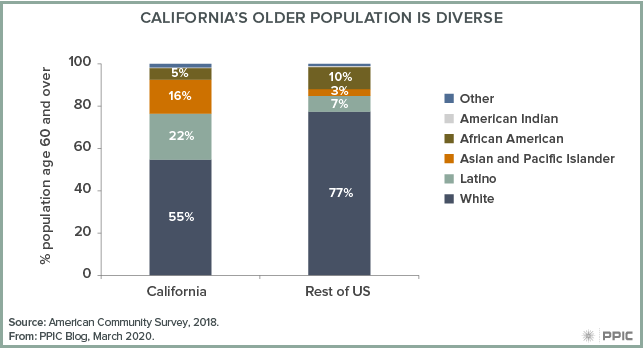
What sets California apart is its diversity. People of color make up almost half (45%) of California’s 60 and over population, about double the share of the rest of the nation (23%). In California, Latino and Asian American populations make up relatively high shares.

figure - California’s Older Population Is Diverse

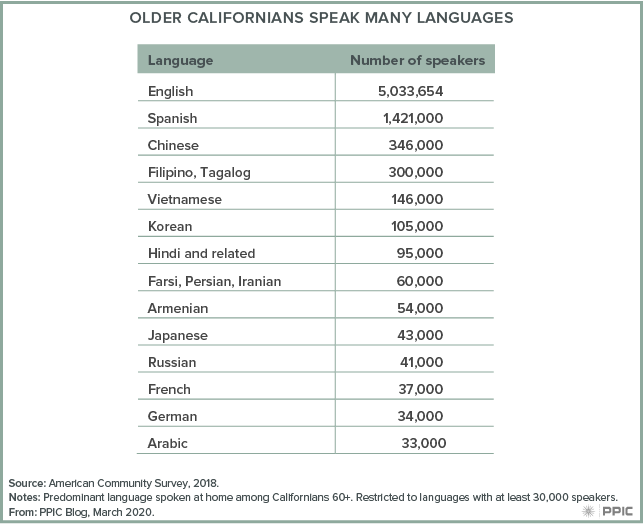
California’s older population is also diverse in terms of language: 37% of older Californians speak a language other than English at home, compared to 13% in the rest of the nation. While Spanish predominates among non-English speaking households, dozens of languages have at least 10,000 speakers. Among the 2.9 million Californians who do not speak English at home, 1.2 million are not proficient in English (speaking only some or no English).

figure - Older Californians Speak Many Languages

The vast majority of older adults live in the state’s large metropolitan areas—Los Angeles, Orange, San Diego, and Ventura Counties, along with the Bay Area. But in some lightly populated rural counties, they make up one-third or more of the population. These counties, in the far northern part of the state (Modoc, Trinity, and Siskiyou) and in the Sierra Nevada (Alpine, Amador, Calaveras, Mariposa, Nevada, Plumas, Sierra, and Tuolumne), could face acute local health care challenges.

It is essential that health services and public health messaging in California consider the state’s diverse population of older adults. Culturally and linguistically appropriate public health announcements, news, and services will help ensure that all Californians in all regions of the state have up-to-date information on the novel coronavirus and steps they can take to protect themselves and lessen its spread.

Will Students without Home Internet Fall Behind During Coronavirus Shutdowns?

K–12 schools across California are preparing for closures due to the coronavirus outbreak, to protect students from unnecessary exposure and to sanitize facilities. As schools consider moving classes online to mitigate the disruption to student learning, broadband access at home presents a formidable challenge.

The good news is that K–12 schools have the means to deliver classes online. PPIC research has found that the overwhelming majority (90%) of California schools met the Federal Communications Commission’s (FCC) minimum threshold for digital learning in 2018, and 59% of schools met the FCC’s long-term targets.

However, internet access is a bigger problem for students in their homes. In 2017, close to 1 million (15.6%) school-aged children (ages 6–17) had no internet connection at home, while over 1.6 million (27.5%) did not have broadband access. About 9.5 percent of households with school-aged children reach the internet only via a cellular data plan, which can be slower and more expensive. For these same households, the devices available are limited as well, with 12.7 percent reporting no laptop, desktop, tablet, or other portable wireless computer at home.

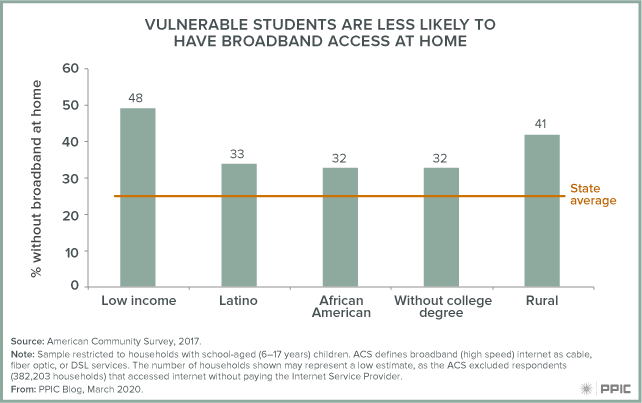
Underrepresented students are most at risk of falling further behind during school closures. About a third of Latino or African American students and students whose parents do not have a college degree lack a broadband subscription at home. Nearly half of low-income households with school-aged children have no broadband at home. Affordability remains a key barrier, as half of low-income households did not subscribe to broadband because of the cost.

In rural areas, access may depend on whether an area offers services. Forty-one percent of rural households with school-aged children do not subscribe to broadband at home, which is much higher than the state average (25%). For households with no internet access, 33.2 percent indicated internet was not available where they lived compared to 1.3 percent of respondents in metropolitan areas.

Households may not have internet or broadband for many reasons, including financial, technological, and topographical barriers.

figure - Vulnerable Students Are Less Likely to Have Broadband Access at Home

As the state and local authorities consider alternatives to in-person instruction, policymakers will need to consider how internet access will affect all students in the days and weeks ahead.