Reducing Drought Risks in Rural Communities

Disadvantaged rural communities are disproportionately exposed to drinking water risks in California. Too many experience insecure supplies and contamination of their water sources. While there are growing efforts by policymakers to address water contamination, many communities will need further help to prepare for future droughts. Improved planning efforts could help avert water shortages.

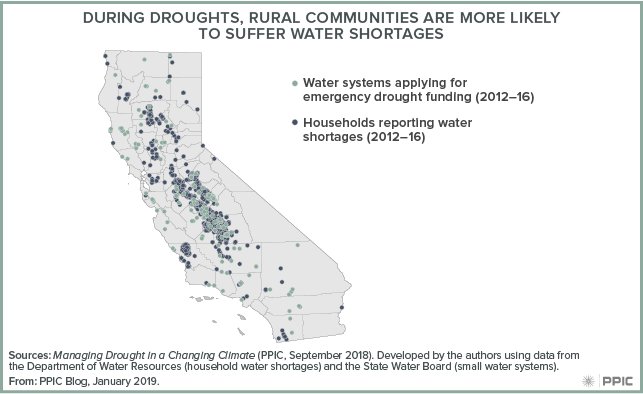
Rural residents are more vulnerable to running out of water during droughts because they are more likely to rely solely on groundwater from small community wells or domestic wells. These wells tend to be relatively shallow, so they are susceptible to running dry when pumping lowers groundwater levels. During the 2012‒16 drought, farmers and cities pumped extra groundwater to make up for surface water shortages. Thousands of wells went dry―mostly domestic drinking water wells in rural communities, especially in the San Joaquin Valley. And roughly 150 small community water systems sought emergency assistance to keep the taps flowing.

Although the state’s Sustainable Groundwater Management Act (SGMA) is expected to lead to balanced groundwater use and reduce over-pumping in the long term, California’s highly variable climate means that groundwater levels will still drop during droughts. This could result in more drinking water wells going dry. In a recent submission to the California Water Data Challenge, several colleagues from UC Davis and I found that a drought similar to the latest one could cause more than 4,000 domestic wells to go dry in the Central Valley.

A recent PPIC report on managing drought in a changing climate offers two ideas for reducing these risks:

  • Develop drinking water plans for rural communities and identify durable funding sources. Small rural systems do not have the financial capacity for drought planning and mitigation. State and local partners should use their experience from the recent drought to identify communities at highest risk, connect them to larger systems where feasible, and devise drought response programs for the others with reliable funding sources. The newly formed groundwater sustainability agencies, working with local partners such as counties and agricultural and urban dischargers, could help coordinate actions and streamline funding mechanisms.
  • Ensure groundwater sustainability plans include mitigation actions for dry drinking wells. Sustainability plans should describe preparation for groundwater drawdowns during severe drought similar to the one in 2012‒16. For instance, as groundwater sustainability agencies develop their plans, mapping drinking water wells that might be at risk for different drought scenarios and proposing mitigation actions that proactively decrease the risks are both imperative.

Studies of institutional responses to the latest drought largely find that planning for drought response and recovery paid off. Making an action plan to avoid further water-supply risks in disadvantaged rural communities―as well as identifying reliable funding mechanisms to implement it―should be top priorities for California policymakers.
Adapting to an Uncertain Water Future

As the world’s biggest climate meeting continues in Poland this week, the growing threats from climate change―and the lack of large-scale action to match the risks―have been much in the news. Global, national, and statewide assessments all point to severe consequences if greenhouse gas emissions are not greatly reduced. Evidence is growing that climate change is a “threat multiplier,” increasing the frequency and intensity of natural disasters worldwide and here in California. And just this past week, the Global Carbon Project reported that emissions are rising rapidly, making it even more difficult to meet the goals of the Paris Agreement and heightening the possibility of more-frequent and more-damaging climate impacts.

These reports all point to the same policy direction for California. While it is important that the state continue its leadership on reducing greenhouse gas emissions, it is time to greatly increase efforts at adaptation.

Water is where climate change is having its most direct and measurable impact in California. A recent PPIC report found that five climate pressures—warming temperatures, shrinking snowpack, shorter wet seasons, more volatile precipitation, and rising seas—affect all aspects of water. We recommended a suite of integrated reforms to adapt to these changes. These include better planning for water use in cities and farms, and for the environment; upgrading the state’s water management infrastructure; improving the way the state allocates water; and coming up with innovative new funding mechanisms.

Although all of the reforms are important, two—upgrading infrastructure and providing adequate funding—are the most critical. California’s water management infrastructure is vast and complex. Nearly 1,500 dams and reservoirs provide numerous services, some of which are at cross purposes with each other: they store water, reduce flood risk, generate electricity, help maintain downstream ecosystems, and provide recreation. Large volumes of existing and potential storage occur in more than 500 groundwater basins.

The above- and below-ground storage is linked from far-northern California to the suburbs of San Diego by a network of thousands of miles of canals and aqueducts, as well as rivers that function as aqueducts. California could not function without this networked “grid.” This grid is the state’s most valuable asset for adapting to an uncertain climate future.

We recommend that this grid be upgraded. A top priority includes repairing or strengthening dams, canals, and aqueducts—most of which were designed and built more than 50 years ago using outdated hydrology that doesn’t reflect a changing climate. Another upgrade is adding connections to the grid so that water can be conveyed more easily to where it’s needed for replenishing groundwater storage or to support water trading. And integrating operations of the grid, possibly involving a wholesale change in the way it is managed and governed, should also be prioritized.

But talk about upgrading the grid will be insufficient if the state does not find a way to pay for it. The defeat of the statewide water bond, Proposition 3, in November may be an indication of “bond fatigue.” Instead, the burden for paying for this upgrade is likely to fall upon local communities, who already shoulder about 85% of the costs for water management every year. This will be a contentious but necessary public debate. Without new resources, upgrading the grid will be very difficult.

The climate is changing, and the direction of change poses great challenges for California water management. But the state has a very large portfolio of assets to help adapt to this change. If these assets are managed well—and California makes well-funded investments in upgrades and focuses on sustainability—the state can weather these changes with minimal social and economic disruptions.

Video: Water Advice for Governor-Elect Newsom

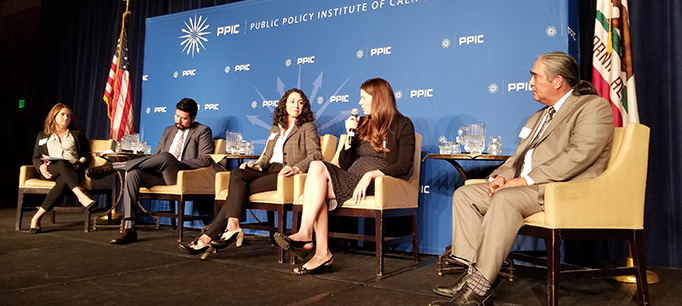
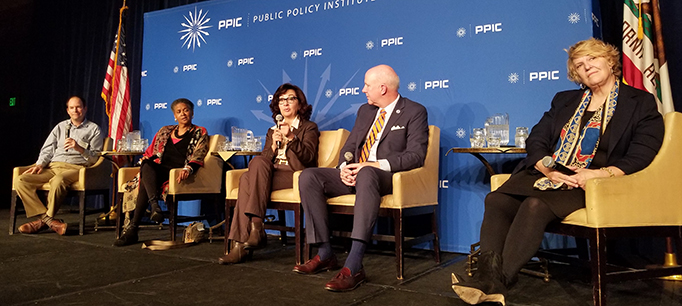
Each fall, the PPIC Water Policy Center hosts a public event to review water policy priorities for the coming year. This year’s panel discussions focused on ways the new administration can promote water policies and practices that benefit the state’s people, economy, and environment. A diverse group of experts on three panels discussed the intersection of water policies with California’s most pressing economic issues; innovations in policy, practice, and technology that offer solutions for key water problems; and steps needed to adapt the state’s water systems to a changing climate.

Each panelist was given an opportunity to make a short “elevator pitch” on water priorities for the governor-elect. Topics included the nexus between water and housing, the challenge of bringing groundwater into balance in the San Joaquin Valley, and improving water management with better data and information technology.

Watch the video to see which water issues these 12 experts think Gavin Newsom should prioritize when he takes over from Jerry Brown in January. And here’s a playlist of all videos from the event.

Video: Water Priorities for California’s Next Governor

California’s many water challenges are complex, with many possible solutions and even more opinions about best approaches. How can a new governor forge a path forward in this critical area?

The PPIC Water Policy Center assembled a group of 16 experts this week for a half-day workshop in Sacramento to discuss how the new administration can promote water policies and practices that benefit the state’s people, economy, and environment. Lively discussions addressed three overarching topics: how local and state water policies intersect with California’s most pressing economic issues; innovations in policy, practice, and technology that offer better solutions for key water problems; and steps needed to adapt the state’s water systems to a changing climate.

Ellen Hanak, director of the PPIC Water Policy Center, summarized some major water challenges the new administration will face, including increased risks of drought and floods; poor water quality and drying wells in disadvantaged rural communities; and finding durable ways to pay for needed water system improvements. Leadership will be key to advancing solutions, she said.

“California has been a leader both nationally and internationally” on climate change mitigation and reducing emissions, Hanak said. “We think California has the potential to be a leader when it comes to climate adaptation as well.” She noted that water is a lynchpin issue for addressing the effects of a changing climate.

The first panel shed light on the links between water and the state’s leading economic challenges, from housing affordability to jobs. For example, growing water scarcity in the San Joaquin Valley—one of California’s fastest-growing areas―will affect plans to build new housing there. And regulation can complicate efforts to build affordable housing. Dan Dunmoyer of the California Building Industry Association noted that some water-related regulations—such as strict rules to prevent runoff from construction sites during the rainy season—can significantly increase building costs. Panelists agreed that better coordination could help open up many of these bottlenecks.

Denise Fairchild of Emerald Cities Collaborative highlighted the potential for job training programs in the water sector—which is grappling with the “silver tsunami” of an aging workforce—to create economic opportunities for low-income communities. “If we take this opportunity to rebuild California’s water infrastructure, it has great job generation potential” in communities affected by a historical lack of water sector investment.

The next panel looked at technical and policy-related innovations that can improve water management, such as weather forecasting tools that enable more nimble water management in dams—key to adapting to an increasingly volatile climate. Also, better information on agricultural water use can “empower communities to stop arguing about numbers and start working on solutions,” said Robyn Grimm of Environmental Defense.

The final panel explored opportunities to modernize the state’s water “grid”—its vast network of reservoirs, aquifers and conveyance systems—to make it more resilient in the face of five climate pressures: warming temperatures, shrinking snowpack, shorter and more intense wet seasons, more volatile precipitation, and rising seas. Improving water conveyance and reworking the current system would enable the state to “take advantage of bigger storms” linked to climate change by capturing their water for recharge, said Ashley Boren of Sustainable Conservation.

Each panel discussion included a quick round of “elevator pitch” advice for the governor-elect. Jennifer Pierre of the State Water Contractors captured the mood of the group with her pitch: “In water, flexibility is the name of the game—we need it for managing the existing grid, and for grid improvements. Don’t wait for the perfect plan; we’ll suffer every year that we delay.”

We invite you to watch the videos from this event and hope you find the discussions helpful:

Groundwater Management is Key to Adapting to Climate Change

California relies heavily on groundwater for its water supply, particularly during drought.  Climate change is increasing drought intensity, making groundwater―with its immense potential for low-cost storage―an ever more important water source. Sustainable groundwater management will be vital to adapting to a warmer future and should be a top policy priority for the next administration.

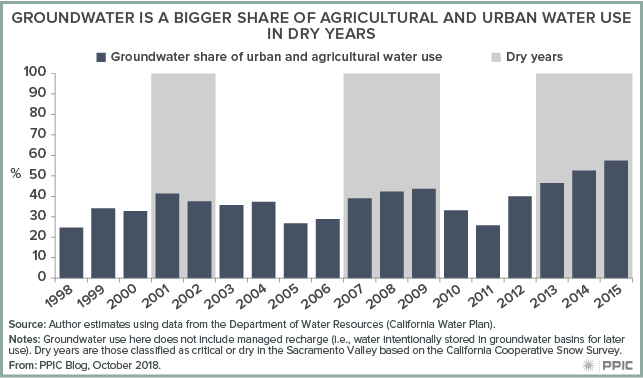
In non-drought years, groundwater supplies approximately one-third of urban and agricultural water use in California, but its share rises during droughts, when snow and surface water are scarce. In severe drought years, it provides more than half of urban and agricultural water use.

A recent report by the PPIC Water Policy Center and a large team of experts highlighted the impacts of climate change on water supply and ecosystem management during drought. As winter precipitation shifts from snow to rain in a warming climate, a key issue will be adapting the management of the state’s water storage system. A more volatile climate and changes in precipitation could shift the use of large multipurpose reservoirs from water storage to protection against flood risk, thus reducing the water available from reservoirs in some years―and making groundwater storage even more important.

In some regions, including the San Joaquin Valley, groundwater overdraft—taking more water out of aquifers than is put back—has been going on for decades. This has increased the cost of groundwater pumping, dried up wells in many rural areas, and caused land to sink, damaging infrastructure.

But the greatest long-term impact of unsustainable groundwater use is the loss of stored water that can be economically pumped during dry periods. This makes the state increasingly vulnerable to drought in a changing climate.

The 2014 Sustainable Groundwater Management Act (SGMA) requires water users and other stakeholders to self-organize into groundwater sustainability agencies (GSAs) and prepare and implement plans to achieve sustainability in the next 20 years. Done well, these efforts will restore the capacity of the state’s groundwater basins to supply water during drought.

GSAs have begun the hard work of developing their sustainability plans—due in January 2020 for critically overdrafted basins and two years later for the rest. The Department of Water Resources is providing technical and planning assistance, and the State Water Board―which has ultimate authority over these plans―is offering policy and legal guidance where it can.

Making SGMA a success will require additional action in the following four areas:

  • Advance planning. At the top of the list is expanding state and regional support for groundwater sustainability plans. Factoring in the predicted effects of climate change and developing robust water accounting and regional strategies for managing scarcity will be key.
  • Modernizing the water grid. A major priority for helping groundwater basins achieve sustainability is to upgrade and modernize the state’s water “grid”―the network of reservoirs, canals, rivers, and groundwater basins that store and convey water. Improving the grid’s capacity to move surface water into groundwater storage during wet periods is essential.
  • Updating water allocation rules. For the improved grid capacity to function well, the state will need to make it easier to recharge, trade, and bank groundwater.
  • Finding the money. Finding the money for groundwater sustainability programs will be crucial. The best solutions focus on expanding funding from local water bills and taxes—which currently fund roughly 85% of water management expenditures—and using state general obligation bonds to fund projects with clearly defined public benefits.

Achieving sustainable groundwater management is one of the most important things California can do to prepare for a warming climate. Getting there will require a suite of actions―including some reforms beyond those called for under SGMA. Better planning, modernizing the grid, streamlining water allocation, and finding program funding can help us manage this critical water supply.

The Connection between Groundwater and Surface Water

When the California Legislature created the “modern” water rights regulatory system more than a century ago, it focused exclusively on surface water, exempting groundwater from the permitting system. Yet in most watersheds, surface water and groundwater are closely linked. Actions that change one often have an impact on the other. The arbitrary legal divide has made it harder to manage the state’s water. But a recent law and a new court decision have done a better job of connecting surface water and groundwater.

When rain falls or snow melts in the foothills and mountains of California, water follows several pathways downhill and into rivers and streams. Some water moves across the land or through deep soils and weathered bedrock, arriving in rivers hours to weeks after rain or snowmelt. And some percolates deep into the ground, becoming groundwater.

As groundwater tables rise in winter and spring, they discharge water into rivers and streams, either directly through river beds and banks or indirectly through springs. This is why many of California’s rivers and streams flow long after the rain stops.

The exchange between surface water and groundwater continues when rivers emerge from mountains and flow across the state’s large valleys. Winter flooding, along with rainfall in the valleys, recharges groundwater during the winter. Some of that groundwater moves back into rivers and helps maintain flow in the dry season. Shallow groundwater also supports wetlands and riparian vegetation.

Groundwater pumping alters the exchange between surface water and groundwater. In many of the state’s large valleys, such as the Central Valley and valleys in the Central Coast and Southern California, streams and rivers that historically flowed all year are now intermittent due to lowered groundwater tables. In many cases, groundwater tables are so far below the surface that water only flows one way: from the river bed to the aquifer.

The arbitrary legal divide between surface water and groundwater has begun to change. A big step was the 2014 enactment of the Sustainable Groundwater Management Act (SGMA). SGMA requires water users in overdrafted groundwater basins to develop and implement groundwater sustainability plans to bring groundwater use and recharge into balance by 2040. SGMA mandates that these plans include measures to avoid undesirable effects from pumping, such as reduced stream flows and harm to groundwater-dependent ecosystems like wetlands. This is one of the few explicit legislative acknowledgements of the links between groundwater pumping and surface water flows.

Additionally, the California Court of Appeal recently added an important legal connection between groundwater pumping and surface water uses. In litigation to protect salmon and steelhead in the Scott River, the court ruled that the public trust doctrine―which protects the public’s right to use waterways for navigation, fishing, boating, natural habitat protection, and other activities―applies to groundwater pumping that adversely affects a navigable river or lake. The court also held that SGMA doesn’t override the public trust doctrine in groundwater cases.

These developments will have far-reaching implications for how California’s groundwater will be managed in the future. They also bring the law closer to hydrologic reality, which is likely to improve the effectiveness of both surface water and groundwater management.

A more extensive analysis of the Scott River decision by PPIC senior fellow Brian Gray was published on the California WaterBlog. Richard Frank, a UC Davis law professor and a member of the PPIC Water Policy Center’s research network, has also written a summary of the case.

Groundwater and the Colorado River

Like so many rivers, the Colorado is closely linked to groundwater. A US Geological Survey study found that more than half of the streamflow in the upper Colorado Basin originates as groundwater.  We talked to Doug Kenney—director of the Western Water Policy Program at the University of Colorado and a member of the PPIC Water Policy Center research network―about managing groundwater in the basin. Kenney organized a conference in June that covered these issues in depth.

PPIC: What is the status of the basin’s groundwater?
Doug Kenney: That’s difficult to answer, in part because there’s a lack of good information on groundwater in many areas. Also, there is no one groundwater source—the Colorado Basin has multiple aquifers, with different types of connections to surface waters and different uses for the water. Some aquifers provide potable water, while others are too salty or polluted to use for drinking. We have a number of huge aquifers, and some very tiny ones.

Some places have a very tight physical connection between groundwater and rivers. In those areas, if you drill a lot of wells and the water table drops, streams can dry up. The connection goes the other way as well—when there’s a lot of water flowing in streams, some seeps into aquifers. In other places, there may not be a physical connection but groundwater use impacts overall water management. The key is that if you manage groundwater poorly, surface water will ultimately suffer―and vice versa.

PPIC: What are the big challenges for managing groundwater in the basin?

DK: While it’s hard to generalize, the trend is increased pressure on groundwater, just as with the basin’s surface water. In some aquifers, depletion is a really acute problem. The management challenge is that with so many differing circumstances, you need a unique approach for each one. Each state in the basin has come up with its own groundwater laws and policies, but each state also recognizes that managing groundwater at the state level is too broad―you still need solutions tailored to local conditions.

Managing groundwater is just inherently difficult—you can’t see it and it’s hard to measure. And there’s a time lag: bad groundwater management today often creates slow-moving problems that might not be felt for many years. In those cases, there’s no constituency to protest groundwater mismanagement because those constituents haven’t been born yet. With surface water, if someone is using water in a way that harms another user, that user will draw attention to the problem.

The Colorado River is governed by a compact between states, and there’s a body of law to help manage its surface waters. But the river’s compact doesn’t deal with groundwater, and it’s always been left out of the discussion. You can get away with that for a while, but once it affects surface-water allocations, that’s where agreements start to fall apart—as has happened on the Rio Grande, the Arkansas, and the Republican Rivers. These are just three examples where the Supreme Court had to get involved. I worry that’s going to be the future for the Colorado too.

PPIC: What strategies hold promise for improving groundwater management in the future?

DK: I’d say 80% of good groundwater management is just making the effort. It will always be a difficult endeavor, but you have to try.

In many respects, groundwater management has become more innovative than for surface water. For example, there are more experiments with market-based approaches in groundwater. In places as diverse as the Diamond Valley in Nevada and in the San Luis Valley in Colorado, new incentive structures are being tried to reward people for not depleting the aquifer. In both places, prospects for maintaining the agricultural economy are much better than before; people have had to innovate or die. In surface water, it’s more about clarifying who has what rights to water and enforcing them—there’s not as much innovation. But in groundwater people are trying creative things and it’s encouraging.

Four Ways to Foster Cooperation over Groundwater

Last summer, some 250 local groundwater sustainability agencies (GSAs) were formed―the first step in meeting the requirements of California’s historic Sustainable Groundwater Management Act (SGMA).  Now these agencies face the difficult task of developing and implementing plans to bring their groundwater basins into balance over the next 20 years.

A recent event by the Groundwater Resources Association of California explored groundwater governance, and laid out ways that locals will need to cooperate to manage groundwater for long-term sustainability. Here are four key takeaways.

Coordination within GSA boundaries: GSAs must have strong internal cooperation to be effective. Many GSAs are composed of multiple public agencies (water districts, cities, and counties). Those agencies have to set up a new governance structure—agreeing on how to make joint decisions, and deciding how to split up the costs of management. And all GSAs must seek to involve a broad spectrum of stakeholders in the sustainability planning process—for example, domestic well users in disadvantaged communities, who have historically been left out of water planning processes.

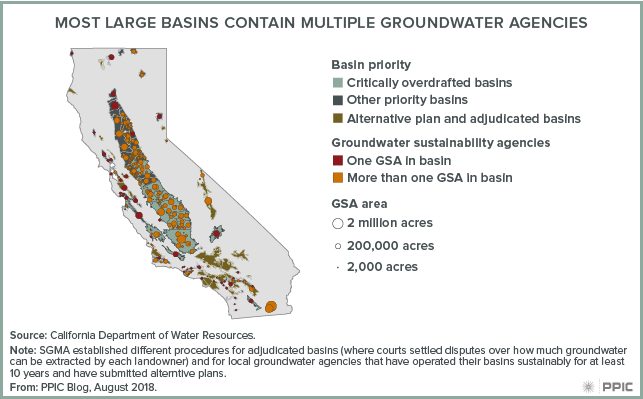
Coordination within basins: Equally important will be collaboration across GSAs within the same basin. SGMA authorized the creation of more than one GSA per basin—and most of the larger basins have multiple GSAs (see map). But SGMA requires them to work together—either to develop a single sustainability plan, or to ensure consistency if there is more than one plan. GSAs will have to make sure that they speak a common language—including common metrics for their groundwater budgets and indicators of sustainability.

Coordination across basins: GSAs will need to collaborate across basins as well. GSAs in adjacent basins should be able to understand how their plans work regionally, and how their management actions affect their neighbors. This is important hydrologically—because groundwater often moves across the basin boundaries established by SGMA. But it is also important for developing projects and actions to attain sustainability.  For instance, one of the most promising ways to augment supplies in depleted basins is by capturing high flow water and recharging it into aquifers. In the San Joaquin Valley, conveying that water to the best recharge locations could generate benefits for multiple basins—but this can’t happen without regional cooperation.

Coordination with counties: Both within and across basins, GSAs will also need to involve relevant agencies that may not be part of the GSA. In particular, county officials have responsibilities and policy instruments that can help in groundwater management. For example, Stanislaus County—which overlies four basins—used its authority to adopt a well moratorium that limits unmanaged expansion of groundwater use. Kern County’s land use planning office implemented a new land use management plan—including updated zoning—to help the community of Indian Wells Valley reduce water use to bring its groundwater resources into balance.

SGMA gives local agencies and water users tremendous responsibility and unique opportunities to manage shared groundwater resources for the long term. It will take time to get the groundwater governance right. Developing strong lines of cooperation early in the planning process will set GSAs up for success.

How Much Water Is Available for Groundwater Recharge?

The wet winter of 2017 brought an opportunity to test groundwater recharge—the intentional spreading of water on fields to percolate into the aquifer—as a tool for restoring groundwater levels and helping basins comply with the Sustainable Groundwater Management Act (SGMA). This is especially important in the San Joaquin Valley, which has the biggest imbalance between groundwater pumping and replenishment in the state.

A key question for many valley water managers is how much water will be available for recharge in the long term. By law, only river flows in excess of what is required for environmental purposes and to supply existing water-right holders are available for recharge. A recent report by the PPIC Water Policy Center estimated how much water would be available in the San Joaquin Valley over the long term. Two earlier studies—one by two scientists at UC Davis and the other by the Department of Water Resources—estimated a maximum of about half a million acre-feet on average, which is about a quarter of the valley’s estimated deficit. The PPIC study updated these estimates in the context of current conditions and concluded that an average of more than a million acre-feet of San Joaquin River flows may be available.

There are two big challenges to getting more water into underground storage in the valley:

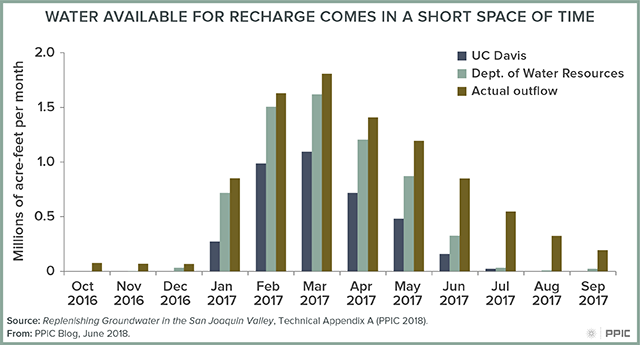
  • Most water for recharge becomes available during short periods. These periods usually coincide with floods, when recharge infrastructure—such as canals, pipelines, and recharge basins—is already working at full capacity. In 2017, for example, more than half of the available water would need to be diverted in February and March, with diversions above 30,000 acre-feet on most days (see figure). To put that into perspective, the California Aqueduct—the state’s largest conveyance system—has a maximum capacity of 26,000 acre-feet per day. While such daily volumes are lower than the overall volume of water moved in the valley during the summer irrigation season, seasonal floods are concentrated in relatively few areas where conveyance limits are likely to be a challenge.
  • Most of the available flows are in the northern half of the valley, while most of the overdrafted basins are in the drier south. This highlights the need to evaluate the capacity of large system-level water conveyance systems, such as the Friant-Kern Canal and the California Aqueduct, to move more water from north to south for recharge purposes.

The State Water Board—which oversees surface water rights—has the last word on this issue. Given the nature of California’s “flashy” river systems—in which very high flows develop rapidly during the winter and spring—the board will need to develop a simple, quick way to determine when river flows exceed water required for the environment and water-right holders.

We can’t count on groundwater recharge to singlehandedly end overdraft in the valley, but efforts to expand recharge in wet years will be helpful. The most pressing issues are to determine how much water is legally available and how best to put this water into the ground. Assessing the infrastructure needed for capturing flows during floods is an essential piece of this puzzle.

Blog figure: Water Available for Recharge Comes in a Short Space of Time


Image above courtesy of Jonathan Parker, Kern Water Bank Authority

Three Water Challenges for Almonds

California is a force of nature when it comes to almonds. The state’s farmers produce virtually the entire US almond crop and dominate the international market. As the market has grown, almonds have become California’s largest single crop—now accounting for about 12% of irrigated acreage, with more than 1.2 million acres harvested in 2016. Availability of water is clearly a major issue for the industry, since the trees must be irrigated throughout the long spring and summer dry season. At a May event on water issues organized by the Almond Board of California, I was asked for some thoughts on the water realities almond growers must grapple with in coming years. Here are three key takeaways.

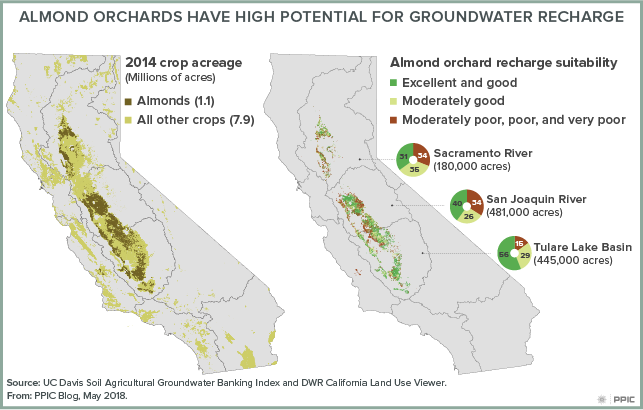
  • Growers in the San Joaquin Valley must address a long-term groundwater deficit. More than 80% of almond acreage is in the San Joaquin Valley (see map). Decades of unchecked pumping in the valley have resulted in a chronic groundwater deficit averaging nearly 2 million acre-feet per year—equivalent to about two Folsom reservoirs. Groundwater sustainability agencies must now devise plans to comply with the state’s 2014 groundwater law by bringing their water supply and use into balance over the next two decades. This means both augmenting supplies and reducing water use. Almond growers—along with others—need to be engaged in this process.
  • Augmenting local supplies can fill some of the gap––and almond growers can help. Up to a quarter of the San Joaquin Valley’s groundwater deficit could be eliminated by replenishing aquifers during high-flow events and wet winters like 2017. Spreading water on farmland is a cost-effective way to capture this water. Almond orchards are good candidates for such a process, given the suitability of much of the land for recharge (see map). Moreover, almond trees are dormant in winter and early spring, when extra water is most often available. Pilot projects and groundwater-recharge research are helping establish best practices and addressing ongoing questions among growers about the impact of winter flooding on almond crops. Almond growers also need to support other types of groundwater banking projects—such as recharge basins—that can help maximize available water supplies.
  • Managing demand will also be essential for reaching sustainability. Water use will need to fall to reduce the groundwater deficit. While this will pose some challenges, the good news is that farmers have been managing water demand for decades in this water-scarce region. Since the early 1980s, irrigated crop acreage in the San Joaquin Valley has hovered around 5 million acres, while the value of valley agriculture has roughly doubled (in today’s dollars). Farmers have responded to water scarcity by investing in crops and practices that generate more dollars per drop. The expansion of crops like almonds—and the corresponding decline in cotton and other field crops that bring in less revenue—reflects this shift. During the recent drought, farmers also used tools such as water trading and selective fallowing of less-productive lands. These same tools can help smooth the transition to balanced groundwater use, given the willingness of  water users who benefit most from using scarce supplies—for instance, those who need to keep orchards thriving during droughts—to compensate others who can use less.

Almonds are expected to remain a top crop in the state, and a leading source of farm revenues, for decades to come. But water stress will be an increasingly important factor for California’s almond growers and for the San Joaquin Valley more generally. The farm sector’s water challenges can’t be addressed farm by farm, or crop by crop. Cooperative approaches—including trading and groundwater recharge—will be essential to a smooth landing for the valley’s almond industry and the regional economy overall.