Bringing Order to Groundwater Management

California’s water management is a complex stew with many cooks. At the local level, hundreds of irrigation districts and urban water agencies and a few thousand small drinking water suppliers are responsible for a wide variety of water-related issues. And it just got more complex: as of June 30, more than 250 newly formed Groundwater Sustainability Agencies (GSAs) were added to the mix.

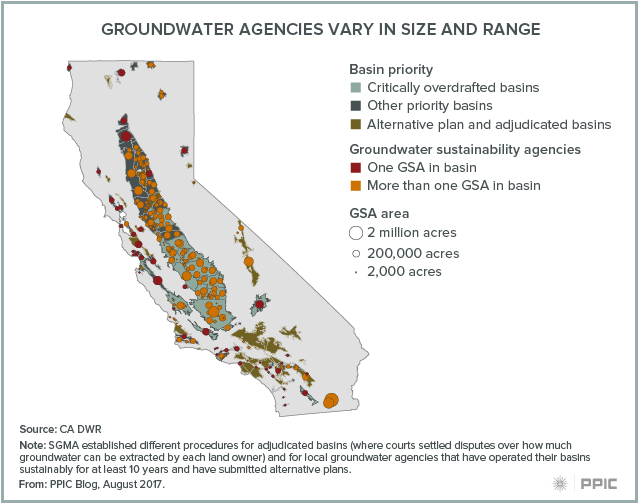
The 2014 Sustainable Groundwater Management Act (SGMA) directed local agencies to develop institutions, plans, and implementation strategies to sustainably manage their groundwater resources for the long run. As a result, more than 250 local agencies have formed GSAs in 140 “priority basins” (those that account for most of California’s groundwater use). More than 70 percent of the new GSAs are in the San Joaquin Valley and the Sacramento Valley—regions whose large groundwater basins supply farms, cities, and small rural communities.

A variety of parties can form GSAs, though most are made up of local agencies such as counties, cities, and irrigation districts. A GSA can also be formed by a single entity, such an irrigation district—Westlands Water District has formed one. It can be formed by groups of agencies, as is the case with the Merced Subbasin GSA, which includes six public agencies with water management or land use authority. These parties vary widely in their interests and experience in groundwater management.

The first task of the GSAs will be to develop groundwater sustainability plans for their basins. In basins with multiple GSAs, the agencies will either have to create a common plan or have an agreement to coordinate plans. This is no small task, given the number of agencies and their institutional diversity. Anticipating some of these complexities, the Department of Water Resources has already published a set of documents to guide plan development.

Although GSAs and their local partners will have the lead responsibility for developing and implementing groundwater sustainability plans, the state can play a pivotal supportive role. Given the varying technical and institutional capacity at the local scale and the challenges of coordinating different plans, a number of tools could help GSAs implement effective programs in ways that reduce conflict and foster success.

Developing common accounting standards is a top priority. GSAs must speak the same language to ensure consistency in groundwater budgets across agencies and basins. Statewide standards are needed on matters such as units used and frequency of measurement to enable comparability, auditability, and consistent analysis and management. Accounting templates and modeling standards could help guide this process. The Department of Water Resources has developed online reporting standards for other water sectors—such as the templates for submitting Urban Water Management Plans that standardize basic information agencies must submit—which might be a good model to follow. This might also help bridge some chronic water data gaps that have made it more difficult to manage California’s water.

The state could also provide technical guidance on developing local monitoring and enforcement regulations, which will be key to implementing the plans. Critically overdrafted basins—where long-term pumping has exceeded the rate of replenishment—will need to develop strategies to increase recharge and reduce pumping. Doing this well will require measuring groundwater extraction, setting overall pumping limits, and establishing pumping allocations. These tasks will help to establish a water budget, and are also essential to implementing innovative mechanisms such as incentives for recharge, storing groundwater for later use, and trading, which can add flexibility in groundwater management. Making these tools available for every agency, no matter its size and capabilities, will help ease the transition to sustainable management with minimal economic disruptions.

Getting to groundwater sustainability might be the most challenging issue in California’s water management for the foreseeable future. But it also provides opportunities to overcome some chronic water management gaps and encourage stakeholders to work cooperatively in a basin-scale approach. Local leadership is key to defining the proper solutions for each basin. But state guidance will also be essential to coordinate efforts and to promote innovation and knowledge sharing across the intricate landscape of agencies.
Learn more

Read the report Accounting for California’s Water (July 2016)
Read the report Water Stress and a Changing San Joaquin Valley (March 2017)
Read “Groundwater in California” (PPIC fact sheet, May 2017)
Visit the PPIC Water Policy Center

Banking on Groundwater

California’s groundwater basins can store much more water than surface reservoirs. After years of unchecked depletion of many groundwater basins, communities are now coming together to figure out how to manage them sustainably. We talked to Helen Dahlke, a hydrologist at UC Davis and a member of the PPIC Water Policy Center’s research network, about efforts to recharge groundwater basins to help bring them back into balance.

PPIC: Where do we stand with groundwater recharge?

Helen Dahlke: California has huge potential to store water underground. Over the past century, we lost more than 120 million acre-feet of groundwater in Central Valley aquifers. With increased pumping in recent years there is now plenty of space to put groundwater back into these aquifers. Local groundwater agencies are starting to figure out how to implement the state’s Sustainable Groundwater Management Act. There is growing interest in recharge and a number of new projects are underway. Many water districts have purchased land to create recharge basins. And several groundwater banks in the Central Valley buy water from state and federal water projects to store water underground for use in dry years.

We’ll need to do more. In the past 15 years or so we’ve only had three wet years. Climate models tell us we’ll see fewer wet years in the future, and recharge systems can help make the most of those years. This year—a really wet year—has been marked by not having enough space in reservoirs to store surface water. It would have been really great to have had a coordinated effort to use more of the flood runoff to recharge groundwater, but existing groundwater recharge basins—which allow water to infiltrate the aquifer―are at full capacity. We need to use good recharge lands to capture these floods and restore groundwater resources. The bottom line is, we need to put a larger fraction of winter floods into groundwater storage.

PPIC: What are some of the most difficult challenges for groundwater recharge?

HD: Besides natural recharge from rainfall, in the past much of California’s groundwater has been recharged from irrigation. Flood irrigation (in which water flows across fields or between furrows) is a major source of groundwater recharge in the Central Valley―about 10–20% of the irrigation water percolates beyond the root zone to recharge groundwater. As farmers have switched to more efficient irrigation systems―which use less water and promote better crop quality and higher yields―the amount of recharge has been decreasing. To compensate, we need to do more intentional groundwater recharge during winter when plants are dormant. However, this approach requires a larger effort and would benefit from some coordination by the state. We also need to learn more about which crops can tolerate winter flooding without increasing root diseases or reducing crop quality or yields. And if we do flood farmland, we need to take into account fertilizer use, because flooding farmed lands can result in more leaching of salts and nitrate into groundwater. We’re actively working on that now.

Learn more

Read “Reforming California’s Groundwater Management” (PPIC fact sheet, June 2015)
Read “Groundwater: Act Locally, Think Sustainably” (PPIC Blog, March 1, 2017)
Visit the PPIC Water Policy Center

Commentary: Cooperation Needed on San Joaquin Valley Water


This commentary was published in the Sacramento Bee on Thursday, March 2, 2017.

Recent rains have not washed away the growing threat of water scarcity in the San Joaquin Valley, California’s largest agricultural region. Over time it could bring disruptive changes not only to the region’s farmers but also to rural communities, the local economy, and the state as a whole. Resolving this problem will take creativity and cooperation.

Read the full commentary on sacbee.com.

Groundwater: Act Locally, Think Sustainably

The complex challenges that the state’s Sustainable Groundwater Management Act aims to resolve don’t lend themselves to quick fixes. With the deadline for the first major step—forming “groundwater sustainability agencies” in affected basins—coming up in June, we asked Karen Ross, secretary of the California Department of Food and Agriculture, about progress to date.

PPIC: How are California communities doing in implementing the law so far?

Karen Ross: I’ve been very impressed with how implementation is progressing. Clearly, people realize it’s time to address groundwater sustainability, and they are working together at the local level because they prefer that to state action. This is a big undertaking because to address groundwater covers areas like land use and economic development for cities and counties. So the progress made on establishing the governance structure is just the first step. The next step is the hard part: putting together plans that will bring basins back into water balance. That will require very difficult decisions about how the resource is allocated and managed.

The state is supporting this process in a number of ways. Our colleagues at the Department of Water Resources (DWR) have a huge role to play in supporting the process by establishing guidance for governance structures and the criteria for what constitutes a sustainable groundwater plan. The state is backing that up with facilitation and financial support. For example, DWR awarded $6.7 million in grants last year to 21 counties for groundwater planning projects, and just last month the Department of Food and Agriculture and DWR announced a joint $6 million water efficiency grant program for agricultural water suppliers and farmers.

PPIC: What big challenges do you think will result?

KR: Some of the critically overdrafted basins will have challenges getting back into balance, and many of these areas are dependent on agriculture as the primary engine for their local economy. The state of the basins is directly impacted by the lack of surface water over time. Tough decisions will have to be made about demand management, potential fallowing, and how to balance the human impacts we saw during the drought, like drinking water supplies and jobs.

It won’t be easy to bring all parties to the table to address these issues―not to mention the specific trade-offs needed to bring the water supply back into balance. But we must ensure that all have a voice in determining the governance structure and taking part in the planning process. That is critical to success.

PPIC: What kinds of opportunities do you think will arise for communities implementing the law?

KR: I see a unique opportunity to unite communities in a deep and lasting way. This is a chance to help determine the future of their community. People must work together to maintain a thriving local economy, their quality of life, and environmental quality. What these communities face is daunting. While it is easy for me in my position to be optimistic about future progress in maintaining sustainability in a special part of California, we must all recognize that building resiliency for the long term will be hard work. But future generations will thank us—just as we owe previous generations a debt of gratitude for the vision, the leadership, and the investment they made in the infrastructure for agriculture and rural California that we enjoy today.

Learn more

Watch “Implementing the Sustainable Groundwater Management Act,” a video featuring Secretary Ross and other panelists (October 21, 2016)
Read “Reforming California’s Groundwater Management,” (PPIC fact sheet, June 2015)
Visit the PPIC Water Policy Center

Making the Groundwater Law Work

California was one of the last western states to regulate the use of groundwater. Now, the state’s landmark law mandating sustainable use of this critical resource is significantly changing how communities manage it. We talked to Thomas Harter—a groundwater expert at UC Davis and a member of the PPIC Water Policy Center’s research network—about implementing the 2014 law, which he calls “the most important water legislation in 50 years.”

PPIC: What are the key components of groundwater sustainability?

Thomas Harter: The state law is based on six “commandments” that interpret what groundwater sustainability means: thou shall not draw down water levels too far, deplete storage in the aquifer, degrade water quality, allow seawater intrusion, cause land to subside, or use groundwater in ways that reduces other people’s surface water or harms ecosystems.

The law mandates that groundwater must be sustainably managed for the long run. It’s not an option. Another critical piece of the law is that it be managed locally. This is an opportunity for local agencies, water districts, and stakeholders to take charge of whatever needs to be done.

Another important aspect is having everyone around the table who’s benefiting from, using, or concerned about groundwater. Stakeholders may have to make decisions on how to augment their groundwater supplies or how to reduce demand to make local use sustainable. People are going to come to the table with different core issues—for example, some will be more concerned about protecting domestic water users, while others will be focused on the economic impacts of using less groundwater.

PPIC: What more do we need to know about our groundwater basins to better manage them?

TH: We have to understand the resource, and how our uses affect it. What are water levels doing? Are we degrading the quality of groundwater? Is it being used or managed in ways that harm surface water uses and users? That kind of basic understanding is really important.

There are some important things we need to know about the state of our groundwater that the state could play a role in, which would help locals bring their basins to sustainability.

First, the state has a responsibility to monitor land subsidence across California, as sinking land is one of the key indicators of unsustainable conditions. We need more consistent measurements to determine how fast land is subsiding. The state would be in the best position to collect this data, and make it useable and accessible to local groundwater sustainability agencies.

The state is also in the best position to collect data on land use and evapotranspiration, which is a measure of how much water plants use. Evapotranspiration is one of the biggest water budget components in the state and the largest single consumptive use. In other words, it is water that is removed from the water system through use or evaporation by plants, consumed by people or animals, or incorporated into products or crops. Having a high-resolution understanding of evapotranspiration and how it changes over time and across years will be critical to ensure we have accurate water budgets.

California also needs to get back to more frequently mapping land use across the state and make that data available. Land use is closely related to evapotranspiration. To devise an accurate water budget, you need to know which field is planted in which crop at which time of year, which areas are being urbanized, and where other changes in land use are occurring.

The state’s system for gauging streamflow also needs work. To make good decisions, locals need a better understanding of the contributions of groundwater to their tributary streams. The US Geological Survey and the Department of Water Resources, which manage these gauges, are struggling to keep up with the network they have, and many gauges have been discontinued due to lack of funding. We need to fund ongoing maintenance of this water-monitoring network so we don’t lose a legacy of valuable information. And we need to expand it in areas where groundwater and surface water are closely connected.

PPIC: What changes do you expect to see as communities move to implement the groundwater law?

TH: I think the biggest thing is that, at the local level, we’ll have a much broader stakeholder group informed about and engaged in their groundwater system. There will be greater understanding about the interconnections between land use, groundwater, surface water, and water supply and quality, and about the kinds of projects we can do to address sustainability issues. I hope that in 10 years we’ll have a better understanding of how we can transition to sustainable resource management with the least amount of economic pain. I think there are opportunities for creative solutions that are win-wins for the environment and people dependent on groundwater resources. I also think that having a better understanding across stakeholder groups will lead to increased cooperation, which will be important for implementing and funding solutions.

Learn more

Watch “Implementing the Sustainable Groundwater Management Act” (PPIC event video, Oct. 18, 2016)
Read “Reforming California’s Groundwater Management” (PPIC fact sheet)
Visit the PPIC Water Policy Center’s water supply resource page

Drinking Water Quality: Perceptions and Challenges

Months after lead contamination in the drinking water of Flint, Michigan, gained national attention, the PPIC Statewide Survey asked if Californians think drinking water pollution is a more serious health threat in lower-income areas than in other parts of their regions. In the July survey, about 6 in 10 adults statewide said “yes,” including majorities across regions.

There is evidence to support this view. Contamination of drinking water continues to be a serious health risk for small water districts serving low-income customers, especially in rural parts of the state. Despite recent progress in building a stronger water safety net, this is a problem lacking a long-term policy solution.

As estimated in the PPIC Water Policy Center’s report Paying for Water, roughly 80,000 to 160,000 Californians live in small economically disadvantaged communities that struggle to provide safe drinking water on a consistent basis. A key part of this challenge is the dependence of many small rural water districts on groundwater that contains naturally occurring or man-made contaminants at levels unsafe for human consumption.

Cost is a key factor. Removing contaminants like arsenic or nitrate from groundwater requires large up-front expenditures, technical and managerial expertise, and the ability to cover long-term operational costs. In most water districts, these costs are borne by rate-paying customers. Small water districts serving low-income communities struggle to pay for this kind of ongoing drinking water treatment because they have higher costs per household than their much larger counterparts, and their customers can’t afford high rates.

In recent years, California has increased the amount of financial and technical assistance for improving access to safe drinking water in these communities. The state provides financial assistance through emergency spending (in response to the ongoing drought, for example), competitive grant-based awards from multiyear general obligation bonds such as Proposition 1, or low-interest loans and grants through the state revolving fund. But long-term solutions will require funding mechanisms that are more accessible, reliable, and sustainable. For example, the state General Fund or a statewide surcharge on water use could help solve this social equity issue. It will also be important to invest in solutions that are cost-effective and that communities can manage well over time. That’s an argument in favor of connecting these small systems to larger ones wherever feasible—something now under way in East Porterville and some other Central Valley communities.

The PPIC Statewide Survey finds that, while a majority of Californians see drinking water quality in lower-income areas as a serious health threat, there are wide differences among demographic and voter groups. Fewer than half of Republicans, whites, high-income Californians, or likely voters see this as a problem. On the subject of drought response, however, solid majorities across these groups (and 6 in 10 adults overall) say state and local governments are not doing enough. This eagerness for government action, coupled with policymakers’ willingness to address long-term water problems, may pave the way for solutions to drinking water contamination in vulnerable communities.

Learn more

Read “California’s Water Quality Challenges” (PPIC Water Policy Center fact sheet, October 2015)
Read “Building a Better Water Safety Net” (PPIC Blog, October 21, 2015)
Read “Flint, a Water Quality Reminder for California” (PPIC Blog, January 27, 2016)

Video: Improving California’s Water Accounting

Understanding California’s balance sheet for water—how much there is, who has claims to it, and what is actually being “spent”—is key to effective and sustainable water management, especially during droughts. But the state’s system of accounting is outdated and ineffective for managing some of our biggest water challenges, according to new research from the PPIC Water Policy Center.

A group of water management experts gathered to discuss the topic at a PPIC event last week.

“The drought has spotlighted weaknesses in California’s water accounting,” said PPIC researcher Alvar Escriva-Bou. These weaknesses make it harder to manage groundwater, water for the environment, surface water allocations, and water trading, he said.

Better information about groundwater use and claims is an especially urgent need. Lance Eckhart, director of basin management and resource planning for the Mojave Water Agency (which relies 100% on groundwater), said, “It’s probably going to take a generation” to bring the state’s over-drafted basins into balance. “The way you do that is by collecting good data…to quantify how much you have going in and how much is going out.” A lack of good information increases conflict over the resource, he said.

Tom Howard, executive director of the State Water Resources Control Board, noted that California has made “huge improvements” in managing information about water rights in the past six years. “But there are still a lot of blank spots” in the state’s water accounting system—for example, understanding how much water returns to the system from farms.

The drought revealed major weaknesses in how the state accounts for environmental water. Maurice Hall, associate vice president of water for the Environmental Defense Fund, said tightening the system of environmental water management through better information would allow managers to “specifically put the water where it needs to be for the fish and wildlife” and enable them to “defend the actions we are making for those wildlife.”

The issue of cost prompted a lively conversation about how we currently value water and how to fund the modernization of the system. Ellen Hanak, director of PPIC’s Water Policy Center, put the cost in context: “California annually spends $31 billion on our water system overall… And then look at the size of our economy—over $2 trillion. In the scheme of things, we ought to be able to find a little more money to do these kinds of things.”

Escriva-Bou and Hanak are coauthors of a new report that compares California’s water accounting systems to those of 11 other western states, Australia, and Spain. The authors identify gaps in California’s water information systems, and propose a dozen ways to bridge them.

Learn more

Read the report, Accounting for California’s Water (July 2016)
Visit the PPIC Water Policy Center

Commentary: California Needs Better Account of Groundwater


This commentary was published in the Sacramento Bee today, Thursday, July 21, 2016.

California’s prolonged drought has driven home the need to improve our balance sheet for water—determining how much there is, who has claims to it, and what is actually being used. New research by the PPIC Water Policy Center compared California to 11 other western states, Australia and Spain—places that also struggle with water scarcity—and found significant room for improvement.

Read the full commentary on sacbee.com.

Learn more

Read Accounting for California’s Water (July 2016)
Visit the PPIC Water Policy Center

Implementing California’s Groundwater Law

What will it take to successfully manage groundwater in California? This was the topic of a recent workshop jointly held by UC Water and the PPIC Water Policy Center. The workshop brought together researchers, policy makers, and water managers to reflect on the challenges of implementing the Sustainable Groundwater Management Act in California’s Central Valley, the state’s leading agricultural region. Here are some key takeaways.

  • Groundwater recharge should become more intentional. Farmers are the biggest users of groundwater in the Central Valley—but they also do the most to replenish it. When they apply water to their fields, crops don’t use all of it—some water seeps down and recharges underground aquifers. However, to achieve sustainable use in many aquifers, the process of recharge will have to become more deliberate and widespread in the Central Valley. UC Water experts presented research from several experimental sites across the state showing that recharge can be increased in a variety of ways. Depending on local circumstances, some possible solutions include having farmers flood their fields with excess winter runoff, setting back levees and using floodplains as infiltration grounds during flooding, and engineering recharge basins or using injection wells to direct water underground. Some of this is already happening in different parts of the valley. But scaling up recharge efforts to a magnitude large enough to bring overdrafted basins into balance will likely mean developing hundreds of additional small, decentralized projects across the valley.
  • It’s all about incentives. Recharge is a local process, but the benefits can be regional. To make recharge projects sprout in the Central Valley, incentive mechanisms will be needed to credit individuals who participate. One promising way of incentivizing farmers to recharge was presented by UC Santa Cruz researcher Andrew Fisher, who described experiences from a pilot project in the Pajaro Valley on California’s Central Coast. That project’s goal is to establish a system that provides rebates to those who recharge groundwater.
  • Accounting will be critical.California’s groundwater law requires users to establish local groundwater sustainability agencies (GSAs), which will have authority to monitor, measure, and regulate pumping and to fund recharge projects. Before passage of the law, California generally did not require monitoring of groundwater pumping or restrict its use, despite continued declines of groundwater levels in many parts of the state. As a result, there is little historical data on groundwater pumping and storage for Central Valley groundwater basins. At least some GSAs are likely to begin metering agricultural pumping, which can serve both as monitoring and enforcement. As GSAs make these important decisions, it will be important for them to strive for having widely available, transparent estimates of groundwater use and recharge volumes. Such data are critical to estimate groundwater budgets and provide a framework for water trading. For instance, crediting farmers for recharge is impossible if we don’t know how much water they pump out and how much they recharge.
  • No silver bullets. While recharge is promising, some reductions in groundwater use may also be necessary to achieve sustainability in some areas. For example, in parts of the southern Central Valley, there may not be enough extra surface water to justify building new recharge infrastructure. Many places across the valley may not have the right soil composition for recharge. Fortunately, California has extensive infrastructure to move surface water from where it is more plentiful to where it is scarce. As locals begin to implement the groundwater law and seek to reduce overdraft, water trading can help increase the efficiency and reliability of water allocation.

The workshop showed that there is a high level of interest in discussing solutions to California’s groundwater management challenges. Finding more opportunities to bring researchers and practitioners together to discuss ongoing work and identify ways to collaborate is an important step forward in the state’s path toward sustainable groundwater management.

Learn more

Read “The Coming Groundwater Revolution” (PPIC Blog, January 6, 2016)
Read our policy brief “California’s Water: Storing Water” (from California’s Water briefing kit, April 2015)
Visit the PPIC Water Policy Center

Paying for Groundwater Recharge

The author is a member of the PPIC Water Policy Center research network.

Water levels in many of California’s groundwater basins have dropped too far, too fast in recent years, prompting a wave of experimental projects to augment the natural recharge of aquifers. But funding is a missing element in many of these efforts. A new local program to provide incentives for groundwater recharge could be replicated in other parts of the state.

Most Californians who use groundwater do not pay to use it. Instead, in many basins, property owners with an “overlying right” to water underground are free to extract as much as they need for “reasonable and beneficial use,” as loosely defined by state law, paying only for the costs of pumping.

The state’s Sustainable Groundwater Management Act, enacted in 2014, empowers local Groundwater Sustainability Agencies (GSAs) to impose fees in support of long-term water resource management and develop funding mechanisms for projects that conserve water and augment available supplies.

The Pajaro Valley Water Management Agency, adjacent to Monterey Bay, manages groundwater in one of California’s most productive and economically important agricultural areas. For decades, this area has experienced persistent groundwater overdraft. The water agency meters most wells and levies an “augmentation charge” to pumpers in the basin. In March, the agency’s Board of Directors approved a five-year pilot program of “recharge net metering.” The program seeks to enhance groundwater recharge by some 1,000 acre-feet per year using stormwater runoff from nearby slopes as the primary water supply.

Representatives from UC Santa Cruz and the Santa Cruz County Resource Conservation District will act as third-party certifiers and help identify and screen project sites. The water agency will credit pumpers who run successful projects, partly offsetting their augmentation charges. This rebate helps to compensate pumpers for losses of land use or access and periodic maintenance needed for the recharge systems. It’s intended to function like the electricity net-metering program run by PG&E for customers who contribute power to the grid with home solar panels.

Could a program like this work in other parts of the state? Much depends on how GSAs set up water management programs and metering and fee structures. Developing a rebate program in parallel with a structure to charge for groundwater pumping might make fees more palatable to land owners who are not used to paying for groundwater. Giving a rebate for recharge makes sense if the GSA can subsequently levy a fee for use of the additional water.

Other factors that will influence project success include the availability of suitable recharge sites and the ability to collect runoff from a large enough drainage area to justify the effort. The effect on water quality also has to be considered. Besides rebates, other costs to consider include those to identify promising sites and verify field conditions, conduct community outreach, secure permits to satisfy environmental and other requirements, design and install the systems, and measure the benefits—the basis for the rebate. Yet even with these costs, this approach can be economically viable when compared to other supply alternatives.

This is just one approach to solving a difficult problem. Given California’s history of paradigm-shifting innovation, we are likely to see more ways to incentivize sustainable groundwater resources as GSAs figure out how to manage their basins for the long term.

Learn more

Read “Reforming California’s Groundwater Management” (PPIC fact sheet)
Read “Farms that Grow Groundwater” (PPIC blog, April 18, 2016)
Visit the PPIC Water Policy Center’s water supply resource page