
Standardized Testing and College Eligibility

In California and across the nation, there has been a growing focus on increasing college access by improving college readiness for high school students and encouraging more eligible students to attend college. To this end, many states and educational institutions have changed how they use college entrance exams like the SAT and ACT.

One approach has been to have more students take the SAT or ACT in hopes of identifying those who are eligible for college but might not have taken a college entrance exam on their own. As of 2016–17, 25 states use the SAT or ACT as their standardized test for 11th graders.

Assemblymember O’Donnell (D-Long Beach) has proposed AB 1951, which would give districts the option to use the SAT or ACT in place of California’s 11th-grade standardized test. Though Governor Brown vetoed the bill at the end of the 2017–18 legislative session, O’Donnell promised to bring it back in the next session, when California has a new governor.

But even as many states are administering the SAT or ACT to all students, a growing number of colleges and universities are dropping these tests as an entrance requirement. Citing concerns about biases in the exams, as well as the extra financial or time constraints for students, liberal arts colleges like Mills College in California and prominent universities such as the University of Chicago have made submitting test scores optional. Currently, California State University (CSU) does not require students to submit an SAT score (though most still do) if they meet the high school GPA threshold of 3.0 or higher. Despite this trend, most four-year colleges continue to use college entrance exams in their admissions decisions and a growing share of high school graduates take either the SAT or ACT.

In his veto message, the governor suggested another possible way to expand eligibility. California universities could consider using the state’s standardized test (SBAC) as an eligibility measure. All California 11th graders in public schools take the SBAC, which is aligned with the Common Core State Standards and is already used as an early diagnostic of college readiness at CSU and many community colleges. New evidence suggests that the SBAC does as well as the SAT in predicting first-year performance at California’s public universities.

Any of these strategies could increase the number of students eligible for California’s universities—but not all of them would work well together. For example, the University of California and CSU are further scrutinizing the role of the SAT in the admissions process. If the systems decide to drop the SAT requirement, then AB 1951 might have less of an impact. Looking forward, as state policymakers and districts continue to craft policies to improve college access, they should first consider how California’s universities are using—or not using—standardized tests.
 

Can Mandatory College Entrance Exams Boost College Access?


This post is part of an occasional series examining how California can learn from policies in other states.

California ranks 47th out of the 50 states in the proportion of recent high school graduates that attend a four-year college. There are big recognizable barriers to attending a four-year college, such as cost. However, there are also smaller barriers—like taking a college entrance exam such as the SAT or ACT—that can keep students from even being eligible for entry to a four-year college.

Policy: Mandatory College Entrance Testing in High School

Several states have recently instituted statewide college entrance exams for high school students through allowances in the federal Every Student Succeeds Act (ESSA), which mandates that states test their students for accountability purposes. The ESSA allows states to use college entrance tests as their high school tests. Students in states that use college entrance exams have one less hurdle to college eligibility, as well as experience taking the test and a signal of their level of college readiness. These benefits could help students make their way to a four-year college. Does the policy work?

Policy Impact

Because many states are only recently requiring a college entrance exam, there has not been enough time to analyze long-term trends. However, a 2015 study by Daniel Klasik evaluates the college-going behavior of students in three states (Illinois, Colorado, and Maine) that have long required all students to take national college entrance exams in high school. The study shows that statewide college enrollment may not necessarily increase, but students may have enrolled in different types of institutions than they otherwise would have. In Illinois and Maine the entrance exam policy was associated with a shift in enrollment away from public two-year colleges, which generally don’t require entrance exams; Illinois saw increases in four-year college attendance. Students in Maine and Colorado were more likely to enroll in institutions that required entrance exams for admission. All three states saw a positive impact on attendance at private four-year colleges.

Lessons for California

California currently uses the Smarter Balanced Assessment Consortium (SBAC) tests, which students take in grades 3-8 and 11. Of the fifteen states in SBAC, six use a college exam for federal accountability for their high schools and another three states require (and pay for) all students to take a college exam in addition to their normal state test.

The trend is catching on in California. Right now only 60% of students take the SAT, but several California districts are offering the test free to all students. In fact, Long Beach Unified School District recently asked the state if it could replace the SBAC test with the SAT, citing similar schoolwide accountability scores and the additional college-going benefits. The state declined, citing concerns about alignment with the Common Core State Standards, the ability of the SAT to accurately assess lower-performing students, and accommodations for students with limited English proficiency or learning disabilities.

But mandatory college entrance exams could remove a barrier to college entry for California students. As we have examined in prior research, the SBAC tests already link high school testing to college readiness at the California State University (CSU) and some community colleges through the Early Assessment Program. However, the University of California and many private schools still require a college entrance exam score. And while CSU does not require an entrance exam for all students, it does require an ACT or SAT score for students with GPA that is below 3.0 and for those applying to some impacted campuses or majors.

A statewide entrance exam program may not solve all of California’s enrollment issues—in part because California’s master plan limits entry to public universities and many campuses are not currently able to accept all qualified applicants. California could still benefit if the policy increases enrollment at four-year private schools, as students starting at four-year institutions are generally more likely to obtain a bachelor’s degree than those who start at a community college. In a state that is facing a 1.1 million degree gap by 2030, removing barriers to college entry is an important step toward producing more college graduates.

Interpreting California’s Latest SAT Scores

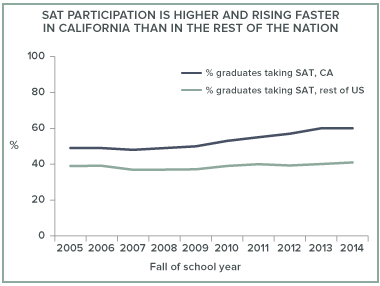
An increasing share of California students are taking the SAT. This is good news for California, suggesting that more and more students are preparing for college. Sixty percent of the high school graduating class of 2015 took the SAT, a much higher share than in the rest of the United States (41%). Moreover, SAT participation has been growing faster in California than in the rest of the nation.

Even though raw scores have declined, once we adjust for the increased share of graduates taking the SAT, the latest scores represent an improvement from a decade ago. On average, California’s graduating class of 2015 scored 1,492 out of 2,400 points on the SAT college admission tests—28 points lower than a decade ago, and 2 points higher than the national average. However, once we factor in the increase in participation over the past decade, California’s 2015 score actually represents an improvement compared to a decade earlier. As participation in the SAT increases, the mix of students taking the exam shifts towards those less academically prepared. In states with high average SAT scores, participation rates are very low, because the only students who participate tend to be very well prepared. On average, a 1 percentage point increase in participation is associated with a 3.4 point decrease in average performance. Given the 11 percentage point increase in participation among California high school seniors over the past decade, we would expect the state’s average SAT score to drop 10 points more than it did.

Latino students have experienced the largest increase in SAT participation. Over time, SAT participation has increased steadily among all major racial/ethnic groups—including Asian, white, Latino, and African American students. But the largest gain has been among Latino students. For instance, in the 2013–14 school year, 43 percent of Latino graduates took the SAT, up from 35 percent in 2005–06. (Graduation data for 2014–15 has not yet been released.)

Race/ethnicity-related performance gaps are changing. Asian students outperformed white students in the 2014–15 school year by 11 points, reversing a trend in which whites were the higher scorers. The gap between African Americans and whites has narrowed over time. In the 2014–15 school year, white students scored 295 points higher, on average, than African American students and the score gap has decreased from 317 points in the 2005–06 school year. However, the Latino-white gap has increased slightly—not very surprising given the huge increase in Latino students’ participation in the SAT.

Parental education level, family income matters more now. Parental education and family income are closely related to SAT performance. In 2014–15, students whose parents have bachelor’s degrees scored, on average, 1,601 points—200 points higher than students whose parents have only a high school diploma. Over time this gap has widened, mostly because students whose parents have graduate degrees are scoring higher on the SAT. There is also a widening performance gap connected to gaps in family income, particularly at the upper end of income distribution. For instance, the performance gap between students whose families make more than $200,000 (roughly the top 10 percentile) and those from families earning $60,000 to $80,000 (roughly the median household income) widened from 172 points in 2007 to 251 points in 2014.

The increase in SAT participation, especially among groups that are underrepresented in higher education, is good news for California. At the same time, the continuing gaps in performance represent an ongoing challenge that must be addressed, especially given California’s changing demographics.

Chart source: (TOP) National Center for Education Statistics, College Board, 2005–14. Chart notes: (TOP) Participation rate is based on the projection of high school graduates by the Western Interstate Commission for Higher Education (WICHE), and the number of seniors who took the SAT in each state. Participation varies widely across states and can be partially explained by state policies. For instance, all public high school juniors in Maine have been required to take the SAT since 2006. Similarly, since 2011, Delaware has made the SAT available to all public high school juniors. And, starting with the class of 2014, all juniors in District of Columbia public schools take the SAT.
Chart source: (MIDDLE) College Board, 2014–15.
Chart source: (BOTTOM) College Board, 2014–15. Chart note: (BOTTOM) Orange vertical line indicates the College Board’s College and Career Ready (CCR) benchmark.