Testimony: Managing California’s Headwater Forests

Van Butsic, a forestry expert with UC Berkeley’s cooperative extension and a member of the PPIC Water Policy Center’s research network, testified before the Little Hoover Commission in Sacramento today (August 24, 2017).


The hearing focused on California forest management and was held in response to the sharp increase in the number of trees dying in headwater forests. Butsic drew his prepared remarks from the PPIC policy brief California’s Water: Protecting Headwaters. Here is a summary.

The committee asked Butsic to explain the risks to the state’s forested upper watersheds and ways to improve forest health. He described a number of risks, including:

  • Policies aimed at extinguishing fires as quickly as possible—combined with reduced timber harvesting—have resulted in exceptionally dense vegetation in many California forests, increasing the risk of extreme wildfires;
  • The expansion of rural communities into wildland areas has complicated efforts to manage fire risk, and;
  • Stress from drought and a changing climate.

Butsic said California stands to lose timber production, wildlife habitat, recreational opportunities, and water supply if this natural infrastructure continues to decline. He noted that the bulk of forestry funding is spent on putting out fires rather than managing forests for long-term resilience.

Butsic explained that to improve health of headwater forests, California must increase the pace and scale of management tools such as fire and forest thinning. This will require management, regulatory, and legal reforms. He described ongoing research being undertaken by PPIC into ways to improve forest management. And he noted that due to a diverse mix of land ownership in the headwaters area, collaborative approaches will be critical.

Learn more
PPIC is preparing a report on California’s headwater forests. Register to attend the related event, Improving the Health of California’s Headwater Forests.
How Unhealthy Forests Affect Water Supply

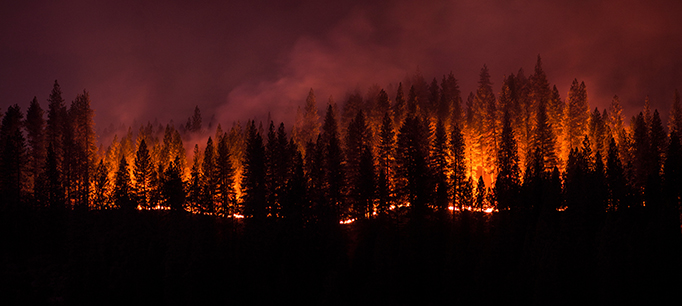
California’s mountain forests have been badly stressed by years of drought and fire suppression practices that encourage overly dense stands of trees. We talked to Scott Stephens―a forestry and wildfire expert at UC Berkeley and a member of the PPIC Water Policy Center research network―about how unhealthy forests affect the watershed.

PPIC: What is the status of the state’s forests?

Scott Stephens: California now has more than 100 million dead trees, mostly in the central and southern Sierra. This has implications for water supply, wildfire management, local economies, and many other issues. The die-off is a symptom of unsustainable forest conditions. Drought is part of the California landscape, but why are we seeing such profound mortality? The drought caused more trees to compete for less water and increased infestations of bark beetles, which kill trees. Droughts are getting warmer, which stresses the trees more. But the underlying cause is unsustainably dense forests. Forest management in the past century increased forest density by removing the most common ecosystem process that once thinned the forest: fire. We need to reduce tree density in Sierra forests so they are more resilient to drought.

Fires start more easily in recently killed forests because embers have more dead foliage to land on. Fighting fires is much harder because there’s an increased risk that standing dead trees will fall and kill people. And since most of these dead trees will never be removed, in 10 to 15 years they’ll be on the ground. This will increase the fuel load substantially and make for hotter fires.

PPIC: What are the consequences to our water supply from dying or burning forests?

SS: It’s useful to compare the effects of a large uncontrolled wildfire—such as the 2013 Rim Fire in San Francisco’s Hetch Hetchy watershed—with what is going on in a part of Yosemite that has had regular fires over the past 40 years. In the Rim Fire zone, trees were killed over a vast area, and sediment and fire debris has moved into streams and reservoirs. By comparison, there’s an area in Yosemite called Illiloutte Creek basin, where small natural fires have been allowed to burn—unlike in most forests, where all fires are extinguished as quickly as possible. We’ve seen a jigsaw puzzle of fire-changed landscapes develop in Illiloutte basin over this time and a change in forest density. For example, an area that was once a solid pine forest is now a wetland after fire cleared about 10 acres of trees. Now we’re doing research to see if water in that basin is increasing. One thing is certain: fewer trees use less water. Also, in denser forests some snow stays in the canopy and is more likely to go back into the atmosphere rather than seep into the ground.

PPIC: Given the scope of the problem, what are our management options?

SS: There are three potential options that would improve on current practices. The first is to manage lightning fires in some areas—such as the remote upper watersheds―so we can naturally reduce forest density. This option can be scaled up relatively fast. We’d need to monitor these fires carefully and allow them to work―just as they’ve done in Yosemite for the past 40 years. Three national forests have proposed allowing managed lightning fires on about two-thirds of their land―Inyo, Sierra, and Sequoia. A second option is to do more prescribed burns. These will be smaller in scale than lightning fires. Lastly, we can use ecologically based mechanical thinning of forests, which can be combined with prescribed burns.

These fixes will be expensive in some areas. But fire suppression currently costs us about $2.5 billion a year just on federal lands—and these methods can help bring down that cost. Shifting the federal firefighting budget so more money goes for forest management could help.

Learn more

Read California’s Water: Protecting Headwaters (from California’s Water briefing kit, October 2016)
Watch our 3-minute video “Headwaters”
Read “Managing Wildfires Requires New Strategies” (PPIC Blog, September 23, 2015)
Visit the PPIC Water Policy Center’s drought resource page

Managing Wildfires Requires New Strategies

Severe wildfires have been dominating the news this summer, with good reason. The persistent drought, coupled with the legacy of poor forest management practices, has produced historic fire conditions in California and much of the West.

In the month since the publication of our report on the California drought’s major repercussions—which projected a growth in extreme fires if the drought continues another few years—California has experienced several new fires that are among the largest or most damaging in recorded history.

Since this drought began in 2012, California has experienced two of the three largest fires on record, and four of the top 20, as measured by number of acres burned (see table). The newest “top 20” is the Fresno-area Rough Fire, which continues to spread and rise in fire rankings since its start in July. From September 11-17, the Rough Fire consumed around 20,000 additional acres and rose from eighteenth to fifteenth largest wildfire on record.

As of mid-September, this year’s Valley and Butte fires ranked third and seventh on the state’s list of most damaging fires, as measured by number of structures destroyed (see table). At this writing, neither fire was fully contained.

All three of these wildfires continue to burn despite a massive fire-suppression effort by the Department of Forestry and Fire Protection (CAL FIRE).

UC Berkeley wildfire expert Scott Stephens explains that the current statewide drought has affected the frequency and behavior of recent wildfires. Hotter temperatures and dry conditions have “reduced moisture in both live and dead trees, as well as shrub leaves and tree needles, which allows for more efficient fire initiation and high intensity burns,” says Stephens.

A century of wildfire suppression and inconsistent fuel reduction efforts—such as thinning out trees and introducing more frequent, low-intensity fires—has increased the risk of major wildfires in California’s forestlands. Unnaturally dense forests create ample fuel for wildfires once they ignite.

One new drought-induced characteristic is that wildfires are continuing to grow throughout the night, Stephens notes. Historically, lower temperature and higher relative humidity at night would slow wildfire growth and give firefighters a chance to suppress the burn. The Moonlight (2008), Rim (2013), King (2014), and Valley (2015) wildfires burned intensely throughout the night.

Stephens warns that that we need to rethink our approach to forest management. Intense fires have the potential to convert forests to shrublands, permanently altering their ecology. To avoid this, the state must increase fuel-reduction efforts to ten times the area that is currently treated. “The good news is this is possible,” Stephens says. “We have the techniques and research to show forest restoration treatments are in line with the ecology of these ecosystems.”

Short-term fire suppression is extremely important for protecting human life and property, but experts agree that California needs to take a longer range view of forest management to limit damage from wildfires as the climate warms, and reduce the ever-growing cost of fighting fires. Fuel reduction efforts require sustained application over large areas for decades. The fractured ownership of California’s forestland makes implementation difficult. Some efforts are underway on private lands in California, but this has proven more difficult on federal lands (roughly half of our forestlands) due to permitting constraints. Until private and public forestland owners coordinate long term fuel-reduction efforts, California can expect to experience larger, more frequent, and increasingly severe wildfires.

Table notes: *Number of acres burned or structures destroyed may increase until wildfire is fully contained. Wildfires in bold started since the drought began in 2012.

Table source: CAL FIRE, Top 20 Largest California Wildfires (updated by PPIC with current wildfire information as of September 23, 2015); CAL FIRE Top 20 Most Damaging California Wildfires (updated by PPIC with current wildfire information as of September 23, 2015).