Rebooting California’s Congressional Delegation

We’ve just passed through retirement season in California politics: the weeks leading up to the candidate filing deadline when incumbents who have decided to step down often make their announcements. Six of California’s 53-member delegation to the U.S. House of Representatives have decided not to run; the latest is Democrat Gloria Negrete McLeod, who is leaving after only one term to run for the San Bernardino County Board of Supervisors. Also retiring are John Campbell, Buck McKeon, Gary Miller, George Miller, and Henry Waxman.

Six retirements might seem like a lot, but California’s rate of open seats this year (11%) is only slightly above the national rate (9%) and in line with the national rate in other recent non-redistricting years. (The disruption caused by redrawn district lines usually increases the number of retirements.)

California had gotten used to low turnover in part because the districts drawn by the legislature in 2001 preserved the status quo. But the new independent redistricting commission and top-two primary have opened the floodgates. Fourteen incumbents either retired or were defeated for reelection in 2012. With this year’s retirements (not all of which can be traced to the reforms), more than a third of the delegation will have turned over by the time the dust settles this fall.

This turnover is having a dramatic impact. At the start of the 112th Congress in 2011, California’s delegation had served an average of 15.1 years, far higher than the national average of 9.8 years (this number comes from the Congressional Research Service). But by the start of the 113th Congress in 2013, California’s average had plummeted to 10.2 years, and with this year’s retirements it will fall to 9.7 (or lower if some incumbents are not reelected). In the context of congressional history, that’s like pressing the reset button.

This rapid change raises questions about what we need from our representatives. On the one hand, we want turnover in Congress. New members can bring new ideas and fresh perspectives. At the very least, we want to feel like we can kick members out of office if we get fed up with them.

On the other hand, experienced representation can be more effective for both the state and the nation as a whole, and even mediocre representatives gain influence over time. Incumbent retirements or losses since 2010 have included the top majority or minority member on eight committees and 10 subcommittees, some of them among the most influential in Congress. The state should expect a diminished profile on Capitol Hill as a result.

Which is better: experience or responsiveness? There’s no simple answer. Without passing judgment on the specific members who have retired, one might argue that the pre-reform delegation had gotten out of whack, with too many members serving too long. But if things shift too far the other direction we could lose all the benefits of experience.

The recent turnover puts California at the national average for the first time in decades. We’ll see what impact that has on both behavior and legislation.

Ready for College?

California needs more college graduates than it is currently producing. Part of the problem has been a lack of college readiness among the state’s high school graduates. Fortunately, recent trends in college preparation provide some good news. By several measures, a large and growing share of the state’s high school graduates are ready for college-level work. Indeed, many of them have successfully completed college-level courses even while still enrolled in high school.

New data on Advanced Placement (AP) exams are especially encouraging. AP courses are college-level courses in more than 30 subjects offered in high schools throughout the country. AP exams determine whether a student has attained college-level proficiency in the course, and AP exam passage rates are a meaningful measure of college preparation. Many colleges accept AP exams for college credit, and research shows that AP students outperform other students in college. Indeed, students who earn AP credits graduate at higher rates overall and often perform better in subsequent courses in the same field.

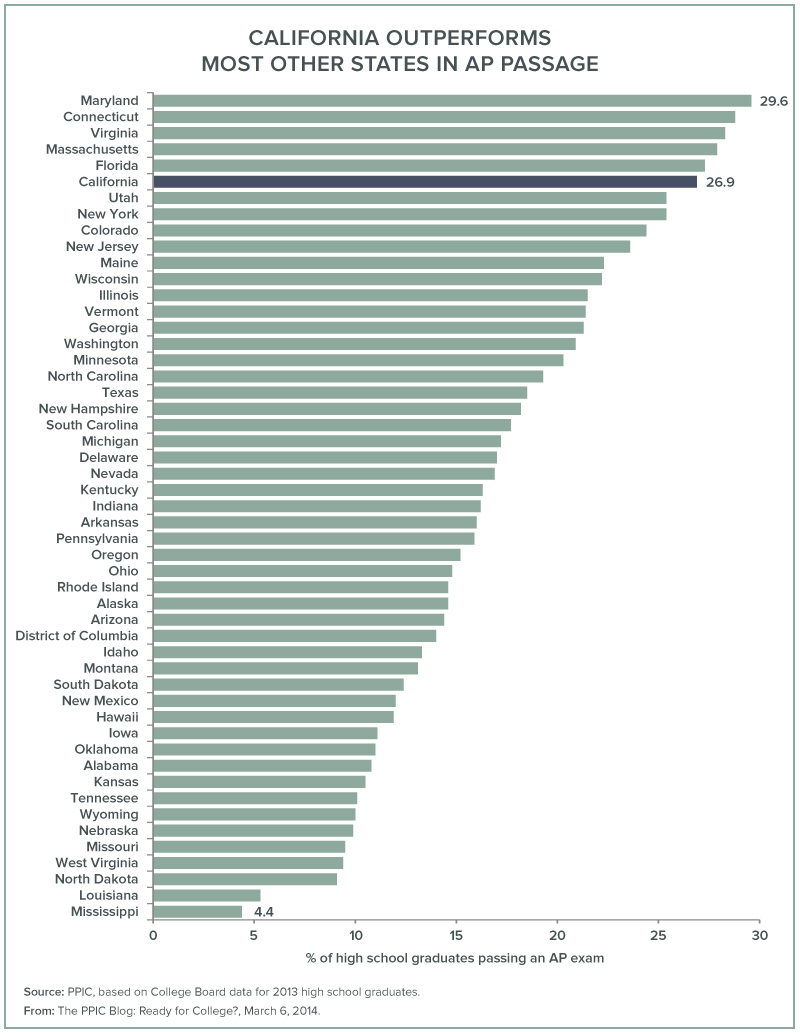
California’s high school graduates outperform their peers in the rest of the country on AP exams. In 2013, more than one in four California high school graduates (26.9%) passed at least one AP exam sometime during high school, compared to one in five in the nation as a whole. Among the 50 states and the District of Columbia, California high school graduates ranked sixth highest. Moreover, the share of graduates successfully completing an AP exam is going up fast in California—higher than in the rest of the nation. Between 2003 and 2013, the share of high school graduates passing at least one AP exam increased 9.6 percentage points in California, compared to 7.9 percentage points for the entire nation. California has a higher share of graduates taking AP exams than does the nation as a whole (45.6% versus 35.0%), with passage rates among AP exam takers slightly higher in California (59.0% versus 57.4%).
Other measures of college readiness also show progress. More students are taking the college preparatory courses (known as the “a–g” courses) required for admission to the University of California (UC) and the California State University (CSU). The latest data from the California Department of Education show that 38.3 percent of public high school graduates in California took the a–g courses in 2011–12, up from 34.6 percent in 2001–02 and from 32.3 percent in 1993–94. Gains in college prep work have been especially impressive among the state’s Latino high school graduates, who now make up almost half of all high school graduates. Among Latino graduates, the share taking a–g courses increased from 21.8 percent in 2001–02 to 28.0 percent in 2011–12. Increases in college readiness would be even better news if our state was responding with policies to meet the growing demand for college. But it’s not. Only the top eighth of high school graduates are eligible for UC and only the top third are eligible for CSU—according to eligibility thresholds that were set more than 50 years ago. Given the increasing shares of high school students who are well prepared for college, some reconsideration of those thresholds is long overdue.

If California is to meet the demand for educated workers, it needs to produce more college graduates. Making room for these highly capable students—by increasing the share of high school graduates eligible for the University of California and the California State University systems—would improve the well-being of our state and the lives of these young Californians.

Chart sources: PPIC calculations based on College Board data.

Drought Watch: Harnessing the Storms

This is part of a continuing series on the impact of the drought.

Southern California got a thorough soaking in late February and early March, with intense storms that caused localized urban and coastal flooding. Northern California also received some much needed rain and snow. As officials pointed out during and after this wet interlude, it helped, but it was not a drought buster.

So where did all that rain go and did we miss an opportunity to improve our water supplies?

In urban Southern California and the San Francisco Bay Area, most of this water was lost to the ocean. This loss comes from both the nature of the storms and our long-standing approaches to stormwater management.

First, like many of California’s winter storms, these storms were very intense. When heavy rains fall on urban landscapes, all those hard surfaces—roads, roofs, gutters—gather and shed water quickly rather than allowing it to soak in to recharge groundwater.

Second, the way we manage most of this runoff in coastal areas ensures that it goes to the ocean. During the post-WWII expansion of urban California, planners and engineers viewed storm runoff as a nuisance to be disposed of as quickly as possible. The iconic California urban stream—straightened, channelized, and lined with concrete—is designed to move water rapidly out of neighborhoods and route it to the ocean. This design has made places like the Los Angeles River better suited to filming car chases than to harnessing local water supplies. Moreover, this fast-moving stormwater is a major source of pollution of California’s bays, beaches, and watersheds. Regulations to limit this pollution have become increasingly strict, making this one of the costliest water management headaches for many California communities.

Fortunately, this antiquated style of stormwater management is now changing. Many of the state’s urbanized areas have begun to capture and store stormwater in groundwater basins for later reuse. Sustainable stormwater management can be accomplished in many ways: installing pavements that soak up rain instead of repelling it, designing landscapes and streetscapes to capture runoff, replacing hard urban landscapes with parks, and routing stormwater into settling basins. These projects achieve multiple benefits: in addition to increasing local water supplies and greening our neighborhoods, they help reduce water pollution.

All of these efforts are still a work in progress. Drought legislation signed by the governor will allocate some additional state funds to stormwater projects. This money is a welcome boost, because funding stormwater projects with local dollars is difficult to accomplish. As a forthcoming PPIC report on water system finance shows, stormwater is a “fiscal orphan” —an area where our current funding rules (including two-thirds majority voting requirements to pass local special taxes) limit the ability of local managers to raise the resources they need to make smart community investments. Reshaping our urban environments to make stormwater an asset, rather than a liability, will take time and money but it will pay off in future droughts.

Evaluating Student Success at the City College of San Francisco

In July 2013, the Accreditation Commission for Community and Junior Colleges reaffirmed its earlier decision to pull accreditation from the City College of San Francisco (CCSF). Citing a “lack of financial accountability as well as institutional deficiencies in the area of leadership and governance” as the “main obstacles to the college’s turnaround,” the commission allowed CCSF 12 months to prepare to cease operation. San Francisco’s city attorney and City College faculty have filed lawsuits against the commission, and in January a court granted an injunction placing the loss of accreditation on hold. The California Community College Chancellor’s Office, which oversees the state’s 72 community college districts, is working closely with City College to address the commission’s concerns and avoid the loss of accreditation. And the state legislature is considering a bill that would stabilize CCSF funding for the next two years. Meanwhile, students are responding to the controversy: City College reports a 16 percent decline in spring enrollment in 2014 compared to 2013.

The fight over CCSF’s accreditation is focused on a number of issues and concerns. But it raises important questions about how colleges should be evaluated. Many states have begun funding higher education institutions based on performance, and California officials are discussing similar performance measures. Most would agree that student outcomes are an important measure of any college’s effectiveness. Of course, good student outcomes for a college might simply reflect the strength and preparation of incoming students.

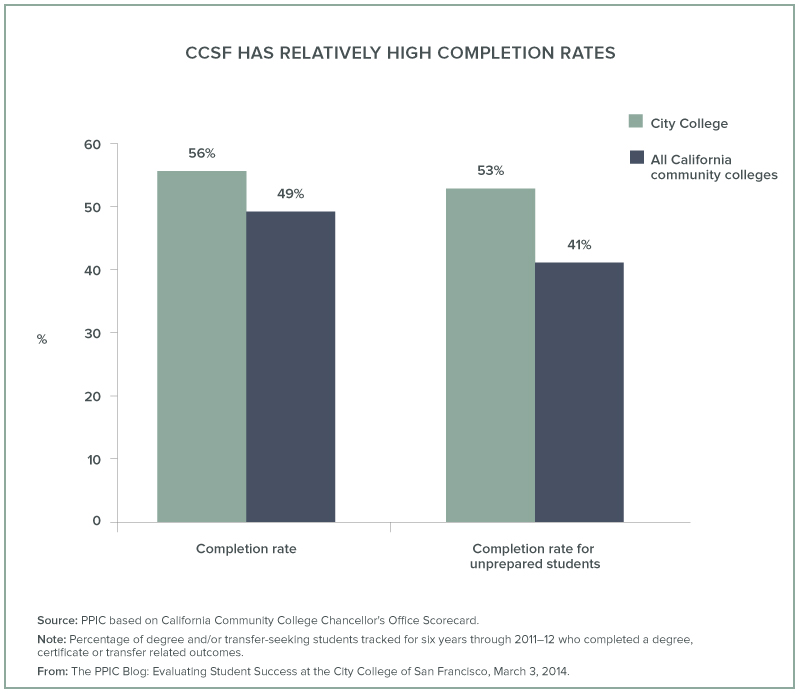
Because the California Community College Chancellor’s Office does an excellent job of providing information on student success, we have a wealth of data to examine student outcomes at CCSF. By most measures, City College fares well relative to other community colleges in the state. The share of students who complete college by earning a degree or certificate, or by transferring to a four-year college, is higher at CCSF than in the rest of the state. This advantage holds even when we limit our analysis to students who are initially unprepared for college-level work, which suggests that it is not simply the mix of students drawn to City College that drives its outcomes. (Although it is possible that CCSF’s unprepared students are closer to college level than unprepared students at other colleges.)

Of particular interest is how effectively a community college prepares students for transfer to four-year colleges or universities—this is arguably the most important mission of community colleges. Among students defined by the chancellor’s office as intending to transfer, City College has a higher success rate than most other college districts, ranking 6th out of the state’s 72 community college districts and 4th among the state’s larger districts—those with at least 2,000 students intending to transfer. The other top districts are a who’s who of the state’s most highly regarded: Foothill-De Anza, South Orange County, San Diego, Pasadena, and Santa Monica. By this important measure, City College is in very good company.

On some outcomes, City College performs below average. For example, its success rates in math remediation are significantly lower than the state average, and the share of career technical, or vocational, students who earn a certificate is slightly lower than the state average. However, City College fares well in most other measures. For example, the share of students who successfully complete remediation in English is higher than the statewide average, as is the share of students who successfully complete ESL courses.

Student outcomes are not the only way to assess a college. But they are an important measure of success. CCSF has provided thousands of students with a pathway toward meeting educational and occupational goals. That is no small feat.