
Half a Million New Enrollees in Covered California

The 2015 enrollment period for Covered California is wrapping up, and the state appears to have exceeded its forecast of 500,000 new enrollees. According to the most recent available data, more than 495,000 people signed up for private plans through the exchange during open enrollment, and another 93,000 signed up during a special enrollment period from February to April 30. Among those who enrolled before February 22, approximately 88 percent were eligible for federal subsidies to help pay for premiums. In addition, more than 780,000 people enrolled in Medi-Cal, bringing total Medi-Cal enrollment to slightly more than 12 million.

In addition to working to increase total enrollment, the state prioritized outreach to the Latino and under-35 populations during the second open enrollment period. Among subsidized enrollees, the share that are Latino rose from 31 percent to 37 percent, and the share that are under 35 rose from 29 percent to 34 percent.

Peter Lee, Covered California’s executive director, had announced the special enrollment period for uninsured Californians who were surprised to learn that there’s a tax penalty for remaining uninsured. Residents who didn’t have health coverage in 2014 owed $95, or 1 percent of their income (whichever is higher). Those who are uninsured in 2015 face a higher penalty: $325, or 2 percent of income.

The special enrollment period resulted from a discussion about the misalignment of the Covered California enrollment period and the April 15 deadline for filing taxes. Many Californians were unaware of the tax penalty for being uninsured in 2014 until after the February open enrollment deadline. This year’s special enrollment period allowed people who were still unaware of the tax penalty to avoid paying it in 2015—more than 33,000 of those who signed up during this period indicated that they were unaware of the tax penalty.

Even though the 2015 open enrollment period is over, there are pathways for some individuals to obtain healthcare through Covered California or Medi-Cal. For example, individuals may sign up for or change private plans within 60 days of a “life-changing event” such as getting married or having a baby. And Californians who are eligible for Medi-Cal can enroll year-round.

Looking forward, the state will continue to face the challenge of ensuring access to providers for Medi-Cal recipients. California’s reimbursement rate for providers is among the lowest in the nation, leading many doctors to turn away Medi-Cal patients. Several bills have been proposed in the state assembly and senate to raise these rates. AB 366, which would prohibit the application of existing reductions to reimbursement rates, has moved into appropriations after unanimously passing the health committee. We’ll be tracking its progress throughout the term.

Automatic Voter Registration Is No Panacea

This commentary was published on Tuesday, May 5, 2015, in the Sacramento Bee.

California voter turnout has reached record lows. Only 18 percent of 24 million eligible adults cast ballots in the June 2014 primary and only 31 percent last November. As a result, state lawmakers and good government groups are searching for new ways to increase participation in elections.

One proposal that is gaining traction—and was discussed at a recent Public Policy Institute of California event with Secretary of State Alex Padilla and other officials—is to import an automatic voter registration system from Oregon.

There’s no question that such a system would swell California’s voter rolls. But would it significantly increase turnout? That’s much less clear.

(continue reading at sacbee.com)

Video: Addressing California’s Water Challenge

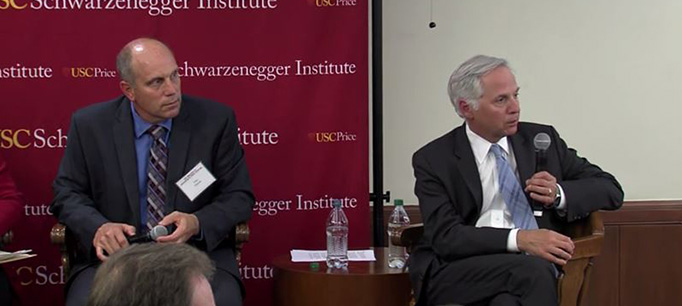
Last week the PPIC Water Policy Center partnered with the USC Schwarzenegger Institute for an important and timely discussion on the current drought and long-term solutions to California’s water challenges. The forum brought together water, business, university, and community leaders from around the state. Former governor Arnold Schwarzenegger, whose remarks opened and closed the event, emphasized the need for a big vision to tackle the drought, accompanied by strong leadership to ensure the timely implementation of creative solutions.

The event provided an opportunity to go beyond the current finger-pointing of who uses how much water, resulting in a more productive conversation about what can be done in key sectors and regions of California. In her presentation introducing key facts about the state’s big water issues, Ellen Hanak, director of the PPIC Water Policy Center, introduced two main themes that helped guide further discussions: “We’re all in this together” and “There are no silver bullets” to tackle major droughts. There was widespread agreement among speakers that a more sustainable future for water in California will benefit both our economy and environment, but we need an “all of the above” approach. We need to increase supplies, reduce demand, and modernize our approach.

More than 20 participants shared their views in a series of three panel discussions, including two members of the PPIC Water Policy Center advisory council, Tim Quinn and Lester Snow, and a member of our research network, Dan Sumner. Mark Baldassare, president and CEO of PPIC, served as moderator for a discussion on the state’s most important drought-based challenges, the role of agriculture, and solutions for addressing the drought.

Video: Press Club Focuses on Water

California’s drought has gone on long enough that many of the state’s reporters­—whether or not they cover the environment—have found they need to learn more about how water is managed in the state. The Sacramento Press Club helped close this information gap yesterday by hosting PPIC’s Water Policy Center director Ellen Hanak, who talked about the five things you need to know about water.

One of her points, that there are no silver bullets to solve our long-term water policy challenges, prompted the most conversation. While many reporters in the room may have already understood this, their questions were tinged with hope that there might be some solutions that could help make this drought go away (silver-plated bullets, perhaps?).

What about desalination, one reporter asked? The constraint, noted Hanak, is the cost. Seawater desalination is still a very expensive option for most water agencies. Using recycled wastewater (including to recharge groundwater) is a somewhat cheaper way to get “more water” for parched urban areas. But in some areas—like San Diego and some Central Coast communities—residents are already willing to pay the higher price tag for desalination to improve reliability Hanak said.

Another member of the audience asked about two proposed storage reservoirs, Temperance Flat (Fresno County) and Sites (Colusa-Glenn counties), both of which would be built off-stream in the Central Valley. “Our current system of reservoirs can collect roughly 40 million acre-feet, or about what we use in a year, statewide,” Hanak said. “Our groundwater basins can store at least three times that amount, and they can be recharged.” Hanak noted that storage investments will be needed to capture more water in wet years and make up for the shrinking snowpack. Surface reservoirs provide more flexibility, but groundwater storage is often much less costly. Operating the two types of storage in combination—and putting more drought storage into the ground—is an especially promising approach. “We need to think about managing water as a system.”

Another immutable water fact that Hanak shared is that the situation is hard but not hopeless. California has made steady progress in improving water management and systems, though much remains to be done—especially for maintaining healthy ecosystems and the wildlife they support. Water used to maintain environmental stability has become quite contentious, yet there are some promising stories, including in the Sacramento area. She described how water managers have introduced more natural flows in Putah Creek (a major stream that is part of the greater Sacramento River watershed)—using much less water than nature used to provide—with the result that native fish species are doing much better. This past year, even salmon returned after many decades’ absence.

Good reporting on the current drought, and on longer term water challenges, can help us all gain greater understanding of the highly complex world of water use in the state. We thank the Sacramento Press Club for the opportunity to help take the conversation forward.

ABOVE: PPIC’s Ellen Hanak greets Juliet Williams, Associated Press correspondent and president of the Sacramento Press Club, at the recent Press Club event. Photo: Phil Kampel Photography8.