Video: Remedial Education Reform in Community College

Since the passage of Assembly Bill (AB) 705, California community colleges have been transforming their approach to remedial—or developmental—education. AB 705 requires community colleges to maximize the probability of their students completing transfer-level courses in the one-year time frame. To comply with AB 705, colleges are revising the way they assess student readiness for college-level courses—giving priority to high school GPA rather than tests. They are also changing course offerings and classroom approaches. How will the reforms affect student outcomes, and how are colleges dealing with the challenges of implementation?

At an event in Sacramento last week, PPIC researcher Marisol Cuellar Mejia outlined the findings of a new report that sheds light on AB 705’s potential impact by looking at the efforts of “early implementers”—colleges that began experimenting with reforms before AB 705 was signed into law. A panel of experts then offered a range of perspectives on AB 705 implementation.

Roanna Bennie, interim president of Las Positas College—an early implementer—noted that only a small fraction of students who start at the beginning of a traditional, multi-course math remediation pathway end up taking transfer-level courses. “It’s the data that’s been really influencing our campus to take measures,” she added. But she also said that her college is wrestling with full-scale implementation. The challenges include covering the cost of additional courses, getting input from faculty and other staff across campus, and helping students adjust to the changes.

Laura Metune, vice chancellor for external relations in the California Community Colleges Chancellor’s Office, emphasized the importance of professional development for both faculty and staff: “Everybody needs to understand what these changes are that we’re asking for, the research behind them, and what their individual roles are in helping them be successful.”

What comes next? As Katie Hern, an English instructor at Chabot College who co-founded the California Acceleration Project, put it: “The debate up until now has been whether to make these changes. That debate is over—the legislature settled that one. Now we have to make these changes and now we get to really study how to do it as effectively as possible.”

Strong Support for California’s Climate Leadership

From September 12 to 14, Governor Jerry Brown will co-chair the Global Climate Action Summit in San Francisco. This gathering of world leaders will review achievements to date and discuss next steps in meeting the international goals established to reduce greenhouse gas emissions. How do Californians feel about their state playing such a prominent role in the global warming policy arena?

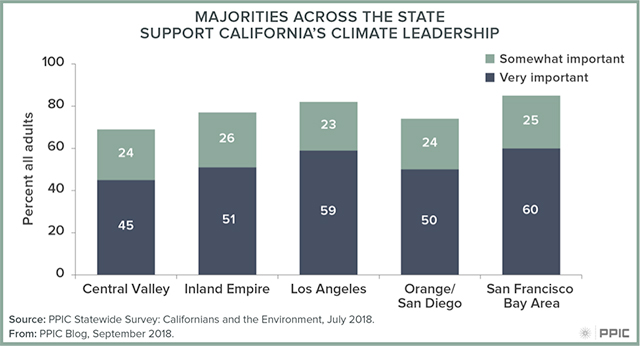
In the July PPIC Statewide Survey, a majority of California adults told us that California’s climate change leadership around the world is very (54%) or somewhat (24%) important to them; findings are similar among likely voters (51% very, 22% somewhat). Last July, after the Trump Administration’s decision to exit the Paris Agreement on climate change, a similar proportion of adults (58% very, 23% somewhat) and likely voters (52% very, 20% somewhat) said the state’s leadership was important. Today, overwhelming majorities of Democrats (95%) and independents (78%) and 41% of Republicans say it is important that California acts as a leader around the world. Majorities across age, education, gender, income, racial/ethnic groups, and regions of the state say this is important. Six in ten or more Latinos (68%) and African Americans (65%), Democrats (67%), San Francisco Bay Area residents (60%), and those with children under 18 (60%) say this is “very” important.

blog figure: Majorities across the state support California's climate leadership

These views are aligned with Californians’ willingness for the state to determine its own destiny in this policy arena. In the July survey, majorities of Californians (65% adults, 62% likely voters) favor having the state government make its own policies, separate from the federal government, to address the issue of global warming. Since we first asked this question in July 2005—throughout changes in presidents, governors, and party leadership in Washington, DC and Sacramento—more than half of Californians have favored state action on this issue.

blog figure: Majorities of Californians favor state action on global warming

Today, solid majorities of Democrats (82%) and independents (61%) and 29% of Republicans favor the state government making its own global warming policies. Majorities across age, education, gender, income, racial/ethnic groups, and regions of the state are in favor. Seven in ten or more are in favor among residents in Los Angeles (73%) and the San Francisco Bay Area (73%), Asian Americans (71%) and Latinos (70%), those under age 35 (75%), and college graduates (73%). Majority support has also been consistent for state policies (i.e., AB 32, SB 32) aimed at reducing greenhouse gas emissions.

What explains this California “exceptionalism” when it comes to climate change actions? In the July PPIC survey, two in three Californians (67% adults, 69% likely voters) say the effects of global warming have already begun. In thinking about the possible impacts of global warming in California, most residents express concerns about more severe wildfires (62% very, 23% somewhat), ocean warming (50% very, 28% somewhat), and rising sea levels (45% very, 29% somewhat). More than eight in ten Californians say that the issue of global warming is personally important to them (28% extremely, 34% very, 20% somewhat). These findings suggest that recent weather events—combined with a growing body of scientific evidence on climate change—have tapped into the long tradition of environmental stewardship in California.

This global meeting occurs at a critical moment for the state. PPIC is hosting related events and, along with many Californians, we look forward to learning more about what Governor Brown called “the existential threat of climate change” in convening this summit.

Make California’s Water Grid Climate-Ready

Next week people from around the globe will gather at the Global Climate Action Summit in San Francisco to explore solutions to climate change. California has long played a leadership role in reducing climate emissions. But the state has a crucial weakness in its climate readiness: its vast water system. Modernizing California’s “water grid”―the linked network of above- and below-ground storage and conveyance systems that connects most water use in the state―can help reduce the costs and impacts of a changing climate.

The PPIC Water Policy Center put together a team of experts in climate science, hydrology, ecology, engineering, economics, and law to review the weak points in California’s water system and recommend actions to build the system’s climate resilience. The focus of the work was on managing water scarcity, using lessons learned from California’s most recent drought.

We found that five climate pressures will seriously impact the state’s water system: warming temperatures, shrinking snowpack, shorter and more intense wet seasons, more volatile precipitation patterns, and rising seas.

During drought, California relies heavily on its water grid to manage supplies. This system will become even more important for managing more intense droughts of the future. Yet elements of this grid are in trouble, and climate pressures will make it harder to manage competing demands—particularly the need to store more water for drought while also capturing high flows to reduce flood risk, while also protecting freshwater ecosystems.

California’s climate is changing and drought intensity is increasing. Adapting to and preparing for change will require a more robust, better-integrated water grid. This should be a top priority for the next governor.

To make the grid climate-ready, the new administration should undertake a thorough assessment of weaknesses in the state’s storage and conveyance system—including important canals and aqueducts that help recharge groundwater, deliver surface water, and manage floods―and launch a major upgrade of this network.

The state’s many underground basins have a much large capacity for storage than surface reservoirs and will become much more important as a drought reserve. Strategic investments are needed to help California store water more effectively and take better advantage of opportunities to trade and share it—an important way to reduce the social, economic, and environmental costs of using less.

Adapting to a more volatile climate—including more intense winter storms—will also require more operational flexibility to enable storage and conveyance facilities to work together as an integrated water supply and flood management system. Investments will be needed to update hydrological assumptions for reservoirs, and improve water accounting in all sectors, including groundwater recharge and use.

This water infrastructure revolution won’t just be technically challenging: it will also require finding reliable funding to pay for necessary investments. Californians will need to look beyond general obligation bonds and develop long-term funding sources to adapt the water grid to a changing climate.

Strong leadership from state and local institutions has guided the development of the water system that California relies on today. Despite its many problems, this system has mostly served the state well, even in the face of occasional severe drought. Leadership—an essential ingredient for continued progress in water management—is a key requirement to prepare for droughts of the future.

2020 Census: Counting the Inland Empire

The decennial census plays an essential role in American democracy. The stakes are huge for California, and 2020 is fast approaching. This series of blog posts takes a detailed look at California communities that may be at risk of being undercounted.

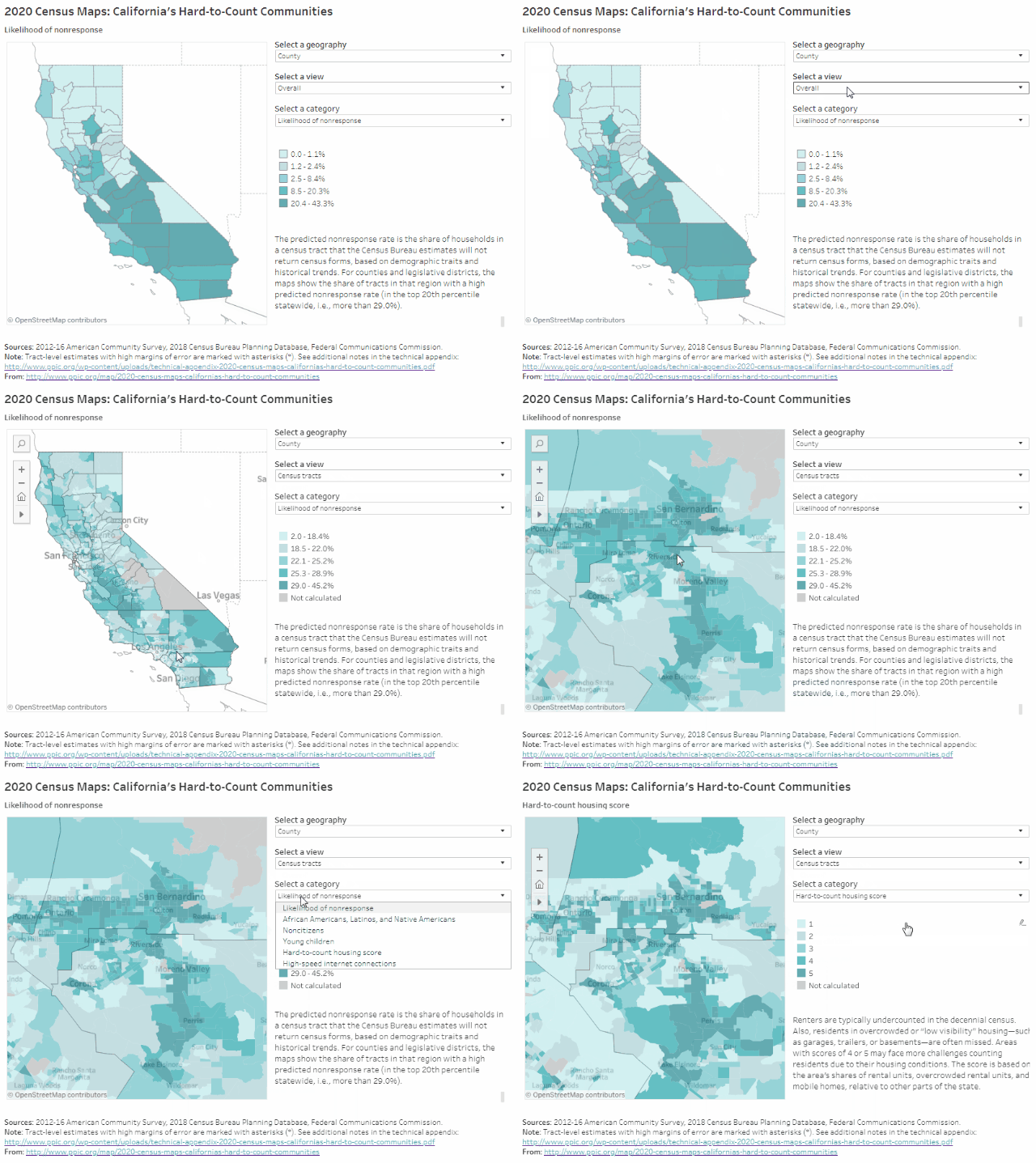
PPIC’s interactive census maps are an important tool for Californians working to ensure an accurate census count. Using estimates from the Census Bureau and the Federal Communications Commission, they highlight hard-to-count communities across the state and pinpoint reasons why certain areas may be hard to reach.

The Inland Empire is home to more than 4.5 million Californians (over 11% of the state’s population). About 29% of census tracts in San Bernardino County are likely to be very hard to count, compared to 17% in Riverside County, according to Census Bureau estimates that draw on demographic characteristics and historical trends. Households in these very hard-to-count areas are less likely to respond initially to census forms and are therefore at risk of being undercounted. Many hard-to-reach census tracts are clustered in and around the San Bernardino–Riverside metro area, including the neighboring cities of Moreno Valley and Ontario.

Some highlights:

  • Very hard-to-count communities in the Inland Empire tend to be concentrated in urban legislative districts. Since legislative district lines will be redrawn based on the census, disproportionately undercounting parts of the Inland Empire could affect the region’s political representation. For example, in Congressional Districts 31 (Aguilar) and 35 (Torres), more than 30% of census tracts are likely to be very hard to count. The same is true for State Senate District 20 (Leyva) and State Assembly Districts 40 (Steinorth), 47 (Reyes), and 52 (Rodriguez).
  • Undercounting people of color could disproportionately affect the Inland Empire. African Americans, Latinos, and Native Americans tend to be undercounted in the census. These groups make up more than half of the population in the Inland Empire—54% in Riverside County and 60% in San Bernardino County—compared to 45% statewide. In metro areas, over 80% of residents in many neighborhoods are people of color. The Inland Empire also includes several tribal reservations, such as those southeast of Coachella and northwest of Palm Springs.
  • Parts of the Inland Empire have particularly high shares of young children. Young children are historically underrepresented in the census. Riverside and San Bernardino Counties have relatively high percentages of young children (6.8% and 7.3%, respectively) compared to the state as a whole (6.5%). Certain areas have even higher concentrations of families with young children: children under five years old make up between 9% and 11% of the population around Victorville, in western San Bernardino County, and the same is true for numerous census tracts around the city of San Bernardino.
  • Communities can be hard to count for multiple reasons. Housing conditions (high shares of rentals, overcrowded rental units, and mobile homes) may make it more difficult to count residents accurately. There is hard-to-count housing throughout the Inland Empire, with pockets in metro areas, south of Moreno Valley, and in the rural eastern parts of the region. Residents may also be hard to count for other reasons. For example, in some areas with hard-to-count housing, many residents are noncitizens—who may be less likely to respond in 2020 due to the planned addition of a citizenship question. Recognizing ways that hard-to-count communities intersect with each other will be critical to conducting effective outreach to Inland Empire residents.
  • Rural areas tend to have lower internet access, as do some urban neighborhoods. The US Census Bureau plans to collect the majority of responses online in 2020—a change from previous practice. The eastern, rural parts of the Inland Empire have low levels of residential high-speed internet access and therefore may face more challenges responding to the census online. We also see lower levels of access in the city of San Bernardino and Moreno Valley relative to surrounding areas. It’s important to note that people may still have internet access through smartphones, public libraries, or other services.

We hope these maps serve as a starting point to help local, regional, and state leaders think about which activities, resources, and partnerships—including language assistance, awareness raising, and community outreach—might be most effective for accurately counting different parts of California. Stay tuned for future posts that examine hard-to-count communities in other regions of the state.