Online Learning and College Costs

As the price of attending college has risen and access to higher education has declined, policymakers are looking to online learning as a way to better serve student needs, increase access—and lower the costs of higher education. In California, the state’s community colleges have taken the lead in online learning, with total course enrollment reaching about one million. We have been able to study the impact of online education on hundreds of thousands of students at the state’s community colleges. What we found points to important issues in the discussion of higher education access and costs.

It is easy to understand why online education is being championed as a cost-saver. Online courses do not require classroom space, and the cost of developing courses can be amortized over time. Savings could come through economies of scale, including centralization of online student services. If faculty members do not have to invest as much time designing, facilitating, and seeking approval for individual online courses, the colleges’ overall labor costs could drop.

But at this point, these savings are theoretical. So far, there is no empirical evidence that online learning is less expensive than face-to-face learning. In fact, research shows that preparing an online course is usually more time consuming—and therefore expensive—than preparing a traditional class.

And there are other drawbacks to online education as it’s currently practiced. In California’s community colleges, online student success rates are lower than success rates in traditional courses. Success rates for African American and Hispanic students are significantly worse. If these gaps persist and online enrollment continues to increase, then community colleges will be less equitable. The result will be increased costs to students and the state—and a failure to realize the promise of online education.

Despite these drawbacks, certain online courses are highly successful. Our analysis of these courses led us to recommend that the colleges move away from the current model, which relies on an individual faculty member to design and deliver an online course, and adopt a more systematic approach to creating online courses. A team that supports faculty members—including administrators, media developers, and information technology experts—would be better able to maximize the potential of the online learning environment.

However, it is unclear how moving to a team model would affect costs. Incorporating specialists in course design would raise upfront costs. Regularly updating software and updating course material could quickly exceed any savings from economies of scale. Providing essential student support services, such as technical support, online tutoring, and counseling, might also significantly raise costs.

But online learning is an important tool for improving access to higher education in California, even if it does not cost less. Online classes are increasingly popular in the community colleges—which are the higher education institutions most likely to serve nontraditional students. Incorporating best practices into these courses would improve the colleges’ ability to serve the state’s diverse students.

The community college system’s Online Education Initiative is an important step in the effort to accommodate demand for online learning and improve student outcomes. If it is successful, it can serve as a model for other online learning programs in higher education.

Improving Online College Courses

Not all online college courses are alike. In fact, students in California community colleges are more likely to be successful in courses that have been designed recently than ones that are much older. And success varies by course topic, but not always in ways you might expect.

Hans Johnson, PPIC senior and Bren fellow, identified some elements important to a successful online course at a briefing in Sacramento last week. The research suggests that courses designed by a team—including media developers and information technology experts, as well as instructors—are better able than a single faculty member to take advantage of the online medium.

Online learning is an important topic throughout higher education. The report—Successful Online Courses in California Community Colleges—points out the increasing popularity of online offerings at the community colleges. Online learning reaches students who aren’t able to attend classes in traditional settings, Johnson said, and improving it is key to improving student success.

Increasing Transfer Students at UC

The University of California has agreed to bring in more transfer students as part of its budget agreement with the governor. Specifically, UC has committed to enrolling one new transfer student for every two new freshman. This means that one third (33%) of entering students will be transfers system-wide and at each campus (except Merced) by 2017. It also means that unless there is funding to increase enrollment, there may be fewer places for entering freshman.

Three campuses—Davis, Los Angeles, and San Diego—met the transfer enrollment goal in the fall of 2014. The other five campuses have a long way to go: they would have needed to enroll between 500 and 950 more transfer students each to reach the 33% target last fall, given their freshmen enrollment levels.

In total, the five campuses would have had to enroll 3,776 more transfer students to meet the ratio last year. Are there enough qualified transfers to make up that ground? Some campuses have plenty of applicants. Berkeley, Irvine, and Santa Barbara admit fewer than half of their transfer applicants, and each campus denied more than 7,000 applicants in 2014. Riverside and Santa Cruz, however, could have more trouble finding students to fill the spots. Those campuses already admit almost 60% of their transfer applicants, and though they denied enrollment to about 3,600 students in 2014, many of these students could be ineligible for transfer to the university or specific major to which they are applying.

UC hopes to increase the size and strength of the pool of transfer applicants, as the UC President’s Transfer Action Team suggests in a recent report. The report recommends actions to increase outreach at the community colleges, streamline some of the transfer processes, and support transfer students once they arrive at a UC.

There is evidence that transfer students are successful at UC. Transfer students and students who enroll as freshmen have similar graduation rates. About 60% of freshmen graduate in four years and 83% graduate by their sixth year; 53% of transfer students graduate two years after transferring to a UC and 86% graduate by their fourth year after transferring.

UC’s recent budget agreement with the governor did not allocate any state funds for enrollment increases. That can change, depending on action taken by the legislature and governor.

Placing more community college transfers in UCs could help California close the gap between the number of college graduates the public higher education system is producing and the projected demand for college graduates by 2025. But at a time when UC is already turning away qualified high school graduates, the tradeoff between admitting transfer students and freshmen could be painful. Finding space for more eligible students in both categories would most benefit the state in the long run.

Chart source: Author calculations from University of California Office of the President Data.
Note: “Additional transfers needed” assumes a desired 2 to 1 freshmen to transfer ratio and that the enrollment of freshmen does not change. *Merced is not required to maintain a 2 to 1 ratio of freshmen to transfers.

Are Enough Californians Attending UC?

At the recent UC Board of Regents meeting, the regents approved a plan by Governor Brown and UC President Janet Napolitano—among other things, it freezes in-state tuition, reforms the pension system, and increases transfer student enrollment in exchange for extra funding from the state. However, it does not fund any additional California resident enrollment, suggesting that without legislative action for more funding, campuses may not increase enrollment for in-state students.

Enrollment growth for California residents at UC has slowed since the recession, while at the same time the proportion of out-of-state students has grown to an all-time high. UC officials acknowledge that out-of-state enrollment has grown as a result of statewide budget cuts. They contend that the extra tuition paid by out-of-state students enables UC to admit more California residents than it could otherwise. And even with the fast growth of out-of-state students in the UC system, California residents still make up over 80% of UC freshmen. But are enough Californians attending the UCs?

One way to answer that question is to see if UC is meeting the requirements of California’s Master Plan for Higher Education. The plan indicates that the UCs should choose from among the top 12.5% of students in the state. If we examine the proportion of California high school graduates admitted to the UC system, we find that UC admits more than 12.5% of California high school graduates. This percentage declined between 2007 and 2010 during the recession (also during the increase in out-of-state students), but it never dipped below 13%.

Let’s also consider the number of students receiving a UC education. Only 7.4 % of California’s high school graduates enroll at a UC as freshmen—far short of the 13.7 % admitted. Some students choose to attend other competitive schools, others decline to enroll at UC after being rejected from their first-choice campus, and still others may prefer a cheaper or closer-to-home option such as starting at a community college or attending a CSU. Lastly, let’s look at the number of students who are ready and eligible for UC. As the percentage of high school graduates admitted to a UC has declined, the percentage of public high school students who complete the UC eligibility requirements has grown. This comes at a time when the state needs to be producing more college graduates to meet the demands of the state’s future economy.

So, are there enough Californians in the UC system? Even with the influx of out-of-state students, the UC system is currently meeting the expectations of the Master Plan for admission. However, the combination of a growing number of UC-ready students and a low yield rate for admits suggests that a shrinking share of students who could benefit from a UC education are getting a UC education—especially if California resident enrollment does not continue to grow.

PPIC and others have suggested that the state review and revise the Master Plan. In the context of today’s debates over enrollment at the state’s universities and colleges, California’s leaders should update the goals of California’s higher education systems and work out how to meet and appropriately fund them.

Notes: (TOP CHART) University of California Office of the President. (BOTTOM FIGURE): Author’s calculations from data from the California Department of Education and University of California Office of the President.

Locking Students Out of Our Colleges a Losing Strategy

This commentary was published on Sunday, April 12, 2015, in the San Francisco Chronicle.

High school seniors across the state are just now hearing if they will be accepted into the college of their choice. Most of those students have applied to one or more of the state’s public four-year universities and, despite meeting eligibility criteria, many will be disappointed. While this is certainly distressing for individual students and their families, this problem points to larger, troubling issues of access to and student success in California’s higher education system. The state’s public universities are not able to accommodate all of the qualified students who apply.

(Continue reading on sfchronicle.com)

Delivering on the Promise of Online Education

Zócalo Public Square, which combines live events and journalism, asked PPIC senior fellow Hans Johnson and other experts to answer this question: How will technology—from massive open online courses and web-based textbooks to big data collection—change universities? Here is his response. Visit Zocalopublicsquare.org to read what others had to say.

A popular prediction is that new technology will revolutionize higher education, making traditional brick and mortar colleges obsolete. Certainly, new technology offers tremendous potential—democratizing access to college, enhancing instruction, and improving graduation rates, to name a few. But before we jump on the bandwagon of declaring a new era in higher education, we should assess the degree to which new technology can address fundamental challenges in higher education.

Perhaps the greatest challenge of all is to ensure that higher education serves as a ladder for economic and social mobility rather than simply reinforcing economic and class divides. By that standard, we can dismiss most Massive Online Open Courses offered in conjunction with the nation’s elite universities. Most of those courses are taken by people who already have a college degree, and the vast majority of students who enroll in such courses never finish them.

A different experiment in online learning, and one that serves hundreds of thousands of students who come from disadvantaged backgrounds, is taking place at California’s community colleges. With over one million course enrollments, California’s community colleges are the largest public provider of online education in the country. They are the gateways to higher education for low-income and nontraditional students—those with jobs and family obligations.

At the Public Policy Institute of California, we examined student success in online courses in the state’s community colleges. In our study, we found that course completion and passage rates are substantially lower in online courses than in traditional ones, even though students in online courses tend to be more advantaged and academically prepared. Moreover, gaps in academic performance that we see among demographic groups in real-life classrooms are exacerbated in the online setting.

What these early findings demonstrate is not failure, but the need to improve both technology and the way it is used in instruction. If we can get it right at the community colleges, we can deliver on the promise of online education.

Commentary: Obama’s Community College Plan No Panacea

This commentary was published today by the Washington Post.

President Obama’s proposal to make community colleges free is a valiant effort to address the rising demand for skilled workers throughout the nation and to improve college access for low-income students. As states consider his proposal, they would be wise to look to California . . .

(Continue reading on washingtonpost.com.)

How Does UC Compare in Enrolling Nonresident Students?

Record-high numbers of out-of-state students are enrolling in the UC system. Estimates show that one out of every five freshmen starting at a University of California campus this fall will be a student who attended high school in a state outside of California or outside of the U.S.

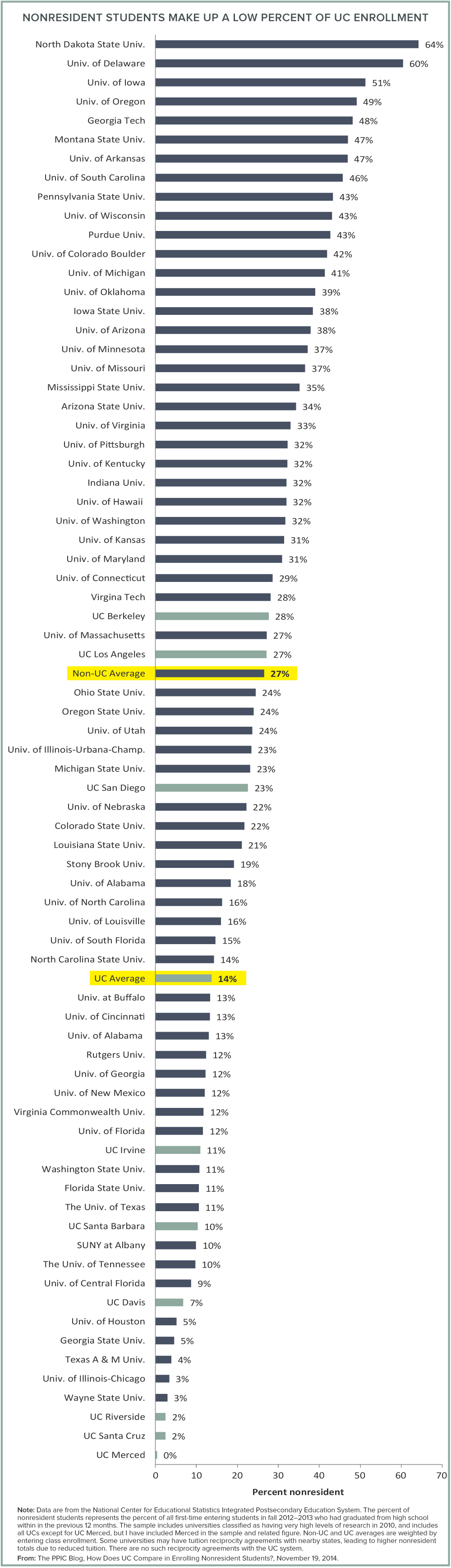
Nonresident students pay about three times the tuition of a California resident. Since the state’s deep cuts to higher education budgets, the UC system has increasingly relied upon nonresident student enrollment as a source of revenue. In fact, Senator Kevin de León recently suggested raising tuition on nonresidents to increase revenue for UC. Several other legislators and members of the public have criticized the increased recruitment and admission of nonresidents. All of which raises a question: How does UC’s enrollment of nonresident students compare to that of similar universities in other states?

Among public, four-year research universities nationwide, only UC Berkeley and UCLA are above the national average in the proportion of students paying out-of-state tuition. The UC average is well below the national average for similar universities. In fact, the UC system claimed six of the bottom 17 spots, as the following chart demonstrates.

Looking at the trend over time, the UC system has enrolled relatively low levels of nonresident students compared to other similar universities, but that average has been increasing sharply since 2010. However, nonresident enrollment is also increasing at other top-tier, public universities throughout the nation—likely because of budget woes in other states. In the most recent two years, there has been no national data for a comparison, but UC provides the number of students intending to register each year, which is likely an upper bound for nonresident enrollment. The number of nonresident students has continued to climb, especially at UC Berkeley and UCLA, where they are estimated to make up 29.8% and 30.1% of 2014 freshmen enrollees, respectively. But even with these increases, nonresident enrollment is still likely lower at UC Berkeley and UCLA than it is at many prestigious public four-year universities, and the UC system is likely well below the national average for similar schools.

UC President Janet Napolitano has stated that she has considered limiting the number nonresident students in the UC system. But instead of setting system-wide limits, and relying on some universities to have fewer nonresidents to balance Berkeley and UCLA, the president and board of regents may consider setting enrollment limits for nonresident students for each university in the system. The full board of regents meets Thursday to vote on a plan for raising tuition at UC. If UC cannot increase revenue through tuition increases or from the state, they may seek to enroll more nonresidents, as they have done in the past. Even though the UC system has a relatively low proportion of nonresident students compared to the nation, such a move would still likely generate controversy.

Note: (BOTTOM CHART) Data are from National Center for Educational Statistics Integrated Postsecondary Education System (IPEDS) and the UC Office of the President. Solid lines indicate data retrieved from IPEDS; dotted lines indicate estimated enrollments based on UC Office of the President’s reported Statement of Intent to Register (SIR). The percent of nonresident students represents the percent of all first-time entering students in fall 2012–2013 who had graduated from high school within in the previous 12 months. The IPEDS sample includes universities classified as having very high levels of research, and includes all UCs except for UC Merced, but I have included Merced in the sample and related figure. Non-UC and UC averages are weighted by entering class enrollment. Universities are not required to submit nonresident counts to IPEDS in odd years, and some do not. Those odd year values are imputed from the even years surrounding them.

Paying for Higher Education

As concerns have grown about access to and affordability of California’s higher education system, understanding costs has become more critical than ever. How are institutions—and students—faring?

This question is the focus of three reports released by PPIC and a panel discussion held last week in Sacramento. Hans Johnson, a Bren fellow at PPIC, first summarized the research. One report shows that federal financial aid has shielded low-income students from rising tuition at the University of California and California State University. A second report evaluates both revenues and spending—including faculty salaries and benefits— and concludes that UC and CSU have not become less efficient in the past several years. A third report suggests that as California begins to reinvest in public higher education, it could tie funding more closely to results—for example, the number of degrees awarded—to meet state goals. In his presentation, Johnson noted that the state’s current goals—the Master Plan for Higher Education—are more than 50 years old and overdue for an update.

Panelists took up the issue of goals—how to set them, what to measure, and how to share the costs—in a discussion moderated by Patrick Murphy, PPIC research director. Participants were Henry Brady, dean of UC Berkeley’s Goldman School of Public Policy; Nancy Shulock, former executive director of CSU Sacramento’s Institute for Higher Education Leadership and Policy; and Amy Supinger, California policy consultant for the Lumina Foundation.

Video: Making College Possible

At a time when California’s economy needs more college graduates, a new PPIC report examines the role of grants and scholarships in making higher education both accessible and helping students graduate. Hans Johnson, the report’s author and PPIC Bren Fellow, talked about his findings at a briefing last week in Sacramento.

He found that although total financial assistance available through federal grants, Cal Grants, institutional aid, and private scholarships has increased, it has not kept pace with the actual cost of attending California State University and community colleges. These are the California colleges that enroll most low-income students in California—a state in which nearly 60 percent of K–12 students qualify for free and reduced price lunch programs.

“If we want the economic ladder to success to work in California, we need more students to go to and complete college,” he said. “And given our student population, a lot of those students will be from very low-income families.”

He recommended strategies to make college more affordable and accessible. They include directing any additional aid to low-income students and helping more students complete financial aid forms.