Introducing the PPIC Higher Education Center

California’s higher education system is not keeping up with the state’s changing economy. Population and education trends suggest that California will face a shortfall of 1.1 million college graduates by 2030. To close this gap and meet future workforce demand, the state needs to act now.

The good news is that higher education policy has gained new prominence in Sacramento. Concerns about affordability and efficiency have opened the way for wide-ranging change in higher education. Identifying policies and resources that improve both student success and institutional effectiveness are essential.

And that is where PPIC comes in.

Today, we are pleased to announce the establishment of the PPIC Higher Education Center. It is dedicated to advancing practical, evidence-based solutions that enhance educational opportunities for all of California’s students—improving lives and expanding economic growth across the state. The center expands on the model of independent, nonpartisan research and constructive engagement that defines all of PPIC’s work.

PPIC laid the groundwork for the center over the past decade with high-quality research on major higher education issues and productive conversations about solutions. The PPIC Higher Education Center represents a significant ramping up of investment in this critical area, and we thank the Sutton Family Fund for its core support of this effort.

The center will focus on three critical issues:

  • Expanding access. Identifying policies that increase and strengthen pathways to higher education, ensuring that all Californians have the opportunity to earn a college degree.
  • Managing finances. Helping to determine the most effective funding approaches, to keep college affordable and broaden the impact of the state’s higher education investments.
  • Improving outcomes. Promoting strategies that produce more college graduates and prepare Californians—and the state’s economy—to be successful in a changing world.

In conjunction with the launch of center, PPIC is releasing Higher Education in California, a set of seven policy briefs on the state’s most critical challenges in higher education. This briefing kit is designed to inform state leaders and to raise awareness more broadly about the important higher education issues facing California.

We invite you to read Higher Education in California and visit our new PPIC Higher Education Center online. We also invite you to stay up to date with PPIC Higher Education Center activities: ·

Photo courtesy of Public Affairs/Sacramento State.

Testimony: Closing California’s Degree Gap

PPIC senior fellow Hans Johnson testified at a joint hearing of the Assembly Higher Education Committee and Assembly Budget Subcommittee on Education Finance yesterday (March 2, 2016). The topic was “Closing California’s Certificate and Degree Attainment Gap.” Here are his prepared remarks.


Thank you for organizing this joint hearing on such an important topic. My name is Hans Johnson. I am a senior fellow at the Public Policy Institute of California. PPIC is a nonpartisan, independent research institute and as such does not take positions on bills before the legislature. My testimony today is based on a recently released PPIC report, Will California Run Out of College Graduates?, which I authored with my colleagues Marisol Cuellar Mejia and Sarah Bohn.

Educational attainment is the single most important determinant of economic well-being for individuals, for states, and for countries. As the California economy continues to change, becoming more technical and requiring more skills of workers, a key question is whether the state’s workforce will be ready to meet these future challenges.

To answer this question, PPIC has developed projections of California’s workforce skills through 2030, focusing on the supply and demand for workers with a bachelor’s degree. We find that the state will fall about 1.1 million college graduates short of economic demand if current trends persist—a problem we call the workforce skills gap. We project that 38 percent of all jobs will depend on workers with at least a bachelor’s degree, but only about 33 percent of workers will have one in 2030. These projections are based on recent economic trends and on forecasts that show a continued increase in the demand for highly educated workers, a demand that is not going to be met by expected increases in the supply of college graduates. So the challenge is clear: either improve educational outcomes for Californians or face a future that has relatively dim economic prospects.

Already we see evidence of strong and increasing demand for highly educated workers. In today’s labor market, workers with a bachelor’s degree have better economic outcomes than those with less education, and that advantage is at or near all-time highs. Over time, college graduates have seen lower rates of unemployment and higher wages than other workers—even through the Great Recession and certainly in the recovery—illustrating that college degrees have become increasingly valuable in California’s labor market.

Future Jobs

To assess California’s future job market, we rely on long-term occupational projections from the state’s Employment Development Department (EDD). Here, we are concerned not just with changes in the state’s overall occupational mix but also with changes in skill requirements within occupational categories. Understanding these changes helps to provide a clearer picture of where the growth in demand for college degrees is likely to occur. To do so, we look at both broad occupational categories, such as business operations, and jobs within those categories, such as marketing specialists.

The projections suggest that the mix of occupational categories in California’s labor market is not going to change drastically over the next decade or so. The fastest-growing categories will include both high and low skills. Among the ten fastest-growing categories, five require high levels of educational attainment and five do not. This means that the bifurcation of California’s occupational mix, an important component of wage inequality, is expected to continue.

Because the demand for highly educated workers within occupational categories has been growing over the past decade, even though the mix of these categories is not shifting much, we expect the economy to require a higher share of educated workers by 2030. In most occupational categories, the share of workers holding at least a bachelor’s degree is projected to increase by 2030.

These increases are projected to occur in most occupational categories, from those regarded as high skill (such as management) to those regarded as low skill (food preparation). Some of this increase will be caused by a shift toward specific occupations within broader occupational categories. But the larger shift is likely to be an increase in educational attainment within specific occupations themselves.

Business operations is a case in point. In 2000, about half of the workers in the business operations occupational category held a bachelor’s degree; by 2013, this share had increased to 60 percent. If these trends continue, 74 percent will have a bachelor’s degree in 2030—a 14 percentage point increase over 17 years. But as an overall occupational category, business operations will make up a similar share of the economy as it does today—3.0 percent in 2030, compared with 2.7 percent in 2013.

The increase in educational attainment within this occupational category is occurring because its fastest-growing specific occupations include some with high levels of education—for example, market research analysts and marketing specialists, 75 percent of whom hold at least a bachelor’s degree. In addition, some specific occupations have seen a large increase in the share of workers with college degrees—for example, the share of fundraisers with a bachelor’s degree increased from 44 percent in 2000 to 84 percent in 2013.

Overall, there are no indications that the rocky economic landscape of the recent recession has shifted the trend in demand for highly educated workers. In the past, a strong demand for highly educated workers occurred as the economy shifted toward occupational categories and industries that demanded these workers. But in the 1990s and—based on our current analysis—through the 2000s, the strong demand for highly educated workers has reflected growth in education levels within industries and occupations.

Do these projections indicate a real demand, or are they simply evidence of a trend toward overeducating the workforce? One way to distinguish between these two possibilities is to examine the wage premium paid to college workers—that is, the extra wages employers are willing to pay college workers compared with less educated workers in the same occupational category. Positive and increasing wage premiums for college-educated workers reflect the economic demand for high skills. In general, the college wage premium is large and increasing economy-wide; moreover, we find that within occupational categories, the same is generally true. College-educated workers enjoy positive and significant wage premiums within almost every occupational category. These findings indicate that the strong demand for highly educated workers is likely to continue because employers and the economy require the skills associated with more highly educated workers.

Of course, the labor market does not value all college degrees equally. For degrees in highly lucrative fields, such as engineering and computer science, the lifetime wage premium—that is, the expected present value of the gain in wages by completing college, even after accounting for college costs—can total more than $1 million; but even for degrees with the lowest economic returns, the lifetime wage premium totals more than $200,000.

Future Educational Attainment

The share of adults in the workforce with a bachelor’s degree or more will increase only slightly—about 1 percent—by 2030. To a great extent, this slow growth stems from the retirement of the numerous and very highly educated members of the baby boom generation. Today, the best-educated age group in California consists of adults age 60 to 64. By 2030, these adults will be retired.

In the past, retirees tended to be less educated and relatively few in number—and they were replaced by younger, more-numerous, and more-educated adults. In the future, this will no longer be the case. Indeed, the retirement of the baby boomers represents the first time in California’s history that such a large and well-educated generation is exiting the labor force. This loss helps to explain the size of the skills gap we see in 2030.

California is unlikely to attract enough highly educated migrants from elsewhere to close the skills gap. For a long time, the state has relied on migrants to supply employers with the college graduates they need. Until recently, more of California’s college graduates, by percentage, were born elsewhere in the United States. And since 1980, the share of college graduates from other countries has increased quickly, a reflection of the globalization of the state’s economy—and we expect this to continue. Were it not for these increases, the size of the skills gap would be even larger.

California residents are making slight improvements in educational attainment. Indeed, in 2010, for the first time in the state’s history, more of California’s college graduates were born in the state (37%) than in other states (33%) or internationally (30%). Going forward, California’s best approach to closing its skills gap will be to concentrate on improving the educational attainment of its residents.

Policy Implications

We believe that the most promising approach to closing the workforce skills gap is to concentrate on improving the educational attainment of California residents. Here, I will outline four key strategies for the state and its colleges and universities to pursue. Implementing these strategies—which should be the core of a new state plan for higher education—would require increased coordination across institutions.

First, increase access. Research shows that students are much more likely to earn a bachelor’s degree if they first enroll in a four-year college, rather than in a community college—even when we account for differences in academic preparation. This means that increasing the share of high school graduates eligible for the University of California and California State University would be an important step toward increasing the number of college graduates. It would also improve access for students from low-income families and other underrepresented groups.

Second, improve completion rates and time to degree. Despite progress by both university systems to address these issues, only 19 percent of students at CSU and 60 percent of those at UC earn a bachelor’s degree in four years. Current strategies to graduate more students more quickly should be assessed to identify which are most effective. And new approaches—such as offering colleges fiscal incentives to increase the share of students taking a full, 15-unit course load—should be considered.

Third, expand transfers to four-year colleges. Improving transfer pathways from community colleges to four-year institutions is essential because California relies heavily on its two-year institutions. Currently, the vast majority of community college students do not earn degrees or certificates. Associate degree programs guaranteeing that qualified community college students can transfer to CSU should be expanded. These programs now depend on individual agreements between specific campuses and apply only to specific majors; expanding them to include more majors and transfers to UC is likely to increase the number of students who ultimately earn bachelor’s degrees.

Finally, be smart about aid. Grant and aid programs mean that most low-income and even some middle-income students do not have to pay tuition at the state’s public colleges and universities. But other educational costs are not well covered and student debt has been rising, raising questions about whether state Cal Grants should cover more than tuition. The state should also consider increasing the size of Cal Grants to students attending private colleges that have good graduation rates and low loan-default rates.

In summary, a state plan for higher education should ensure that enough high school graduates are ready for college, enough slots are available for new college students, more community college students are able to transfer to four-year institutions, and more students complete college in four years. Of critical importance, California and its higher education institutions must strengthen access to and success in college for low-income and underrepresented students, who make up an increasing share of the state’s population. Ultimately, closing the workforce skills gap will result in a more productive economy, higher incomes, greater tax revenues, less pressure on the social safety net—and a brighter future all Californians.

Increasing On-time Graduation Rates at CSU

Just 19% of California students at California State University (CSU) campuses graduate in four years. A bill introduced this week is aimed at improving these graduation rates by addressing two commonly cited issues important to graduating on time: getting access to necessary classes and taking a full course load.

The bill would guarantee that students’ tuition is frozen at freshmen-year levels and provide priority registration for classes—as long as they take enough units to stay on track to graduate in four years and carry a certain minimum GPA. In order to graduate in 4 years, students need to average 15 units a semester (about 5 classes). However, students can take 12 units a semester (about 4 classes) and still be considered full-time by university standards and for financial aid purposes. While it does not cost any more money for students to take 15 units, many students choose to take 12 units so they can work or because they feel that 15 units would be too challenging. It’s also possible that some students just don’t know that taking only 12 units pushes them off-track to graduate on time.

Would a promise of frozen tuition be enough to cause more students to graduate in four years? After all, there has always been a financial incentive to do so. The fifth (and sixth) year of college is expensive, and later graduation also keeps student from entering the workforce full time and earning income. For example, a student starting in 2007 who graduated in 4 years would save $5,472 in tuition alone by not attending a fifth year—when including a year’s worth of room, board, books, and other related expenses, this number is closer to $20,000,and likely even more when considering the foregone earnings a student could be making during that year. Under the proposed bill, SB 1450, that student would save an additional $3,198, thanks to frozen tuition. If a vast majority of students do not finish in 4 years in light of the significant savings, would the promise of additional $3,000 in eventual savings push them to take more classes each semester?

It is possible that by highlighting near-term savings on yearly tuition the bill could convince some students to stay on track and graduate on time. How much it could move the needle for on-time graduation remains to be seen. If few students are moved to participate, the state could end up just partially subsidizing the degrees of students who were already going to finish in 4 years.

It makes sense for legislators and the higher education systems to work together to remove the barriers for on-time graduation for California’s students. This would cost students and the state less money, increase the number of CSU graduates, and makes space for more students at the university.

Video: Higher Education & Our Economic Future

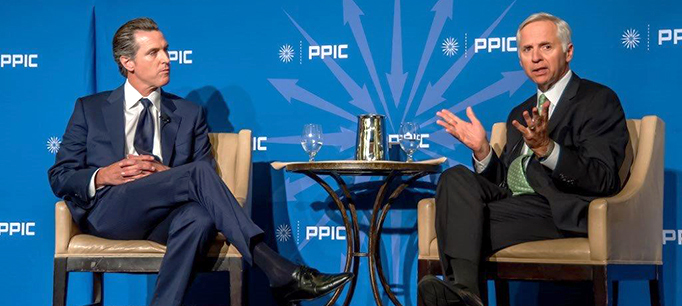
“The world is radically changed,” Gavin Newsom, California’s lieutenant governor, told a Sacramento audience this week.

“We’re competing against billions and billions of people, not just competing against cheap labor now, but against cheap genius,” he continued.

Newsom—who is also a University of California regent and California State University trustee—spoke in a conversation with Mark Baldassare, PPIC president and CEO. PPIC’s new report Will California Run Out of College Graduates? provided the context for the discussion. The report concludes that California will fall 1.1 million college graduates short of economic demand by 2030, if current trends persist.

Newsom said that “there is not a major industrialized nation in the world that is not focusing with intention on radically transforming their education system. One of the remarkable things about California is that we do not have a plan.”

He summed up: “We need goals. And we need to be able to measure those goals. And those goals must emanate from the state itself.”

Newsom was not the only speaker at the PPIC event to use words like “radical” and “revolution” to describe changes needed in higher education.

At a subsequent panel discussion, state assemblymember Catharine Baker said she is concerned that the state is falling short of the workforce needed even now. She noted that there is bipartisan agreement in the legislature that higher education is important but not about the need for major change. “There is a lot more focus on issues around the margins, that is, on how many students are we admitting, what few changes we can make in the community college system.”

Eloy Ortiz Oakley, superintendent-president of the Long Beach Community College District, said, “We almost need a revolution in our system. We started to get there when we were in crisis mode.”

“During the recession, we saw more creativity than ever before in the community college system and we began to focus,” he said. “I fear that post-recession that focus will start to dissipate.”

Hans Johnson, coauthor of the PPIC report and PPIC senior fellow, said the big challenge for the state is replacing the retiring baby boom generation with young, well-educated workers.

“I think there is a very clear path to closing that skills gap,” he said. “We need to have more students going to colleges—especially four-year colleges. We need improve completion rates—that opens up room for more students. We need to improve transfer rates from community colleges to the four-year colleges. And if we do all of those things—and these are all decisions we can make, as policymakers and higher education officials—we can actually close that skills gap.”

Timothy White, California State University chancellor, said CSU can do its part to fill the workforce skills gap—with the help of its educational and funding partners. He called the PPIC report “a very sobering clarion call that is of crisis proportion— not for the CSU or for the University of California, or the community colleges, but rather for California. And I hope we take it with the seriousness that it deserves.”

A College Degree in Three Years?

During the recent state budget negotiations, the University of California promised to develop three-year degree programs on each campus for 10 of its top 15 majors by March 1, 2016. In addition, UC committed to enrolling 5 percent of students system-wide in an accelerated degree program by the summer of 2017. This is an intriguing goal that could benefit students and the state as a whole. Reaching it, however, would require overcoming significant obstacles.

The idea of accelerating the traditional four-year bachelor’s degree is not a new one. The three-year degree is especially likely to be touted as a way to boost the efficiency of public higher education during periods of declining state funding, growing enrollment, and rising tuition. It has been discussed in California and proposed in other states. Over the past two decades, Indiana, Ohio, Arizona, Illinois, and Florida have all directed their public four-year institutions to develop three-year degree programs. But the idea has not been widely adopted.

The vast majority of three-year degree programs attempt to attract high-achieving recent high school graduates who have already earned some college credit—either through advanced placement exams or by taking classes at a community college while still in high school. In exchange for a commitment to attend school year-round, students are promised priority course enrollment, a structured degree path, and high-intensity advising. Condensing the bachelor’s degree allows a student to reduce costs while burnishing a resume and possibly getting a jump-start on graduate school. Florida State University has had some success with its Degree in Three program, which began in 2000. Enrollment has been limited, though it increased from 71 students to 123 out of a total of about 6,500 freshmen between 2007 and 2008. And 40 percent of students who initially enrolled in the program ended up staying for four years–after switching majors, studying abroad, or participating in student government.

It is easy to see the appeal of completing a bachelor’s degree in three years. For students it has the potential to produce net financial benefits. Three-year graduates are likely to reduce the overall cost of their education despite the additional costs of attending summer sessions and forgoing summer employment. And newly minted graduates can enter the job market one year earlier, presumably with greater earning potential. For schools, reducing the amount of time students take to get degrees allows them to enroll more students. As PPIC research has shown, California needs to produce more college graduates to meet the state’s future workforce demand.

But the challenges are greater than they appear at first glance. For one thing, not all students complete their degrees in four years. As of 2013, only 60 percent of first-time, full-time UC freshmen graduated in four years; nearly one in five took between four and five years to graduate. In other words, for a significant number of students, participation in a three-year program would mean shortening their time at UC by more than a year. Campuses would need to re-examine their course offerings to make sure there are enough seats in required classes to meet student demand. Equally important would be to ensure that the sequence of offerings allows students to take all of their classes in three years. These changes would involve shifting teaching assignments and/or adding new instructors.

Even if the institutional challenges can be met, a larger question looms: What is the demand for a three-year degree? The students most able to attend classes year-round are those with more resources and/or fewer work or family obligations. The most motivated may be out-of-state students, who pay the steepest tuition. But we know that many UC freshmen today who have sophomore standing, and could finish in three years, choose not to.

A successfully implemented three-year degree program is likely to have a small impact on capacity. But if UC were to pursue this effort more broadly, and if the time to degree could be shortened to four years for students who now need five years to complete their degrees, the impact on capacity would be greater.


Improving Online College Courses

Not all online college courses are alike. In fact, students in California community colleges are more likely to be successful in courses that have been designed recently than ones that are much older. And success varies by course topic, but not always in ways you might expect.

Hans Johnson, PPIC senior and Bren fellow, identified some elements important to a successful online course at a briefing in Sacramento last week. The research suggests that courses designed by a team—including media developers and information technology experts, as well as instructors—are better able than a single faculty member to take advantage of the online medium.

Online learning is an important topic throughout higher education. The report—Successful Online Courses in California Community Colleges—points out the increasing popularity of online offerings at the community colleges. Online learning reaches students who aren’t able to attend classes in traditional settings, Johnson said, and improving it is key to improving student success.

Increasing Transfer Students at UC

The University of California has agreed to bring in more transfer students as part of its budget agreement with the governor. Specifically, UC has committed to enrolling one new transfer student for every two new freshman. This means that one third (33%) of entering students will be transfers system-wide and at each campus (except Merced) by 2017. It also means that unless there is funding to increase enrollment, there may be fewer places for entering freshman.

Three campuses—Davis, Los Angeles, and San Diego—met the transfer enrollment goal in the fall of 2014. The other five campuses have a long way to go: they would have needed to enroll between 500 and 950 more transfer students each to reach the 33% target last fall, given their freshmen enrollment levels.

In total, the five campuses would have had to enroll 3,776 more transfer students to meet the ratio last year. Are there enough qualified transfers to make up that ground? Some campuses have plenty of applicants. Berkeley, Irvine, and Santa Barbara admit fewer than half of their transfer applicants, and each campus denied more than 7,000 applicants in 2014. Riverside and Santa Cruz, however, could have more trouble finding students to fill the spots. Those campuses already admit almost 60% of their transfer applicants, and though they denied enrollment to about 3,600 students in 2014, many of these students could be ineligible for transfer to the university or specific major to which they are applying.

UC hopes to increase the size and strength of the pool of transfer applicants, as the UC President’s Transfer Action Team suggests in a recent report. The report recommends actions to increase outreach at the community colleges, streamline some of the transfer processes, and support transfer students once they arrive at a UC.

There is evidence that transfer students are successful at UC. Transfer students and students who enroll as freshmen have similar graduation rates. About 60% of freshmen graduate in four years and 83% graduate by their sixth year; 53% of transfer students graduate two years after transferring to a UC and 86% graduate by their fourth year after transferring.

UC’s recent budget agreement with the governor did not allocate any state funds for enrollment increases. That can change, depending on action taken by the legislature and governor.

Placing more community college transfers in UCs could help California close the gap between the number of college graduates the public higher education system is producing and the projected demand for college graduates by 2025. But at a time when UC is already turning away qualified high school graduates, the tradeoff between admitting transfer students and freshmen could be painful. Finding space for more eligible students in both categories would most benefit the state in the long run.

Chart source: Author calculations from University of California Office of the President Data.
Note: “Additional transfers needed” assumes a desired 2 to 1 freshmen to transfer ratio and that the enrollment of freshmen does not change. *Merced is not required to maintain a 2 to 1 ratio of freshmen to transfers.

Testimony: Improving the Cal Grant Program

PPIC researchers Hans Johnson and Kevin Cook testified before the California Student Aid Commission last week at a hearing to provide information about improving the Cal Grant program. The program provides about $1.5 billion in grants to college students in California each year and is administered by the commission. The program provides grants to state residents attending approved institutions and is the largest source of state aid to California students. Here is a summary of the testimony.


Rapidly increasing costs to students, low completion rates, and lack of access to four-year colleges are key challenges facing the state and the Cal Grant program. Given relatively high rates of poverty among high school graduates, grant and scholarship aid is more important than ever in making college possible for many Californians. Currently, California ranks 47th among all states in the share of high school graduates that go to four-year colleges. Only about half of California State University (CSU) students earn a bachelor’s degree within six years, and less than half of community college students earn an associate degree or vocational certificate or transfer to a four-year college.

To improve outcomes, the California Student Aid Commission should invest in what works, taking into account both efficiency and equity. One possibility would be to provide incentives for completion by providing more funding for students taking a full course load of 15 units. Students who take only 12 units per semester are currently considered full-time students but will not acquire enough units to graduate in four years. Of course, making this change might require increasing the size of grants so that students would be able to cut back on the number of hours they work at jobs.

Student outcomes might also be improved by using Cal Grants to encourage enrollment at four-year colleges. One way to achieve this would be to provide tuition, as well as a living stipend, for students eligible for the University of California and CSU. Currently, some awards for the students with the lowest incomes provide a living stipend for four years but tuition support for only three years.

More and better data is necessary to properly evaluate these and other proposals for improving student outcomes. The best way to identify effective and equitable delivery of Cal Grant aid would be to develop a statewide longitudinal data base that follows students from high school through college and into the workforce. Such a database, already developed in many other states, would allow the commission to answer additional questions that would help them understand what works—and doesn’t—to effectively target grant aid in California.

View the presentation slides


Delivering on the Promise of Online Education

Zócalo Public Square, which combines live events and journalism, asked PPIC senior fellow Hans Johnson and other experts to answer this question: How will technology—from massive open online courses and web-based textbooks to big data collection—change universities? Here is his response. Visit Zocalopublicsquare.org to read what others had to say.

A popular prediction is that new technology will revolutionize higher education, making traditional brick and mortar colleges obsolete. Certainly, new technology offers tremendous potential—democratizing access to college, enhancing instruction, and improving graduation rates, to name a few. But before we jump on the bandwagon of declaring a new era in higher education, we should assess the degree to which new technology can address fundamental challenges in higher education.

Perhaps the greatest challenge of all is to ensure that higher education serves as a ladder for economic and social mobility rather than simply reinforcing economic and class divides. By that standard, we can dismiss most Massive Online Open Courses offered in conjunction with the nation’s elite universities. Most of those courses are taken by people who already have a college degree, and the vast majority of students who enroll in such courses never finish them.

A different experiment in online learning, and one that serves hundreds of thousands of students who come from disadvantaged backgrounds, is taking place at California’s community colleges. With over one million course enrollments, California’s community colleges are the largest public provider of online education in the country. They are the gateways to higher education for low-income and nontraditional students—those with jobs and family obligations.

At the Public Policy Institute of California, we examined student success in online courses in the state’s community colleges. In our study, we found that course completion and passage rates are substantially lower in online courses than in traditional ones, even though students in online courses tend to be more advantaged and academically prepared. Moreover, gaps in academic performance that we see among demographic groups in real-life classrooms are exacerbated in the online setting.

What these early findings demonstrate is not failure, but the need to improve both technology and the way it is used in instruction. If we can get it right at the community colleges, we can deliver on the promise of online education.

Commentary: Obama’s Community College Plan No Panacea

This commentary was published today by the Washington Post.

President Obama’s proposal to make community colleges free is a valiant effort to address the rising demand for skilled workers throughout the nation and to improve college access for low-income students. As states consider his proposal, they would be wise to look to California . . .

(Continue reading on washingtonpost.com.)