Regional Higher Education Gap Grows

Just as income gaps have grown across California’s regions, so too have disparities in levels of education. Because higher education is a major contributor to economic opportunity, these disparities have significant implications for the future well-being of the state and its residents.

Since 1980, personal income has grown at vastly different rates across the state. Workers in the Bay Area and Orange County earn substantially more (on an aggregate, per capita basis) than the average Californian. Residents in the Central Valley and Sierras, the Inland Empire, and the far north earn substantially less than the statewide average. These disparities have grown over time. In 1980, per capita regional income ranged from 80% to 111% of statewide per capita income. Today, this range is wider, with the Inland Empire at 66% and the Bay Area at 138% of the statewide average.

Regional income differences are tied to the industries and occupations that make up regional economies, as well as broad economic drivers that have accelerated growth in some industries but not others. These same factors affect individual workers’ decisions about where to live.

Given the importance of post-secondary education to economic opportunity, it is not surprising that regional differences in the share of adults with college degrees are similar to differences in income. In the Bay Area as well as Orange and San Diego Counties, the share of adults with four-year college degrees is much larger than the statewide share. The Central Coast region, Sacramento metro area, and Los Angeles County have roughly similar concentrations of college degrees as the state overall; the Central Valley, Inland Empire, and far northern parts of the state have substantially smaller shares.

However, the value of post-secondary degrees has been increasing even in occupations that traditionally have not required college education—including the jobs that comprise a larger share of the economy in lower-income regions of the state. So we might expect regional disparities in college degree attainment to be narrower today. But this is not the case.

In fact, the distribution of higher education credentials across California has become more uneven over time. For example, in 1980 the share of Bay Area adults with college degrees was 128% of the statewide average; today, that share is 138%. Over the same period, the share of college graduates in the Central Valley has fallen from 65% of the statewide average to 56%.

These widening educational disparities are a warning sign for the state’s future. Narrowing regional gaps in educational attainment probably won’t eliminate differences in income, but it could increase competitiveness across all regions and expand economic opportunities for individual Californians.

Note (TOP CHART):The “far north” region includes Butte, Colusa, Del Norte, Glenn, Humboldt, Lake, Lassen, Mendocino, Modoc, Nevada, Plumas, Shasta, Sierra, Siskiyou, Tehama, and Trinity Counties.
Source (TOP CHART): Author calculations from Bureau of Economic Analysis data.

Note (BOTTOM CHART): Share of regional population with a bachelor’s degree or higher compared to statewide share in each year. Source (BOTTOM CHART):Author calculations from the 1980 and 2000 Decennial Censuses and the 2014 American Community Survey, age 25–64 in California.

Learn more

Will California Run Out of College Graduates?
Income Inequality and the Safety Net in California

The Employment Value of Higher Education

As of June, California’s unemployment rate was 5.4%, the lowest that it’s been in nearly nine years. Of course, in that nine years, California’s workers have seen drastic swings in employment opportunity. Higher education is a key determinant of how people fare when the economy slows.

Californians with education credentials beyond high school, from an associate’s degree up to a doctoral degree, have lower than average unemployment rates in general – and had smaller spikes in unemployment during the recession. Even workers with just some schooling beyond high school, but less than an associate’s or bachelor’s degree, fare systematically better than those without any college experience. The following figure shows how unemployment varied according to education levels since 2008. These estimates rely on detailed Census Bureau survey data, which is produced with a significant lag, so the most recent information we have pertains to calendar year 2014.

Although employment across all categories has recovered to its pre-recession levels (or nearly so), Californians with more education have had a smoother course. Unemployment among workers without a post-secondary degree jumped 5–7 points during the recession, but increased by only 2 points for those with advanced degrees.

In good times and in bad, the likelihood of employment is higher the more education Californians have. This—along with generally higher wages—contributes to the substantial gain in lifetime earnings for those who obtain post-secondary credentials. Despite widespread discussion about the value of a college education, the lifetime economic opportunity afforded by post-secondary credentials is not up for debate.

Chart source: Author calculations from American Community Survey data, age 25 and older.

Learn more

Will California Run out of College Graduates?
California’s Need for Skilled Workers
Student Debt and the Value of a College Degree

A Generational Challenge for Higher Education

Generational progress in educational attainment has long been a critical component of societal improvements in well-being and economic mobility. For many decades in California and the United States, the expectation has been that children will eventually attain a higher level of education than their parents. And for many decades, that is exactly what occurred.

In recent years, however, generational progress has stalled. The share of Californians ages 25–34 with at least a bachelor’s degree (33%) is only very slightly higher than the share of bachelor’s-degree holders among the 55–64 age group (31%). Compared to countries that are part of the Organisation for Economic Co-operation and Development (OECD), an international organization of 34 member countries that provides data on economic and education trends, California ranks 1st in the share of older adults holding at least a bachelor’s degree (or equivalent), but only 22nd among younger adults.

Unlike almost all OECD countries, California has seen very little generational progress (2 percentage points). In stark contrast, Korea, Poland, and Ireland witnessed gains of 23 or more percentage points in the share of bachelor’s-degree holders among younger adults, relative to older adults. Because educational attainment is the single most important determinant of employment and wages, this lack of progress has implications not only for individuals but also for the state’s economy.

Not all states share California’s lack of progress. Among the 30 largest states, California ranks 21st in generational gains. New York, Iowa, and Illinois have all seen some of the largest improvements (10 to 12 percentage points) in the share of bachelor’s-degree holders among younger adults, compared to older adults. In Massachusetts (not shown), half of all young adults have a bachelor’s degree, compared to 40% of older adults.

A few states, including Arizona, Colorado, and Oklahoma, actually saw generational regress, meaning older adults are more highly educated than younger adults. Despite the lack of generational progress, Colorado still has a relatively high share of young adults (37%) with at least a bachelor’s degree.

What is most worrisome for California is that the lack of generational progress is coupled with a relatively low share (33%) of young adults with college degrees. Connecticut (not shown) has not seen much generational progress either, but even so, over 40% of young adults in that state have a college degree.

These differences in generational progress (or lack thereof) are not necessarily attributable to differences in education systems across states. For example, in Colorado, many highly educated older adults have migrated to the state from elsewhere.

The tremendous challenge facing California and the key to improving economic well-being in the state is to increase educational attainment among young adults. PPIC has identified key strategies to do this:

  • Improve access to four-year colleges.
  • Increase transfers from community colleges to four-year colleges.
  • Raise graduation rates for those already in college.

By taking steps now, the state and higher education leaders can put California back on the path of strong generational progress.

Chart source: OECD and American Community Survey.
Figure notes: Charts display select countries or states, including those with the highest and lowest generational gains.

Learn more

Read Higher Education in California: Addressing California’s Skills Gap
Visit the PPIC Higher Education Center

The Rise and Fall of Enrollment at For-Profit Colleges

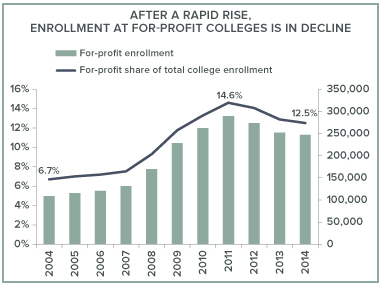
Increased demand for postsecondary education in California has contributed to dramatic growth in enrollment at for-profit colleges. But in recent years, this trend has begun to reverse. Many students who saw for-profit colleges as a viable alternative to public and private nonprofit institutions are in debt and without a degree, and some for-profit colleges are now the focus of state and national investigations, lawsuits, and sanctions.

California is home to almost 400 private, for-profit postsecondary institutions that are eligible to participate in federal financial aid programs. These colleges vary widely in size and mission, from small independent vocational schools enrolling only a few dozen students to large national chains that enroll thousands and offer graduate as well as bachelor’s degrees. Altogether, for-profit colleges make up more than half of all postsecondary institutions in the state and enroll one in eight postsecondary students.

Enrollment at for-profit colleges in California almost tripled between 2004 and 2011, growing from 109,000 students to 289,000 students (as measured by full-time equivalent enrollment). Over the same period, enrollment in other colleges changed very little (increasing only 12%). By 2011, one in seven college students attended a for-profit institution. For-profit colleges enrolled more students than the University of California system and all private nonprofit colleges in the state.

But since 2011, enrollment in for-profit colleges has declined by more than 40,000 students, a 15% drop. Every sector of for-profit colleges experienced declines, with the sharpest reduction (29%) occurring among two-year institutions. Meanwhile, public and private nonprofit colleges saw slight enrollment increases during this same time frame.

What accounts for the rise and fall of enrollment at for-profit colleges?

Certainly, students were attracted to the easy access and convenient course times that for-profit colleges offered—something that other colleges can and have been learning from. But investigators have also found that a number of for-profit colleges engaged in predatory marketing practices, targeting vulnerable students and making false promises about job placement. Such practices may have helped enrollment growth at first, but as these practices became more well-known, and as regulatory and legal actions became more widespread, enrollment began to decline.

The decline also coincides with restrictions on institutional eligibility for the state’s large financial aid program, Cal Grants. In 2011, institutions with a high share of students receiving federal loans were required for the first time to meet minimum standards for graduation rates and loan default rates for their students to remain eligible for Cal Grants. In 2014, only 40 of the 383 for-profit colleges in California met these standards and remained eligible for Cal Grants. Enrollment declines were smaller (9%) at the for-profit colleges that retained Cal Grant eligibility. (Students at colleges that do not meet the minimum standards for Cal Grant eligibility can still receive federal financial aid.)

The future of for-profit colleges is uncertain. In the near term, enrollment losses are likely to continue. Though not yet available, 2015 enrollment data will show further declines due to the closing of Corinthian Colleges, the parent company for Heald, Everest, and WyoTech colleges, in California. Those institutions enrolled over 15,000 students in fall 2014.

Meanwhile, the US Department of Education has taken aim at the Accrediting Council for Independent Colleges and Schools (ACISC), the largest accrediting agency of for-profit colleges in the nation. Continued actions such as this one could eventually lead to a loss of accreditation and hence federal funds for hundreds of for-profit institutions nationwide. Without federal funding, many for-profit colleges would be unable to operate, leading to further enrollment declines.

Chart source: Integrated Postsecondary Education Data System (IPEDS), fall full-time equivalent enrollment in California.

Learn more

Visit the PPIC Higher Education Center

Increasing On-Time Graduation Rates in Hawai‘i


This post is part of an occasional series examining how California can learn from policies in other states.

While 57 percent of students at California State University (CSU) earn a bachelor’s degree, only 19 percent of first-time freshmen graduate in four years. Taking longer to graduate increases the cost of the degree and delays entry into the workforce.

One reason students are not graduating in four years is because they are not taking a full course load of 15 units—about five classes—per term. For financial aid purposes, students are considered full-time if they enroll in 12 units per term—about four classes. But taking 12 units means taking an extra year to graduate. Students have many reasons for taking less than a full load: family obligations, employment, inadequate preparation for the rigor of college courses, or the cost of extra books. It is also possible that students do not realize they need 15 units per term to graduate in four years. UCLA’s Cooperative Institutional Research Program found that 86 percent of freshmen nationwide believe they will graduate in four years, but only about 55 percent actually do so. CSU may be able to learn from 15 to Finish, a campaign adopted by the University of Hawai‘i in 2011 to increase student enrollment in 15 units per term and increase their four-year graduation rates.

Policy: University of Hawai‘i’s 15 to Finish Campaign

In 2010, the University of Hawai‘i system (UH) launched the Hawai‘i Graduation Initiative (HGI) to increase college participation and completion. One of HGI’s strategies is a 15 to Finish campaign to encourage university and community college students to enroll in 15 units a term so they can graduate in four years. Other HGI strategies include creating block or cohort scheduling so that groups of students take the same courses together; reducing summer tuition; and developing academic roadmaps to help freshmen plan their course sequences to graduate on-time. The 15 to Finish campaign’s communication strategy highlights the need to take 15 credits per term and the benefits of graduating in four years in television commercials, informational handouts, and student orientations. It also markets the additional three units as “free” because tuition is the same for 12 and 15 units.

Policy Impact

The early results of UH’s 15 to Finish campaign look promising. Between 2011 and 2013, enrollment in 15 units per term rose by about 5 percentage points, to 25 percent of the UH student population enrolled in 15 units. More important, the system’s four-year graduation rate has risen 7.2 percentage points since the graduating class of 2012, to 25 percent. At CSU, the four-year graduation rate has improved just 2.9 percentage points, to 19 percent, over the same period.

Lessons for California

CSU’s 2015 Graduation Initiative was successful in raising six-year graduation rates. As the system launches a new 2025 Graduation Initiative, which focuses in part on increasing four-year graduation rates, campuses should consider implementing a media strategy to inform students about the three “free” units per term that will help them graduate on-time. One campus, Cal State LA, has already started: it launched a 15 to Finish campaign in August 2015, in anticipation of its transition to a semester calendar.

A system-wide 15 to Finish campaign could also persuade some campuses to stop discouraging students from taking 15 units if they work. It would be more helpful for campuses to inform students they need 15 units a semester to graduate in four years and give them estimates of the number of homework hours created by this course load, so they can make their own decisions about how many units to take each term.

This kind of messaging could also help UC and the community colleges increase on-time completion rates. It could be a relatively simple way to create more room for new students and increase the number of college graduates in our state.

Learn more

Visit the PPIC Higher Education Center

Does Free Community College Grow Enrollment?

This post is the first in an occasional series examining how California can learn from policies in other states.

Tuition-free community college has garnered increasing political support over the past two years. In his recent budget requests, President Obama proposed legislation entitled America’s College Promise to make community college free nationwide. Three states—Oregon, Minnesota, and Tennessee—already have free community college programs, while nine more are considering legislation to create similar programs.

Supporters say that making community college more affordable will increase enrollment and graduation. But will free community college increase overall college enrollment, or will it merely shift enrollment from four-year colleges to two-year colleges?

Policy: Tennessee’s College Promise
Tennessee’s College Promise program—the model for the federal America’s College Promise program—offered its first scholarships to students starting college in the 2015–16 academic year. This program is part of a larger effort to increase the state’s percentage of college graduates from 32% to 55% by 2025.The program provides “last-dollar” scholarships that cover the remaining cost of tuition after a student has used all other available federal, state, and local grant and scholarship aid. Funded by state lottery revenues, Tennessee’s College Promise program will cost an estimated $12 million and provide scholarships to nearly 15,000 students in its first year.

Policy Impact
Initial results suggest that free community college may shift enrollment, rather than growing enrollment. According to an article in the Tennessean, community college enrollment rose by nearly 14% following the program’s implementation, while enrollment at the state’s public four-year institutions decreased. At the University of Tennessee at Martin, enrollment declined by 13% in one year. The University of Tennessee at Chattanooga also saw declines in freshmen enrollment, while two nearby community colleges saw dramatic increases.These preliminary results run counter to national trends, which have shown a shift in enrollment away from community colleges to public four-year institutions since 2010.

Lessons for California
California’s community colleges play an essential role in our higher education pipeline. They often serve non-traditional and underserved minority students, and provide workforce training to help students ascend the economic ladder. If providing free community college increased enrollment and graduation, this could lead to higher earnings, more tax revenue, and reduced demand for social services in the state.

But there’s a chance the policy could limit degree production. According to our research, students who begin their postsecondary career at a four-year college are much more likely than those who enroll at a community college to earn a bachelor’s degree, even when controlling for student characteristics. For example, students from low-income families who begin at a four-year college are, on average, two to three times more likely to finish their bachelor’s degree, regardless of their high school GPA.

Other approaches to making college more affordable might have a bigger impact. In California, two-thirds of students already receive free tuition, and about 90% of the cost of attending community college comes from living expenses. Increasing state awards for non-tuition educational costs would be a logical step to improve student access and educational attainment. The Cal Grant B access award currently provides low-income students with up to $1,656 to help pay for items like books, housing, and food. If funding for this award, which started in 1969–70, had kept up with inflation, it would currently by worth over $6,000, nearly four times its current value.

Compared to other states, California ranks 47th in sending our high school graduates to four-year colleges. Improving access and affordability is vital, but California should make sure that policies also increase students’ likelihood of earning a bachelor’s degree, so that more individuals have the opportunity to realize the myriad benefits—economic and otherwise—that these degrees confer.

Figure source: Author’s calculations based on logit regression models using College Futures Foundation student data. Students followed for six years. Data and methods available in Technical Appendix A of the report Making College Possible for Low-Income Students.

Learn more

Visit the PPIC Higher Education Center

Video: Improving Graduation Rates at California State University

California State University (CSU), the nation’s largest university system, has steadily improved graduation rates, but there is more work to be done, PPIC researcher Jacob Jackson told a Sacramento audience last week.

The system still struggles with graduation gaps. Historically underrepresented students are much less likely than their peers to get degrees. Even though the system has higher six-year graduation rates than similar universities, it lags behind in the share of students who graduate in four years. This comes at a high cost to both the state and CSU students.

As CSU launches a new initiative to improve graduation rates, Jackson and fellow PPIC researcher Kevin Cook coauthored a report analyzing the system’s progress to date. The authors also describe promising strategies that could help CSU reach its goal of increasing graduation rates and cutting graduation gaps in half by 2025.

Learn more

Read the report, Improving College Graduation Rates: A Closer Look at California State University
Visit the PPIC Higher Education Center

Testimony: Closing California’s Workforce Skills Gap

Hans Johnson, director of the PPIC Higher Education Center and PPIC senior fellow, testified before the Assembly Budget Subcommittee Number 2 on Education Finance in Sacramento yesterday (May 17, 2016). Here are his prepared remarks.


The Public Policy Institute of California (PPIC) projects that between now and 2030 California will fall 1.1 million bachelor’s degrees short of workforce demand.1 Closing this gap will require substantial improvements in access to four-year colleges, transfer rates from community colleges, and completion rates among students who enroll in college. In this testimony, PPIC identifies specific goals for access, transfer, and completion at California’s public colleges and universities, and increases in private colleges that together could close the workforce skills gap.

Our work on this issue emphasizes that closing the workforce skills gap will require strong improvements in college enrollment and completion among underrepresented groups, including low-income students, first-generation college students, Latinos, and African Americans. California cannot succeed economically unless gaps in educational attainment are eliminated or at least substantially reduced. A forthcoming report from PPIC will show how new goals for access, completion, and transfer will improve equity in California.

In our baseline scenario, which is based on current practices and procedures, California’s public and private higher education institutions will produce 3.1 million bachelor’s degrees between 2015–16 and 2029–30. This baseline scenario assumes that the state’s college enrollment rates, completion rates, and transfer rates will remain at current levels.

Our “closing-the-gap” scenario charts a course to producing 4.2 million bachelor’s degrees over the next 15 years. In this scenario, the total number of bachelor’s degrees awarded in 2029–30 would be 60 percent higher than in the baseline scenario—and it would be 72 percent higher than the number of degrees awarded in 2014–15. Such dramatic increases are not entirely without precedent. Between 2002–03 and 2014–15, the annual number of bachelor’s degrees awarded by California’s public and private universities increased almost 50 percent. Gains in earlier periods were even more impressive. For example, between 1964–65 and 1979–80 the number of bachelor’s degrees awarded at CSU increased 95 percent.

In the recent past, growth in the number of bachelor’s degrees awarded at UC and CSU was fueled primarily by increases in the number of students who enrolled in college and secondarily by increases in completion rates. Even though the share of high school graduates entering UC and CSU did not change appreciably, enrollment increased as the number of high school graduates grew.

The California Department of Finance projects that the number of high school graduates will not change substantially over the next fifteen years. This means that increasing the number of bachelor’s degrees awarded will require changes in three key thresholds in the education pipeline from high school to college to degree.

  • First, the share of recent high school graduates eligible for and enrolling in four-year colleges will need to increase.
  • Second, persistence and completion rates for students enrolled in college must increase.
  • Third, the number of students who transfer from community colleges to four-year colleges (or return to college) must increase.

The exact mix of improvements in these three areas is not set in stone. Our closing-the-gap scenario is based on empirical trends, and our current focus is on public institutions. We assume that private colleges will keep pace with those in the public sector, continuing to produce about a third of all bachelor’s degrees awarded each year. Also, we have not incorporated applied bachelor’s degrees awarded by the state’s community colleges, as those numbers are still very small. This means that UC and CSU together would need to produce an additional 730,000 bachelor’s degrees over this period and private colleges would need to produce an additional 340,000 bachelor’s degrees (a total of 1.1 million) to fully close the degree gap by 2030. Private nonprofit colleges would account for the vast majority of the additional degrees awarded by the private sector.

Our initial closing-the-gap scenario sets the following targets for the state’s public colleges and universities:

  • Eligibility will increase 5 percentage points over current levels at UC (the top 17.5 percent of high school graduates will be eligible for UC, up from the 12.5 percent share set by California’s Master Plan for Higher Education) and 6.7 percentage points at CSU (the top 40 percent will be eligible for CSU, up from the top third). These new eligibility levels will be phased in over an eight-year period.
  • The number of transfer students will increase 35 percent over baseline levels. These increases will be phased in over a five-year period.
  • Completion rates will increase 9 percentage points at UC and 17 percentage points at CSU. At UC, completion rates for students who enroll as freshmen will increase incrementally from 83 percent in 2016 to 92 percent by 2026. Completion rates for freshmen at CSU will increase incrementally from 57 percent in 2016 to 74 percent by 2030. There will be similar increases in completion rates for transfer students at both institutions.

CSU will account for most of the increase in degrees awarded over the entire projection period—it will award 481,000 additional degrees, compared to UC’s increase of 251,000. This is both because CSU is a larger institution, enrolling many more students than UC, and because CSU has much more room for improvement in graduation rates. Private nonprofit colleges would also play an important role, adding an additional 206,000 degrees. Other additional sources, such as private for-profit colleges, online degree programs, and bachelor’s degrees awarded by community colleges, will also need to play a role (see Table 1).

Most of the projected increase in degrees awarded at CSU comes from improvements in completion, while increased eligibility accounts for almost half of UC’s increase. Increased transfer rates will also be necessary to close the gap (see Table 2).

Of course, this is just one scenario for closing the workforce skills gap (our interactive model is available upon request). In the future, we expect to develop alternative closing-the-gap scenarios; we will also examine the potential impact of shortening the time it takes students to get their degrees. Additional work should assess the role that private institutions might play. Other scenarios might involve different assumptions and targets. But, however it is accomplished, closing the gap will lead to better economic outcomes for all Californians, increased state revenues, and reduced social service demands.

1. Hans Johnson, Marisol Cuellar Mejia, and Sarah Bohn, Will California Run Out of College Graduates? (PPIC, 2015).
Figure note (middle): “Other” includes online degrees, private for-profit degrees, and applied bachelor’s degrees awarded by the community colleges.
Photo credit: Public Affairs/Sacramento State

Assessment and Placement at Community Colleges

The assessment and placement process often represents the first point of contact between incoming students and community colleges. This process aims to evaluate students’ readiness for college-level English and math courses, and for those deemed underprepared, to determine appropriate placement into the remedial—also known as developmental—education sequence. Estimates suggest that 75%–80% of incoming community college students across the state enroll in developmental education in at least one subject.

Despite the prevalence of this process, little is known about how the state’s community colleges assess and place students into math and English courses. The last statewide survey on this topic, conducted over five years ago by WestEd, found that community colleges used placement tests extensively, but the cut-off scores for placement varied a great deal across campuses. Additionally, the survey showed that the use of other student achievement measures for placement was sparse and unsystematic.

Greater clarity regarding assessment and placement is crucial for two reasons. First, decisions made about a student’s readiness for college have significant implications for that student’s educational trajectory. In California’s community colleges, only 40% of underprepared students ever complete a degree or transfer, compared to 70% of their college-prepared peers. Research shows that developmental education may discourage students or “divert” their academic progress, as students spend considerable time and money on developmental courses, but these credits do not count toward a college degree or transfer.

Second, the possible overreliance on placement tests may be cause for concern. The Community College Research Center has found that the placement tests commonly used at colleges across the country are not strongly predictive of student success in college-level courses. In fact, these tests tended to under-place students, meaning students were placed into developmental courses when they could have passed college-level courses. This research also demonstrated that high school grades and other pre-existing student achievement data could do a comparable or better job at predicting success in college-level courses.

More comprehensive research in these areas would allow the state’s community colleges to identify assessment and placement reforms that help improve outcomes for all students. As a step forward in this effort, the Public Policy Institute of California (PPIC) is collecting survey data on the current assessment and placement policies and practices at California Community Colleges. These survey results will help pinpoint the different measures used to assess the math and English skills of incoming students and the ways in which these measures determine appropriate placement.

This research comes at an important time, since more change is underway. As part of the Common Assessment Initiative, over the next several years, community colleges will begin to use a common placement test, set locally determined cut-off scores, and enhance their use of multiple measures. PPIC’s survey will establish a benchmark of the assessment and placement process prior to the implementation of these statewide reforms.

Video: Challenges and Opportunities for Higher Education

This is a critical time for higher education in California. Higher education matters to Californians, who are applying to the University of California (UC) and California State University (CSU) in record numbers. It also matters to the state, whose future prosperity depends on an educated workforce. And California can—indeed, must—do more to increase the number of college graduates. That was the message at the launch of the PPIC Higher Education Center presented by Hans Johnson, center director and PPIC senior fellow.

There is much to be done in the three areas the PPIC Higher Education Center will focus on, Johnson said, providing examples in each one:

  • Access: California ranks 47th in the nation in the proportion of high school graduates who go directly to a four-year college.
  • Outcomes: Fewer than half of community college students ever earn certificates or degrees—or transfer to a four-year institution. Fewer than 60% of CSU students earn bachelor’s degrees.
  • Finance: Tuition at CSU and UC is at an all-time high. California faces the ongoing challenge of figuring out how to fund the higher education system.

But Johnson said he is optimistic. The public systems are adopting innovative strategies, and there is increased interest—on the part of the public and the legislature—in higher education.

Following Johnson’s presentation, Kevin de León, the state senate’s president pro tem, and Janet Napolitano, University of California president, discussed a range of issues in a conversation with Mark Baldassare, PPIC president and CEO. The speakers sounded similar themes.

Both de León and Napolitano emphasized the need to better fund public higher education and expand access at a time when a diverse group of Californians is coming of age. The leaders were asked about their reactions to a highly critical state audit of UC, which concluded that the university hurt California high school graduates by admitting too many out-of-state applicants.

De León said the findings were not surprising, given funding cuts by the state: “When you make deep cuts and when you shortchange California students, in particular, these are the consequences.”

Napolitano said that after the state made deep cuts in UC’s budget, the university had no good options: it could have reduced enrollment slots for California students, raised tuition even more than it did, or brought in more out-of-state and international students. UC chose the latter. She urged Californians—particularly in the legislature and the executive branch—to take a step back.

“Those decisions were made, they had to be made,” she said. “You have to make the best of a bad situation. Now, what do we do together moving forward and what is our collective vision?”