Understanding the New Federal Water Law

A new law signed by President Obama in December alters federal water policy in the Sacramento–San Joaquin Delta. These changes are complicated, and their likely effects on both future water supply and environmental stewardship are largely unknown.

The legislation is part of the Water Infrastructure Improvements for the Nation Act, which authorizes water-related investments around the United States. It includes funding for an array of projects in California, such as flood protection in the Sacramento Valley, watershed restoration and water quality improvements in the Lake Tahoe Basin, infrastructure for water recycling and desalination, and new surface water supply projects. It also includes funds for new fish hatcheries, acquisitions of water and land to support aquatic habitat, and programs to control invasive species that exacerbate the threats to endangered species. Before these projects can receive these federal dollars, Congress will also have to appropriate funding for them.

The most controversial aspect of the new law is a change in the way federal fisheries agencies must balance water supply for farms and cities with protection of endangered fish species in the Delta—including the Delta smelt and most species of salmon and steelhead. Under the authority of the Endangered Species Act (ESA), these agencies write “biological opinions” about how the projects must operate to minimize harm to ESA-listed species. The biological opinions that currently govern the operation of the federal Central Valley Project (CVP) and California’s State Water Project (SWP) prescribe a flexible range of allowed water exports. The new law requires the agencies to revise several terms of the biological opinions to “provide the maximum quantity of water supplies practicable” to CVP and SWP contractors “without causing additional harm to the protected species.”

Proponents of this change believe that the existing biological opinions require the projects to leave more water in the Delta than the fish need for their survival, especially during periods of high flows. Opponents believe that the legislation will add to the accumulating stresses on the fish and increase their risk of extinction. The actual benefits and risks of the operational changes are difficult to predict.

The amount of additional water the new law will make available to CVP and SWP contractors is uncertain—though it is likely to vary considerably with hydrologic conditions. We estimate that the projects may have been able to export several hundred thousand acre-feet of additional water during high flow periods in 2016—a year with average precipitation. However, it is unlikely that significant additional water would be made available during dry years—such as 2014 and 2015—when water supplies are especially scarce. In such years, most of the uncaptured flows through the Delta are needed to repel salinity and protect the quality of the water that is exported to farms and cities.

The risk of the new legislation to endangered fishes is also unknown. The existing biological opinions allow for flexible responses to account for rapid changes in water flows and temperature, information about fish locations, and new knowledge about how water supply operations affect fish. This flexibility acknowledges the uncertainties inherent in protecting endangered species in a complex and highly variable Delta ecosystem. By removing this flexibility, the new law has the practical effect of removing the margin of error in a complicated and error-prone system.

The latest drought has shown that removing flexibility in how we manage water for vulnerable species can increase the risk of extinction. How the fisheries agencies will strive to maximize water exports while avoiding additional harm to the protected species is an open and vexing question. Much depends on how the new federal administration chooses to interpret and administer the new law. And, as is often the case in California water policy, much depends on the inevitable legal challenges to its implementation.

This post was revised on January 27, 2017.

Learn more

Read a Statement by President Obama on the Water Infrastructure Improvements for the Nation Act
Read California’s Water: The Sacramento-San Joaquin Delta (from the California’s Water briefing kit, October 2016)
Visit the PPIC Water Policy Center’s Delta resource page
From Drought to Deluge

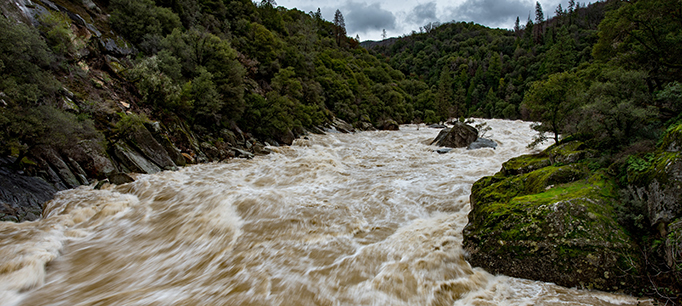
The recent change in the weather is prompting many Californians to shift their worry over drought to fretting about floods. That’s an understandable response to California’s volatile climate, which is the most variable in North America. Most notable this year is the return of atmospheric rivers—river-like bands of moisture that periodically stream into California, often from the tropics. These storms are responsible for most of our large, devastating floods. They are also critical for our water supply, providing roughly half of our precipitation in normal and wet years. When atmospheric rivers don’t occur, we usually have a drought.

Here are a few key takeaways from this welcome stretch of wet weather:

  • This is likely to be the end of the surface-storage drought for most of the state. In other words, by next week almost all the major reservoirs will be at or above their seasonal averages (there’s a good summary here)—conditions we have not seen in six years. This is great news since reservoirs are the primary source of water for cities and farms.
  • Many multipurpose reservoirs—those that supply water, hydropower, and flood storage—are well above historic averages. To maintain their flood management capacity for future winter storms, these reservoirs are required by federal rules to release large amounts of water, which is why so many rivers below dams are running high.
  • It is reasonable to be optimistic that our reservoirs will fill this spring. We rely on melting snowpack to top up reservoirs in the spring and to provide roughly a third of the state’s water supply in an average year. The warmth of the weekend storms washed away some of this snowpack, particularly in the middle elevations of the Sierra Nevada (5,000–7,000 feet). Still, higher elevations accumulated a great deal of new snow with these storms, and more than two months remain in the winter snow season.
  • One wet year is not a drought buster. During the height of the drought, the state’s farmers and others turned to groundwater pumping to make up for surface water shortages. The water deficit in our aquifers is now immense. For example, in 2014 and 2015, surface water supplies to farmers in the Central Valley were cut nearly in half, causing them to make up most of this reduction through additional groundwater pumping or land fallowing. It would take many successive wet years—and more intentional groundwater capture and storage—to restore aquifers to the condition they were in before the onset of drought.

The wet beginning to 2017 is a welcome relief from the past five dry years. Full surface reservoirs take pressure off water users and water regulators. But the rains did not wash away California’s major water challenges. There are big decisions ahead—many to be made this year—about how to sustainably manage groundwater, improve storage, resolve the problems of the Delta, and arrest the decline of our native fish and wildlife. Maintaining momentum on these issues is as critical now as when the reservoirs were low.

Learn more

Read California’s Water (PPIC briefing kit, October 2016)
Visit the Policy Priorities for California’s Water YouTube page
Visit the PPIC Water Policy Center flood resources page

Photo by Carson Jeffres


A State of Water Independence

The presidential election has raised questions about how changes in federal environmental policy could affect California’s water resources management. Concerns include the potential loosening of endangered species protections and changes to federal regulatory jurisdiction under the Clean Water Act. These questions are especially pronounced in California, where the United States is both an environmental regulator and operator of several of the state’s largest water projects.

While there are areas of uncertainty, California’s water rights and environmental laws are both robust and comprehensive, and thus will provide something of a firewall to changes in federal policy. Although many of these laws apply in tandem with their federal counterparts, California’s laws are also largely independent of federal environmental standards. Here are a few examples.

Reasonable use and the public trust: The California Constitution’s “reasonable use” requirement and the state’s public trust doctrine recognize a strong and continuing public interest in protecting the ecological integrity of the state’s waters. In 2009, the California Legislature declared that these principles “shall be the foundation of state water management policy.”

Water rights: The State Water Board has permitting authority over a majority of surface water rights, including those for the federal Central Valley Project (CVP) and California’s own State Water Project (SWP). These projects supply water to more than 25 million residents and businesses across the state and to almost four million acres of farmland in the Central Valley. Permit conditions require the projects to release water from reservoirs and to limit pumping from the Delta to protect water quality, fish and wildlife, and other instream uses throughout the Sacramento–San Joaquin Delta ecosystem.

Federal law directs the US Bureau of Reclamation to operate the CVP in compliance with all requirements of California law, including conditions in its water rights permits. This is an important mandate because CVP operations are coordinated with the SWP, and the two projects’ water supply and environmental stewardship functions must be synchronized.

The bureau also controls the distribution of water diverted from the Colorado River for agricultural and urban uses in Southern California. Although federal law generally governs, the State Water Board has significant authority over the use of this water through its constitutional authority to prevent waste and unreasonable use.

Water quality: The State Water Board and the nine Regional Water Quality Control Boards also set water quality standards and issue permits governing discharges of pollutants. California’s water quality laws implement the federal Clean Water Act, but they also function independently. California often sets stricter pollution limits than required under federal standards, and the state permitting system applies more broadly than its federal counterpart (covering discharges to groundwater, for example). Equally importantly, California’s water quality laws do not depend on the Clean Water Act for their existence and would continue even if significant changes are made in federal law.

California’s authority to protect its water resources will be largely insulated from changes in federal environmental policy.

Stream flows: In addition to the State Water Board’s power to protect stream flows through water quality standards and the reasonable use and public trust doctrines, the California Fish and Game Code compels all dam operators to release water to support fish. In litigation to restore flows and salmon to the San Joaquin River, the federal courts ruled that this law applies to the CVP.

Endangered species: The California Department of Fish and Wildlife has extensive authority to protect vulnerable species under the California Endangered Species Act. Although the state statute is more limited than its federal counterpart, it does prohibit the unauthorized “taking” of protected species. If federal endangered species policy were to change, the department could use this authority to place conditions on water project operations to prevent or minimize harm to state-listed species. The department also could expand the list of state-protected species to fill any gaps created by federal policy changes.

Wetlands: The federal government has extensive jurisdiction under the Clean Water Act to regulate activities that may alter wetlands, and the state and regional water boards often implement this federal law. But California also has independent authority to protect wetlands through discharge permits and land use regulations. This regulatory authority would continue even if, as expected, the new administration reduces the scope of the federal wetlands rules.

In light of these laws, California’s authority to protect its water resources will be largely insulated from changes in federal environmental policy. Of course, Congress could amend the statutes that require federal compliance with California law. But such a change would contradict a long history of federal deference to state water rights law and support for state administration of water quality protections.

These policies reflect Congress’ understanding of the benefits of comprehensive and integrated water resource management and its recognition that the states are best suited to decide how to allocate and manage water in light of local conditions and local needs. Indeed, in the recent federal legislation that changes endangered species management in the Sacramento–San Joaquin Delta, a large and bipartisan majority in both houses of Congress reconfirmed the United States’ continuing “obligation to act in conformance with applicable state law, including applicable state water law.”

Going forward, it would be extraordinary for Congress to depart from this foundational policy.

Learn more

Read California’s Water (PPIC briefing kit, October 2016) and Managing California’s Water: From Conflict to Reconciliation (PPIC 2011).
Visit the PPIC Water Policy Center’s water quality resource page.

A Water Sector Energy Hog

When we use water, we’re also using energy—sometimes a little, sometimes a lot. Overall, water use accounts for about 20 percent of California’s electricity use and 30 percent of natural gas used by businesses and homes. This energy is used to supply, convey, treat, and heat water.

Where does it all go, and more importantly, how can we best save both water and energy?

You might guess that our long-distance transport of water through the state’s network of canals and pumping stations is a big energy hog. The federal and state water projects combined move about a quarter of all water used in California. The State Water Project—which conveys water from the Sacramento–San Joaquin Delta to cities and farms in the San Joaquin Valley, the Central Coast, and Southern California—is the largest single user of electricity. But even so, the state’s water conveyance system is something of an energy sipper, accounting for just 4 percent of the sector’s total energy use.

Or maybe you’d assume that California farmers—who use about four times more water than the state’s urban areas—use the most water-related energy. But even though farmers pump some 10 million acre-feet of water in an average year, they use just 5 percent of California’s water-related energy.

Have you guessed it yet? Hint: The state’s cities, especially California households and industries, use by far the most water-related energy—and much of it goes down the drain.

Heating water is the most energy-intensive water-related activity. Some residential “end uses” of water—faucets, showers, and clothes washers—are energy hogs, accounting for 42 percent of all energy used in the water cycle. And in total, the residential, industrial, and commercial end uses of water account for more than 85 percent of energy used in the water sector. By comparison, supplying, pumping, and treating urban water make up about 5 percent. 

Reducing the energy footprint of the state’s water cycle will require more reductions in hot water use.

A recent study, which looked at the energy use of supplying, pumping, and treating water, estimated that the energy savings resulting from drought-related urban water conservation to date has equaled the combined savings of all energy efficiency programs offered by the state’s major energy utilities. The study did not account for water heating or other energy-intensive uses of water.

California has been a leader in energy efficiency for many years. Its efforts include reducing energy use of washing machines and dishwashers—which together still use less energy than showers. Last year, the state’s energy commission adopted new standards (which went into effect this summer) that will cut water flow in showerheads by 20 percent. The move is expected to save more than 2.4 billion gallons a year in the first year—and enough energy to power more than 200,000 homes for a year.

To further reduce the energy footprint of the state’s water cycle, it would be most effective to continue to target reductions in hot water use. This can be done by changing our habits (such as decreasing water heater temperatures), improving water-heating efficiency, and reducing the energy intensity of some industrial processes.

Saving energy in the water sector also reduces greenhouse gas emissions—nearly 10 percent of the state’s emissions are directly associated with water use. California plans to reduce its emissions 40 percent below 1990 levels by 2030, and the water sector can provide some of the most cost-effective ways to meet that goal.

But as always in California’s water management, there is no one-size-fits-all solution. Local assessments—with state agencies’ support—are needed to evaluate cost-effectiveness of various solutions locally and across regions. The state could then use these assessments to devise a statewide plan for reducing the water sector’s energy consumption and greenhouse gas emissions.

Learn more

Read California’s Water: Energy and Water (from the California’s Water briefing kit, October 2016)
Visit the PPIC Water Policy Center

Making the Groundwater Law Work

California was one of the last western states to regulate the use of groundwater. Now, the state’s landmark law mandating sustainable use of this critical resource is significantly changing how communities manage it. We talked to Thomas Harter—a groundwater expert at UC Davis and a member of the PPIC Water Policy Center’s research network—about implementing the 2014 law, which he calls “the most important water legislation in 50 years.”

PPIC: What are the key components of groundwater sustainability?

Thomas Harter: The state law is based on six “commandments” that interpret what groundwater sustainability means: thou shall not draw down water levels too far, deplete storage in the aquifer, degrade water quality, allow seawater intrusion, cause land to subside, or use groundwater in ways that reduces other people’s surface water or harms ecosystems.

The law mandates that groundwater must be sustainably managed for the long run. It’s not an option. Another critical piece of the law is that it be managed locally. This is an opportunity for local agencies, water districts, and stakeholders to take charge of whatever needs to be done.

Another important aspect is having everyone around the table who’s benefiting from, using, or concerned about groundwater. Stakeholders may have to make decisions on how to augment their groundwater supplies or how to reduce demand to make local use sustainable. People are going to come to the table with different core issues—for example, some will be more concerned about protecting domestic water users, while others will be focused on the economic impacts of using less groundwater.

PPIC: What more do we need to know about our groundwater basins to better manage them?

TH: We have to understand the resource, and how our uses affect it. What are water levels doing? Are we degrading the quality of groundwater? Is it being used or managed in ways that harm surface water uses and users? That kind of basic understanding is really important.

There are some important things we need to know about the state of our groundwater that the state could play a role in, which would help locals bring their basins to sustainability.

First, the state has a responsibility to monitor land subsidence across California, as sinking land is one of the key indicators of unsustainable conditions. We need more consistent measurements to determine how fast land is subsiding. The state would be in the best position to collect this data, and make it useable and accessible to local groundwater sustainability agencies.

The state is also in the best position to collect data on land use and evapotranspiration, which is a measure of how much water plants use. Evapotranspiration is one of the biggest water budget components in the state and the largest single consumptive use. In other words, it is water that is removed from the water system through use or evaporation by plants, consumed by people or animals, or incorporated into products or crops. Having a high-resolution understanding of evapotranspiration and how it changes over time and across years will be critical to ensure we have accurate water budgets.

California also needs to get back to more frequently mapping land use across the state and make that data available. Land use is closely related to evapotranspiration. To devise an accurate water budget, you need to know which field is planted in which crop at which time of year, which areas are being urbanized, and where other changes in land use are occurring.

The state’s system for gauging streamflow also needs work. To make good decisions, locals need a better understanding of the contributions of groundwater to their tributary streams. The US Geological Survey and the Department of Water Resources, which manage these gauges, are struggling to keep up with the network they have, and many gauges have been discontinued due to lack of funding. We need to fund ongoing maintenance of this water-monitoring network so we don’t lose a legacy of valuable information. And we need to expand it in areas where groundwater and surface water are closely connected.

PPIC: What changes do you expect to see as communities move to implement the groundwater law?

TH: I think the biggest thing is that, at the local level, we’ll have a much broader stakeholder group informed about and engaged in their groundwater system. There will be greater understanding about the interconnections between land use, groundwater, surface water, and water supply and quality, and about the kinds of projects we can do to address sustainability issues. I hope that in 10 years we’ll have a better understanding of how we can transition to sustainable resource management with the least amount of economic pain. I think there are opportunities for creative solutions that are win-wins for the environment and people dependent on groundwater resources. I also think that having a better understanding across stakeholder groups will lead to increased cooperation, which will be important for implementing and funding solutions.

Learn more

Watch “Implementing the Sustainable Groundwater Management Act” (PPIC event video, Oct. 18, 2016)
Read “Reforming California’s Groundwater Management” (PPIC fact sheet)
Visit the PPIC Water Policy Center’s water supply resource page

Commentary: A Grand Compromise for the Delta


This commentary was published in the Sacramento Bee on December 2, 2016

Conflict over water allocations from the Sacramento-San Joaquin Delta is the most intractable water management problem in California. The sources of contention are many, but three interrelated issues dominate the debate: whether to build two tunnels that divert water from the Sacramento River, how much water to allocate to endangered fish species, and what to do about the 1,100 miles of Delta levees that are essential to the local economy. Here we outline a potential “grand compromise” for the Delta that meets the co-equal goals of water supply reliability and ecosystem health prescribed by the 2009 Delta Reform Act.

Read the full commentary on sacbee.com.

Learn more

Read California’s Water: The Sacramento-San Joaquin Delta (from the California’s Water briefing kit, October 2016)

Visit the PPIC Water Policy Center’s Delta resource page

 

California’s Changing Headwaters

Much of the state’s water supply originates in forested headwaters high in the mountains. Yufang Jin is a UC Davis professor specializing in ecosystem change and remote sensing (gathering aerial images of the earth). She is also a member of the PPIC Water Policy Center’s research network. She talked to us about how a warming climate and extreme wildfires are changing these crucial ecosystems.

PPIC: How are large wildfires changing our watersheds?

Yufang Jin: We’re seeing intensifying wildfires in California, especially in the headwater regions where our rivers originate. More intense fires have significantly changed the composition and structure of forest ecosystems, affecting both water quality and quantity—though not always for the worse. For example, large fires can significantly reduce the amount of vegetation covering the land, which reduces the amount of water consumed by plants. Burned areas also have much less water circulating in the soil. Both of these post-fire processes have a positive impact on streamflow, as more water works its way into the water table and streams. But the loss of groundcover plants from intense fires also increases surface erosion, which can cause landslides in the rainy season. Ashes and sediments flowing into streams harm water quality.

PPIC: What are catastrophic fires teaching us about managing forests, wildfires, and water in California?

YJ: They’re pushing us to use management strategies that recognize the relationships between forests, fires, and water supply. In the past most forest management focused on wildfire suppression. There’s now recognition that solely focusing on suppression led to unnaturally dense forests, which in turn led to larger and catastrophic fires. So now there’s a growing effort to use forest thinning and prescribed fires to reduce fire hazards. Some pilot projects indicate that allowing natural fire to thin forests can lead to increases in water quantity in the watershed as well. A lot of federal and state agencies are now emphasizing watershed restoration strategies that bring multiple benefits. They are paying more attention to approaches that reduce fire hazards and may also increase water yields.

PPIC: How will climate change affect the severity of wildfires in California?

YJ: All climate models predict that the warming trend will continue in coming decades, and will often be accompanied by drier conditions. There is consensus that with these conditions, we can expect more severe wildfires across California and in the West more generally. One of our recent studies showed that the average area burned in Southern California could increase 70 percent by mid-century. Another effect of climate change is that forests in the western US will become more vulnerable to drought stress, making them more prone to diseases and beetles, leading to greater tree mortality and more fires.

PPIC: What kinds of technological advances can help us improve watershed management in the state?

YJ: There are two technologies that can provide more informed water management. One is obtaining images from satellites with remote sensors to learn about ecological and hydrological conditions on the ground. The other is using big data analytics and cloud computing, which can help us interpret the huge amount of data you get from remote sensors and translate it into information that farmers and water managers can use and act upon.

Basically, remote sensors can be used to monitor factors like water temperatures, the range of particular plant types, or the amount of water being released from plants. You can observe relatively large areas over time in a cost-effective way. For example, remote sensors can help detect algal blooms and invasive aquatic species throughout the watershed. Water managers can use remote sensing to estimate how much water is being used by crops or by natural vegetation, and how that water use changes from season to season or year to year. It can also help figure out how ecosystems will respond to a changing climate or how changing land use can affect water use. For fire management, remote sensing can track when and where fires occur, how effective fuel treatment projects are in reducing fire severity, and how vegetation recovers after fires.

While there are no simple technological solutions for managing the effect of a changing climate, having tools like these will make it much easier to get the quantitative information that we need to develop adaptive forest and watershed management strategies.

Learn more

Read California’s Water: Protecting Headwaters (from California’s Water briefing kit, October 2016)
Read “Managing Wildfires Requires New Strategies” (PPIC Blog, September 23, 2015)
Visit the PPIC Water Policy Center’s drought resource page

Solutions for the Delta

California asks a lot of the Sacramento-San Joaquin Delta. This vast, watery landscape is expected to be the ultimate multitasker—a major source of water for cities and farms, a critical aquatic ecosystem, and a center for recreation and tourism. No wonder it’s showing serious signs of stress.

At the Bay Delta Science Conference last week, experts gathered to present and discuss the science of the Delta’s many difficult challenges.

Speakers focused on ways to make this science more useful for policymakers, linking data and decisions to come up with science-based solutions, and using them as the foundation for stakeholders to find common ground over contentious issues.

Felicia Marcus, the chair of the State Water Board, said more could be done to ensure that decision makers are engaged by the science they’re presented with. For example, she said the policy process would be improved if scientists made their work more accessible and intelligible, and were less reluctant to make recommendations.

Striking a similar note, Phil Isenberg, former chair of the Delta Stewardship Council and a member of PPIC’s board of directors, called for making research actionable by focusing on solutions instead of just defining the problems. Multiple speakers noted that experts who work in teams that include both natural and social scientists are more successful at providing a path forward for policymakers because of their ability to address tradeoffs and find “win-win” scenarios.

Peter Moyle, one of the state’s top scientists on fisheries and the Delta (and a member of the PPIC Water Policy Center research network), said California needs to emphasize solutions that provide flexibility in management. An ecosystem-based plan of action brings such flexibility, which is one reason he recommends focusing restoration efforts on a specific “arc of habitat” in the north Delta.

The event also honored Jeffrey Mount, senior fellow at the PPIC Water Policy Center, who received the Brown-Nichols Award for his scientific contributions to improving the management of the Delta watershed. His decades of contributions go beyond his work here at PPIC. In addition to longstanding engagement in key policy discussions on Delta challenges and California water more generally, he is former chair of the Delta Science Board and a founder of the Center for Watershed Sciences at UC Davis. While at UC Davis, he was also a coauthor on a number of Delta-focused PPIC reports, including Comparing Futures for the Sacramento San Joaquin Delta (2008), and Stress Relief: Prescriptions for a Healthier Delta Ecosystem (2013), which looks at ways to address multiple ecosystem stressors in the Delta while stressing the importance of considering the science, the institutions, the economics, and the law.

Ellen Hanak, director of the PPIC Water Policy Center, said, “This award serves as an example of Jeff’s ability to use science to improve decisions. The community of researchers, analysts, policymakers, and engaged citizens interested in the future of California water and the Sacramento-San Joaquin Delta is fortunate that he has chosen to devote himself to these issues.”

Learn more

Read California’s Water: The Sacramento-San Joaquin Delta (from the California’s Water briefing kit, October 2016)
Watch our short video on the Delta
Visit the PPIC Water Policy Center’s Delta resource page

Water Trivia Quiz Answers

Yesterday we published a water trivia quiz to ring in the new water year. Today we bring you answers. For each right answer, have a drink of water—you deserve it! (Answer to bonus question: the water year runs from Oct. 1 to Sept. 30, which is the period when precipitation totals are measured.)

  1. What could bring the biggest reduction in water use for a family in a single-family home? B: Removing a lawn would bring the highest water savings. Outdoor landscaping accounts for roughly half of all urban water use, and lawn is the thirstiest piece of that equation, especially in the hotter, dryer parts of the state. Replacing lawn with native plants can reduce water use by up to 60%. But this can be a costly change for households to make.

    Second best would be replacing an old toilet. Toilet flushing accounts for nearly a quarter of water use in the average home. Switching to a high-efficiency 1.28 gallon model can save more than 6,789 gallons per year if you started with a 5 gallon model, and about 4,000 if you had a 3.5 gallon one. Replacing a leaking toilet will bring even greater savings.

    The showerhead is next. Bathing accounts for about 17 percent of household water use, and the US EPA Water Sense program estimates that switching from a standard 2.5 gallon-per-minute showerhead to a 2 gallon-per-minute one can save 2,900 gallons per year (and a significant amount of energy from lower water heating as well).

  2. What was California’s per-capita water use in 2015? B: 130 gallons per day in 2015 (the fourth year of the latest drought). That’s down from 232 gallons per day in 1995. On average, inland residents used more. The reasons: outdoor watering and a hotter climate (their average was 168 gallons per person per day), while coastal residents used just 119 gallons per day.
  3. What causes toxic algal blooms? D: The growing problem of toxic algal blooms is an “all of the above” problem. A combination of nutrient-rich runoff from farms, discharges of treated sewage and urban runoff, and the drought’s warmer water temperatures and reduced river flows, caused numerous algal blooms in our waterways this year.
  4. How much surface water did Central Valley farms receive in 2015 compared to a year with normal rainfall? C: In 2015, surface water deliveries to Central Valley farmers were about half those of a normal year. About half a million acres were fallowed in both 2014 and 2015, costing the farm economy nearly $2 billion, and as many as 10,000 full- and part-time farm jobs. Groundwater pumping replaced about 70 percent of the lost surface water, which worsened the problem of overdrafted groundwater basins in some places.
  5. How was California’s energy supply affected by the drought? D: All of the above. A drop in urban water use brought significant energy savings statewide. Some Central Valley power plants that rely on surface water for cooling faced water shortages. The industry is being encouraged to switch to more reliable recycled water supplies, which is already the cooling source for a third of the state’s power production. California also produced about half as much hydropower during the latest drought compared to normal years; fossil fuels made up most of the drop. The growing problem of California’s “snow droughts” reduces the state’s ability to store water and produce hydropower in summer, when demand is highest. A warming climate will worsen this problem.
  6. Which new water supply would be the least costly to develop? D: While it’s a bit hard to generalize—the answer depends on the local cost of water, geography, and project particulars—the cheapest is likely a conservation program to replace old toilets, showerheads, washing machines and the like, according to a 2016 study by the California Public Utilities Commission. Some efficiency measures can even generate more benefits than costs over their lifetime, according to a recent report by the Pacific Institute. For urban areas located near an aquifer, groundwater recharge is second in terms of cost. For areas with poor access to groundwater basins, the best bet for a new water source may be recycling wastewater and piping it directly into the existing water system (called “direct potable reuse”); the state is currently developing policies that would make this possible. Seawater desalination is likely to remain the most expensive new source for most California communities.
  7. How many of California’s native fish are now at risk of extinction? B: At least 18 of California’s native 122 fish species are now at near-term risk of extinction. The drought’s low flows and high water temperatures add to the effects of dams, water diversions, habitat degradation, and the introduction of non-native species. A total of 90 native fishes are in trouble in one way or the other, with 31 already listed under the Endangered Species Act. The way we manage water leaves our freshwater ecosystems in perpetual drought.

Drought Savvy? Take Our Water Trivia Quiz

The start of the new “water year” has brought mixed messages to drought-stressed Californians—from above-normal rains in the northern part of the state to lingering drought in the southern half. But whether you live in the wet or dry part of the state, everyone can use a refresher course on what the drought means for our water supply. The answers are here. (Bonus question: What is a water year?)

1. Californians have experienced both mandated and voluntary calls for water conservation during this drought. For a family living in an older single-family-home, which of the following could bring the biggest reduction in water use?

A. Replace old showerheads with low-flow ones

B. Remove the lawn

C. Replace an old toilet with a water-efficient one

2. Water use in cities and suburbs has been declining for many years. What was California’s per-capita water use in 2015 (the fourth year of the latest drought)?

A. 175 gallons per day

B. 130 gallons per day

C. 55 gallons per day

3. Toxic algal blooms have become more common in California waterways in recent years, causing lake and beach closures, poisoning pets and sea life, and posing human health risks. What causes them?

A. Warmer water temperatures

B. Nutrients in the water from farms, treated sewage, and urban runoff

C. Lower flows into lakes, wetlands and estuaries

D. All of the above

4. How much surface water did Central Valley farms receive in 2015 compared to a year with normal rainfall?

A. Most farmers received the same amount.

B. They got 25% less—the statewide conservation mandate

C. They got about half of normal allocations

5. How was California’s energy supply affected by the drought?

A. Since it takes energy to supply, treat, and heat water, California households saved significant amounts of energy by using less water.

B. Some inland power plants faced water shortages that threatened their cooling-water supply

C. Hydropower production was cut in half due to reduced snowpack and runoff into reservoirs

D. All of the above

6. To help us address future shortages in urban areas, which of the following new water supplies would be the least costly to develop?

A. Building seawater desalination plants

B. Recharging groundwater with urban stormwater or treated wastewater

C. Making wastewater clean enough to drink

D. Enacting water efficiency programs, such as those to replace wasteful indoor water fixtures and appliances, and thirsty lawns

7. The ongoing drought has pushed many already troubled freshwater species to the brink. How many of California’s 122 species of native fish are now at near-term risk of extinction?

A. 12

B. 18

C. 27