Remaking the Salton Sea

The Salton Sea—California’s largest lake—faces an environmental crisis. The already-shrinking desert lake will receive less water starting next year, which will accelerate the exposure of toxic dust along its shore, increase its already high salinity, and reduce a food source and habitat for hundreds of bird species that rely on the lake.

The sea, which was created by a break in a Colorado River irrigation canal in the 1900s, for decades relied on irrigation runoff from local farms for sustenance. In recent years, the sea received a temporary water source arranged as part of a Colorado River water trading agreement that is sending some irrigation water to cities on the Southern California coast. But these temporary flows are slated to end in January 2018, after which inflows to the lake will decline.

Various proposals to restore the sea over the years were deemed too costly (both in dollars and water). Now, a recently released 10-year plan by the state proposes to address both dust and habitat problems for a price tag of $383 million—down from earlier, longer term restoration plans that were projected to cost as much as $9 billion. The plan will include farm runoff to the sea through a new canal and new bird habitat areas.

We talked to two experts who have a long involvement in trying to resolve this complex water challenge: Fran Spivy-Weber, who as former vice chair of the State Water Resources Control Board was involved in multiple programs to address the sea’s problems, and Lester Snow, who has worked on the sea for more than a decade in his various capacities in the state’s water agencies and most recently on behalf of the Water Foundation. Both are members of the PPIC Water Policy Center’s advisory council.

“For so long, nothing was done. Now there’s a realistic plan that can help guide expenditures,” Spivy-Weber said. “It’s not a gold-plated plan. The state is trying to create something that does the job as cost effectively as possible.”

Dust has been “a sleeping giant of a problem that brings serious public health risks,” Snow said. The region has some of the highest asthma-hospitalization rates in the state, and dust from the sea has worsened already bad air quality. “I believe the lake’s dust problem is now getting the attention it needs, with a number of legislators now focusing on it.”

The plan is to build thousands of acres of shallow ponds to cover the dust-prone exposed shore; these will double as wildlife habitat. In other areas, hillocks will be built to stop blowing dust—an approach that has worked at Owens Lake, which dried up from overuse after its source was diverted to Los Angeles.

Because California has lost nearly all of its riparian and wetland habitat over the past century, the Salton Sea is now a critically important stop for birds migrating on the Pacific Flyway. “Many species of birds adopted the sea as a critical part of their migration path, so maintaining its habitat functions is important,” Snow said. More than 400 species rely on the lake, some of them endangered.

The state plan has a 10-year scope, which Spivy-Weber noted will make it more adaptable to changing conditions. “If you tried to do a long-range plan you’d probably have to change it at 10 years anyway,” she said. “Let’s get started and show some real progress, and start to think about how to address things like how quickly the sea is receding, how the cost of water is changing, and what we want to do about developing the large geothermal resources in the region.”

Spivy-Weber said the plan’s success depends on sustained interest from Sacramento. “We’ll need the next administration to be as interested and as flexible as this one has been in implementing plans and appropriating money. It’s also incredibly important that the legislature makes the Salton Sea as a priority and ensures that some funds go into projects for the sea every year.”

The multi-state commitment to improve management of the Colorado River brings momentum to the effort. Arresting the sea’s decline is tied to an agreement on sharing the river’s over-allocated waters. “We need to bring rational water management to the Colorado River, and live within our means,” Snow said. “The Salton Sea is a linchpin to our sustainable management of this important resource.”

Learn more

Read recommendations from the state’s Salton Sea Task Force
Read California’s Water: The Colorado River (from the California’s Water briefing kit, October 2016)

Californians Favor Funding Flood Improvements

California’s very wet winter has revealed both literal and figurative cracks in the state’s flood management infrastructure. While most flood-related problems this year didn’t reach the level of the Oroville Dam spillway disaster, public concern about California’s aging flood infrastructure is growing—including how to pay for upgrades.

According to the latest PPIC statewide survey, 61% of Californians say that more spending on water and flood management infrastructure is very important for their part of California. Only one in ten say it is not important. When we asked a similar question in October 2006, fewer than half (43%) said such spending was very important. Today, the view is widely held, with about majorities across partisan, racial/ethnic, age, education, and income groups saying so. Across regions of the state, majorities say more spending is very important, ranging from 56% in the San Francisco Bay Area to 65% in the Central Valley.

Governor Brown recently requested the appropriation of $437 million for flood control projects. The majority of the funds ($387 million) come from Proposition 1, the 2014 water bond devoted to investments in the state’s water systems. These funds would finance high-priority infrastructure projects―for instance, maintaining and improving Sacramento–San Joaquin Delta levees. Another $50 million of the governor’s proposal would come from the general fund for ongoing emergency needs and would cover government agency coordination and flood management equipment needs.

But even with this one-time infusion of dollars, the funding gap for flood management activities is large. Our earlier work, Paying for Water in California, estimates it at $800 million to $1 billion annually. This gap varies regionally, with areas located in floodplains needing higher levels of investment in flood-protection infrastructure.

Finding ways to close this gap will require us to rethink not only how we pay for flood infrastructure but also how we manage floods more generally. In fact, using flood management approaches that derive multiple benefits―for instance, to recharge groundwater basins and to restore ecosystems—could help improve the state’s ability to adapt to a changing climate. But just as floods are sporadic, so too is public interest in funding flood infrastructure projects. With the Oroville Dam crisis and San Jose flood still fresh in the minds of many Californians, the timing may be right to start a conversation about creating more stable financing mechanisms that can help us prepare for floods of the future.

Learn more

Visit the PPIC Water Policy Center flood resources page
Read California’s Water: Paying for Water (from California’s Water briefing kit, October 2016)

Banking on Groundwater

California’s groundwater basins can store much more water than surface reservoirs. After years of unchecked depletion of many groundwater basins, communities are now coming together to figure out how to manage them sustainably. We talked to Helen Dahlke, a hydrologist at UC Davis and a member of the PPIC Water Policy Center’s research network, about efforts to recharge groundwater basins to help bring them back into balance.

PPIC: Where do we stand with groundwater recharge?

Helen Dahlke: California has huge potential to store water underground. Over the past century, we lost more than 120 million acre-feet of groundwater in Central Valley aquifers. With increased pumping in recent years there is now plenty of space to put groundwater back into these aquifers. Local groundwater agencies are starting to figure out how to implement the state’s Sustainable Groundwater Management Act. There is growing interest in recharge and a number of new projects are underway. Many water districts have purchased land to create recharge basins. And several groundwater banks in the Central Valley buy water from state and federal water projects to store water underground for use in dry years.

We’ll need to do more. In the past 15 years or so we’ve only had three wet years. Climate models tell us we’ll see fewer wet years in the future, and recharge systems can help make the most of those years. This year—a really wet year—has been marked by not having enough space in reservoirs to store surface water. It would have been really great to have had a coordinated effort to use more of the flood runoff to recharge groundwater, but existing groundwater recharge basins—which allow water to infiltrate the aquifer―are at full capacity. We need to use good recharge lands to capture these floods and restore groundwater resources. The bottom line is, we need to put a larger fraction of winter floods into groundwater storage.

PPIC: What are some of the most difficult challenges for groundwater recharge?

HD: Besides natural recharge from rainfall, in the past much of California’s groundwater has been recharged from irrigation. Flood irrigation (in which water flows across fields or between furrows) is a major source of groundwater recharge in the Central Valley―about 10–20% of the irrigation water percolates beyond the root zone to recharge groundwater. As farmers have switched to more efficient irrigation systems―which use less water and promote better crop quality and higher yields―the amount of recharge has been decreasing. To compensate, we need to do more intentional groundwater recharge during winter when plants are dormant. However, this approach requires a larger effort and would benefit from some coordination by the state. We also need to learn more about which crops can tolerate winter flooding without increasing root diseases or reducing crop quality or yields. And if we do flood farmland, we need to take into account fertilizer use, because flooding farmed lands can result in more leaching of salts and nitrate into groundwater. We’re actively working on that now.

Learn more

Read “Reforming California’s Groundwater Management” (PPIC fact sheet, June 2015)
Read “Groundwater: Act Locally, Think Sustainably” (PPIC Blog, March 1, 2017)
Visit the PPIC Water Policy Center

Video: Water Stress in San Joaquin Valley

The San Joaquin Valley―California’s largest agricultural region―faces growing water stress that will bring significant changes to the region’s farms, communities, and economy. Increased cooperation and coordination from the region’s complex mix of agencies and water users is needed to address water shortages and water-related environmental and public health challenges. These are key takeaways from an event in Clovis last week, co-sponsored by the PPIC Water Policy Center and the California Water Institute at Fresno State.

Ellen Hanak, director of the PPIC Water Policy Center, introduced the discussion by summarizing the findings of a new PPIC report on the drivers of water stress in the San Joaquin Valley—the state’s most water-dependent economy—and some tools and strategies that can help. “The valley is an agricultural powerhouse,” Hanak said. “A lot is at stake for the region’s economy, communities, and the environment.”

The first panel looked at balancing water supply and demand, and included experts from water and irrigation districts and farming interests. Panelist Eric Averett, general manager of the Rosedale-Rio Bravo Water Storage District—an area he called “ground zero” for groundwater overdraft—said that the variety of interests in that basin makes it challenging to finding common ground for getting groundwater use to sustainable levels. “However, it also represents a unique opportunity. [We] will pass or fail … collectively as a basin. That brings us all to the common table of addressing and solving these challenges.”

The second panel covered improving the quality of the valley’s water, air, and habitat. Maria Herrera of Self-Help Enterprises noted that disadvantaged rural communities continue to struggle with water contamination and dry wells. “We need to make sure the communities understand what’s at stake for them” and include them directly in negotiations.

Michelle Selmon of the California Department of Water Resources noted that when lands move out of production, it opens an opportunity to create permanent or temporary habitat. “Instead of growing alfalfa or cotton they’re growing habitat. But farmers will need incentives,” she said.

Dairyman Chuck Ahlem of Hilmar Cheese Company said there is a need for sustainable funding for solving the valley’s various challenges, and he said he hopes that increased collaboration can help “find the dollars to address some of these issues.” And, he notes, to be effective partners in resolving these issues, farmers and dairies “need regulatory certainty that we’ll be allowed to operate 10 years from now.”

The last panel of the day looked at collaborative solutions. Former Fresno mayor Ashley Swearengin said that even though urban water use is relatively small, the region’s cities depend on a “healthy, thriving ag community” and must provide leadership on sustainable groundwater management—including with better urban land-use planning.

Dave Orth of the California Water Commission likened the valley’s water management challenges to a “ball of string”—pull on one string and you find that everything’s connected. Some of the “strings” the panel touched on included managing the Delta for both improved water reliability and environmental protection, making use of flood waters to restore groundwater, and accounting for groundwater recharge. “We need to think beyond just looking at new surface storage facilities. We need integrated solutions that bring multiple benefits,” Orth said.

While implementing these solutions won’t be simple, Fresno State’s David Zoldoske noted a key takeaway of the event is that “there’s a lot of expertise here in the valley. I’m very encouraged we will find a path forward.” 

We invite you to watch the videos from this event, and hope you find the discussions illuminating and useful:

Learn more

Read the report Water Stress and a Changing San Joaquin Valley (March 2017)
Read “Reforming California’s Groundwater Management,” (PPIC fact sheet, June 2015)
Visit the PPIC Water Policy Center

Commentary: Cooperation Needed on San Joaquin Valley Water


This commentary was published in the Sacramento Bee on Thursday, March 2, 2017.

Recent rains have not washed away the growing threat of water scarcity in the San Joaquin Valley, California’s largest agricultural region. Over time it could bring disruptive changes not only to the region’s farmers but also to rural communities, the local economy, and the state as a whole. Resolving this problem will take creativity and cooperation.

Read the full commentary on sacbee.com.

Groundwater: Act Locally, Think Sustainably

The complex challenges that the state’s Sustainable Groundwater Management Act aims to resolve don’t lend themselves to quick fixes. With the deadline for the first major step—forming “groundwater sustainability agencies” in affected basins—coming up in June, we asked Karen Ross, secretary of the California Department of Food and Agriculture, about progress to date.

PPIC: How are California communities doing in implementing the law so far?

Karen Ross: I’ve been very impressed with how implementation is progressing. Clearly, people realize it’s time to address groundwater sustainability, and they are working together at the local level because they prefer that to state action. This is a big undertaking because to address groundwater covers areas like land use and economic development for cities and counties. So the progress made on establishing the governance structure is just the first step. The next step is the hard part: putting together plans that will bring basins back into water balance. That will require very difficult decisions about how the resource is allocated and managed.

The state is supporting this process in a number of ways. Our colleagues at the Department of Water Resources (DWR) have a huge role to play in supporting the process by establishing guidance for governance structures and the criteria for what constitutes a sustainable groundwater plan. The state is backing that up with facilitation and financial support. For example, DWR awarded $6.7 million in grants last year to 21 counties for groundwater planning projects, and just last month the Department of Food and Agriculture and DWR announced a joint $6 million water efficiency grant program for agricultural water suppliers and farmers.

PPIC: What big challenges do you think will result?

KR: Some of the critically overdrafted basins will have challenges getting back into balance, and many of these areas are dependent on agriculture as the primary engine for their local economy. The state of the basins is directly impacted by the lack of surface water over time. Tough decisions will have to be made about demand management, potential fallowing, and how to balance the human impacts we saw during the drought, like drinking water supplies and jobs.

It won’t be easy to bring all parties to the table to address these issues―not to mention the specific trade-offs needed to bring the water supply back into balance. But we must ensure that all have a voice in determining the governance structure and taking part in the planning process. That is critical to success.

PPIC: What kinds of opportunities do you think will arise for communities implementing the law?

KR: I see a unique opportunity to unite communities in a deep and lasting way. This is a chance to help determine the future of their community. People must work together to maintain a thriving local economy, their quality of life, and environmental quality. What these communities face is daunting. While it is easy for me in my position to be optimistic about future progress in maintaining sustainability in a special part of California, we must all recognize that building resiliency for the long term will be hard work. But future generations will thank us—just as we owe previous generations a debt of gratitude for the vision, the leadership, and the investment they made in the infrastructure for agriculture and rural California that we enjoy today.

Learn more

Watch “Implementing the Sustainable Groundwater Management Act,” a video featuring Secretary Ross and other panelists (October 21, 2016)
Read “Reforming California’s Groundwater Management,” (PPIC fact sheet, June 2015)
Visit the PPIC Water Policy Center

Video: Feinstein on Her Role in a New World

Senator Dianne Feinstein was clear about the challenges ahead for a California Democrat in contentious times.

“Here we are: outnumbered, outvoted, in the West, fairly liberal,” she said.

Speaking before an energetic capacity crowd in San Francisco, Feinstein said her office had received more than a million phone calls about Trump’s cabinet nominees. She described her approach to them: careful evaluation, rather than blanket opposition—an approach too conciliatory for some sign-carrying audience members. Feinstein said that in her role on the Senate Judiciary Committee, she needed to work with the administration officials in charge of national security and felt she could work with Trump appointees James Mattis, defense secretary; John Kelley, secretary of homeland security; and Mike Pompeo, CIA director. But she opposed other nominees because they lacked credentials for the job or they aren’t right for the county, she said. Nevertheless, they went on to win approval.

“The key for me is to figure out how we can begin to win some of these battles.”

Asked about Trump’s nominee to the Supreme Court, Neil Gorsuch, Feinstein wouldn’t say how she would vote. She said she will be particularly interested in his views on gun laws and on women’s reproductive rights.

Feinstein’s visit was greeted by dozens of protesters who marched outside, upset that she had not hosted a traditional town hall. Inside, Feinstein touched on a range of issues from climate change to immigration to health care, in a wide-ranging conversation with Mark Baldassare, PPIC president and CEO. His questions included a number that PPIC solicited online in advance of the event.

The High Cost of Fixing Levees

The crisis at Oroville brought dams to the forefront of state and national discussions about aging infrastructure. Now, as full dams release high flows into rivers hemmed in by levees, this element of the state’s flood management system is in the spotlight.

Many of our levees are very old—much older than most of the state’s dams—and in need of modernization. Nowhere in California is the issue more important—or more challenging—than in the Central Valley, and particularly, the Sacramento-San Joaquin Delta.

The levees of the Central Valley are being tested this winter by sustained high flows. Some have failed, resulting in evacuations—including along the Cosumnes and San Joaquin Rivers. More challenges are in store in the Delta as flood waters move downstream later this week and into the spring.

The scale of modernization needed to avoid damaging floods—particularly as the climate changes and population on the floodplain grows—is vast. At least 1,600 miles of levees line the rivers and flood bypasses upstream of the Delta, forming the federally authorized Central Valley Flood Control Project. The most robust levees in this project protect cities like Sacramento, involving hundreds of millions of dollars’ worth of upgrades. But most of the project has weak and outdated levees that are unreliable in large floods.

The Delta has its own unique network of more than 1,100 miles of levees, which ring islands that lie well below sea level. The Delta levees are the least reliable in the Central Valley and are under threat from sea level rise, continued sinking of the islands, and earthquakes.

The good news for Central Valley levees is that there is consensus that the system needs a substantial upgrade, and there has been significant progress in envisioning what that might entail. In 2006, the legislature instructed the Department of Water Resources to develop a comprehensive plan for improving flood management within the region. The Central Valley Flood Protection Plan—released in 2012 and updated every five years—identifies a range of options, including new infrastructure, updated operation systems, and land use changes that could improve flood protection for the Sacramento and San Joaquin Valleys.

In the Delta, a 2009 law instructed the Delta Stewardship Council to develop a plan for prioritizing state investments in levees, balancing local needs with statewide interests. A draft plan now under review is expected to be adopted later this year.

The bad news is that doing anything about these levees is going to be difficult for three reasons: it would be very expensive, take a very long time to implement, and be very controversial. The Central Valley plan has a price tag of $17–$21 billion over 30-plus years. For the Delta, the council has identified more than $2 billion in high-priority upgrades.

These costs far outstrip the resources of local flood management entities—particularly in the Delta, where low land values and farm revenues make it hard to generate funds for major upgrades. State bonds and some federal dollars have provided key support, but there is still a large gap—in the range of $800 million to $1 billion annually. Indeed, flood management remains one of the water sector’s most prominent “fiscal orphans,” with one of the biggest funding gaps compared to need.

State policymakers will need to assess what is achievable with known or likely resources and make tough choices about priorities based on state interests and public safety. This is not an easy task. There is usually strong local pressure to do something for as many people as possible with the limited funds available. While this approach appears equitable, it is unlikely to yield significant reductions in flood risk. Investments will need to be concentrated to be effective.

As noted in our recent blog post, the silver lining of this winter’s flooding is renewed attention to the urgent need to modernize the state’s flood management infrastructure. These discussions have begun in the legislature. Sustained leadership on this issue will be needed to sustain the urgency to act once the sun shines again. The good news is that the legislature has taken the all-important first step in tackling this difficult but very important problem.

Learn more

Visit the PPIC Water Policy Center flood resources page
Read California’s Water: Paying for Water (from California’s Water briefing kit, October 2016)

Yesterday’s Dams Face Tomorrow’s Floods

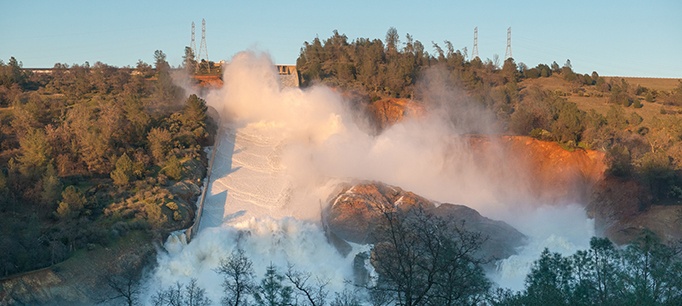
The crisis at Oroville Dam on the Feather River eased yesterday as state officials gained control over the damaged spillway and allowed the more than 180,000 evacuees to return home. Prospects are good that dam operators will be able to control releases through the remainder of the wet season. Now that the immediate crisis is past, we should take the opportunity to review how we manage California’s big dams—and what changes would help us do so more effectively in future.

Water—whether too much or too little—has a way of revealing weaknesses in design and decision making. For Oroville Dam—the tallest dam in the nation—the crisis began with poor maintenance of its main spillway compounded by wholly inadequate design of the emergency spillway, a known problem. But the crisis at Oroville also raise five broader concerns that California will have to reckon with:

  • Aging dams. Most of the state’s 1,400 large dams were designed using slide rules and based on simplistic assumptions about hydrology and earthquakes. These dams are marvels of engineering considering when they were built, but many are in need of major upgrades in infrastructure and operations. California needs a comprehensive plan for evaluating and modernizing these structures.
  • A changing climate. California’s dams must be adapted to address new risks from a changing climate. These dams were built to respond to early- to mid-20th century conditions. The climate has shifted since that time, and the bulk of climate simulations point to significant changes in the near future. Our dry periods are getting both drier and warmer, and our wet periods are getting wetter with more precipitation falling as rain rather than snow. Part of the problem at Oroville is that the warm temperatures have meant there’s more water to manage right now than usual because less of it is staying in the snowpack. The past seven years—which included five years of record warm, dry conditions bracketed by extremely wet ones—is a glimpse into our future. It is time to rethink how we are going to operate and maintain our dams to respond to these changes.
  • Conflicting goals. We may be asking too much of our dams. For example, Oroville Dam provides water supply, hydropower, flood management, recreation, and ecosystem flows for rivers and the Delta. Flood management is in tension with the other services because a mostly empty reservoir—bad for the other services—is the best hedge against floods. By design, Oroville was relatively full when the latest floods arrived, reflecting its top priority (water supply) and compounding flood risk. It may be time to rethink the balance of objectives for all of our large, multipurpose dams.
  • Rigid rules. Adjusting course on dams—whether by changing the infrastructure or the way they are operated—is difficult. Licenses for non-federal dams like Oroville—administered by the Federal Energy Regulatory Commission—last for 30–50 years. These lock in place all aspects of dam operation for several generations and require herculean efforts to overcome. Moreover, flood operations on all dams are mandated by the US Army Corps of Engineers and require an act of Congress to change. When it comes to changing course on dams, institutional inertia is a powerful countervailing force.
  • High cost of improvements. Any change in course is likely to be very expensive. California relied heavily on federal support for construction of many of its large, multipurpose dams. Support ended decades ago and is unlikely to resume in the future. California is going to need a comprehensive funding plan for modernizing its dams and other flood management systems that does not rely on extensive federal support.

Most water crises have a silver lining. The recent drought spurred changes to the way we manage water scarcity in the state, resulting in one of the most important pieces of water legislation—the Sustainable Groundwater Management Act—in many decades. The crisis at Oroville should spur Californians to rethink how we manage our network of large dams. New management approaches, new technology, and new investments to modernize dams will be necessary to adapt to changing conditions, both today and tomorrow.

Learn more

Visit the PPIC Water Policy Center flood resources page
Read California’s Water: Climate Change and Water (from California’s Water briefing kit, October 2016)

Governor’s Funding Plan for Climate, Drought

Governor Brown has released a proposed budget that reaffirms the state’s commitment to boosting drought resiliency and battling climate change. While specifics are likely to change before the budget is finalized in June, here is a summary of key proposals.

  • Cap and trade. California’s recent efforts to combat climate change have been funded from its cap-and-trade program. The program faces an uncertain future because its statutory authority is set to expire in 2020. Partly due to this uncertainty, 2016 cap-and-trade auctions raised a fraction of the money raised in previous years. At the governor’s budget press conference, he announced legislation that would extend the program beyond 2020. Appropriation of cap-and-trade funds in the new budget is dependent on the passage of this bill—which will require a two-thirds vote in both the senate and the assembly. Should it pass, the governor proposes appropriating $2.2 billion for cap and trade, a decrease from last year’s $3.1 billion. As in past years, 60 percent of the proceeds would be for ongoing funding of public transit, affordable housing, sustainable communities, and high-speed rail. The rest is split among one-time investments. This year, the largest sum in the one-time investment pot ($863 million) is for public transit improvements aimed at increasing ridership and decreasing greenhouse gas emissions. Smaller sums include $142 million to fund local climate actions in the state’s most disadvantaged communities and $128 million for projects in forests and urban and agricultural landscapes that remove carbon dioxide from the atmosphere and store it in vegetation or soils.
  • Emergency drought spending. While recent rains have drenched California, the governor’s emergency drought declaration is still in effect, and the new budget appropriates an additional $188 million in one-time resources for drought relief. Roughly half ($91 million) is allocated to CAL FIRE—the agency dedicated to fire protection and stewardship of the state’s forests—to enhance its firefighting capacities and support the removal of dead trees. The drought has contributed to widespread tree mortality, which has raised concerns that the dead trees might fuel future destructive wildfires.
  • Water bond updates. Nearly 80 percent of Proposition 1 water bond funding has already been appropriated (though far less has been awarded for spending). This year, the governor proposes appropriating $248 million from the bond for an Integrated Regional Water Management grant program. These funds are meant to incentivize regional cooperation with the goal of resolving complex water management challenges at a broad scale while balancing social, environmental, and economic objectives. For instance, these funds could foster a regional approach to helping water systems adapt to climate change. An additional $3.8 million would enable the State Water Resources Control Board to enforce the implementation of California’s groundwater law.

Although state money represent only a fraction of California’s total water sector spending (13%—the rest is mostly locally funded), it is an important piece of the funding pie. While the governor’s proposed budget would bring welcome funding to a number of critically important areas, key water challenges continue to experience long-term funding gaps—especially safe water for small rural communities, flood control systems, stormwater management, and ecosystem management.

Learn more

Read California’s Water: Paying for Water (from California’s Water briefing kit, October 2016)
Visit the PPIC Water Policy Center