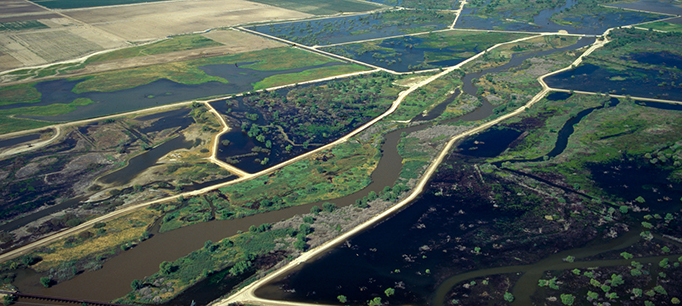
Farms That Grow Groundwater

Farmers use the lion’s share of California’s groundwater, but they also do the most to rebuild depleted reserves of this critically important water source. We talked to Graham Fogg—a groundwater expert at UC Davis and a member of the PPIC Water Policy Center research network—about farmland groundwater recharge.

PPIC: How do farms recharge groundwater?

Graham Fogg: Crops don’t use all the water they get through irrigation—a lot seeps into underlying groundwater. Farms also move water from place to place through leaky ditches. The type of irrigation can affect the amount of recharge. For example, with flood irrigation a large fraction can end up back in the aquifer—commonly as much as a third or more. With micro-irrigation, a larger fraction of applied water is taken up by plants, and less ends up recharging groundwater.

Many farmers have adopted micro-irrigation technology. Farmers prefer groundwater when using drip systems because it’s free of sediment that can clog emitters, and groundwater is available whenever the farmer needs to run the system, sometimes multiple times a week. The result is that drip-irrigated farms may pump more groundwater—and they’re not recharging the aquifer as much. It’s an unintended consequence of more efficient irrigation.

PPIC: Are farmers being encouraged to recharge groundwater?

GF: The drought has helped many farmers realize the importance of better groundwater management, and some are figuring out how they can do more recharging on their land. The Sustainable Groundwater Management Act will require better management and balanced water budgets in each basin. This can be achieved with decreased groundwater pumping or increased recharge. In essence, we need to start managing groundwater systems in ways that are similar to surface storage reservoirs and use recharge as a hedge against future drought.

If we continue to rely on irrigation for most of our recharge, it raises questions about groundwater quality. Water that goes through farmland is more likely than non-farm recharge to be tainted with salts, nitrates, and some pesticides.

PPIC: What practices can improve California’s groundwater supplies?

GF: We need to do a variety of things to bank groundwater or face the prospect of having to reduce pumping in dry years and in depleted basins. One solution with high potential is “spreading basins.” These are flat places with the right soils and geological conditions for ponding water so it can infiltrate the aquifer. We need to map these surface and subsurface features and take steps to protect them for recharge purposes.

The Central Valley is not only home to some of our most over-tapped groundwater basins, but also to lands with good potential for fast infiltration. One promising approach is routing excess winter runoff onto farmlands, where irrigation infrastructure can be used to spread the water and recharge groundwater. This practice is gaining much interest from farmers.

We also can manage rivers to encourage recharge, bringing benefits to entire basins. Rivers can recharge groundwater with seepage through their beds. And when rivers overflow their banks, water spreads across the floodplain. Two approaches with high potential to improve groundwater conditions are moving levees back to reconnect rivers with their floodplains, and managing groundwater and surface water as an integrated system. When groundwater systems fill to the point of spilling over, rivers and wetlands stay wet, and there’s a natural exits for groundwater contaminants. Without such exits, these basins will become increasingly polluted over time.

Learn more

Read “The Coming Groundwater Revolution” (PPIC Blog, January 6, 2016)
Read our policy brief “California’s Water: Storing Water” (from California’s Water briefing kit, April 2015)
Visit the PPIC Water Policy Center
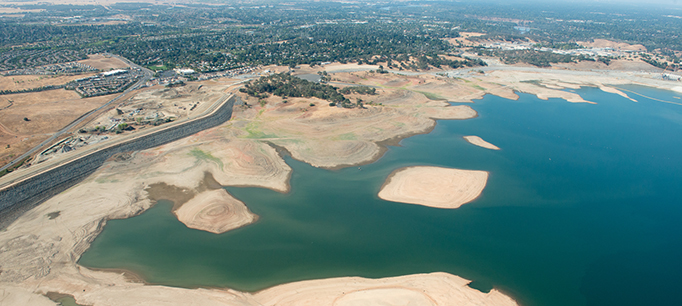
A California Drought Report Card

A year ago, Governor Jerry Brown issued California’s first-ever statewide water conservation mandate. Today, conditions are better: Northern California reservoirs have been filling, and the snow survey found a much-improved snowpack compared to last year. But one near-average year is not enough to recover from the driest, warmest four-year stretch on record. El Niño was not a drought-buster. In the southern half of the state, reservoirs remain low and groundwater basins even lower.

The end of the rainy season is a good time to evaluate our drought response. So, how did we do last year, and what changes could help us better manage one or more additional dry years? We graded California’s drought response for urban areas, the farming sector, rural water supply, and the environment, and found great disparities in the results.
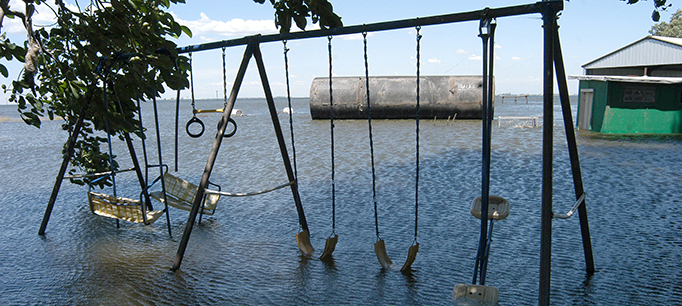
This drought gave us a glimpse into a challenging future. Our commentary also outlines policy changes that will help us weather a few more years of drought—and more importantly, improve our ability to adapt to a hotter, drier future.

Read our commentary detailing this drought report card in the San Francisco Chronicle.

Flood Insurance: Why Don’t People Buy It?

The author is a member of the PPIC Water Policy Center research network.

Flood damage has been increasing in the US, largely due to where we build. Climate scientists are concerned that as the climate warms, there will be more intense downpours, stronger hurricanes, and rising seas, all of which could increase flood risk. Despite this, people have been dropping flood insurance nationwide. The number of policies from the National Flood Insurance Program (NFIP)—the main provider of flood coverage in the US—has been falling since 2011, perhaps due to changes in pricing. But Californians have recently bucked the trend. The Federal Emergency Management Agency (FEMA) reports that flood insurance sales in the state are up 12 percent this winter (compared to 3 percent last fall) as residents prepared for possible El Niño flooding.

This increase in California is all the more notable since, generally speaking, most people don’t voluntarily buy disaster insurance. Low demand for flood insurance led Congress, early in the history of the NFIP, to make purchase mandatory for homes located in a FEMA-mapped 100-year floodplain that had a mortgage from a federally backed or regulated lender. Yet just half of these homes are insured, with more in coastal areas. Outside the 100-year floodplain, even where there is flood risk, few homes are insured.

This can have ripple effects in flood-prone communities. Insurance protects families against the financial impacts of substantial flood damage. Insured properties were 37 percent more likely to have been rebuilt after Hurricane Katrina. And when people rebuild, economies can come back to life. Len Shabman and I found that post-disaster aid to households is usually quite limited, making insurance the main tool for households unable to cover rebuilding expenses.

So why don’t more people buy disaster insurance? People may think floods won’t happen to them. Insurance may be too expensive, or they may believe it isn’t worth it. They may be uninformed about flood risks. People seem to insure when recent events raise awareness about the risks. My recent research shows that a federal requirement for disaster-aid recipients to purchase flood coverage explains much of this increase.

For people living in a floodplain or behind a levee, flood coverage is important well beyond El Niño. Yet past experience suggests many newly insured Californians will not keep their policies after El Niño passes. Many NFIP policies are dropped in a few years; only a third of policies are held for six years or longer. Although some of this can be explained by people moving, fading concern about floods is likely also a factor. In 1998—a year after California’s last widespread flooding—flood insurance sales were at an all-time high of nearly half a million policies. Ten years later, that number had fallen by half.

Several policy changes could encourage more at-risk households to insure. Informing residents of the likelihood of flooding, potential damage, and the limitations of disaster aid can help them make better decisions. FEMA outreach at times of increased risk, such as El Niño events or after major wildfires, can help alert homeowners to times when coverage may be warranted. Finally, a recent report from the National Research Council addressed ways to help lower premiums when insurance is too costly for low- or middle-income families in risky locations.

Learn more

Read “California’s Water: Preparing for Floods” (from California’s Water briefing kit, April 2015)
Read “A Look at 35 Years of Flood Insurance Claims” (from Resources magazine, winter 2016)
Visit the PPIC Water Policy Center

Making Federal Farm Support Drought-Smart

A new initiative launched by President Obama in March seeks to better coordinate federal drought-management efforts at the basin scale, and ensure that key federal farm programs are in alignment with watershed conservation objectives developed by state and local partners. Making federal farm-program dollars work better and go farther will be key to this effort’s success.

The critical role of US Department of Agriculture (USDA) programs in managing water scarcity is often overlooked. But as we document in our recent report on the federal role in western water, USDA’s programs represent the lion’s share of federal water- and drought-related funding in the region. Given farming’s large water footprint in the West, even small changes in farm practices can have broad effects on water supplies and ecosystem health.

The agricultural water and land stewardship programs run by the Natural Resources Conservation Service (NRCS) and the Farm Service Agency are singularly important, due to their size and reach. These programs provide farmers with technical and financial support to improve water use efficiency and conserve soils, water, and wildlife habitat through on-farm investments. In addition, easement programs pay farmers to convert environmentally sensitive lands to wetland or cover crops—or to keep their lands in production rather than allow it to be developed.

Practical reforms in easement programs could yield drought-management results. The wetland recovery program pays farmers to permanently restore fields to wetlands, and the conservation reserve program pays them to convert fields to cover crops for 10–15 years. But such long-term commitments to fallow lands are unappealing to many farmers.

These programs could be more effective by allowing shorter easements and working with groups of farmers rather than individuals. For instance, paying farmers to create temporary wetlands during droughts can stretch scarce water and dollars while supporting waterbirds. Similarly, paying a group of farmers to do rotational fallowing—which means they take turns temporarily fallowing fields—can reduce overall water use while keeping farms in production. Meanwhile, other incentives could focus on farmers who commit to maintaining land in field crops rather than permanent crops—a change that could boost drought resilience in places like California, which has seen a big expansion of tree crops that are harder to fallow.

USDA programs represent the lion’s share of federal water- and drought-related funding in the West.

Another important change involves the popular NRCS subsidies to support efficiency investments on farms. The problem is that reducing the amount of water needed to grow specific crops does not usually translate into more water in the system, since newly available water is often used to increase production. And this water can be vital to downstream users and the recharge of groundwater.

To make sure these subsidies don’t conflict with basin management goals, USDA efficiency programs should seek to maintain or enhance water to meet environmental needs, and prevent harm to groundwater basins. Solutions could include expanding and improving temporary, strategic flows to meet habitat needs, and dedicating water created through efficiency programs to environmental uses or groundwater recharge.

Many of these changes could occur under existing statutory authority, and some program updates could be included in the 2019 Farm Bill. To be more effective in managing western drought, future farm bills should also put relatively more emphasis on easements and less on efficiency-oriented subsidies.

These changes would make federal support programs a better fit for many farmers, while supporting basin-level drought management goals of improving conditions for fish and wildlife, recharging groundwater, and reducing overall water use in areas grappling with water scarcity.

Learn more

Read a summary of policy recommendations from Improving the Federal Response to Western Drought (February 2016)
Read the federal action plan on improving long-term drought resilience
Watch a video on “Reforming Federal Drought Management”
Visit the PPIC Water Policy Center

Safeguarding Groundwater for a Drier Future

California is not alone in facing serious groundwater challenges—overuse is causing water tables to fall in many parts of the globe. Sharing ideas on how to protect and restore this important resource is the theme of a special opinion forum on the global groundwater crisis in The Desert Sun. Ten experts from the US West, Ethiopia, South Africa, India, and Peru weighed in.

My commentary focused on groundwater’s role as an “unsung hero” in California’s latest drought, and the need to manage it more carefully to ensure its critical role in getting agriculture through future droughts. This doesn’t mean restricting pumping in the midst of the drought—as tempting as that might be—because that could worsen the economic impacts of water shortages. Instead, it means rolling up our sleeves to develop and implement long-term management plans—a path made easier by the passage of the Sustainable Groundwater Management Act in 2014.

Here’s my contribution to the opinion forum:

Most Californians have first-hand experience with our record-breaking drought. Far fewer understand the role that groundwater has played in easing the drought’s impact on our cities and farms. Groundwater typically provides about a third of total water supplies, with the balance coming from rivers and lakes. Last year, its share was closer to two-thirds. Extra groundwater pumping bolstered the state’s urban economy and kept thousands of acres of valuable orchards, vines, and vegetables in production.

Many of California’s urban areas planned ahead to build their underground drought reserves. Since the last major drought (1987–92) they made large investments in groundwater storage as part of a strategy to diversify their water sources. In Southern California and Silicon Valley, locals also adopted management systems that facilitate water banking—which requires putting more water into the ground and pumping less in wet and normal years so that it’s available during droughts.

Most of California’s farming areas have less-robust groundwater oversight, and one consequence is long-term declines in water tables. The extra pumping during the drought is compounding this problem, causing some wells to go dry and some lands to sink. The good news is that many farmers now recognize the importance of managing groundwater as a drought reserve. And the state’s 2014 Sustainable Groundwater Management Act gives them the tools to make this happen.

It’s tempting during a drought to call for pumping restrictions, but this can worsen economic impacts, especially on the farm sector. Now is a good time to take actions that ensure groundwater is available for future droughts.

Learn more

Read “Reforming California’s Groundwater Management” (PPIC fact sheet)
Read “The Coming Groundwater Revolution” (PPIC blog, January 6, 2016)
Read “Getting to Groundwater Sustainability” (PPIC blog, June 16, 2015)
Visit the PPIC Water Policy Center’s water supply resource page

Federal Drought Management: It’s Complicated

More than two dozen federal departments and agencies engage in some facet of water resource management in the West. This complex institutional landscape is a big obstacle to effective management of western droughts.

The wildly differing jurisdictions of federal agencies across the West provide a striking illustration of this complex landscape. While these boundaries were created with the individual agencies’ missions and objectives in mind, the resulting jigsaw puzzle complicates efforts to address the varied objectives of sustainable water management.

During the latest drought, the federal government made noteworthy attempts to improve how agencies work together—for example, the White House established the National Drought Resilience Partnership, which aims to strengthen coordination of federal drought policies and programs in support of state, tribal, and community efforts. Yet the federal response to drought is fragmented, with imprecise definition of authorities and poorly aligned missions.

A major challenge to better coordination lies in the diverse, and occasionally conflicting, roles and responsibilities of different federal agencies. For example, in basins where farmers rely on the federal government for water supply but where there is also a need to protect the environment, the missions of the various federal agencies can be in direct conflict. This lack of clarity impedes federal efforts to help the West manage drought and adapt to a changing climate.

A recent report by the PPIC Water Policy Center, Improving the Federal Response to Western Drought, recommends that federal agencies better coordinate actions among themselves and with state and local partners. Coordination will work best when multi-agency efforts are aligned at the scale of large river basins and the watersheds within those basins. Federal drought response also needs to shift away from a centralized, Washington, DC-based approach to a more distributed authority, using interagency teams with basin-level expertise to address priority actions and help balance competing needs.

The federal government is an instrumental partner in western water management, but its complexity and disparate missions limit its ability to respond creatively to water scarcity. Taking steps now to make federal policies and practices more nimble will help the West better manage the inevitable droughts of the future.

Video: Congressman Kevin McCarthy in Conversation

The majority leader of the US House of Representatives ticked off the issues in an ambitious agenda that he and Congressman Paul Ryan, the House Speaker, are working on in Congress. Congressman Kevin McCarthy told a Sacramento audience that they include national security, the economy, tax reform, poverty, regulatory reform, innovation in government, and water.

McCarthy shares a sense of urgency with Senator Dianne Feinstein about getting a water bill through Congress this year. But he made clear in his conversation with Mark Baldassare, president and CEO of PPIC, that he and the senator—who spoke to a PPIC audience last month—differ in their policy priorities. His include building more water storage and pumping more water from the Sacramento-San Joaquin River Delta.

McCarthy said he thought a water bill could be passed this year, perhaps in a bill that addresses the water problem in Flint, Michigan.

“I think there’s a window of opportunity,” he said.

When the conversation turned to the presidential race, McCarthy was asked to compare two political outsiders—presidential candidate Donald Trump and former Governor Arnold Schwarzenegger. McCarthy said both tapped frustration in the electorate and both brought new voters to the process.

“When I went to the rallies with Arnold it was amazing,” he said. “There’d be 7,000 people in Bakersfield. Lived there my whole life, but I’d see people I’d never met before.”

Today, he said, “the country feels as though the government is not listening to them, they’re divided on all sides, and they’re just not going to take it anymore.”

“I don’t believe it’s a bad thing at all. I believe it’s good.”

California’s Farmers Adapt to Drought (in English and Spanish)

California’s drought has caused significant damage to the most important agricultural region in the United States. Half a million acres had to be fallowed, causing the loss of thousands of jobs in rural communities. The proportion of farmland planted to permanent crops has risen, making it harder to use fallowing as a drought strategy. Much of the shortage in surface water has been alleviated by pumping groundwater. But going forward, this practice will be increasingly challenged by the considerable drop in the water table in some areas, and management practices that will be required by the new statewide groundwater law adopted in late 2014.

We interviewed Josué Medellín-Azuara—a researcher at the UC Davis Center for Watershed Sciences and a member of the PPIC Water Policy Center’s research network—about how the agricultural sector has been coping with drought, and practices and technologies that can help farmers weather future droughts. As Medellín-Azuara says, “There isn’t a simple solution to this problem—the strategy will be to implement a mix of the actions that are available to us.” This video is in Spanish only.

_____________________________

Video: La adaptación a la sequía del sector agrícola de California

La sequía que ha sufrido California en estos últimos años ha causado daños significativos en la región agrícola más importante de Estados Unidos. Se estima que medio millón de acres se han tenido que dejar en barbecho, propiciando la pérdida de miles de puestos de trabajo sobretodo en comunidades rurales. Pero la tendencia durante estos últimos años ha sido la de aumentar la proporción de cultivos perennes, reduciendo la flexibilidad del sistema para disminuir la demanda durante sequías. Por suerte, parte de la escasez de agua superficial se ha paliado bombeando agua desde los acuíferos, aunque esta práctica está cada vez más cuestionada por la disminución considerable del nivel freático en algunas zonas, que la implementación de la nueva ley estatal de gestión sustentable de los acuíferos aprobada en 2014 tratará de paliar.
Entrevistamos a Josué Medellín-Azuara —investigador del Center for Watershed Sciences de la Universidad de California, Davis, y miembro de la red de investigadores del PPIC Water Policy Center—sobre cómo el sector agrícola ha respondido a la sequía, sobre qué podemos esperar en el futuro. Como dice el Medellín-Azuara, “No existe un solución única a todos los problemas—la estrategia será la de implementar una combinación de las todas las acciones disponibles.”
Aprende más 
Lee nuestro informe Qué Pasaría Si la Sequía de California Continuara? (Agosto de 2015) (versión original en inglés)

Video: Farming’s Water Future

The latest drought has roiled the state’s agricultural heartland, causing job losses in rural communities, fallowed fields, and dropping groundwater levels. Increased groundwater pumping helped minimize economic losses for many farmers, but this could prove unsustainable in some areas during longer droughts.

We interviewed Richard Howitt—professor emeritus of agricultural and resource economics at the University of California, Davis, and a Steyer Fellow with the PPIC Water Policy Center—on what can be done to make California’s agricultural economy more resilient to future droughts.

Learn more

Read our report What If California’s Drought Continues? (August 2015)
Read an interview with Howitt on Water Deeply (February 26, 2016)
Visit the PPIC Water Policy Center

Linking Land Use and Water Decisions

In nature, water and land are intimately entwined. But in the human landscape, we’ve created divides. Communities across the state separate water and land use, and this can lead to inconsistency, inefficiency, and conflict. The Governor’s Office of Planning and Research (OPR) recently convened a series of workshops in rural California on aligning land and water planning for long-term sustainability. Debbie Franco is OPR’s community and rural affairs advisor and local drought liaison, and a member of the PPIC Water Policy Center’s advisory council. We talked to her about this ongoing process.

PPIC: What was the purpose of these workshops, and what common themes did you hear?

Debbie Franco: We’re seeking ways to ensure that water and land use decisions are informed by each other and ultimately are driving toward the same goal. As a first step, we organized six regional workshops in rural parts of the state to talk to folks working in water and land-use planning, with the goal of better understanding how locals see optimum alignment, where there are gaps or barriers, and opportunities to close the gaps and overcome the barriers. We logged more than a hundred ideas, and now we’re working to figure out what actions would move us toward more resilient water and land systems.

Themes that emerged included:

  • The need for strong political leadership, supported by mechanisms to help leaders balance competing priorities and to achieve equity across our various water divides;
  • Institutional drivers that lead to good choices for water and land management—such as eliminating the pressure small local governments feel to embrace development as a way to fund community services;
  • The value of using common data and metrics across land use and water planning, and focusing on measurable outcomes.

PPIC: What are the most pressing issues you heard about?

DF: The biggest idea that came up over and over was the need to have watershed-scale water accounting. The idea needs a lot more discussion and research, but basically, such a process might for example document how much water everyone gets, what water rights pertain, and where you have lands with high potential for stormwater capture or groundwater recharge. You might end up with a watershed map showing lands with high potential for storing water, where everyone benefits from ensuring they are used for that purpose. Sharing such information with land use authorities could lead to better analysis of land options for new developments. We heard from participants that California’s “show me the water” requirements and environmental review process under CEQA (the California Environmental Quality Act) happen too late, when proposed developments are far along in the planning process. If developers got water information to inform site selection, it could make it easier for them and result in water benefits, too. Some jurisdictions are already taking this approach.

Several regions discussed the potential for marijuana to be legalized, and the crop possibly shifting from the forests to conventional farmlands. There’s a huge opportunity to be forward-thinking on solving water issues that might arise from this shift.

Every workshop included a discussion about how under-resourced local government planning is. There are so many barriers—no dedicated funding source for this kind of planning, out-of-date general plans, plans trapped in litigation for years. We need sufficient resources for local governments to do good planning.

Learn more

More on this topic: “Video: Water and Growth in the West” (PPIC Blog, February 18, 2016)
Read the California Water Action Plan, which was a motivation for these meetings
Visit the PPIC Water Policy Center