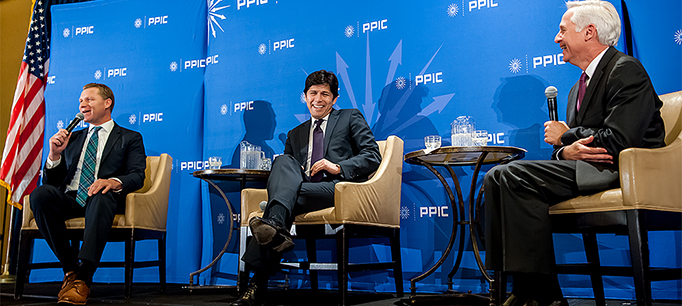
Video: Senator Dianne Feinstein in Conversation

Underscoring her role in three contentious policy issues, California’s senior senator spoke to a Sacramento audience last week about filling the vacancy on the US Supreme Court, the dispute between Apple and the FBI, and drought relief.

Senator Dianne Feinstein urged speedy consideration of a nominee to replace the late Antonin Scalia on the court, saying that Senate can consider and confirm a new justice within 69 days—the average time for the process has taken in the past. She acknowledged that it would not be easy.

“I wish we could go back to the days when I first went to the Senate when the belief was that every president deserves his nominations,” she told Mark Baldassare, PPIC president and CEO, at the PPIC event.

Asked about the Apple controversy, she called on the company to reconsider its position and cooperate with the FBI to access data on a phone used by one of the San Bernardino killers. “Apple is not above the laws of the United States,” she said.

She said her position on the Senate Intelligence Committee—which occupies most of her time—gives her a perspective not shared by many on the dangers posed by terrorists.

Feinstein also detailed some of the provisions in her drought-relief bill, which would fund recycling, desalination, and water storage projects, as well as ease water trading.

She closed by describing her leadership style, saying she tries to “use the time to get things done. If I can’t do them through legislation, I’ll do them another way.”

Video: Water and Growth in the West

When water supplies are tight—as during the latest drought—discussions often turn to the question of whether state and local governments should be limiting growth. How western states are managing this issue—and areas where improvement is needed—was the topic of my presentation at a recent conference on sustaining western water. The event, which also featured presentations from three members of the PPIC Water Policy Center’s research network, was sponsored by the Renewable Natural Resources Foundation.

Most western states have laws to ensure adequate water supply for new developments. These laws generally require that developers—or the city and county governments that approve new construction on their behalf—ensure the availability of long-term supplies before the projects can go forward. In rural areas, the concern is often to prevent individual consumers from being sold a “dry lot,” lacking basic services. In larger communities, the concern is more often about making sure that new projects don’t reduce the reliability of community-wide supplies, ultimately requiring costly new investments for existing residents. California’s law falls somewhere in the middle of the spectrum. We require new developments of 500 or more units to demonstrate at least 20 years of water supply availability. (Arizona’s law requires 100 years of supply in major metropolitan areas; Colorado usually leaves this decision up to local utilities.)

Our research has found that these laws are working fairly well in cities and suburbs, where utilities can provide good oversight and draw on multiple tools to ensure water availability. For instance, in California, utilities generally require supplies well beyond the 20-year requirement of state law. Investments in conservation, recycled wastewater, new storage, and water trading have all enabled communities to accommodate growth.

Things are more likely to fall through the cracks in smaller rural communities. As California has seen during the latest drought, some well-dependent rural homes are facing water supply shortages; many also have inadequate sanitation and other services.

Western states also need to devote more attention to agricultural land use. On average, farms use 85 percent of total business and residential water use in the West, so farming needs to be part of any equation addressing water scarcity. Pressing issues right now include making sure there’s enough water to support long term investments in tree and vine crops, which now account for more than 40 percent of crop acreage in the water-scarce San Joaquin Valley. And as we move to implement the new Sustainable Groundwater Management Act, there’s great interest in making sure that communities manage both urban and farm development in ways that protect lands with high potential for groundwater recharge. This means not paving over these lands in cities and managing farmlands so that these fields can be flooded during winter and early spring.

Learn more

Watch these video presentations from other PPIC Water Policy Center researchers who spoke at the conference:

About the PPIC Water Policy Center

Steyer Fellowship to Focus on Groundwater

A new fellowship will enable the PPIC Water Policy Center to explore solutions to some of California’s toughest groundwater policy challenges. This three-year program is supported with funding from the TomKat Foundation, established with funding from Tom Steyer and Kat Taylor. PPIC has appointed Richard Howitt, an adjunct fellow at the center, as the 2016 Steyer Fellow.

Howitt is one of the state’s leading thinkers on how drought, land-use changes, and economic factors are affecting California’s agricultural sector. As an emeritus professor of agricultural and resource economics at the University of California, Davis, he’s devoted years to researching the agricultural economy and water markets. He’s played an important role in a number of major research projects looking into drought’s impacts on the farm economy and water management solutions for the long term.

“We are grateful for this support because it advances the water center’s programs and priorities,” said Ellen Hanak, center director.

Howitt will explore solutions to excess groundwater pumping the San Joaquin Valley—the state’s most important agricultural region and largest water user.

“Farmers significantly increased pumping to weather the latest drought. At the same time, they’ve been increasing acreage devoted to perennial crops—which can’t be fallowed as easily when water supplies are short,” Howitt notes.

The state’s new groundwater law requires the valley’s water users to develop sustainable groundwater management plans by 2020. Howitt and a team of PPIC Water Policy Center researchers will undertake a comprehensive analysis of possible sustainable water management solutions for the region.

Video: Reforming Federal Drought Management

The federal government is a key partner in just about every aspect of western water management. It’s the West’s largest landowner, chief environmental regulator, major supplier of irrigation water and hydropower, key provider of water information, and an important source of water-related funding. The vast scale of its involvement has brought big challenges to how it manages the drought that has affected the entire 11-state region in recent years.

The fed’s role in managing droughts in the West was the topic of a seminar in Washington, DC, last week, a joint effort of Resources for the Future and the PPIC Water Policy Center. Along with a panel of prominent national experts, we discussed how to improve policies and practices to build drought resilience at the federal level, with a focus on pragmatic changes that are doable in the near term. I introduced recommendations from our new report, Improving the Federal Response to Drought: Five Areas for Reform, to help structure the conversation.

A panel discussion followed, with my colleague Jeffrey Mount moderating. He asked panelist Ann Mills, deputy under secretary for natural resources and environment at the US Department of Agriculture, about how USDA’s vast array of programs could be better coordinated for drought.

Noting that there are 15 agencies just within the department that have some influence on water management, Mills said, “We’ve started to create USDA water teams at the senior policy level … to make sure we’re coordinating our work as effectively as possible. There are real challenges in breaking down silos in the USDA and the federal family.” Mills noted that USDA is also seeking to improve its data and make it actionable and more available to customers. “And we’re building on the really great work that’s already happening on the ground,” she said.

Panelist Mark Kramer of The Nature Conservancy was asked about the lack of a “drought plan” for the environment during the latest drought, which might have reduced the crisis now facing some species.

“The pressure to squeeze more water out of the system is enormous,” Kramer said. Water has been framed as an “either-or” proposition—either it goes to the environment or to human uses. But, he noted, it can be managed in ways that address environmental needs without harming other users. The Nature Conservancy has been working on pilot projects that help farmers put water “when and where it’s needed”—for example, to create temporary wetlands for birds during drought. To scale up these efforts, some agencies may need more funding and other tools.

These are tough, multidimensional problems, and solving them will require a heavy lift. But increasingly, people in the West realize we can’t continue with “business-as-usual” water management. Tom Iseman, deputy assistant secretary for water and science at the US Bureau of Reclamation, noted that westerners are already experiencing the impacts of hotter, longer droughts, and realizing some things will need to change. “We’re trying to get ahead of these problems, to promote long-term drought resilience.”

Learn more

Read a summary of policy recommendations from Improving the Federal Response to Western Drought (February 2016)
Read “There’s Always Drought Somewhere in the West” (PPIC blog, February 4, 2016)

There’s Always Drought Somewhere in the West

Thanks to the January rains, hopes for an end to the latest drought are rising along with reservoir levels. But the reality is, drought is occurring somewhere in the West practically all the time.

Over the past decade, except for a few brief wet periods, more than a quarter of western lands have been in drought. Since 2012, more than half of the West has been hit, with large areas facing extremely dry conditions.

To get a better sense of how drought conditions vary across the region over time, we created a time-lapse animation using the maps released weekly by the US Drought Monitor.

The 10-year span shows strong regional differences. Droughts in California and the Pacific Northwest tend to develop and end relatively quickly. In contrast, parts of the Colorado Basin have been dry for much of the past decade or longer—a situation that is proving difficult to manage.

The rain and snow we’ve experienced already in this wet season have made modest dents in the latest drought. And there’s been a pronounced turnaround in the Pacific Northwest, where unusually severe storms have moved much of the region out of drought.

California’s above-average snowpack in is encouraging, and it seems that the outlook for 2016 is improving. But these graphics remind us that droughts never truly leave the West. As we highlight in our recent report, Improving the Federal Response to Western Drought, California—like its western neighbors—must continue to strengthen its water management to better cope with ongoing drought and prepare for the next.

State Water Market Needs Reform

Water trading is an important tool for managing water scarcity. It enables water right-holders to voluntarily shift water—permanently or temporarily—to those who need it, making better use of existing supplies. Despite potential benefits, the approval process for trading water in California continues to be lengthy, cumbersome, and lacking in transparency. This is an especially big concern during droughts, when speed is important.

In California, water trading takes the form of short-term leases, long-term leases, and permanent sales. The figure below shows statewide estimates of volumes of water traded in recent decades, including the first three years of the latest drought.

Since the onset of the latest drought, total volumes traded appear to have tapered off, despite strong demand. Farmers facing scarcity have been willing to pay record-high water prices for their high-value crops. Prior to this drought, an acre-foot of water typically sold for less than $500, and sometimes less than $100. In the spring of 2014, a Kern County water district auctioned 12,000 acre-feet of stored groundwater to local users and got bids for more than 60,000 acre-feet at a price of $650 per acre-foot or more. In the summer of 2015, some San Joaquin Valley farmers were reported to have leased water for as much as $2,000 per acre-foot—more than most cities pay for municipal supplies.

But the slow approval process, along with tight supply conditions, limited volumes available for sale. While senior water-rights holders normally have more reliable and ample water supplies, the past several years have been so dry that the state decided to cut their water allocations for the first time since 1977. The cuts rippled throughout the market. For instance, the Metropolitan Water District of Southern California had planned to purchase around 100,000 acre-feet from Sacramento Valley rice growers, but that deal was contingent on the growers getting a full allocation. When the growers’ allocation was cut by half, the deal was significantly scaled back.

The drought has placed markets at the center of a conversation about ways to manage droughts and lessen the costs of scarcity. Many point to the example of Australia, which significantly expanded water rights trading in the midst of drought. Buyers and sellers register their shares with the help of brokers—often using online trading platforms—and trades are approved within a matter of hours or days, not the weeks and months that are the norm in California.

To reach Australia’s level of fast-paced trading, California would need to address many challenges. Clarifying and simplifying the review process for transfers is one priority. This will require improving information about water availability and how much can be safely traded without harming the environment or other legal water users. In addition, California will need to address infrastructure weaknesses that restrict moving water between buyers and sellers in some places.

Making these changes will require the cooperation of water users and state, federal, and local agencies. It won’t happen overnight, but we need to get started. Strengthening California’s water market will be key to effectively managing future droughts, a regular feature of our climate.

Chart source: Updated from E. Hanak and E. Stryjewski. California’s Water Market, By the Numbers: Update 2012 (PPIC, 2012).

Chart notes: The figure shows water traded between entities that are not members of the same water district or wholesale agency. It excludes volumes committed under long-term lease and permanent-sale contracts that were not physically transferred. Dry years are those classified as critical or dry for the Sacramento Valley

Learn more
Read our report What If California’s Drought Continues? (August 2015)
Read our report Allocating California’s Water: Directions for Reform (November 2015)

Video: A Conversation with Legislative Leadership

At a PPIC event last week, Kevin de León, senate leader pro tem, and Chad Mayes, the Assembly Republican leader, were asked to name the top three issues the legislature should work on with the governor. Though the leaders come from different sides of the aisle, the list of issues they named before a large Sacramento audience had a lot in common. De León’s priorities began with income inequality between the coastal and inland regions, a “tale of two states.” He also listed water and making targeted investments, particularly in higher education. He went on to list a fourth issue: climate change.

Mayes named water and a lack of water infrastructure, and the many Californians left behind in the state’s economic recovery. His third issue was transportation, the focus of an ongoing special legislative session.

“Everywhere that I go in California,” he said, “I’m stuck in traffic. So we know there’s a problem.”

The leaders’ top issues dovetail with findings from the latest PPIC Statewide Survey in which Californians identify water and the economy as the most important issues for the legislature and governor to work on in 2016. 

Though De León and Mayes named similar priorities, there was much less agreement on solutions. But the two maintained a collaborative tone throughout their conversation, denounced what Mayes termed “demagoguery on the national stage,” and repeated their commitment to working together productively.

De León said the legislature can avoid being mired in bitter national political debates if leaders continue to work cooperatively to “get some real tangible victories for Californians.”

“We’re doing things very differently in the state of California,” he said.

Flint, a Water Quality Reminder for California

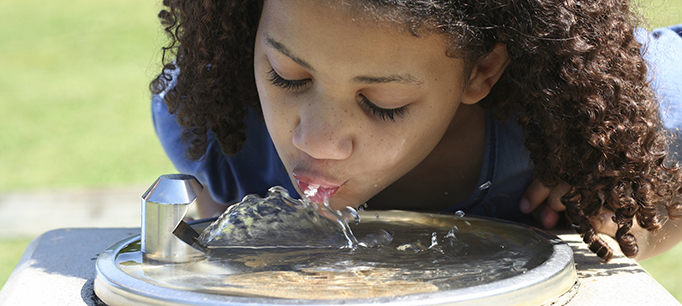
The ongoing public health crisis in Flint, Michigan is a reminder that exposure to dangerous contaminants in drinking water is still a challenge in the US, more than 40 years after the enactment of the 1974 Safe Drinking Water Act. Flint began drawing water from a new source, the Flint River, in early 2014. It corroded pipes and carried harmful lead to residents’ taps. Although California does not face this specific problem, we are still failing to provide safe drinking water to some of the state’s most vulnerable residents.

In general, California’s large urban and suburban drinking water systems—which serve roughly 95% of the population—are in good shape. These systems occasionally exceed regulatory standards for pollutants, but they have the resources and oversight needed to address the problem quickly. In contrast, for roughly 400 small rural communities and schools, the water coming from the tap contains unsafe levels of nitrate, arsenic, and other contaminants. This issue is not new; these communities—whose residents are among the poorest in the state—have been relying on contaminated water for years.

The good news is that after years of neglect, this issue is now front and center in California’s water policy agenda. In 2012 legislation was enacted that recognizes the human right to water, formalizing the state’s commitment to guaranteeing affordable, accessible, and safe water to all of its residents. Progress has been made in documenting the extent of the state’s water-quality problem, dedicating funds to help address it, and changing governance structures to improve oversight. Actions taken include merging the state’s water quality programs under the State Water Board, creating a special office to focus on the problems of disadvantaged communities, and enacting legislation that authorizes the board to require consolidation of water systems when it is the best way to sustainably and affordably provide access to safe drinking water.

California’s rural communities have small customer bases, making it more costly for them to provide safe drinking water. Consolidation—the physical or administrative merging of drinking water systems—can be a cost-effective solution to providing a higher level of service and safer supplies. But it also requires willingness of both small and large communities to merge, and parties both large and small often resist this kind of change.

Although the types of contaminants and the scale of the problems differ, California can draw some lessons from Flint’s experience. In both places, contaminated water is being delivered to poor communities for whom affordability is a major concern. In Flint, water managers were trying to save money by switching to a cheaper source, but they didn’t sufficiently analyze the water quality implications of this switch. Flint managers also refused the offer to hook back up to the safer Detroit water —because of cost. What they neglected to consider was the long-term cost of unsafe water to the community.

Learn more

Visit the PPIC Water Policy Center water quality resource page
Read “Building a Better Water Safety Net” (PPIC blog, October 21, 2015)
Read California’s Water: Paying for Water (from California’s Water briefing kit, April 2015)

A Strong Start for PPIC’s Water Policy Center

Nine months ago—serendipitously, just one day after Governor Brown announced a state of emergency in response to the drought—the PPIC Water Policy Center was launched with the goal of spurring water management innovations to support a healthy economy, environment, and society. Today, cities throughout the state remain focused on water conservation while simultaneously bracing for El Niño floods (it will take more than one wet year to recover from the drought).Through it all, our center—with its network of more than 40 researchers—has been contributing to important water policy debates with new research, publications, and public outreach.

In our first nine months, the Water Policy Center waded quickly into the depths of California’s most pressing water issues, starting with the ongoing drought. Our first major report, What If California’s Drought Continues?, documented the drought’s effects on different sectors and suggestions to improve drought response in the most urgent problem areas—particularly water for rural communities and the environment.

We also reviewed the performance of the state’s water market and water rights systems in response to drought. Allocating California’s Water: Directions for Reform describes ways to improve these systems’ efficiency and transparency, as well as their responsiveness to the environment and public health. We briefed the governor’s office, the State Water Board, California Environmental Protection Agency, and the legislature on the findings. The report generated a spirited conversation in the media and with decision makers about the need to reform water rights to improve water management across the state.

In addition to these major research efforts, we’ve been hard at work interpreting key water issues in “short form” as well. You can get quickly up to speed on key topics through our water blog (sign up for it here) and our growing library of fact sheets, which cover topics such as California’s water quality challenges and reforming groundwater management. Our briefing kit outlines nine pressing water issues facing the state. Our YouTube page hosts our videos on a range of key topics and events.

Another very important aspect of our work is public outreach. In its inaugural year, the Water Policy Center sponsored four regional outreach meetings in Fresno, Monterey, Los Angeles, and San Jose on locally important topics. We testified at hearings held by the state assembly and senate, and had numerous meetings with state, federal, and local water officials and key stakeholders. We gave many talks around the state and in other western states, including at a “Climate One” panel in San Francisco; a forum for environmental educators in San Diego; and meetings of Water Education for Latino Leaders, the Association of California Water Agencies, and the Western Growers Association, among others.

Looking ahead, we’re working on a number of exciting new projects, ranging from improving the federal response to western drought, to strengthening California’s water accounting and information systems, to applying lessons from Australia’s experience with environmental drought planning and management. We are beginning a three-year project funded by the US Environmental Protection Agency to examine the response by federal, state, and local institutions to drought, and develop recommendations to improve long-term drought management.

California’s water landscape is unpredictable and challenging—yet ripe for reforms that will help the state prepare for a changing climate and a growing population and economy. We’re already seeing progress on some of California’s toughest problems, from groundwater management to addressing water security in rural communities. We at the Water Policy Center are looking forward to tackling the state’s most pressing water challenges in the coming year—and to hearing your perspectives on these critical issues.

State’s Ecosystems Face a Flood of Changes

With El Niño making an impressive new year’s debut, talk of drought has turned to worries about floods. How will the state’s drought-starved ecosystems adapt to the taps being turned on again? We talked with Joshua Viers, an ecological engineer at UC Merced and a member of the PPIC Water Policy Center research network, about California ecosystems’ response to flooding.

PPIC: Are floods “natural disasters” for nature?

Josh Viers: Disturbances like floods, droughts, and fire are regular features in California, and our ecosystems are fairly well adapted to these extreme events. There has been a lot of evolutionary adaptation to these disturbances over time, and this is one reason California has such high biodiversity. What compromises our ecosystems’ ability to be resilient to extreme events is that many habitats and species populations have been degraded by human activities. That makes it harder to gauge an ecosystem’s ability to snap back after extreme drought or floods.

Flooding can be quite good for aquatic ecosystems, especially after years of drought, because it reorganizes the physical habitat by moving rocks, logs, and sediments. If water overflows into the floodplain, it can recharge shallow groundwater, replenish soil nutrients, distribute seeds from native plants, and create new habitat for animals and plants.

PPIC: How does California’s flood-control infrastructure affect the ability to manage water for the environment?

JV: California has one of the most elaborate water infrastructure systems in the world. Over the decades, it has had both positive and negative effects on our ecosystems. Our system of dams and canals has degraded habitat, and severely altered the natural variability of river flows, which can disrupt ecosystem functioning and species’ life cycles. But we’re increasingly able to manage the system to mimic rivers’ natural flows and improve long-term ecosystem functioning. As the climate warms, however, we will need to manage water flows to ensure downstream water temperatures don’t get too high for many of our native fish species.

PPIC: What changes to our flood management system could improve environmental conditions?

JV: We need better forecasting on the amount of water coming into reservoirs, so we can minimize the impacts of sudden high releases from dams, which can damage ecosystems downstream. Being able to “pre-wet” ecosystems dried from the drought can help reduce the effects of a sharp change. For example, in fall the Cosumnes River had many native fish waiting to swim upstream to spawn, but its dry channel forced them to wait longer than normal. The first rains just saturate the streambed. Pre-wetting it allows these rains to become streamflow and help get those fish moving upstream on time.

A longer term fix would be to set back more levees, which would give rivers room to flood. This can have ecosystem benefits and reduce property damage from floods. We’ve identified a number of aquatic ecosystem benefits from this approach. The wider channel slows floodwaters and supports growth of phytoplankton, which are the base of the food chain for a whole host of creatures. Juvenile salmon grow much bigger and more quickly in this environment. That means they can survive their ocean migration much better and are more likely to come back to spawn. Additional benefits include forest regeneration, nutrient and sediment deposition (which creates new habitat for riparian plants), and local groundwater recharge. These whole-ecosystem responses have human benefits as well.

Learn more


Read our policy brief California’s Water: Preparing for Floods (from California’s Water briefing kit, April 2015)
Visit the PPIC Water Policy Center ecosystems resource page