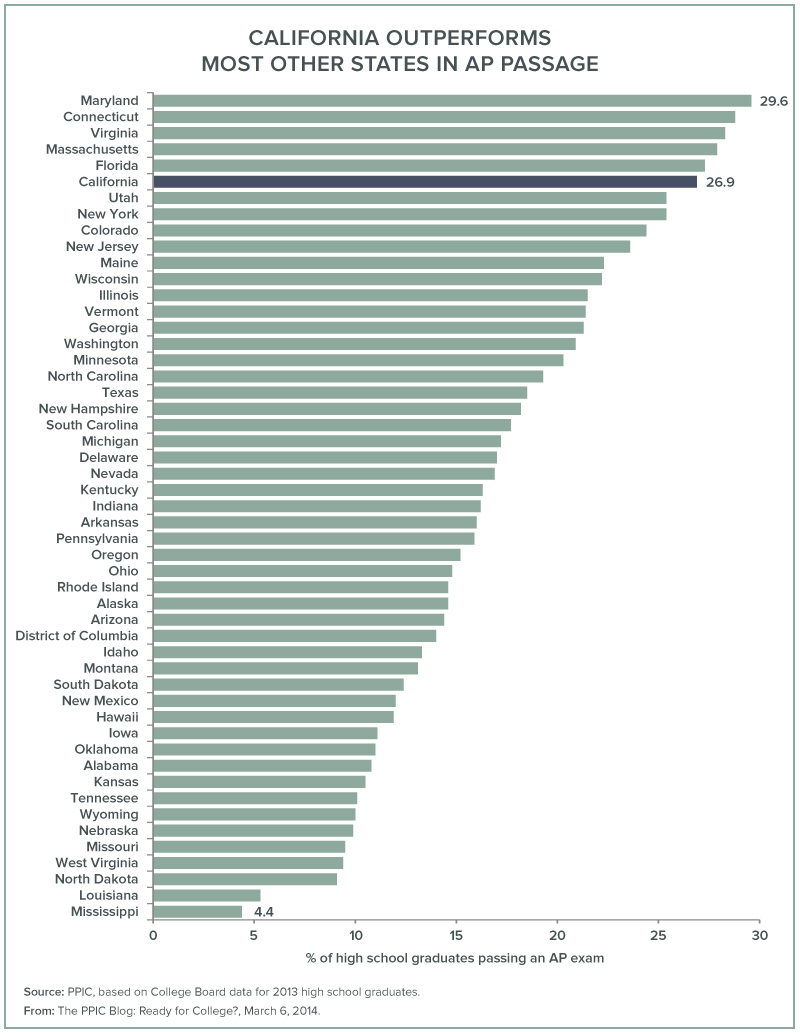
California needs more college graduates than it is currently producing. Part of the problem has been a lack of college readiness among the state’s high school graduates. Fortunately, recent trends in college preparation provide some good news. By several measures, a large and growing share of the state’s high school graduates are ready for college-level work. Indeed, many of them have successfully completed college-level courses even while still enrolled in high school.
New data on Advanced Placement (AP) exams are especially encouraging. AP courses are college-level courses in more than 30 subjects offered in high schools throughout the country. AP exams determine whether a student has attained college-level proficiency in the course, and AP exam passage rates are a meaningful measure of college preparation. Many colleges accept AP exams for college credit, and research shows that AP students outperform other students in college. Indeed, students who earn AP credits graduate at higher rates overall and often perform better in subsequent courses in the same field.
 California’s high school graduates outperform their peers in the rest of the country on AP exams. In 2013, more than one in four California high school graduates (26.9%) passed at least one AP exam sometime during high school, compared to one in five in the nation as a whole. Among the 50 states and the District of Columbia, California high school graduates ranked sixth highest. Moreover, the share of graduates successfully completing an AP exam is going up fast in California—higher than in the rest of the nation. Between 2003 and 2013, the share of high school graduates passing at least one AP exam increased 9.6 percentage points in California, compared to 7.9 percentage points for the entire nation. California has a higher share of graduates taking AP exams than does the nation as a whole (45.6% versus 35.0%), with passage rates among AP exam takers slightly higher in California (59.0% versus 57.4%).
 Other measures of college readiness also show progress. More students are taking the college preparatory courses (known as the “a–g” courses) required for admission to the University of California (UC) and the California State University (CSU). The latest data from the California Department of Education show that 38.3 percent of public high school graduates in California took the a–g courses in 2011–12, up from 34.6 percent in 2001–02 and from 32.3 percent in 1993–94. Gains in college prep work have been especially impressive among the state’s Latino high school graduates, who now make up almost half of all high school graduates. Among Latino graduates, the share taking a–g courses increased from 21.8 percent in 2001–02 to 28.0 percent in 2011–12. Increases in college readiness would be even better news if our state was responding with policies to meet the growing demand for college. But it’s not. Only the top eighth of high school graduates are eligible for UC and only the top third are eligible for CSU—according to eligibility thresholds that were set more than 50 years ago. Given the increasing shares of high school students who are well prepared for college, some reconsideration of those thresholds is long overdue.
If California is to meet the demand for educated workers, it needs to produce more college graduates. Making room for these highly capable students—by increasing the share of high school graduates eligible for the University of California and the California State University systems—would improve the well-being of our state and the lives of these young Californians.