
Just 19% of California students at California State University (CSU) campuses graduate in four years. A bill introduced this week is aimed at improving these graduation rates by addressing two commonly cited issues important to graduating on time: getting access to necessary classes and taking a full course load.
The bill would guarantee that students’ tuition is frozen at freshmen-year levels and provide priority registration for classes—as long as they take enough units to stay on track to graduate in four years and carry a certain minimum GPA. In order to graduate in 4 years, students need to average 15 units a semester (about 5 classes). However, students can take 12 units a semester (about 4 classes) and still be considered full-time by university standards and for financial aid purposes. While it does not cost any more money for students to take 15 units, many students choose to take 12 units so they can work or because they feel that 15 units would be too challenging. It’s also possible that some students just don’t know that taking only 12 units pushes them off-track to graduate on time.
Would a promise of frozen tuition be enough to cause more students to graduate in four years? After all, there has always been a financial incentive to do so. The fifth (and sixth) year of college is expensive, and later graduation also keeps student from entering the workforce full time and earning income. For example, a student starting in 2007 who graduated in 4 years would save $5,472 in tuition alone by not attending a fifth year—when including a year’s worth of room, board, books, and other related expenses, this number is closer to $20,000,and likely even more when considering the foregone earnings a student could be making during that year. Under the proposed bill, SB 1450, that student would save an additional $3,198, thanks to frozen tuition. If a vast majority of students do not finish in 4 years in light of the significant savings, would the promise of additional $3,000 in eventual savings push them to take more classes each semester?
It is possible that by highlighting near-term savings on yearly tuition the bill could convince some students to stay on track and graduate on time. How much it could move the needle for on-time graduation remains to be seen. If few students are moved to participate, the state could end up just partially subsidizing the degrees of students who were already going to finish in 4 years.
It makes sense for legislators and the higher education systems to work together to remove the barriers for on-time graduation for California’s students. This would cost students and the state less money, increase the number of CSU graduates, and makes space for more students at the university.



 Still, it is instructive to compare the earnings of former students across institutional sectors. The table shows what you would see if you looked up earnings profiles for different types of California colleges. We chose colleges with median earnings that were closest to the median of each sector.
 What the scorecards don’t show is that the difference between colleges is far smaller than the difference within colleges. The figure shows the variation in earnings at the same campuses included in the table above. First, note the tremendous overlap: many students who start at community college end up earning more than some students who started at UC and CSU. The difference in median earnings between the typical CSU and the typical UC is approximately $10,000. But the difference between the 25th percentiles and the 75th percentile of UC Davis student earnings is almost $50,000.
 The fact that most 11th-grade students are not yet ready for college is not necessarily news for California. Since 2004, California students have been able to participate in California’s Early Assessment Program (EAP), which used an optional statewide test to determine college readiness levels of 11th-grade students. The college readiness identification component of the new tests is based on the EAP and informs 11th grade students whether they are ready, conditionally ready, or not ready for college.
  But there is also some good news here for California. For students, new ratings regarding college readiness come early enough for the information to help before they enroll in their 12th-grade classes.
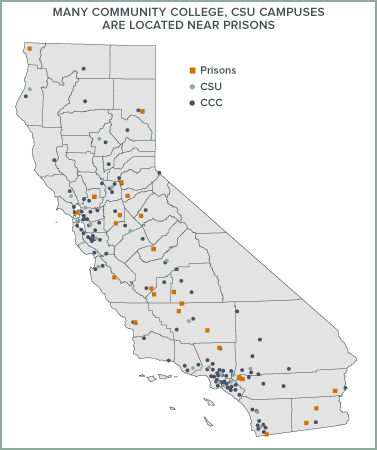 California currently supports community college education for all low-income students, including inmates, through fee waivers. However, these waivers are not available for students who wish to pursue four-year degrees. These students rely on other forms of aid, including federal Pell Grants. The Pell Grant pilot program presents an opportunity for CSU to begin working with CDCR to leverage federal dollars to expand access to high-quality, onsite higher education for inmates in state prison.


 Since 1965, the share of higher education funding provided directly by the state has shifted from the four-year systems to the community colleges. In the mid-1980s, the community colleges received about a third of the state allocations to public higher education institutions. In 2014‒15, the community colleges got more than half of the pie. Meanwhile, the share allocated to CSU and especially UC has been shrinking. UC’s share fell from 38% in 1965 to 24% in 2014‒15, and CSU’s share declined from 25% to 22%. The governor’s proposed 2015‒16 budget includes a funding increase of $843 million to the state’s public colleges and universities—71% ($600 million) of which would go to the community colleges.
 The short answer is Proposition 98.