Comparing College Readiness across States

How does California compare to other states in preparing students for college? This isn’t necessarily a straightforward question to answer, because most cross-state metrics, such as Advanced Placement or SAT performance, only capture the subset of students who are thinking seriously about college. However, California’s new 11th-grade assessments are aligned to college-readiness standards and administered in many other states—allowing us see how California compares to other states in preparing all students for college.

These new Smarter Balanced Assessment Consortium (SBAC) tests are aligned with the Common Core curriculum standards. The 2015–16 school year was the second year of statewide administration of these tests for students in grades 3–8 and grade 11 in California.

A high enough score on the 11th-grade test is an early guarantee that students can take college-level courses, rather than remedial courses, upon enrolling at any California State University (CSU) and most community colleges in the state. As part of California’s Early Assessment Program, students who score in the highest level (“standard exceeded”) in English language arts (ELA) or math are exempt from remediation at participating colleges. Students who score in the second highest level (“standard met”) are considered conditionally ready for college coursework and may become exempt from remediation upon successfully completing a specified course in the 12th grade. Ten other states also participate in the exam, and while the test scores don’t affect college remediation for all colleges in every state, over 200 colleges across most of the states accept the scores.

In California, 13% of 11th graders were ready for college courses in math and 20% were conditionally ready. In English, 26% were ready and an additional 33% were conditionally ready. California ranks about in the middle of all other states taking the exams, a surprising result considering previous standardized tests such as the National Assessment of Educational Progress have consistently placed California students as among the lowest-performing in the nation. Moreover, of the states using the exams, California has the largest share of students in the federal free or reduced-lunch program (a proxy for low-income status) and by far the largest share of English Learners. Students from both groups are about half as likely to be prepared for college compared with their peers. In other words, the California scores are perhaps more impressive in light of the barriers to college readiness that more California students face.


Does this mean that California is doing a good job preparing students for college? This 11th-grade test is meant to be an early signal to students of their college readiness. Students also have their senior year to prepare for college, and the readiness levels of 59% in English and 33% in math will likely improve by the end of 12th grade. However, for students who do go to college, remediation rates are still high at CSU (40%) and community colleges (80%), and haven’t changed much since the new assessments began. These results and cross-state comparisons show us that California has room for improvement and may face more challenges than other states moving forward.

Learn more
Visit the PPIC Higher Education Center

The Promise of a Four-Year Degree in California

Fewer than one in five first-time freshmen graduate from California State University (CSU) within four years. Because students who graduate on time require less state investment, tend to graduate with lower loan amounts and start earning income sooner, and open up space for other students, CSU has made it a priority to boost four-year graduation rates.

Senate Bill 412, known as the California Promise and recently signed by Governor Brown, aims to help more students graduate on time. Under the law, CSU campuses will promise priority course registration and additional academic advising as long as participating students pledge to take 15 units (usually four courses) per semester—while 12 units per semester is considered full-time for financial aid purposes, students need to accumulate 30 credits per year to graduate in four years.

How can the California Promise help CSU campuses increase four-year graduation?

In our research on CSU graduation rates, we have identified major factors related to low graduation rates and longer times to degree. Among the most common roadblocks are bottleneck courses—for which there is more demand than seats available. Another common problem is that students who change majors or simply don’t take the right combination of courses end up accumulating more units than they need to graduate.

Campuses have implemented several strategies to help students avoid bottlenecks, such as eliminating or streamlining course requirements, as well as increasing the number of sections offered for courses in high demand. Campuses have also focused on engaging students, improving and expanding advising, standardizing requirements across majors, and adjusting major-switching policies to address students accumulating extra units. Campuses expect their focus on four-year graduation to increase with the implementation of the new Graduation Initiative, which sets specific targets for on-time graduation rates. The California Promise also aims to help campuses address these roadblocks. Students who participate in the program will be able to enroll in the courses they need through priority registration. Participating students will receive advising and monitoring to help them take the right number and types of courses. The contracts will also stress the importance of taking enough units to graduate on time.

Who will benefit from the California Promise?

Students have to apply for the program, but automatic acceptance will be offered to any eligible applicant who graduated from an underserved high school, comes from a low-income family (defined as being eligible for a federal Pell Grant), or is a transfer student or first-generation college student. Other students may be accepted as well, as money permits. The California Promise may shorten times to degree for students in the targeted groups who are ready for college-level courses and able to take a full load but who would normally struggle to graduate on time due to course availability, a lack of advising, or who might otherwise take less than a full load without the promise. It is difficult to estimate how many students will fit into this group.

We know that about 40% of freshmen require remediation and may not be able to participate in the promise. Other students may work too many hours to enroll in 30 units per year. Another potential challenge is that high participation levels may make it harder for students who aren’t part of the program to graduate on time. Since no new funding is attached to the law, there are no new courses or advisers. Students without priority registration are likely to have less of a chance of getting in-demand courses that they need. And advising resources could also shift away from those students who are not a part of the contract.

Some campuses, such as CSU San Bernardino, already offer similar contracts. While initial results from some of these contracts suggest a positive impact, the programs are generally small in scope and still need rigorous evaluation. As campuses consider how to structure these agreements, they need to prevent students who don’t or can’t meet the terms of the contract from getting left behind. It will also be important for policymakers to consult with CSU campus leaders, faculty, and students to ensure that there is sufficient support for the program.

Learn more

Read the report Improving College Graduation Rates: A Closer Look at California State University
Visit the PPIC Higher Education Center

Free University Tuition: How Many California Students Would Benefit?

During this election cycle, several candidates have proposed making public college tuition free. While some at the state and national levels are supporting tuition-free community college, Hillary Clinton has outlined a plan that includes four-year colleges—she proposes free tuition for students whose families earn less than $85,000. By 2021 that income threshold would rise to $125,000. How many students in California might benefit from such a plan?

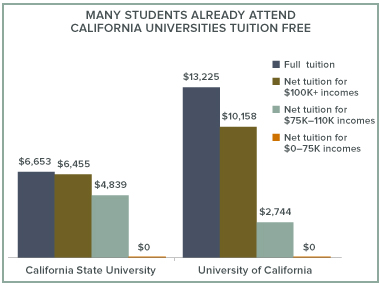
Many students already attend California universities tuition free

California’s financial aid program, Cal Grants, provides grants (funding that students do not have to pay back) for full tuition for the state’s lowest-income students, as well money toward books and living expenses for some of them. Through a combination of Cal Grants, federal aid, and institutional aid, UC’s Blue and Gold Opportunity plan guarantees free tuition for any family making $80,000 a year or less. CSU has a similar plan, the State University Grant, which bases the amount a family will pay on a number of factors. On average, students who receive financial aid pay no tuition at UC or CSU if their families make $75,000 or less.

Expanding free tuition could impact thousands of California families

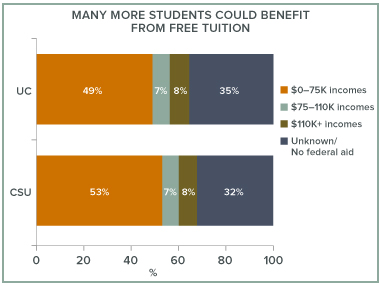
While the data on family income are not perfect, they can help us estimate how many students we might expect to benefit from free tuition. Right now, students from families in the $0 to $75,000 range make up about 49% of entering students at UC and 53% at CSU.

Raising the cap to $110,000—or beyond—would cover at least another 7% of students entering UC (2,300 students) and CSU (3,900 students) in 2014. The average student whose family income is between $75,000 and $110,000 would save about $4,839 at CSU or $2,744 at UC, resulting in more than $25 million in combined tuition savings for those thousands of families.

These estimates may be low, as many middle-class students who currently do not qualify for financial aid may have income levels that that would fall below the cap of an expanded program. Also, a nationwide free tuition program might encourage many low-income students who are currently scared off by the high sticker prices to apply to college or university.

The details of the plan would matter, of course. But if the federal government were to cover all of the $25 million needed to expand full-tuition guarantees at UC and CSU, it’s possible that thousands of low- and middle-income California students could benefit.

Notes: Data for both figures are from IPEDS for entering first-time California resident freshmen in fall 2014. Net tuition applies only to students who received some form of federal aid (grants or loans), which includes 68% of students at CSU and 65% of the students at UC.

Learn more

Visit the PPIC Higher Education Center

Improving On-Time Completion: Year-Round Pell Grants

California and the nation as a whole are pushing for more students to graduate from college in four years. This would not only open up more spots for new students, but also allow students to spend less money on tuition and fees and enter the workforce sooner―creating benefits for both students and the state.

In the graduating class of 2015, 64% of UC and 19% of CSU students graduated within four years. While both systems have made commendable gains since the graduating class of 2005―UC’s on-time graduation rate is 10 percentage points higher and CSU’s has increased by 6 points―there is room for improvement.

We recently looked at the University of Hawai‘i’s 15 to Finish campaign, which has shown early success in encouraging students to take more units per semester and improving on-time graduation rates. However, not all students can take 15 units every semester—and this inability can increase their time to completion. For example, a student who takes 12 or 13 units each semester needs an additional year to complete a four-year degree.

One possible way to help lower-income students graduate on time is to bring back the year-round Pell Grant, which was introduced in the 2009–10 academic year to supplement the original Federal Pell program. The year-round grant allowed students who had exhausted their academic-year Pell awards to pay for summer courses as long as at least one of the units counted toward the next academic year. Funding was also available to students who had not completed the standard unit load due to unforeseen circumstances, allowing them to catch up during the summer. Either way, the year-round Pell provided students unable to take 15 units a semester a pathway to graduate on time.

The year-round Pell was cut in 2011 in response to rising costs—a result of more students becoming eligible and enrolling in college. This cut was part of a compromise that prevented proposed reductions in the maximum award amount from occurring. Because the year-round program was short-lived, we can’t assess its impact. Congress has shown some interest in reviving the year-round Pell, but lawmakers have not passed a bill restoring it, as the Senate and House have differing views on bringing it back.

Given the current focus on improving both student completion and institutional efficiency, it may be time to take another look at a year-round Pell Grant program. Providing more opportunities, especially affordable ones, for summer coursework could help more students graduate on time, make better use of campuses, and help California—and the rest of the nation—meet future demand for educated workers.

Learn More

Visit the PPIC Higher Education Center

Spending on Corrections and Higher Education

California has long been criticized for its growing corrections expenditures, especially as General Fund spending on higher education has declined. The beginning of a new budget year is a good time to examine where the state now stands on spending in these two key areas.

California’s legislature recently adopted a budget for 2016–2017 that devotes $14.5 billion of General Fund revenue to higher education institutions, including the University of California, California State University, and California’s community college system. It allocates $10.6 billion for operations of the California Department of Corrections and Rehabilitation (CDCR), which is responsible for adults in state custody and parolees under state jurisdiction.

These budget allocations reflect a striking shift from California’s budget of forty years ago, when the state spent a larger share on higher education and a much smaller share on corrections. But by the 2008–2009 budget year, allocations to higher education (11.1%) and corrections (10.7%) were almost identical. In the years since, higher education spending has outpaced corrections in relative terms, largely because recent criminal justice reforms have drawn down the number of adults in state custody and on parole. Nonetheless, California spends more on corrections and less on higher education today, in relative terms, than at nearly any point in the past thirty years.

Despite these dramatic trends, spending in each area has actually increased alongside of growth in the populations served. Enrollment in higher education institutions has increased roughly 50% since the 1977–78 academic year; the budget has increased 65% (according to CPEC Fiscal Profiles). Until 2011’s realignment of California’s corrections responsibilities, the number of adults in CDCR custody had increased 555% and the budget increased 526% (CDCR Monthly Population Reports).

Clearly the costs of serving these two populations are different. On average, the cost of the CDCR population is much higher than the cost of students in higher education. Within each area, costs per person vary as well. The cost of educating a student at UC far exceeds the cost of doing so at a community college. Similarly, the cost of incarceration far exceeds the cost of supervising a parolee in the community. Although the per person cost of delivering services has risen over time, the dramatic increase in the prison population has been the key driver of the dramatic shift.

To reverse these trends, the state must identify and disseminate cost-effective strategies to reduce recidivism, further diminish California’s crime rates, and ultimately reduce the prison population enough to allow for the closure of state facilities or the elimination of in-state and out-of-state contract prison beds used to relieve overcrowding. Corrections realignment reduced state prison and parolee populations, but the anticipated savings from this policy shift have yet to materialize. Moreover, the most recent reports show a small uptick in the corrections population (CDCR Monthly Population Reports). ​

In the meantime, California needs to find ways to accommodate more students in its higher education systems—which it could do at relatively low cost by reducing time to degree, or at higher cost by increasing financial aid or expanding the number of slots for students. At the end of the day, ensuring that more of California’s youth attend and complete college will reap positive long-term benefits for the state, helping to meet the needs of the state’s future economy and create a brighter future for all Californians.

Chart source: California Department of Finance Chart C-1 Program Expenditures by Fund.

Learn more

Will California Run Out of College Graduates?
“California’s State Budget”
California’s Future: Corrections

Increasing On-Time Graduation Rates in Hawai‘i


This post is part of an occasional series examining how California can learn from policies in other states.

While 57 percent of students at California State University (CSU) earn a bachelor’s degree, only 19 percent of first-time freshmen graduate in four years. Taking longer to graduate increases the cost of the degree and delays entry into the workforce.

One reason students are not graduating in four years is because they are not taking a full course load of 15 units—about five classes—per term. For financial aid purposes, students are considered full-time if they enroll in 12 units per term—about four classes. But taking 12 units means taking an extra year to graduate. Students have many reasons for taking less than a full load: family obligations, employment, inadequate preparation for the rigor of college courses, or the cost of extra books. It is also possible that students do not realize they need 15 units per term to graduate in four years. UCLA’s Cooperative Institutional Research Program found that 86 percent of freshmen nationwide believe they will graduate in four years, but only about 55 percent actually do so. CSU may be able to learn from 15 to Finish, a campaign adopted by the University of Hawai‘i in 2011 to increase student enrollment in 15 units per term and increase their four-year graduation rates.

Policy: University of Hawai‘i’s 15 to Finish Campaign

In 2010, the University of Hawai‘i system (UH) launched the Hawai‘i Graduation Initiative (HGI) to increase college participation and completion. One of HGI’s strategies is a 15 to Finish campaign to encourage university and community college students to enroll in 15 units a term so they can graduate in four years. Other HGI strategies include creating block or cohort scheduling so that groups of students take the same courses together; reducing summer tuition; and developing academic roadmaps to help freshmen plan their course sequences to graduate on-time. The 15 to Finish campaign’s communication strategy highlights the need to take 15 credits per term and the benefits of graduating in four years in television commercials, informational handouts, and student orientations. It also markets the additional three units as “free” because tuition is the same for 12 and 15 units.

Policy Impact

The early results of UH’s 15 to Finish campaign look promising. Between 2011 and 2013, enrollment in 15 units per term rose by about 5 percentage points, to 25 percent of the UH student population enrolled in 15 units. More important, the system’s four-year graduation rate has risen 7.2 percentage points since the graduating class of 2012, to 25 percent. At CSU, the four-year graduation rate has improved just 2.9 percentage points, to 19 percent, over the same period.

Lessons for California

CSU’s 2015 Graduation Initiative was successful in raising six-year graduation rates. As the system launches a new 2025 Graduation Initiative, which focuses in part on increasing four-year graduation rates, campuses should consider implementing a media strategy to inform students about the three “free” units per term that will help them graduate on-time. One campus, Cal State LA, has already started: it launched a 15 to Finish campaign in August 2015, in anticipation of its transition to a semester calendar.

A system-wide 15 to Finish campaign could also persuade some campuses to stop discouraging students from taking 15 units if they work. It would be more helpful for campuses to inform students they need 15 units a semester to graduate in four years and give them estimates of the number of homework hours created by this course load, so they can make their own decisions about how many units to take each term.

This kind of messaging could also help UC and the community colleges increase on-time completion rates. It could be a relatively simple way to create more room for new students and increase the number of college graduates in our state.

Learn more

Visit the PPIC Higher Education Center

Video: Improving Graduation Rates at California State University

California State University (CSU), the nation’s largest university system, has steadily improved graduation rates, but there is more work to be done, PPIC researcher Jacob Jackson told a Sacramento audience last week.

The system still struggles with graduation gaps. Historically underrepresented students are much less likely than their peers to get degrees. Even though the system has higher six-year graduation rates than similar universities, it lags behind in the share of students who graduate in four years. This comes at a high cost to both the state and CSU students.

As CSU launches a new initiative to improve graduation rates, Jackson and fellow PPIC researcher Kevin Cook coauthored a report analyzing the system’s progress to date. The authors also describe promising strategies that could help CSU reach its goal of increasing graduation rates and cutting graduation gaps in half by 2025.

Learn more

Read the report, Improving College Graduation Rates: A Closer Look at California State University
Visit the PPIC Higher Education Center

Testimony: Closing California’s Workforce Skills Gap

Hans Johnson, director of the PPIC Higher Education Center and PPIC senior fellow, testified before the Assembly Budget Subcommittee Number 2 on Education Finance in Sacramento yesterday (May 17, 2016). Here are his prepared remarks.


The Public Policy Institute of California (PPIC) projects that between now and 2030 California will fall 1.1 million bachelor’s degrees short of workforce demand.1 Closing this gap will require substantial improvements in access to four-year colleges, transfer rates from community colleges, and completion rates among students who enroll in college. In this testimony, PPIC identifies specific goals for access, transfer, and completion at California’s public colleges and universities, and increases in private colleges that together could close the workforce skills gap.

Our work on this issue emphasizes that closing the workforce skills gap will require strong improvements in college enrollment and completion among underrepresented groups, including low-income students, first-generation college students, Latinos, and African Americans. California cannot succeed economically unless gaps in educational attainment are eliminated or at least substantially reduced. A forthcoming report from PPIC will show how new goals for access, completion, and transfer will improve equity in California.

In our baseline scenario, which is based on current practices and procedures, California’s public and private higher education institutions will produce 3.1 million bachelor’s degrees between 2015–16 and 2029–30. This baseline scenario assumes that the state’s college enrollment rates, completion rates, and transfer rates will remain at current levels.

Our “closing-the-gap” scenario charts a course to producing 4.2 million bachelor’s degrees over the next 15 years. In this scenario, the total number of bachelor’s degrees awarded in 2029–30 would be 60 percent higher than in the baseline scenario—and it would be 72 percent higher than the number of degrees awarded in 2014–15. Such dramatic increases are not entirely without precedent. Between 2002–03 and 2014–15, the annual number of bachelor’s degrees awarded by California’s public and private universities increased almost 50 percent. Gains in earlier periods were even more impressive. For example, between 1964–65 and 1979–80 the number of bachelor’s degrees awarded at CSU increased 95 percent.

In the recent past, growth in the number of bachelor’s degrees awarded at UC and CSU was fueled primarily by increases in the number of students who enrolled in college and secondarily by increases in completion rates. Even though the share of high school graduates entering UC and CSU did not change appreciably, enrollment increased as the number of high school graduates grew.

The California Department of Finance projects that the number of high school graduates will not change substantially over the next fifteen years. This means that increasing the number of bachelor’s degrees awarded will require changes in three key thresholds in the education pipeline from high school to college to degree.

  • First, the share of recent high school graduates eligible for and enrolling in four-year colleges will need to increase.
  • Second, persistence and completion rates for students enrolled in college must increase.
  • Third, the number of students who transfer from community colleges to four-year colleges (or return to college) must increase.

The exact mix of improvements in these three areas is not set in stone. Our closing-the-gap scenario is based on empirical trends, and our current focus is on public institutions. We assume that private colleges will keep pace with those in the public sector, continuing to produce about a third of all bachelor’s degrees awarded each year. Also, we have not incorporated applied bachelor’s degrees awarded by the state’s community colleges, as those numbers are still very small. This means that UC and CSU together would need to produce an additional 730,000 bachelor’s degrees over this period and private colleges would need to produce an additional 340,000 bachelor’s degrees (a total of 1.1 million) to fully close the degree gap by 2030. Private nonprofit colleges would account for the vast majority of the additional degrees awarded by the private sector.

Our initial closing-the-gap scenario sets the following targets for the state’s public colleges and universities:

  • Eligibility will increase 5 percentage points over current levels at UC (the top 17.5 percent of high school graduates will be eligible for UC, up from the 12.5 percent share set by California’s Master Plan for Higher Education) and 6.7 percentage points at CSU (the top 40 percent will be eligible for CSU, up from the top third). These new eligibility levels will be phased in over an eight-year period.
  • The number of transfer students will increase 35 percent over baseline levels. These increases will be phased in over a five-year period.
  • Completion rates will increase 9 percentage points at UC and 17 percentage points at CSU. At UC, completion rates for students who enroll as freshmen will increase incrementally from 83 percent in 2016 to 92 percent by 2026. Completion rates for freshmen at CSU will increase incrementally from 57 percent in 2016 to 74 percent by 2030. There will be similar increases in completion rates for transfer students at both institutions.

CSU will account for most of the increase in degrees awarded over the entire projection period—it will award 481,000 additional degrees, compared to UC’s increase of 251,000. This is both because CSU is a larger institution, enrolling many more students than UC, and because CSU has much more room for improvement in graduation rates. Private nonprofit colleges would also play an important role, adding an additional 206,000 degrees. Other additional sources, such as private for-profit colleges, online degree programs, and bachelor’s degrees awarded by community colleges, will also need to play a role (see Table 1).

Most of the projected increase in degrees awarded at CSU comes from improvements in completion, while increased eligibility accounts for almost half of UC’s increase. Increased transfer rates will also be necessary to close the gap (see Table 2).

Of course, this is just one scenario for closing the workforce skills gap (our interactive model is available upon request). In the future, we expect to develop alternative closing-the-gap scenarios; we will also examine the potential impact of shortening the time it takes students to get their degrees. Additional work should assess the role that private institutions might play. Other scenarios might involve different assumptions and targets. But, however it is accomplished, closing the gap will lead to better economic outcomes for all Californians, increased state revenues, and reduced social service demands.

1. Hans Johnson, Marisol Cuellar Mejia, and Sarah Bohn, Will California Run Out of College Graduates? (PPIC, 2015).
Figure note (middle): “Other” includes online degrees, private for-profit degrees, and applied bachelor’s degrees awarded by the community colleges.
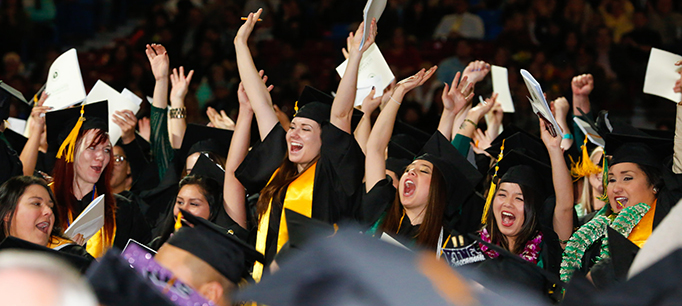
Photo credit: Public Affairs/Sacramento State

Early Results from Education Reforms

California’s K–12 system is implementing an unprecedented number of reforms. The state’s school funding system and curriculum standards are new, as are all statewide tests. A new school accountability system is being developed. A number of large urban districts are changing their high school graduation requirements. These reforms are designed to equalize opportunities for students and close achievement gaps among demographic groups.

It will be some time before we know what all of these changes add up to, but PPIC researchers who examined the early results of two reforms presented their findings at a PPIC event in Sacramento last week.

California’s New Standardized Tests

PPIC senior fellow Laura Hill summarized the results of California’s new standardized tests, the focus of a PPIC report she coauthored. The scores show that English Learners and economically disadvantaged students are far behind other student groups—possibly farther behind than initially thought. As the accountability system evolves in the state, the test results are an important call to action for districts and schools struggling to help high-need students, Hill said. High-need students did well in some schools and districts, and the first-year results provide an opportunity to learn from their experiences.

College Prep for All?

Julian Betts, an economics professor at the University of California, San Diego, and PPIC adjunct fellow, examined a high school graduation requirement that makes college preparatory courses mandatory for all students. Major urban school districts—including Los Angeles, San Diego, San Francisco, and Oakland—recently implemented this requirement, making it mandatory for students to complete the a–g sequence of classes required for admission to the University of California or California State University. Based on a PPIC analysis of the San Diego Unified School Districts’ Class of 2016, Betts and his coauthors concluded that this requirement is likely to help many students but damage the prospects of others. He suggested steps that San Diego and other districts can take to help lower-achieving students meet the new graduation goals.

Learn more

Visit PPIC’s K–12 education pages
Visit the PPIC Higher Education Center

Reducing Tuition Volatility at California’s Universities

After sharp increases in tuition during the recent recession, the California State University (CSU) and University of California (UC) systems made an agreement with the state to freeze tuition in exchange for increases in state funding starting in 2012. However, state support has not returned to pre-recession levels and the agreement runs out after this school year. It’s clear that the universities will raise tuition, but it’s not clear when or by how much.

The history of tuition increases at UC and CSU shows that periods of low or no tuition growth are often followed by large spikes in growth, most recently in response to declines in state support. California’s universities are not guaranteed a part of the budget (as K–12 and the community colleges are), so declines in state revenue (such as during a recession) often result in declines in state allocations for higher education. Universities raise tuition to make up the lost revenue, leading to volatility in tuition increases from year to year.

Instead of instating abrupt tuition increases, universities could rely on gradual, scripted changes, which would benefit students who are planning their finances around spending the next four (or more) years at a university. What kind of gradual change have we seen historically? Since 1979, tuition and fees have risen considerably at both UC and CSU—on average, about 8.6% annually at UC and about 11.3% at CSU. Some have suggested tying tuition increases to inflation, which over the same period, rose only about 3.1% yearly. In 2014, UC considered a plan to increase tuition at 5% each year for five years in an effort to make tuition increases transparent and steady—rather than unpredictably sudden and large. This plan was highly controversial at the time, but it would have resulted in yearly tuition increases that were lower than the average yearly increase across the last 35 years.

It is impossible to predict when the next recession will hit or what it will do to state revenues and higher education support. Steady increases could provide a cushion for universities if a drop in state funding occurs, and may allow them to keep to their planned tuition increases—but that depends on how the legislature responds to increases in tuition and the next recession.

When tuition does rise, the state and university systems should work together to make sure college is affordable for low-income students, especially considering PPIC projections that show a need for more college educated workers by 2030. The state’s generous financial aid programs mostly kept up with the sharp tuition increases from 2007 to 2011, but some low-income families had to pay more than they did before those increases.

The state could take steps of its own to make funding for the university systems less volatile. For example, some have suggested a dedicated funding stream, such as Proposition 98’s provision for community colleges and K-12, could limit cuts in state support for the university systems during recessions and improve their ability to plan for the future.

Chart source (TOP): University of California, California State University, Bureau of Labor Statistics. Chart source (BOTTOM): University of California, California State University.

Learn more

Read Higher Education in California: Making College Affordable
Visit the PPIC Higher Education Center