The Growth of Cal Grants

The Cal Grant program is the primary program for providing tuition assistance and financial aid to California’s college students. It has allowed California to maintain access to college for low-income students during a time of rapid tuition increases. The program has grown significantly since its inception in 1955 and now serves more than 300,000 students at an annual cost of around $2 billion.

State law protects Cal Grant recipients from tuition increases at UC or CSU: when tuition rises, so do these students’ Cal Grants. Consequently, as tuition has increased and enrollment of low-income students has expanded, the program has grown rapidly. Next fall, tuition is scheduled to increase by $280 per year at UC and by $270 per year at CSU. In addition, UC, which has enrolled 7,400 new undergraduates in each of the last two years, plans to enroll an additional 2,500 in the fall of 2017‒18, the largest three-year increase in seventy years. CSU has added around 50,000 additional students over the past five years. The expansion of Cal Grants has drawn the attention of the governor. He noted in his May budget revision that “rising Cal Grant costs from tuition hikes will also limit the state’s ability to increase General Fund support in the future.”

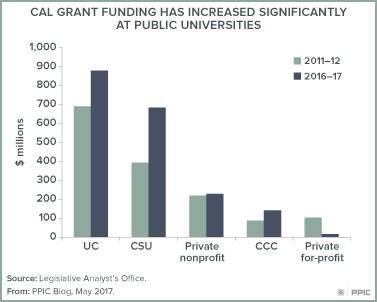
Figure: Cal grant funding has increased significantly at public univerisities

Nearly all of the Cal Grant funding increases have gone to students attending public institutions. CSU has seen a 75% increase in Cal Grant funds since 2011‒12, while the community colleges and UC have received a 61% and 27% increase respectively. Private nonprofit colleges, on the other hand, have seen their Cal Grant funding stagnate. The governor’s budget revision acknowledges this by reallocating $8 million that had been targeted to UC and CSU in his January budget proposal to non-profit private Cal Grant funding. These funds will prevent a planned cut to the maximum award for students attending a nonprofit private college.

By contrast, for-profit colleges have seen their Cal Grant funding decrease substantially over the past five years. The 2012‒13 budget introduced restrictions on access to state Cal Grants which affected many for-profit colleges. To some degree, for-profit colleges satisfy an unmet need for access to higher education for non-traditional students. But investigators have found that many of these colleges engage in predatory marketing and lending practices—targeting vulnerable students, making false statements regarding job placement, and overestimating the value of the degrees they provide. To address these issues the state established new institutional eligibility standards for Cal Grants. To be eligible, a higher education institution must now have a minimum graduation rate of 30% and a loan default rate of less than 15.5%. The 2012‒13 budget also cut the maximum award for a student attending a for-profit college from $9,708 to $4,000. These regulations have saved the state nearly $100 million since 2011‒12, reduced by more than half the number of for-profit colleges eligible for Cal Grants, and ensured that low-income and first generation students were not taken advantage of by higher education institutions that did not serve their economic interest.

Cal Grants are an essential tool for improving the economic mobility of the state’s neediest residents. They also allow the state to reduce the burden of federal loans on young Californians. Maintaining Cal Grants for high performing colleges— public and private—will improve access to college for all Californians.

Learn morEVisit the PPIC Higher Education Center

The Growth of College Promise Programs

A majority of Californians believe that college affordability is a big problem for the state, according to the PPIC Statewide Survey. Low family incomes and the high cost of living have made it difficult for many students to pay the full price of college. This is true even though California’s public colleges and universities have some of the lowest tuition levels in the country and the majority of community college, UC, and CSU students receive grants to cover the cost of tuition. Policymakers have taken notice of the public’s concerns.

Many local governments, school districts, colleges, and business communities have been addressing the issue of access and affordability through “promise programs.” The “promise” label has been adopted to represent a wide range of programs that share at least two specific characteristics: they are limited to individuals in a particular geographic area, such as a city or school district, and they provide some level of financial support for postsecondary education. Nearly 80 promise programs have been launched nationwide since 2001. In California, according to WestEd, 23 of these programs have been created since 2008—13 of them in the past two years.

The most well-known California-based promise program is the Long Beach Promise, which offers all public school students in the district a tuition-free first semester at Long Beach Community College. It also guarantees admission to Long Beach State University for students who complete required college preparatory courses with the necessary grades.

College promise programs often couple financial incentives with extensive outreach to middle-school students and improved student services like tutoring and counseling. In California, the vast majority of these programs are focused on getting students to enroll in community colleges—most offer one semester of free community college tuition and do not provide enrollment guarantees to a four-year college.

While it’s important to ensure that students who might not otherwise consider college be given incentives to attend, the state’s biggest challenge is ensuring that college students stay in school and earn a degree or certificate. Only about half of California community college students receive an associate degree or certificate, transfer to four-year schools, or complete 60 transferable units within six years of enrolling. There is some anecdotal evidence that promise programs improve college-going rates, but they do not seem to boost college completion. In order to improve completion rates, programs may need to provide support services for participants who have entered college.

More generally, the wide range of program designs makes it difficult to assess their effectiveness—even within California, promise programs have different residency requirements, eligibility criteria, grades of entry (middle school vs. freshman year of high school), financial awards, support services, and levels of financial sustainability. Defining the basic elements of promise programs and developing effective standards for program design and implementation will help ensure their future success.

Learn more

Read the PPIC Statewide Survey: Californians and Higher Education
Visit the PPIC Higher Education Center

More Students Completing College Prep Courses

Over the past few years more school districts have made college preparatory courses mandatory for high school graduation. These districts have aligned their graduation requirements to the CSU and UC a-g sequence in an effort to make more students college ready. Some of these districts include Los Angeles, Oakland, San Francisco, San Jose, Sonoma Valley, and Vallejo City Unified; the East Side Union High School District in San Jose; and the San Diego Unified, Carlsbad Unified, and Sweetwater Union High School District in San Diego County. Most of these requirements are too new to evaluate, but as more districts make this change, it is important to understand the potential impact. A PPIC report on San Diego Unified found that about 10 percent more students would become eligible to apply to UC and CSU because of the requirement.

The a-g sequence is a set of high school courses required for admission to UC and CSU. The content is rigorous and broad, designed to provide students with a solid foundation of general knowledge. It covers seven different subject areas: (a) history/social science, (b) English, (c) mathematics, (d) laboratory science, (e) foreign language, (f) visual and performing arts, and (g) college-preparatory electives; it includes a total of 15 year-long courses or 30 semesters. These courses are viewed as more rigorous than standard high school courses, as they must meet the criteria developed by the UC’s Board of Admissions and Relations with Schools (It is possible that a non-a-g course is equally rigorous but has simply not undergone a-g approval).

The new a-g graduation requirements have raised concern that many students would be unable to meet them—the reform designed to prepare more students for college might result in lower high school graduation rates. Given this concern, most a-g aligned districts require that students earn a D or higher, which is lower than the UC and CSU requirement of a grade of C or higher.

As it turns out, more students are meeting the a-g requirements with a C or higher. Over the last 10 years there has been an increase of 48% in those meeting the requirements—or 60,000 more high school graduates—with 43% of the class of 2015 doing so.

As more students complete the a-g sequence, the UC and CSU systems receive more applications and admit more students. Between 2011 and 2016, 23% (or 54,383) more Californians applied to UC and CSU, and the systems admitted 20% (or 33,557) more California applicants. However, both systems still limit or deny access to some qualified students. In the 2014‒15 school year, UC redirected 10,688 eligible California students to UC Merced―they had been denied admission to other campuses―but only 195 actually enrolled. The following year, the CSU denied over 17,000 eligible California students, which amounts to almost 55% of denied applicants.

Improvements in college preparation among California’s high school graduates is great news. The challenge is to ensure that our colleges and universities are able to accommodate the increase in demand that comes with it.

Learn more

Read the report College Readiness in California: A Look at Rigorous High School Course-Taking
Visit the PPIC Higher Education Center

Video: Top Goals of Higher Education Leaders

California’s higher education system is not keeping up with the economy’s changing needs, PPIC research has shown. Falling behind in creating a skilled workforce could curtail economic growth, limit economic mobility, and increase inequality in the state. The leaders of the California Community Colleges (CCC), California State University (CSU), and University of California (UC) are essential in the effort to increase the number of educated workers, because the vast majority of the state’s college students attend public colleges and universities.

Hans Johnson, director of the PPIC Higher Education Center, summarized this research, and the three leaders of the higher education system sat down last week with Mark Baldassare, PPIC president and CEO, to talk about their goals before a large Sacramento audience.

The first question: What are your top goals in the next decade?

Eloy Ortiz Oakley, CCC chancellor, said it is a critical time for the 113-campus system. “We connect with so many Californians at a time when the economy is changing before our eyes, and the default to get into the workforce is no longer a high school diploma. Some sort of post-secondary credential is essential. That is our focus.”

He said he is working with the other higher education branches and the K–12 system to integrate them into “one public system of education, not four separate systems.”

Timothy White, CSU chancellor, had a similar focus on results. “Our number -one priority in the years ahead is to improve the success rates of our students,” he said, adding that just 20 percent of CSU students earn their degrees in four years. He said he wants to make sure CSU students have access to courses when they need to take them, as well as sufficient faculty and academic support.

Janet Napolitano, UC president, said, “My vision is that the University of California remain the top public university in the world.” Citing the recent growth in enrollment of in-state students, she said that sustaining academic excellence, increasing diversity, and producing students who will be the next generation of California’s leaders are all key parts of this vision.

Learn more

Visit the PPIC Higher Education Center

Californians Favor Higher Taxes over Higher Tuition

After six years without tuition increases, California’s public universities are considering proposals to modestly raise tuition for California residents. The University of California (UC) has proposed increasing systemwide tuition and fees for undergraduates by $336 to a total of $12,630 for the academic year. The California State University (CSU) has proposed increasing in-state student undergraduate tuition by $270 to a total of $5,742 for full-time students. Campuses at each system charge additional fees, which currently average about $1,200 at UC and $1,400 at CSU.

A recent PPIC Statewide Survey on Californians and higher education indicates that these proposals are likely to be unpopular with the public. The survey found that Californians are concerned about the cost of college: 57% said that the overall affordability of California’s public colleges and universities is a big problem. Only 23% of Californians would be willing to increase student fees in order to increase funding for California’s public higher education system.

This is not the first time Californians have voiced disapproval of tuition increases. Before UC and CSU raised tuition in 2011, PPIC’s 2010 higher education survey found that only 35% of Californians favored increasing student fees as a way to maintain higher education funding levels in the face of state budget cuts. In 2011, our survey found that 65% of Californians were very concerned about increasing student tuition and fees as a way to deal with decreased funding.

Today, when many policy preferences are often divided along party lines, there is partisan consensus on this issue: at least 70% of Californians across parties say they would be unwilling to increase student fees to fund higher education. Indeed, less than a third of Californians across all regions and demographic groups say they would be willing to increase student fees.

At the same time, a majority of Californians (67%) believe that the current level of state funding for public colleges and universities is inadequate. So what are Californians willing to do to increase funding for public higher education? Overall, they are twice as likely to say they are willing to pay higher taxes as to say they are willing to increase student fees (48% to 23%). However, and perhaps unsurprisingly, we see notable partisan differences when it comes to willingness to pay higher taxes. While 68% of Democrats say they would be willing to pay higher taxes to increase funding for public colleges and universities, only 20% of Republicans say the same.

Another way to increase funding for California’s public colleges and universities would be to admit more out-of-state students, who pay higher tuition. Californians are somewhat divided on this issue, with half saying they would not be willing to admit more out-of-state students, while 46% say they would be willing to do so. However, only 21% of Californians support admitting more out-of-state students if this would mean admitting fewer in-state students. This view holds across party lines: only one in four Republicans (25%), and even fewer independents (21%) and Democrats (16%), are willing to admit more out-of-state students if this would mean admitting fewer in-state students. UC has proposed increasing systemwide out-of-state tuition and fees by over $1,600 to almost $40,000.

Our survey findings suggest that the proposed UC and CSU tuition and fee increases may be unpopular among Californians of all political persuasions—and that Californians’ reluctance to increase the financial burden on the state’s students may be driven by concerns about access and affordability.

Learn more

Read the PPIC Statewide Survey: Californians and Higher Education
Find out more about the PPIC Statewide Survey
Visit the PPIC Higher Education Center

College Costs Could Rise for Some Students

The governor’s budget proposal includes increased funding for UC and CSU but likely not enough to keep the systems from raising tuition—which the governor said he expects. The proposed tuition increases (about 5% at CSU and 3% at UC) are modest compared to the large increases from 2006 to 2011 (104% at CSU and 92% at UC). PPIC has shown that while financial aid increases protect most students from low income families from tuition hikes, students from middle- and upper-class families see their costs increase.

The governor’s proposed budget also phases out the Middle Class Scholarship program. Created by the legislature in 2013—after CSU and UC costs climbed rapidly—this program aimed to help students from families too wealthy to receive Cal Grants (state grants that cover tuition for low-income students). The scholarships cover 10% to 40% of tuition (depending on family income and assets) for eligible students from families with incomes up to $156,000. About 37,000 students benefitted from the scholarship this year.

How much do middle-class students pay?
To characterize what a student pays to attend college, we often use the term “net price”—a comprehensive accounting of student costs and assistance. To determine the net price, we add books, room and board, and other expenses to tuition, and subtract federal, state, institutional, and local grants and scholarships (money that a student doesn’t have to pay back).

Students who receive some form of federal financial aid (grants, loans, work study, etc.) generally pay much less than the full cost of college. For students from families making less than $80,000, federal, state and local grants usually cover at least the full tuition at both CSU and UC—but these students pay a net price that could be as high as $11,000 a year at CSU and $13,000 at UC in order to cover expenses other than tuition. Students from families making $75,000 to $110,000 are generally too wealthy for federal and state grants; they pay a much higher average net price of about $16,000 at CSU and $21,000 at UC. (Also, many students pay close to the full cost because they do not apply for and/or are ineligible for federal aid.)

The most recent cost data is from 2013‒14—this was the first year of the Middle Class Scholarship program. Average awards that year were $1,100 or less, and once the program was fully implemented awards were slated to range from $1,300 and $5,400 at UC and $700 and $2,700 at CSU, depending on the income and assets of eligible students and on the number of applicants.

Not surprisingly, the phasing out of the Middle Class Scholarship and the impending tuition increase are expected to have a disproportionate impact on middle- and upper-class students. As a result, those students will probably pay more for their degrees.

Learn more

Read “Higher Education in California: Student Costs”
Visit the PPIC Higher Education Center

Improving College Placement Policies

Assessment and placement policies govern where students begin their college trajectory. This is a high-stakes issue for students, affecting how quickly they achieve their educational goals. Too often, it affects their likelihood of reaching these goals at all. Students who are placed in developmental, or remedial, courses end up spending significant portions of their limited financial aid packages—and sometimes take on debt—to pay for courses that don’t usually count toward a degree.

Findings from a PPIC survey on assessment and placement policies show that California’s community colleges vary in how they identify college-ready students. First, colleges use different assessment tests. Second, even those that use the same test apply different cut-off scores, which are the minimum scores that a student must get to be designated college ready. While over half of colleges reported using the Accuplacer test to assess college readiness in math, cut-off scores ranged from 25 to 96 out of 120. Students with the median score of 58 would be deemed college ready at only half of these colleges, while at the other half, they would be placed into developmental math. This lack of consistency means that access to transfer-level courses is determined not only by students’ performance on the test, but also by placement policies at the institution where they enroll.

Unfortunately, there’s no easy fix to this problem, as opposing forces are at play. On one hand, the current approach of setting local assessment and placement policies allows for considerable academic freedom and institutional autonomy, giving colleges flexibility to respond to the local needs of the population they serve. This is particularly important for placement into developmental coursework, the structure of which varies significantly across colleges. On the other hand, locally determined cut-off scores into transfer-level courses lead to inconsistent standards and can send a confusing message to high schools around the state about what it means to be college ready.

Accordingly, placement into transfer-level courses should be uniform across the community college system. Having clearer and more uniform policies for accessing introductory transfer-level courses (e.g., college composition, college math, and statistics, among others) is critical because these courses are considered equal in the eyes of four-year institutions accepting them for transfer. Variation in the standards used to access these courses dilutes this presumed equality.

California State University (CSU) presents a compelling case study for a statewide system that has consistent assessment and placement policies for determining college readiness. Across the 23 universities in the CSU system, a common assessment and common cut-off scores are used for placement into transfer-level math and English. Yet individual campuses maintain flexibility regarding how they structure developmental education sequences and placement into these courses.

Systemwide assessment and placement policies at California’s community colleges could yield multiple benefits:

  • Eliminating barriers for students who transfer from one college to another. Clear and uniform policies for accessing transfer-level courses would begin to make students’ assessment results more portable across colleges, especially those in the same region.
  • Improving programs and support for students in developmental education. Currently, the lack of comparable data across colleges has prevented the system from measuring the effectiveness of interventions designed to increase student success in developmental education.
  • Sending a clear message to high schools about college readiness standards at community colleges. This would be akin to the uniform policy used by high schools and colleges across the state to determine college readiness as part of the Early Assessment Program (EAP).

Continuing to let community colleges determine placement into developmental education while standardizing placement policies into transfer-level courses will preserve local autonomy and help to bring about the benefits that come with systemwide uniformity.

Learn more

Read the report Determining College Readiness in California’s Community Colleges: A Survey of Assessment and Placement Policies
Visit the PPIC Higher Education Center

Video: Grading the Higher Education System

Californians give positive grades to the three branches of the state’s public higher education system—the community colleges, California State University, and the University of California. But the PPIC Statewide Survey on higher education shows that they have big concerns about affordability. Most California adults—regardless of political party, income, or age—see it as a big problem. And when Californians are asked to name the most important issue facing the state’s public colleges and universities, affordability leads the list.

“This is really the issue that’s at the forefront of people’s minds when you’re talking about higher education,” said PPIC researcher Lunna Lopes, who presented the findings at a Sacramento briefing last week.

Two out of three Californians say state funding of public colleges and universities is inadequate. While most would support a state construction bond to fund higher education projects, there is much less consensus on other ideas to increase revenue.

Learn more

Read the December PPIC Statewide Survey: Californians and Higher Education
Find out more about the PPIC Statewide Survey

CSU and UC Are a Better Value Than Universities Nationwide

With college application season underway, the US Department of Education’s yearly scorecard helps prospective students and their parents by providing information on the costs, graduation rates, and student debt associated with individual colleges. Since last year, the scorecard has also included wages for former students based on federal tax data. We reported on how to interpret the earnings measure in an earlier blog post.

The scorecard also highlights 26 affordable universities with good outcomes in the form of relatively high earnings. California’s public universities do quite well: eight California State University (CSU) and University of California (UC) campuses make the list. This list uses a school’s average net price (its tuition, fees, room, board, and other expenses minus the average amount of grants and scholarships) and the typical student’s earnings 10 years after enrolling to estimate how much “bang for their buck” students get in terms of future income.

In fact, almost all CSU and UC campuses provide higher-than-average incomes given their net price when compared to four-year colleges nationwide. California’s private four-year colleges show mixed results, as they generally have higher net costs; about half have below-average earnings for their price.

These results speak to the relative success of CSU and UC compared to other universities in the nation. However, it is important to note that this isn’t the whole story: the net price and income data are only collected for students who received some form of federal aid. While this represents a majority of students in public universities, it can represent a smaller fraction of students from private universities in the state.

California’s public universities have a couple built-in advantages. The state’s generous financial aid program provides grants that cover tuition for qualifying low-income students and, in some cases, help pay for living expenses and books—substantially reducing the net price for those students. Also, workers in California earn more than those in other parts of the country, and the concentration of higher-paying jobs in California (such as in the tech industry) may contribute to the relative success of the state’s students. However, many private colleges in the state are associated with low median salaries, suggesting it’s not just location that matters.

California also likely benefits from high-quality institutions. Most UCs are highly ranked nationally, and as PPIC has shown in other research, CSUs have relatively good six-year graduation rates when compared to similar institutions. This is important, as the scorecard reports the incomes of students who attended a university, regardless of whether they graduated. College graduates tend to make more than non-graduates, so institutions with better graduation rates are more likely to produce workers with higher incomes.

While the scorecard can help students decide which college is right for them, it also shows students that the economic returns to a college degree can be had for a reasonable price in California.

For those interested in diving deeper into this finding, this chart illustrates the relationship between net price and the yearly income of students after 10 years. Each dot is a university. The CSUs (orange), UCs (dark teal), and in-state private universities (light teal) are marked alongside other universities in the nation (light grey). Nationwide, higher net prices are associated with higher earnings. This isn’t shocking, as we generally associate higher prices with higher-quality universities, which may net students a higher future income. The diagonal line shows typical earnings for a given net price. Universities above the diagonal line have higher-than-average earnings given their net price, and universities below the line have lower-than-average earnings.

Learn more

Read “What the New College Scorecard Can—and Can’t Tell You”
Visit the PPIC Higher Education Center

Testimony: California’s Future Need for Bachelor’s Degrees


Patrick Murphy, PPIC research director, testified before the Senate Budget Subcommittee Number 1 on Education at San Diego City College in San Diego today (November 1, 2016). Here are his prepared remarks.

The Public Policy Institute of California (PPIC) projects that between now and 2030 California will fall 1.1 million bachelor’s degrees short of workforce demand. Closing this gap will require substantial improvements in access to four-year colleges, transfer rates from community colleges, and completion rates among college students. This testimony describes specific targets for California’s public and private colleges and universities to help ensure that the state will have a sufficient number of highly educated workers in the future. It also briefly describes a recent pilot program in California that offers bachelor’s degrees at community colleges and similar efforts in other states in the context of closing the workforce skills gap.

PPIC senior fellow Hans Johnson, in testimony before the Assembly Budget Subcommittee Number 2, has offered a scenario for how the state might close the workforce skills gap relative to its current baseline. Assuming that college enrollment rates, completion rates, and transfer rates remain at current levels, the state will produce 3.1 million bachelor’s degrees over the next 15 years. Our closing-the-gap scenario charts a course to producing 4.2 million bachelor’s degrees by 2030—a 36% increase over the baseline for the entire projection period. It should be emphasized that this goal cannot be realized unless the state substantially improves the attainment of degrees by currently underrepresented groups, including first-generation college students, low-income students, Latinos, and African Americans.

There are two important issues to note regarding our closing-the-gap scenario. First, successfully reaching this goal requires contributions from all three of the state’s higher education systems as well as private colleges. Our scenario sets the following targets:

  • Access to four-year public institutions will increase, with eligibility increasing 5 percentage points over current levels at UC (the top 17.5% of high school graduates will be eligible for UC, up from the 12.5% set by California’s Master Plan for Higher Education) and 6.7 percentage points at CSU (the top 40% will be eligible for CSU, up from the top third). These new eligibility levels will be phased in over an eight-year period.
  • The number of transfer students from community colleges will grow incrementally to 35% above baseline levels over a five-year period.
  • Completion rates will increase 9 percentage points at UC and 17 percentage points at CSU. At UC, completion rates for students who enroll as freshmen will increase incrementally from 83% in 2016 to 92% by 2026. Completion rates for freshmen at CSU will increase incrementally from 57% in 2016 to 74% by 2030.
  • Private nonprofit colleges, which produce about one-third of all bachelor’s degrees annually, will keep pace with the relative rate of growth, increasing their production of degrees by 26% over baseline levels.

The second notable point is that there is no single solution to closing this gap. Our scenario represents only one path toward reaching the number of bachelor’s-degree holders the state needs. Based on the structure and performance of the current system, our scenario estimates the relative contribution that higher education segments could make in the future. Other combinations are conceivable. For example, a smaller expansion in eligibility and greater improvements in completion rates could also close the gap.

The assumptions underpinning our closing-the-gap scenario are clearly ambitious. Are the assumptions realistic? Is it possible to, for example, raise the completion rate at CSUs by 17 percentage points? Based on recent improvements, we think so. In another PPIC report, my colleagues Jacob Jackson and Kevin Cook observed that, from 2009 to 2015, the CSU system increased its six-year graduation rate 6 percentage points, from 51% to 57%. These increases came at a time when the system was focused on improving completion as part of its 2015 Graduation Initiative. This past September, Chancellor White announced that CSU seeks even greater improvements as part of its 2025 Graduation Initiative. The recently announced goals, including achieving a six-year graduation rate of 70% by 2025, are consistent with our closing-the-gap scenario.

We did not include in our scenario any assumptions regarding the potential for California’s community colleges to produce bachelor’s degrees. Beginning in 2015, the California Community Colleges Chancellor’s Office granted approval to 15 colleges to offer bachelor’s degrees in specific majors as a pilot program under Senate Bill 850. At this time, these programs are quite small and it is difficult to predict what impact they may have on the long-term production of bachelor’s degrees. A brief review of the experiences of two other states provides examples of different trajectories this pilot program could take.

Community colleges in Washington State began a pilot program offering applied bachelor’s degrees following legislation passed in 2005. The program, which focuses on fields currently not addressed by the state’s four-year public institutions, became part of the state’s regular programming in 2010. Community colleges currently offer bachelor’s degrees in 30 fields but produced only about 300 (less than 1%) of the more than 33,000 bachelor’s degrees conferred in the state in 2015.

In Florida, legislation authorizing community colleges to begin offering bachelor’s degrees passed in 2001. Florida has been quite aggressive in expanding the programs and schools offering bachelor’s degrees, with 24 of the state’s 28 colleges offering a total of 170 such programs. In 2015, these colleges produced 6,900 (about 7%) of the state’s 100,500 bachelor’s degrees.

As it is currently configured, California’s pilot program resembles the Washington approach. It has the potential to supply applied degrees in specific fields, making a contribution to the demand for skilled labor in some professions. But, due to its small scale, it is unlikely to have a significant impact on the overall workforce skills gap in the near term.

This is not to suggest that community colleges do not play a role in meeting the growing demand for bachelor’s degrees. In fact, about 103,000 community college students in California transfer to four-year institutions each year. Our closing-the-gap scenario assumes an increase in the number of transfers of 35% over five years—which would mean an additional 36,000 students moving on to four-year institutions. Should those students complete their bachelor’s degrees at rates similar to today’s transfer students, this would lead to tens of thousands of additional bachelor’s-degree holders by 2025.

Community colleges, UC, CSU, and private colleges must all play a role in the state’s efforts to meet the demands of a changing economy. Closing the workforce skills gap will lead to better economic outcomes for all Californians, increased state revenues, and reduced social service demands.