Testimony: The Need for College Graduates in California’s Future Economy

Hans Johnson, director and senior fellow at the PPIC Higher Education Center, testified today, November 1, 2017, before the Assembly Select Committee on the Master Plan for Higher Education in California. The master plan defined a strategy to meet the state’s education needs in 1960—but today, California faces new challenges. The topic of today’s hearing: ensuring that the master plan meets workforce needs.

Here are his prepared remarks.

PPIC has produced a series of reports on California’s future population and economy.  Our report Will California Run Out of College Graduates?, provides projections of the demand for and supply of workers by educational attainment to 2030. Our primary finding is that California faces a shortage of highly educated workers. Specifically, economic projections to 2030 show that about two in five jobs will require at least a bachelor’s degree, while demographic projections suggest only about one in three Californians will have at least a bachelor’s degree. This shortfall equates to 1.1 million workers.
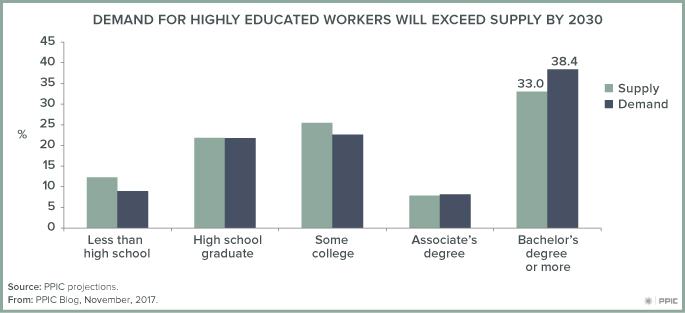
figure - Demand for Highly Educated Workers Will Exceed Supply by 2030

In this testimony, I first describe how California’s population and economy are changing, and then identify how the state and its higher education institutions can increase college enrollment and completion to produce more college graduates.

California’s economy is increasingly demanding highly educated workers

To develop our economic projections, we apply trends in educational attainment levels within occupations to occupational projections developed by the California Employment Development Department. We examine changes in labor market demand that are occurring due to shifts in the distribution of occupations and changes in educational attainment within occupations. Our primary finding is that the state’s economy will continue along a well-established trajectory, with a growing share of jobs requiring at least a bachelor’s degree.
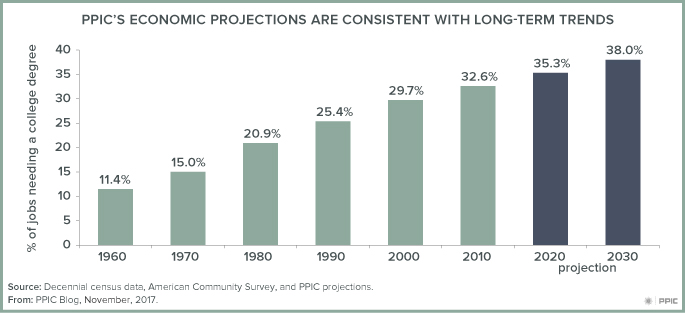
figure - PPIC's Economic Projections Are Consistent with Long-term Trends

The two key drivers of increasing demand for college graduates are: 1) faster growth in occupations that commonly require a college degree (e.g., computer technology occupations), and 2) increases in demand for highly educated workers within occupations (e.g., nursing).  While both drivers are important, in recent years most of the increased demand (74%) for highly educated workers has occurred because of faster job growth in occupations that commonly require a college degree. Among large occupations (with at least 100,000 full-time year-round workers), those with especially rapid growth rates over the past five years include software developers (56% increase between 2010 and 2015), computer scientists and systems analysts (42% increase), and managers (35% increase). These and other highly skilled occupations have experienced faster growth than most less skilled occupations.
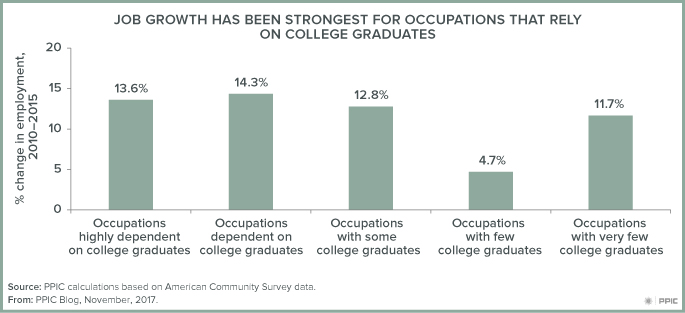
figure - Job Growth Has Been Strongest for Occupations that Rely on College Graduates

The second key driver of demand has been an increase in educational attainment within occupations.  For example, the share of registered nurses with a bachelor’s degree has grown from 57% in 2000 to 68% in 2015.  Altogether, over a five year period (from 2010 to 2015) about 26% of the increase in jobs for college graduates has occurred as demand for highly educated workers has grown within specific occupations.

Are college degrees really necessary for these jobs? We examine a number of labor market outcomes to answer this question.  Within and across occupations, we find higher labor force participation rates, lower unemployment rates, and higher wages for workers with a bachelor’s degree than for those without. And in general, as educational attainment increases, wages also increase. Overall, the wage premium for college graduates relative to less educated workers has grown. By 2015, the average annual wage for full-time year-round workers was more than twice as high for workers with a bachelor’s degree than for those with a high school diploma.
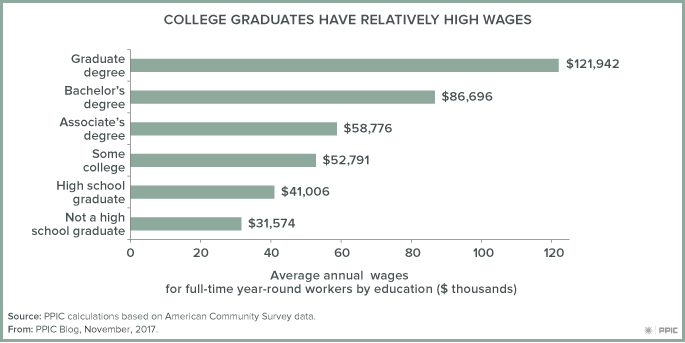
figure - College Graduates Have Relatively High Wages

Within each of 51 occupational groupings we see higher wages for college graduates than for high school graduates. Among registered nurses, for example, those with a bachelor’s degree earned 12% more than those with an associate’s degree.

California’s educational institutions are not keeping up with demand

Too few Californians are graduating from college. At current college enrollment and completion rates, only 30.5% of 9th graders in California will eventually earn a bachelor’s degree either in California or elsewhere in the United States.  Compared to other states, California ranks 47th in the share of high school graduates that enroll in four-year colleges and 5th in the share that go to community colleges. Low rates of transfer from community colleges to four-year colleges exacerbates the problem.
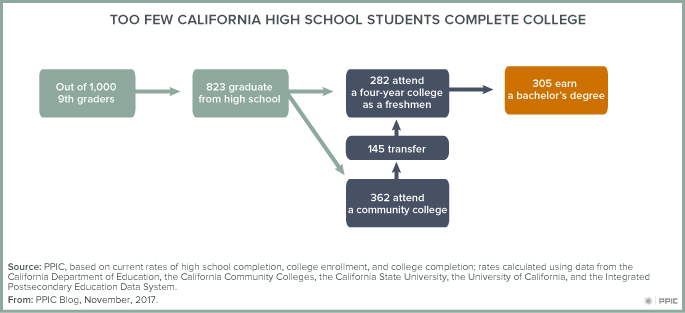
figure - Too Few California High School Students Complete College

A critical challenge is the retirement of the large and relatively well-educated baby boom. Called the “silver tsunami” by some, this aging out of the labor force of millions of older adults is the first time in the history of California that such a large and well-educated group is exiting the labor force. In contrast, the number of young adults in California is projected to increase only modestly.
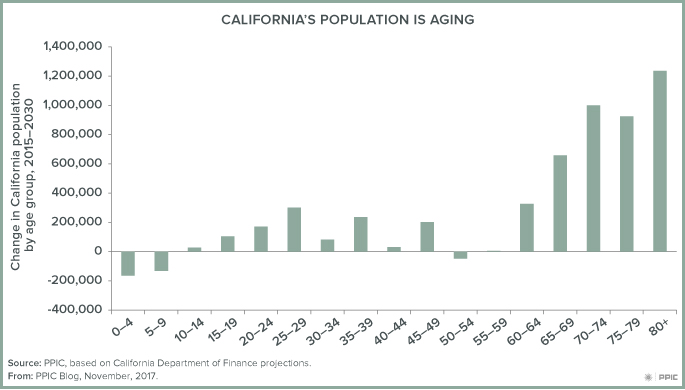
figure - California's Population Is Aging

Not all degrees are equal

On average, college graduates have very strong labor market outcomes. While at any point in time, some college graduates are working in jobs that do not necessarily require a college degree, over the course of their careers the vast majority of college graduates will move into occupations that reward their educational training. Our estimates show that students who earn bachelor’s degree in engineering and computer science fare very well in the labor market, but even those in less remunerative majors such as education and the liberal arts will still earn far more in wages than less educated workers, even after taking into account all the costs of going to college.
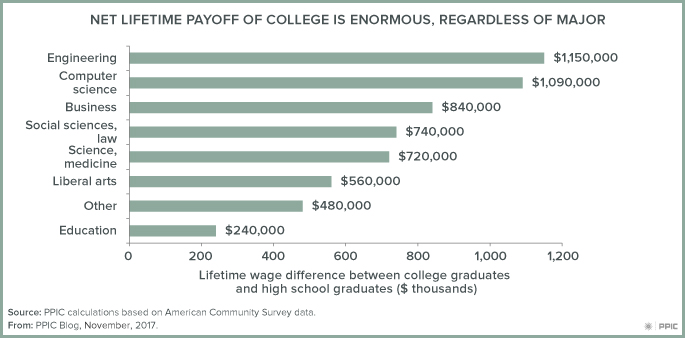
figure - Net Lifetime Payoff of College Is Enormous Regardless of Major

How to close the degree gap

To close the gap, California and its higher education institutions will need to establish new policies and practices to enroll more students, especially in our four-year colleges and universities, and ensure greater success of students already in college. In previous testimony, PPIC has identified targets for each of the state’s public systems with respect to admission, transfer (from community colleges to four-year colleges), and improved graduation rates. Improving access and success among groups historically underrepresented in higher education, including low-income students, first-generation college students, Latinos, and African Americans is essential if we are to close the degree gap.

The good news is that new goals adopted by the California State University (CSU) system and the California Community College system are entirely consistent with PPIC’s identified targets. New initiatives, including remediation reform at the community colleges and at CSU, have the potential to substantially increase student success. CSU’s new graduation initiative aims to substantially increase graduation rates and eliminate gaps between groups of students. Strong increases in college preparation among the state’s high school graduates are also a positive sign, with the share of students completing the college preparatory requirements of UC and CSU reaching an all-time high.

Finding ways to accommodate all these students remains a central challenge, but one we must meet in order to ensure a better future for all Californians.

Learn moreVisit the PPIC Higher Education Center

Testimony: Cybersecurity Needs and Higher Education

Hans Johnson, director of the PPIC Higher Education Center and PPIC senior fellow, testified at the Joint Legislative Oversight Hearing on Cybersecurity Education and the Needs of the Workforce before the Assembly Committee on Higher Education in Sacramento today (October 10, 2017). Assemblymember Jose Medina chairs the Higher Education Committee and Assemblymember Jacqui Irwin chairs the Select Committee on Cybersecurity. Here are Johnson’s prepared remarks.

Thank you Chair Medina, Chair Irwin, and committee members.  My name is Hans Johnson, and I am the director of the Higher Education Center at the Public Policy Institute of California. My role today is to provide a brief overview of cybersecurity labor market needs in the state. First, I’ll define cybersecurity occupations, next I’ll provide data on labor market trends, and finally I will discuss educational awards related to cybersecurity. Sources of information and data used in this testimony include the United States Department of Labor, the California Employment Development Department, the United States Census Bureau, and reporting by California colleges and universities to the United States Department of Education.

As an occupation, cybersecurity is identified by the US Department of Labor as “information security analyst” and resides within a broader set of computer and mathematical occupations. In this testimony, I will focus on the information security (IS) analyst occupation. However, it is important to note that other computer and information technology occupations include individuals who work at least partly on security issues. According to the US Department of Labor: “Information security analysts plan and carry out security measures to protect an organization’s computer networks and systems. Their responsibilities are continually expanding as the number of cyber attacks increases.”

The IS analyst occupation is a high wage, high demand occupation. It is growing but still relatively small. Increasingly, employers are hiring workers with at least a bachelor’s degree to fill IS analyst jobs, but a notable share of jobs are still filled by workers with less than a four-year degree.  California colleges and universities have substantially increased the capacity of their institutions to award degrees in computer science and related fields. Even so, unemployment rates remain very low—an indication that employers could be having a hard time finding workers.

In California, EDD estimates the state was home to about 8,000 IS analysts in 2014, with that number projected to increase to 10,100 by 2024, a growth rate (26%) slower than other computer occupations (29%) but much faster than the state’s overall employment growth rate (15%). Still, it is important to note that IS analysts make up less than 1% of employment in computer occupations in California and less than 2% in the nation (see chart below). IS analysts work in a broad range of industries, including technology, banks, higher education, insurance, and health.

EDD estimates that IS analysts in California had a median wage of $53 per hour in the first quarter of 2017, which amounts to $110,000 on a full-time annual basis. Nationwide, the unemployment rate for IS analysts has been around 2% for several years now (based on my analysis of American Community Survey data from 2012 through 2015), with similarly low unemployment rates in California. Unemployment rates that low are a sign of high labor market demand.


Of critical concern for workers, and for these committees, are the education and training requirements for IS analysts. According to the U.S. Department of Labor:

Information security analysts usually need at least a bachelor’s degree in computer science, programming, or a related field. As information security continues to develop as a career field, many schools are responding with information security programs for prospective job seekers. These programs may become a common path for entry into the occupation. Currently, a well-rounded computer education is preferred.

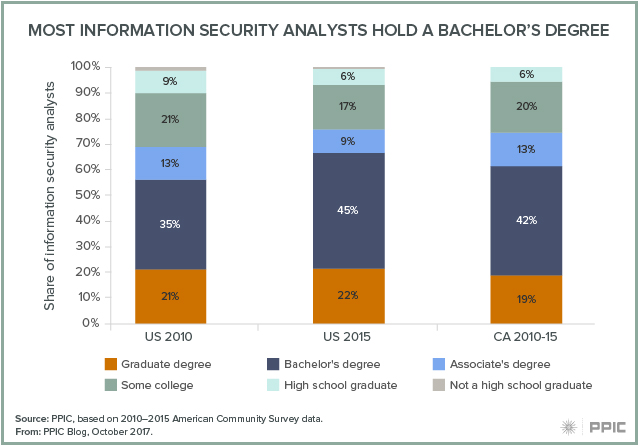
The number of IS analysts has increased nationwide in the last five years and so has their educational attainment. In the US, 67% of IS analysts had at least a bachelor’s degree in 2015 compared to 56% in 2010. In California, about two-thirds of analysts have at least a bachelor’s degree. The share of IS analysts in the US with an associate’s degree has declined from about 15% to less than 10%. The vast majority with a bachelor’s degree majored in one of three fields: computer science (including information systems), engineering (including electrical engineering and computer engineering), and business (including management information systems). In California, annual average earnings for IS analysts with a bachelor’s degree are about 70% higher than for those with some college or an associate’s degree, who in turn earn about 20% more than those with only a high school diploma. Unemployment rates are low for IS analysts, especially those who have some postsecondary education and those who have a bachelor’s or graduate degree.


California is home to dozens of colleges and universities that offer degrees in computer and information sciences. The state’s universities, especially the University of California, have quickly responded to the strong demand for these degrees (see chart below). The total number of bachelor’s degrees awarded increased from less than 3,000 in 2010 to 6,000 by 2016, with UC and CSU accounting for 65% of the total in 2016. The most common major is computer science, followed by computer and information science.


California’s community colleges also offer postsecondary training in computer and information sciences, ranging from short-term certificate programs to associate’s degrees. Importantly, they also provide lower division courses necessary for transfer to a four-year college or university. The total number of associate’s degrees in computer and information sciences and support services doubled between 2010 and 2016, from 719 to 1,490. The number of short-term certificates (completed in less than one academic year) increased from 1,605 in 2010 to 1,838 in 2016, and the number of longer-term certificates (completed in at least one but less than two academic years) increased from 225 to 321. In all, the number of postsecondary awards totaled more than 3,600 by 2016. PPIC is currently developing research that explores information technology awards at the community colleges and is working with the Employment Development Department and the Chancellor’s Office of the California Community Colleges to secure access to student and wage data.

In thinking through the roles of the different segments of higher education in California, it is important to keep in mind that the segments are designed to work as a system. The strong demand, both on the part of students and employers, in technology fields should be met by each institution and by the segments working together. For example, improving transfer from community colleges to UC and CSU in technology fields through better articulation—including Associate Degrees for Transfer—is necessary if students are going to fully realize the economic benefits of these fields. Moreover, cybersecurity occupations are but one part of a larger technology sector. Developing a larger industry-wide and cross-system approach to meeting demand is necessary. Innovations—such as locating some CSU bachelor’s degree programs at community college campuses—offer the promise of reaching more students, including those underrepresented at our four-year colleges. California can best serve the growing number of students who want to pursue technology jobs by taking advantage of the strengths of each segment of its public higher education system—and helping those segments work together to meet the economic need for these highly skilled workers.

Learn moreVisit the PPIC Higher Education Center

California’s Dream Act

As the federal government moves to end the Deferred Action for Childhood Arrivals (DACA) program, California is continuing to support the higher education aspirations of undocumented students. California’s Dream Act is a set of laws intended to lower the cost of higher education for certain undocumented immigrants brought to the US as children and raised in California. Thousands of California students have benefited from the program so far.

College can be especially expensive for undocumented students. For tuition purposes they are not technically California residents and therefore are not eligible for in-state tuition. Public colleges and universities charge extra tuition for nonresidents: currently an additional $28,000 per year at UC and $6,000 per year at CSU. In addition, undocumented students are not eligible for federal financial aid, such as Pell Grants or federal loans, leaving college out of reach for many who are low-income.

California passed AB 540 in 2001, which waives the nonresident portion of tuition for undocumented childhood arrivals as long as they meet certain criteria, including spending three or more years in California K‒12 schools, graduating from a California high school, and promising  to apply for legalizing their immigration status as soon as they are eligible to do so.  In addition, the state passed AB 130 and AB 131 in 2011, which allows state and institutional financial aid to be given to students eligible under AB 540.

Undocumented students cannot file the Free Application for Federal Student Aid (FAFSA) to apply for federal and state financial aid for college. This means that many do not have access to Cal Grants, one of the state’s main forms of financial aid. Instead, those who are eligible can apply for Cal Grants using the California Dream Act application.

Of all Cal Grant offers in 2014‒15, about 3% have been made to California Dream Act applicants. Of those eligible for the awards, both FAFSA filers and Dream Act filers have similar GPAs. However, those obtaining a Cal Grant through the state Dream Act application were more likely to come from families with parents without college degrees and with lower family incomes.

A student’s DACA status has no bearing on the California’s Dream Act, so AB 540 students will continue to pay in-state tuition rates and can apply for and receive state and institutional aid to help lower the cost of college, even if the federal DACA program ends. However, without a work permit these undocumented students still cannot work legally in the US, even if they obtain a degree from a California college or university. The approximately quarter of a million Californians covered by DACA will still be subject to deportation without further federal legislative or executive action. That uncertainty could keep otherwise qualified students from earning a college degree.

Learn more

Read “DACA and California’s Future” on the PPIC Blog.

Visit the PPIC Higher Education Center.

New CSU Admissions Policy Could Increase Access, Enrollment

Overcrowding at some California State University (CSU) campuses has had a serious effect on the system’s ability to increase the number of students graduating with bachelor’s degrees. This is an issue with broad implications for the state and for young Californians: PPIC research has shown that the CSU system will need to produce nearly half a million additional college graduates by the year 2030 to meet economic demand in California.

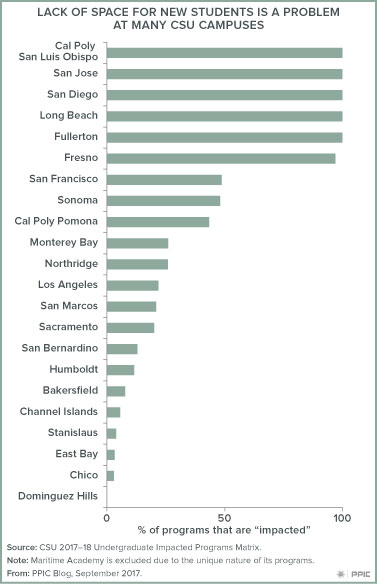
lack of space for new students is a problem at many csu compusesThe state’s most recent budget aims to alleviate overcrowding at CSU, a problem that stems from an enrollment policy dating back to 2000. Under this policy, campuses established local admissions criteria that went beyond systemwide requirements for high-demand academic programs like nursing, business, and psychology. Currently, 6 of the 23 campuses are what CSU calls “fully impacted,” meaning that admissions requirements for local students in every major are significantly higher than those required systemwide. At Fresno State, 32 of its 33 programs are impacted. With higher admissions requirements, impacted programs often turn CSU-eligible students away. However, the rest of CSU campuses have fewer than half of their academic programs impacted. Six campuses—Bakersfield, Channel Islands, Stanislaus, East Bay, Chico, and Dominguez Hills—have less than 10% of their academic programs impacted. Unfortunately, unlike the University of California system where eligible applicants to an oversubscribed campus are referred to open campuses, CSU applicants who were eligible systemwide but did not meet the admissions criteria of their chosen impacted major or campus were denied admissions and not referred to a non-impacted campus.

In 2015–16 alone, CSU estimates that the system turned away nearly 30,000 eligible applicants due to overcrowding. While this did not necessarily prevent all of these students from attending college (many are likely to have attended other four-year colleges or community colleges), the practice of denying admissions to eligible students creates an unnecessary barrier in the education pipeline. Students who begin their higher education at a community college, for example, are less likely to complete a bachelor’s degree.

The 2017–18 state budget requires that CSU change its admissions process. Under the new policy, campuses must give first priority to local students applying to impacted programs and must automatically redirect eligible applicants who are denied admission to similar programs at other CSU campuses that have space. Given that a recent study commissioned by the California Governor’s Office of Planning and Research found that nearly 41% of high school students are eligible for CSU systemwide admission—an increase of nearly 10 percentage points since 2007—the creation of a referral pool could provide students with additional information about nearby campuses that are not impacted, allow them to attend those campuses, and give them a chance to pursue the major of their choice. Furthermore, the creation of this referral pool could more efficiently disperse enrollments across the system’s campuses, increase capacity, and improve bachelor’s-degree attainment in California as a whole.

Learn more

Read center director Hans Johnson’s testimony about the workforce skills gap and CSU’s role in filling in.

Visit the PPIC Higher Education Center.

California’s Partisan Divide on Higher Education

New national polling shows a big divide has opened up between Democrats and Republicans on higher education. A Pew Research Center poll taken in June shows that a majority of Republicans and those who lean Republican (58%) think colleges and universities have a negative effect on the way things are going in the country, while a vast majority of Democrats and those who lean Democrat (72%) think colleges and universities have a positive impact. This is a big change from two years ago, when majorities in both parties said higher education institutions had a positive impact on the direction of the nation.

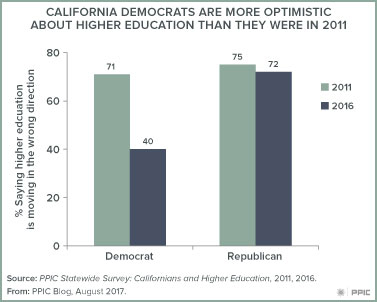
Is there a similar partisan divide over higher education in California? The PPIC Statewide Survey found a similar divergence over the past few years when we asked a different question: Is the state’s public higher education system generally going in the right or wrong direction? In 2016, California Republicans were far more likely than Democrats to say the system is headed in the wrong direction. This marked a change in the five years since we’d last asked this question. When we asked the question in 2011—toward the end of the recession and after large tuition increases—Californians in both parties overwhelmingly said higher education was moving in the wrong direction. Unlike national polling, which shows a shift in Republican opinion, PPIC surveys show a shift in the opinions of Democrats, who have become more positive, while Republicans have remained about the same.

Californians’ responses to other survey questions about higher education point to longer-term partisan divisions. Republicans have generally been more likely than Democrats to say that the overall quality of education in California’s public colleges and universities is a big problem or somewhat of a problem. Views about the direction and overall quality of public higher education are reflected in attitudes about California’s three public higher education systems. Currently about half of Republicans say that each of the systems—community colleges, California State University, and University of California—are doing an excellent or good job. More Democrats—about three-fourths—express this view.

Partisans have also historically differed on higher education funding. Compared to Republicans, Democrats are more likely to say that higher education does not receive enough funding, and Democrats are generally willing to pay higher taxes to support higher education.

Interestingly, there is some evidence that Californians’ views about the importance of college for individual success differ along party lines. A majority of Democrats (68%) say a college education is necessary for a person to be successful in today’s working world, while a majority of Republicans (72%) say there are other pathways to success. It is also true, however, that Californians in both parties have become more optimistic about the chances of success without a college degree since 2011—when the state was recovering from recession.

Finally, there are some areas of agreement. We find that members of both parties generally think that college affordability is a problem and students have to borrow too much money. Perhaps most significant is our finding that overwhelming majorities of both Republicans and Democrats say that the state’s system of higher education is important to California’s economic future and quality of life.

Learn more

Visit the PPIC Higher Education Center

CSU Ends Remedial Courses

Last fall, more than one in three students starting as freshmen at the California State University (CSU) system had to take a remedial course in either English or math before they could take college-level courses in those subjects. These remedial courses generally cover material from high school and don’t count toward a degree—even though they cost the same amount and require as much class time as a college course. But this situation is about to change. Starting in 2018, all CSU freshmen will be placed in college-level courses. Those who are underprepared will receive some kind of extra support.

This is the most recent in a series of CSU reforms intended to place freshmen students into college-level courses. In 2004, the Early Assessment Program (EAP) began giving 11th graders an indication of their readiness for CSU and identified the courses they would need to complete their senior year to avoid remediation. More recently, incoming students who were required to take remediation were enrolled in Early Start, which used summer courses to prepare students for college coursework in the fall. The elimination of all remedial courses is a big change: while previous programs aimed to prepare students for college-level work before their freshmen year, CSU will now focus on helping students complete college-level work regardless of their preparation.

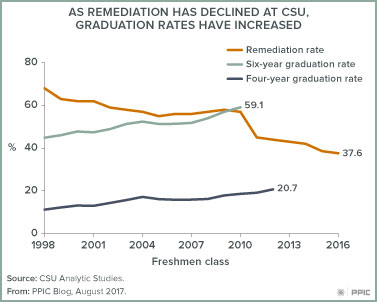
This policy change comes as CSU embarks on its new graduation initiative, whose goal is to raise graduation rates and close achievement gaps by 2025. What kind of impact might the elimination of remedial courses have on college completion? Students who require remediation in one or more subjects are about half as likely to graduate within four years as their peers who are ready for college-level work. The share of CSU students identified as needing remediation has been dropping for some time, and as remediation rates have fallen, six-year and four-year graduation rates have increased.

The general decline in remediation indicates that students have become better prepared over time, either in K–12 or through programs like Early Start. Though eliminating remediation will not affect how prepared students are when they start college, there is still reason to believe CSU could see an increase in graduation rates. As PPIC’s study of community college remediation showed, long remedial course sequences leave students many points of exit and can be barriers to success. Indeed, about 13% of CSU students who entered remediation in 2015 failed to complete remediation and were not at the university by their second year. With the end of remediation at CSU, students will have fewer potential exit points, they will be able to earn more college credits in their first year, and many may experience more success in college-level courses due to additional support. These potential benefits could help more students graduate and shorten their time to degree.

In addition to eliminating remediation, CSU is making changes to the Early Start program and course placement policies to further prepare students and help them find the right classes. These changes could help narrow the graduation gap between races. In 2016, only about 18% of white CSU students required some form of remediation, while about half of Latino and about 60% of African American students needed remediation in at least one subject. If these new policies do increase graduation rates, many traditionally underserved students may benefit.

Learn more

Visit the PPIC Higher Education Center
Read the PPIC report Preparing Students for Success in California’s Community Colleges

Regional Action to Boost College Success

California needs 1.1 million more workers with bachelor’s degrees by 2030 to keep up with economic demand, PPIC research has found. Three regions will play an especially critical role in addressing this challenge: Los Angeles County, the Inland Empire, and the San Joaquin Valley.

Improving college enrollment and graduation rates in these regions could help close more than half of this projected statewide skills gap, according to a new PPIC report, Meeting California’s Need for College Graduates: A Regional Perspective. It analyzes the challenges ahead and recommends ways to meet them. At a Sacramento event, report coauthor Kevin Cook summarized the findings and a panel of experts described promising initiatives already underway in these regions. Report coauthor Hans Johnson, director of the PPIC Higher Education Center, moderated the panel discussion.

Panelist Benjamin Duran, executive director of the Central Valley Higher Education Consortium, said his group has created a partnership of public and private colleges and universities, as well as community college districts, from Kern through San Joaquin Counties. One of the consortium’s projects involves improving remedial education, which has traditionally consisted of non-transferable classes that delay—and all too often end—students’ college careers. Under the newer approach championed by the consortium, students deemed underprepared for college work are able to enroll in college-level courses right away but also get supplementary support.

The Central Valley consortium is also working to encourage more students—particularly those in the community colleges—to take 15 units per semester or 30 per year so that more of them graduate on time. “When you’re able to go to school full time, the research is showing that you’re far less likely to drop out—you’re going to finish quicker,” Duran said.

Alma Salazar, senior vice president of the Center for Education Excellence and Talent Development at the Los Angeles Area Chamber of Commerce, said, “We do what all great organizations do—we take someone else’s idea and try to make it better.” The result, she said, is the L.A. Compact, modeled after an effort in Boston. It is a collaboration among area organizations, educational institutions, unions, and local government leaders. The focus is on three goals:

  • All students graduate from high school;
  • All students have access to and are prepared for success in college; and
  • All students have access to pathways to sustainable jobs and careers.

Ken O’Donnell, associate vice president of the Student Success Program Integration and Assessment at California State University, Dominguez Hills, talked about his campus’s success in improving its six-year graduation rate from about 30% to 42% in a few years. O’Donnell echoed the PPIC report, which finds that improving success rates for those already in college will have the greatest impact on the statewide skills gap. “You’ve already improved capacity without adding a single additional seat,” he said.


Learn more

Read the report Meeting California’s Need for College Graduates: A Regional Perspective
Visit the PPIC Higher Education Center

Year-Round Pell Grant Revived

As California State University and the University of California work to increase the number of students who graduate within four years, the federal government has reinstituted the year-round Pell Grant—a financial aid program that can help accomplish this goal. Increasing on-time graduation rates has benefits for both students and the state—opening up more spots in the state’s higher education institutions, reducing the total amount of tuition and fees that students pay, and allowing students to enter the workforce sooner.

The year-round Pell Grant is designed to address a specific problem: while students need to take 15 units in the fall and in the spring semester to graduate on time, many take only 12 units, which adds an extra year to their time to degree. Acknowledging this issue, some campuses are adopting the “Finish in Four” model, which encourages students to complete 30 units per year while giving them flexibility in how they meet that goal. For example, a student could take 12 units in the fall, 12 in the spring, and 6 in the summer. The year-round grant program complements this model by allowing recipient students flexibility to use Pell funding for summer coursework.

Many California students already receive Pell Grants―around 46% of students at CSU and UC, and 29% at the community colleges. The new year-round grant allows recipients to receive one-and-a-half Pell awards in one academic year. While this may not cover the full cost—six units during the summer term costs about $120 more than six units in the fall and spring terms—it makes attending more affordable.

However, it is unclear if the program will incentivize students to enroll in the summer term to stay on track for timely graduation. The program was previously only in effect for two years (2009–2011), and the limited research studying its impact suggests mixed results. Preliminary findings from a study presented at the Association for Public Policy Analysis and Management conference found a small increase of 3.5 percentage points in Pell students’ summer enrollment. Initial findings from another study presented at the Association for Education Finance and Policy conference found that summer enrollment increased by 28 percentage points. Given the short lifespan of the first year-round Pell, its impact may have been limited by students’ lack of awareness of the program and campuses’ lack of infrastructure to offer the right courses.

To ensure the program’s effectiveness, colleges need to help students use the summer semester to reach a full 30 units per year. The year-round Pell is not the only effort to help students use their summers to finish on time. For example, Sacramento State University is offering $1,000 grants for students who enroll in the summer term. Given the uncertainty of long-term federal funding for a year-round Pell, campuses may need to develop other similar programs to incentivize summer enrollment and encourage on-time graduation.

Learn more

Visit the PPIC Higher Education Center

UC May Struggle to Meet Transfer Requirement

Governor Brown’s May budget proposal withholds $50 million from the University of California (UC), which must undertake a series of reforms to restore the funds. One requirement—the result of a deal made during the 2015 budget process—is that UC meet its fall 2017 target of enrolling only two new in-state freshmen for every in-state transfer student, both systemwide and at each campus (except Merced). In 2016, the system enrolled 2.3 freshmen for every transfer student. The 2:1 target is intended to increase the number of transfer students served by UC. But reaching this freshmen-to-transfer ratio while responding to growing freshmen demand could prove very difficult this year and in the future.

UC has made progress in enrolling more transfer students but has not come closer to meeting its target ratio. In the last year, UC enrolled almost 2,000 more transfer students, a 13% increase and the biggest jump in more than a decade. However, UC also enrolled more than 5,000 additional freshmen compared with the previous year (a 17% increase)—leaving the freshmen-to-transfer ratio slightly higher.

In recent years, demand to attend UC has increased much faster for freshmen than for transfers. This year, there are more than 3.5 freshmen applicants for every transfer applicant. Since 2011, freshmen applications have increased by 31%, while transfer applications have declined by 1%.

Can UC attain a 2:1 ratio while responding to growing demand for freshmen slots in 2017? To do so, the system would need to draw more transfer students from a smaller applicant pool—especially if officials also plan on increasing freshmen enrollment. Compared to last year, 1,000 fewer in-state transfer students and 6,000 more in-state freshman applied. This problem is particularly acute at Santa Cruz and Riverside, which enrolled more than 3.5 freshmen for every transfer student in 2016 and may not meet the 2:1 goal this year.

UC may also have trouble meeting its target freshmen-to-transfer ratio in the future. If the number of freshmen applicants keeps increasing while the number of transfer applicants stagnates, UC may have to turn away more in-state freshmen applicants to meet its goal. To increase the quantity and quality of future transfer pools, the system is working to expand existing transfer agreements between UC campuses and nearby community colleges. In addition, UC’s new Transfer Pathways program helps prepare community college students in the most popular majors to transfer as juniors to any UC campus. The new program could start showing results in the next couple of years.

Though transfer demand at UC is sluggish, transferring is still a popular path for students elsewhere. California State University (CSU) has seen 14% growth in transfer applications since 2011 and, in 2016, received over 106,000 transfer applications (about three times as many as UC). UC could look to a recent success at CSU, which worked with the California Community Colleges to develop the Associate Degree for Transfer (ADT). Like the Transfer Pathways program, the ADT prepares community college students for junior-level entry at any CSU campus. But the ADT goes further by guaranteeing that students will only need 60 more units at CSU to graduate from their major. It also guarantees students admission to the CSU system and offers priority consideration at a local CSU campus. The ADT is quickly becoming a popular option, with 30,000 ADTs awarded in 2015–16 alone. Of course, students are considering other factors, such as cost, distance, eligibility, and availability when choosing where to apply for transfer. Guaranteed pathways to a degree and priority consideration in admission, however, are likely to entice potential transfers.

It will be difficult for UC to achieve its 2017 transfer requirement, especially at Santa Cruz and Riverside—putting into question whether the system will receive the $50 million withheld in the governor’s budget proposal. With increasing demand for freshmen slots, UC must work to increase the pool of transfer applicants to meet both the 2:1 goal and freshmen demand going forward.

Learn more

Read the report Higher Education in California: Expanding College Access
Visit the PPIC Higher Education Center

Educational Progress Stalls in California

California is known as an engine of economic growth and innovation in the United States and across the world. A highly educated workforce has long gone hand in hand with the state’s robust economy.

California’s historically strong commitment to higher education—providing low-cost access to public colleges and universities at a time of rapid population growth—led to a large increase in college enrollment and completion. Baby boomers who were of prime college age during the 1960s and 1970s benefited from that expansion. Today, those boomers are the best-educated adults of that generation in the developed world. Older working-age adults (age 55–64) in California are more likely to have a bachelor’s degree than in any of the 32 member countries of the Organization for Economic Cooperation and Development (OECD).

Is California’s younger generation keeping up with other countries?

Unfortunately, generational progress in college completion has nearly stalled in California. Although more California high schoolers are completing their diploma today than 30 years ago, the share that subsequently earns a bachelor’s degree has not changed much: 33% of those age 25–34 in California today have at least a bachelor’s degree, compared to 31% of those age 55–64. Other countries have made much stronger progress. Indeed, the share of college attainment among young adults in California ranks 22nd of the 32 OECD countries, and the state’s generational progress is dead last.

The lack of generational progress in California is a cause for concern. College attainment not only benefits individuals’ earnings and employment prospects but also contributes to California’s economy by attracting businesses and keeping the state competitive in an increasingly globalized marketplace. Increasing the share of high school graduates eligible for the state’s public universities could help improve educational attainment among California’s young adults.

blog figure