Jacob Jackson, research fellow at the PPIC Higher Education Center, testified before the Senate Committee on Education in Sacramento today (April 11, 2018). Here are his prepared remarks:
Thank you Chair Allen, Vice Chair Wilk, and members of the committee for the opportunity to testify today. My name is Jacob Jackson and I am a research fellow at the Public Policy Institute of California. PPIC is a nonprofit, nonpartisan policy research organization and does not take positions on legislation. My comments today are about the potential benefits of a statewide, longitudinal student data system and are based on research that PPIC and others have conducted.
Right now, educational institutions and government agencies already collect plenty of data. The California Longitudinal Pupil Achievement Data System (CALPADS) tracks students from kindergarten through grade 12. Each public system of higher education (the community colleges, California State University, and the University of California) keeps track of its students while they are attending that institution. And the Labor and Workforce Development Agency collects data on the earnings of Californians over time. However, these data sources remain largely separate—which prevents the state from understanding how students move across educational institutions and into the workforce. Below are three key considerations in thinking about the potential value of an integrated data system.
A statewide longitudinal data system could help answer important questions for California. The lack of an integrated data system leaves California unable to answer basic questions about educational progress, workforce development, and equity. Such questions include:
- Is the state’s educational pipeline working? Who applies to which colleges? Does starting at a community college hurt students’ chances of earning a bachelor’s degree?
- How does education affect workforce outcomes? In what ways are academic coursework and performance during K–12 related to future earnings? What are the economic returns to different Career Technical Education (CTE) pathways?
- Are state interventions working? Are districts that receive extra funding through the Local Control Funding Formula getting better at sending students to college?
- Are state investments paying off? What are the impacts of early childhood education on long-term educational and economic outcomes?
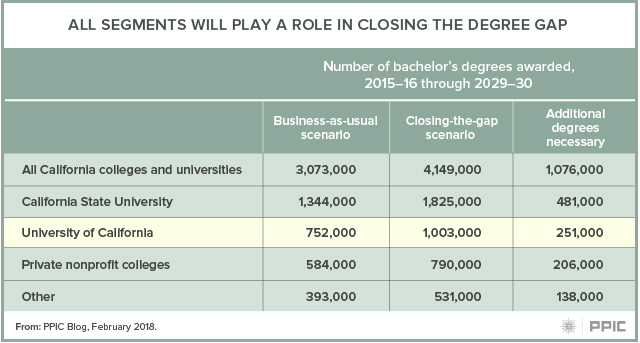
College and career readiness is one area where a longitudinal data system could help inform policy. The Common Core State Standards and the Smarter Balanced assessments are aimed at preparing K–12 students for college and career success. PPIC projects that California will face a shortfall of 1.1 million college graduates if current trends in college-degree production and demand for college-educated workers persist. Getting students ready for college is an important goal for the state. In fact, California’s K–12 scorecard will soon start holding districts accountable for their college and career readiness. The College Career Indicator contains metrics about high school course completion and standardized test measures. But due to the lack of linked data, high schools do not actually know which of their students go to which colleges, whether students need remediation once they get there, and whether students succeed in their academic goals. High schools also lack data on if or when students enter the workforce and how successful they are in their career. A statewide longitudinal data system can connect high school performance with outcomes in college and career, which could in turn provide schools, researchers, and policymakers the feedback they need to improve college and career readiness policies and programs.
Though our current ability to link data across sectors is limited, doing so has already produced important insights. Occasionally, researchers or institutions can link together data on a project-by-project basis. Here I list two examples that uncovered important insights and that would not have been possible without longitudinal data. First, PPIC researchers Sarah Bohn and Shannon McConville’s work on Career Technical Education in health fields linked educational data from the California Community Colleges Chancellor’s Office with earnings data from the state’s Unemployment Insurance system. Their work showed that CTE credentials in health generally have sizeable economic returns. The research also indicated which certificates result in higher wages and showed that earning multiple, short-term credentials yields significant economic returns. My own research with Michal Kurlaender and Scott Carrell of UC Davis connected community college data to high school data to show that incoming student characteristics play a big role in determining college-wide outcomes and rankings. These findings are especially important given the initial conversations around performance funding for California’s community colleges.
It is clear that a statewide longitudinal data system could provide new information and insights that are not currently available or possible. There still may be concerns about organization, privacy, security, costs, and ownership of the data, but if the state is willing to meet those challenges—as many other states have done—this tool could help California evaluate and improve its system of education. Linking K–12, college, and earnings data would allow policy experts to determine which policies and programs produce the best and most efficient outcomes for students, colleges, and the state as a whole.




 These mandated minimum funding levels have protected community colleges from the kind of budget cuts that have affected California’s other public higher education institutions. In addition, Governor Brown has prioritized investments in the community college system, which serves 2.1 million students and is the gateway to higher education for the vast majority of California students.
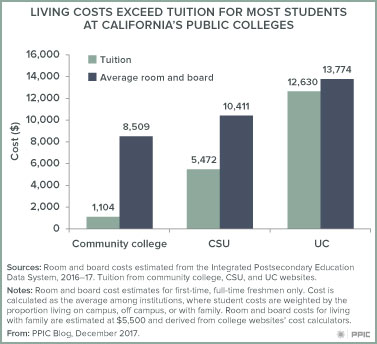 However, housing costs also play a significant role in the total cost of attending college. Californians are well aware of the issue: 85% of residents in the PPIC survey say colleges and universities should do more to make sure that all students have affordable housing options. Indeed, even with the rapid increases in tuition, living costs for many students exceed tuition at California’s public institutions—the state’s community colleges, California State University (CSU), and the University of California (UC). Average room and board costs also differ substantially across the three systems, from $8,509 per year at the community colleges to $13,774 at UC.
 Students’ housing choices also partially depend on where they go to school. Only nine cities in California have UC campuses (excluding UCSF which only enrolls graduate students), and most UC freshmen live on campus in their first year. Historically, the 113 community colleges and 23 CSU campuses have been seen as local and low-cost options. Indeed, both systems show about 30% or more of freshmen living with their families, which helps keep average room and board costs lower than at UC. But it is worth noting that the share of CSU freshmen living on campus may grow.
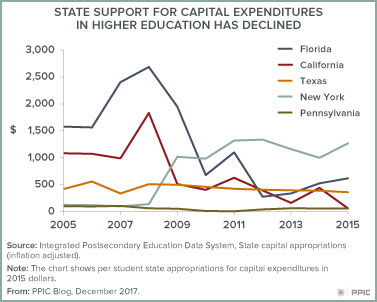 It is important to note that capital investment encompasses more than new classrooms or dormitories. Earlier this week, the
 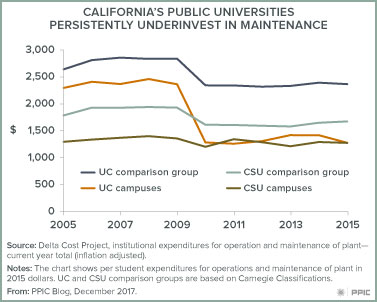 In 2000, California voters approved Proposition 39, which makes it easier for community colleges to pass bond measures. Since then, local community college districts have been relatively successful in funding their capital needs. The state’s four-year universities, however, face a different situation. To compare how much UC and CSU spent (per student) on maintaining and operating their campuses between 2005 and 2015, we separated and compared each system to a nationwide group of similar institutions. As the state cut its investment in higher education infrastructure, UC cut its infrastructure spending dramatically, while CSU’s spending remained relatively constant. But average maintenance spending by both systems was significantly below that of their peers.