Testimony: Low-Income Students and Financial Aid

As the legislature considers a number of bills aimed at increasing access and affordability of public higher education, the state assembly’s subcommittee on education finance invited PPIC to testify this week. The focus was the unmet financial aid needs of low-income college students. Hans Johnson, PPIC senior and Bren Fellow, presented data from the recent PPIC report Making College Possible for Low-Income Students: Grant and Scholarship Aid in California, which details the importance of federal and state grant aid in ensuring that higher education remains a ladder of economic opportunity for all Californians.

Johnson noted that as the state has cut funding for the University of California (UC) and California State University (CSU), tuition has increased and grant aid has become increasingly important to help students afford college. Research has also shown that grants and scholarships help students persist in their education and enables students to focus on their coursework and complete college faster. UC and CSU remain less expensive options for low-income students in terms of “net price”—the cost of attending college after accounting for federal, state, and institutional aid—than non-profit and for-profit private colleges. However, students whose family incomes are $30,000 or less still pay nearly a quarter of their incomes, or $8,000 per year, to attend a public four-year college.

Improving college access and completion is vital to California’s economic well-being, and aid for students has become increasingly necessary. The legislature’s attention to this issue comes at a time when 60% of California high school students qualify for free and reduced price lunch and three-quarters of California’s low-income college freshmen are enrolled in a UC or CSU.

Dividing California’s Higher Education Pie

The tuition increase recently approved by the University of California Regents has ignited a debate about how the state allocates money for higher education. A brief look at the history of state funding can provide some much-needed perspective.

Each higher education system—UC, the California State University, and the community colleges—receives substantial funding from the state. Most of the remaining funds for instruction come from tuition paid by students. (In this analysis, we look at allocations from the state General Fund and property taxes so that we can compare institutions across time.)

Since 1965, the share of higher education funding provided directly by the state has shifted from the four-year systems to the community colleges. In the mid-1980s, the community colleges received about a third of the state allocations to public higher education institutions. In 2014‒15, the community colleges got more than half of the pie. Meanwhile, the share allocated to CSU and especially UC has been shrinking. UC’s share fell from 38% in 1965 to 24% in 2014‒15, and CSU’s share declined from 25% to 22%. The governor’s proposed 2015‒16 budget includes a funding increase of $843 million to the state’s public colleges and universities—71% ($600 million) of which would go to the community colleges.

The large increase in state allocations to community colleges is linked to increased enrollment. But enrollment has increased just as much at UC and CSU. Indeed, on a full-time equivalent basis, UC, CSU, and the community colleges each serve about the same share of the state’s public higher education students today as they did 50 years ago. So what explains the shift in the share of funding from UC and CSU to the community colleges?

The short answer is Proposition 98.

After Proposition 13 passed in 1978, the state’s community colleges—which unlike UC and CSU relied partly on property taxes—saw a sharp reduction in their share of state and local support. Ten years later, voters passed Proposition 98, which guaranteed K–12 schools and community colleges a minimum percentage of the General Fund and property tax revenue. Proposition 98 guarantees that K–12 schools and the community colleges get about 40% of these allocations—and about a tenth of that share goes to the community colleges. Some have argued that Proposition 98 acts as a funding ceiling for K–12 schools and community colleges, but it also serves as a floor.

UC and CSU lack the same funding protection. While many budget areas outside of higher education are at least partially protected by dedicated funding streams, court orders, or matching federal funds, UC and CSU are vulnerable when state revenues decline. The universities have faced disproportionately large cuts in their general fund allocations during times of economic hardship. From this vantage point, a funding floor—even one that doubles as a ceiling—is preferable to a funding drop-off.

The three higher education systems also receive indirect forms of state support such as Cal Grants, fee waivers, and middle-class scholarships. Grant aid has increased for students at all institutions of higher education in California. Our best estimates suggest that community college students receive slightly more of these state funds (41% of the total in 2011‒12), than UC students (40%) and much more than CSU students (18%).

The debate over higher education funding could benefit from a clearer understanding of how the pie is divided. But the most important issue for the state’s young people is that the pie is not keeping pace with demand. Our four-year colleges have record numbers of applicants and the shares of students who are academically qualified to attend them have increased. The future prosperity of Californians and their state depends on access to higher education. To address these issues, policymakers need to focus on improving vocational programs and pathways from community colleges to four-year colleges and improving access and enrollment at UC and CSU.

Notes (TOP FIGURE): 2012-13 to 2014-15 numbers are from the governor’s budget; earlier data is from the California Postsecondary Education Commission. We include property tax allocations which are a component of the state’s obligation to community colleges pursuant to Proposition 98.

How Does UC Compare in Enrolling Nonresident Students?

Record-high numbers of out-of-state students are enrolling in the UC system. Estimates show that one out of every five freshmen starting at a University of California campus this fall will be a student who attended high school in a state outside of California or outside of the U.S.

Nonresident students pay about three times the tuition of a California resident. Since the state’s deep cuts to higher education budgets, the UC system has increasingly relied upon nonresident student enrollment as a source of revenue. In fact, Senator Kevin de León recently suggested raising tuition on nonresidents to increase revenue for UC. Several other legislators and members of the public have criticized the increased recruitment and admission of nonresidents. All of which raises a question: How does UC’s enrollment of nonresident students compare to that of similar universities in other states?

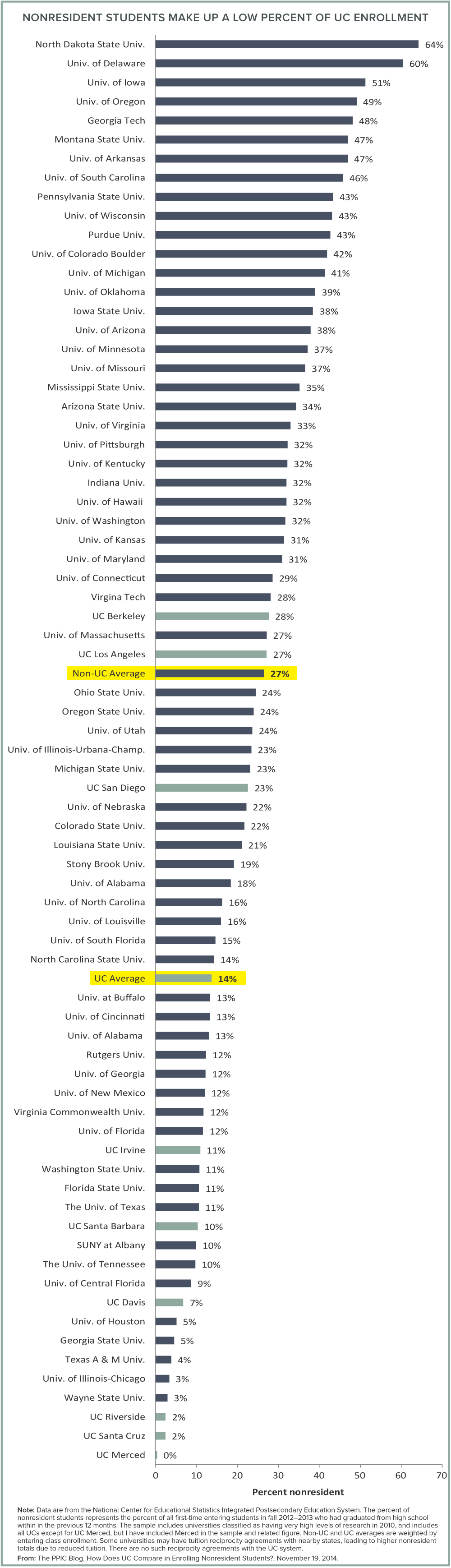
Among public, four-year research universities nationwide, only UC Berkeley and UCLA are above the national average in the proportion of students paying out-of-state tuition. The UC average is well below the national average for similar universities. In fact, the UC system claimed six of the bottom 17 spots, as the following chart demonstrates.

Looking at the trend over time, the UC system has enrolled relatively low levels of nonresident students compared to other similar universities, but that average has been increasing sharply since 2010. However, nonresident enrollment is also increasing at other top-tier, public universities throughout the nation—likely because of budget woes in other states. In the most recent two years, there has been no national data for a comparison, but UC provides the number of students intending to register each year, which is likely an upper bound for nonresident enrollment. The number of nonresident students has continued to climb, especially at UC Berkeley and UCLA, where they are estimated to make up 29.8% and 30.1% of 2014 freshmen enrollees, respectively. But even with these increases, nonresident enrollment is still likely lower at UC Berkeley and UCLA than it is at many prestigious public four-year universities, and the UC system is likely well below the national average for similar schools.

UC President Janet Napolitano has stated that she has considered limiting the number nonresident students in the UC system. But instead of setting system-wide limits, and relying on some universities to have fewer nonresidents to balance Berkeley and UCLA, the president and board of regents may consider setting enrollment limits for nonresident students for each university in the system. The full board of regents meets Thursday to vote on a plan for raising tuition at UC. If UC cannot increase revenue through tuition increases or from the state, they may seek to enroll more nonresidents, as they have done in the past. Even though the UC system has a relatively low proportion of nonresident students compared to the nation, such a move would still likely generate controversy.

Note: (BOTTOM CHART) Data are from National Center for Educational Statistics Integrated Postsecondary Education System (IPEDS) and the UC Office of the President. Solid lines indicate data retrieved from IPEDS; dotted lines indicate estimated enrollments based on UC Office of the President’s reported Statement of Intent to Register (SIR). The percent of nonresident students represents the percent of all first-time entering students in fall 2012–2013 who had graduated from high school within in the previous 12 months. The IPEDS sample includes universities classified as having very high levels of research, and includes all UCs except for UC Merced, but I have included Merced in the sample and related figure. Non-UC and UC averages are weighted by entering class enrollment. Universities are not required to submit nonresident counts to IPEDS in odd years, and some do not. Those odd year values are imputed from the even years surrounding them.

Paying for Higher Education

As concerns have grown about access to and affordability of California’s higher education system, understanding costs has become more critical than ever. How are institutions—and students—faring?

This question is the focus of three reports released by PPIC and a panel discussion held last week in Sacramento. Hans Johnson, a Bren fellow at PPIC, first summarized the research. One report shows that federal financial aid has shielded low-income students from rising tuition at the University of California and California State University. A second report evaluates both revenues and spending—including faculty salaries and benefits— and concludes that UC and CSU have not become less efficient in the past several years. A third report suggests that as California begins to reinvest in public higher education, it could tie funding more closely to results—for example, the number of degrees awarded—to meet state goals. In his presentation, Johnson noted that the state’s current goals—the Master Plan for Higher Education—are more than 50 years old and overdue for an update.

Panelists took up the issue of goals—how to set them, what to measure, and how to share the costs—in a discussion moderated by Patrick Murphy, PPIC research director. Participants were Henry Brady, dean of UC Berkeley’s Goldman School of Public Policy; Nancy Shulock, former executive director of CSU Sacramento’s Institute for Higher Education Leadership and Policy; and Amy Supinger, California policy consultant for the Lumina Foundation.

UC President Napolitano on Tuition, Online Learning, and the Role of the University

image

Janet Napolitano, the new president of the University of California and the former U.S. secretary for Homeland Security, said Monday that she told President Obama that the United States cannot thrive unless California thrives—and California cannot thrive unless the University of California thrives. Napolitano was responding to a question about why Californians should care about the public university system. Her comments were part of PPIC’s 2014 Speaker Series on California’s Future, which drew an online and in-person audience of nearly 500 to a conversation with PPIC President Mark Baldassare at the Sheraton Hotel in Sacramento. The wide-ranging discussion opened with a presentation from Hans Johnson, PPIC senior and Bren fellow, who provided context about the state’s need for educated workers.

The UC president, who also served as governor of Arizona, talked about tuition and budget issues, as well as online education, access for low-income students, and the lessons she’s learned since starting this job about six months ago. Napolitano said there was much the university is doing well: 42 percent of UC students are eligible for grants to low income students, 46 percent are the first generation in their families to go to college, and more than one-third are from families where English is not the primary language. She also said no public research university in the country is more efficient at helping students graduate within four years.

Still, she talked at length about the changes underway in funding for higher education and the need for new models. She emphasized that tuition will not increase for the 2014-15 school year and said that the university is dedicated to a tuition rate that is “as low and predictable as possible.” She also said she hoped to increase the university’s financial connection to philanthropy and the private sector. She said the state could do more and it should do more to support higher education.

Speaking about the future of higher education, Napolitano said online learning “is a tool in the tool box,” not a silver bullet. She said it is not necessarily cheaper than traditional classroom instruction and—despite some claims—no more effective at remedial education. She said, however, that it could get students access to classes not available on their campus.

Ready for College?

California needs more college graduates than it is currently producing. Part of the problem has been a lack of college readiness among the state’s high school graduates. Fortunately, recent trends in college preparation provide some good news. By several measures, a large and growing share of the state’s high school graduates are ready for college-level work. Indeed, many of them have successfully completed college-level courses even while still enrolled in high school.

New data on Advanced Placement (AP) exams are especially encouraging. AP courses are college-level courses in more than 30 subjects offered in high schools throughout the country. AP exams determine whether a student has attained college-level proficiency in the course, and AP exam passage rates are a meaningful measure of college preparation. Many colleges accept AP exams for college credit, and research shows that AP students outperform other students in college. Indeed, students who earn AP credits graduate at higher rates overall and often perform better in subsequent courses in the same field.

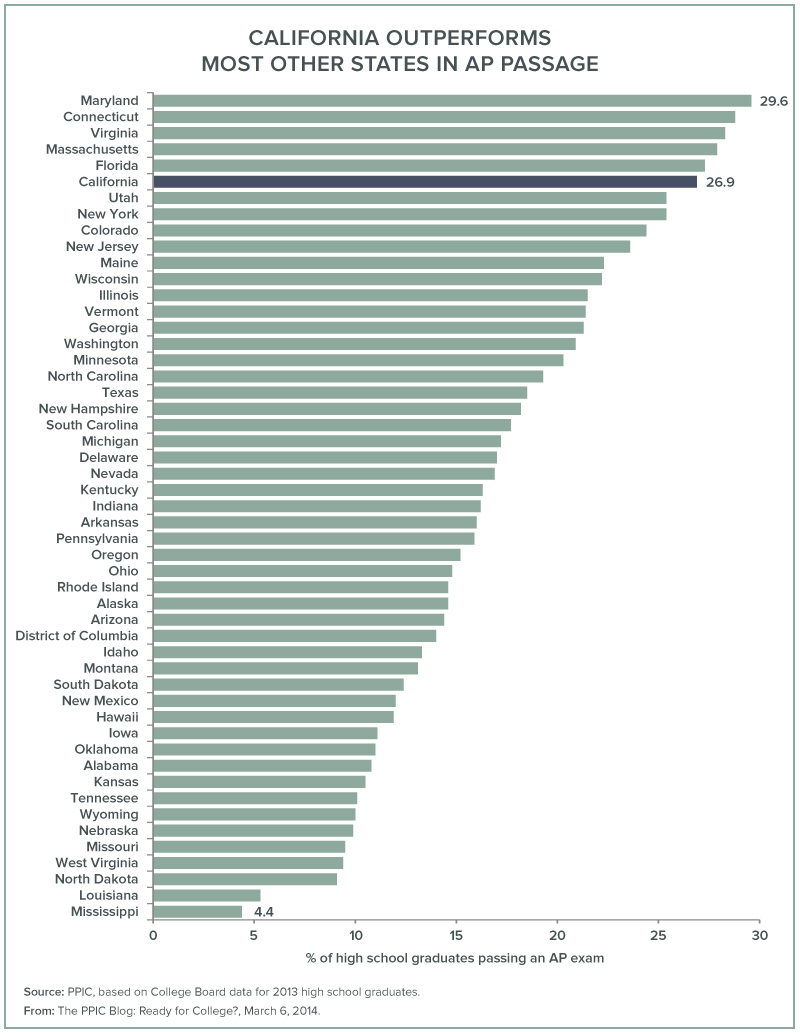
California’s high school graduates outperform their peers in the rest of the country on AP exams. In 2013, more than one in four California high school graduates (26.9%) passed at least one AP exam sometime during high school, compared to one in five in the nation as a whole. Among the 50 states and the District of Columbia, California high school graduates ranked sixth highest. Moreover, the share of graduates successfully completing an AP exam is going up fast in California—higher than in the rest of the nation. Between 2003 and 2013, the share of high school graduates passing at least one AP exam increased 9.6 percentage points in California, compared to 7.9 percentage points for the entire nation. California has a higher share of graduates taking AP exams than does the nation as a whole (45.6% versus 35.0%), with passage rates among AP exam takers slightly higher in California (59.0% versus 57.4%).
Other measures of college readiness also show progress. More students are taking the college preparatory courses (known as the “a–g” courses) required for admission to the University of California (UC) and the California State University (CSU). The latest data from the California Department of Education show that 38.3 percent of public high school graduates in California took the a–g courses in 2011–12, up from 34.6 percent in 2001–02 and from 32.3 percent in 1993–94. Gains in college prep work have been especially impressive among the state’s Latino high school graduates, who now make up almost half of all high school graduates. Among Latino graduates, the share taking a–g courses increased from 21.8 percent in 2001–02 to 28.0 percent in 2011–12. Increases in college readiness would be even better news if our state was responding with policies to meet the growing demand for college. But it’s not. Only the top eighth of high school graduates are eligible for UC and only the top third are eligible for CSU—according to eligibility thresholds that were set more than 50 years ago. Given the increasing shares of high school students who are well prepared for college, some reconsideration of those thresholds is long overdue.

If California is to meet the demand for educated workers, it needs to produce more college graduates. Making room for these highly capable students—by increasing the share of high school graduates eligible for the University of California and the California State University systems—would improve the well-being of our state and the lives of these young Californians.

Chart sources: PPIC calculations based on College Board data.