Federal Immigration Proposal Could Have Widespread Impact

The Department of Homeland Security (DHS) has recently proposed changing how it decides whether a person is or will likely become dependent on government assistance. If implemented, this change would make it harder for immigrants to meet the government’s standard of self-sufficiency—and may deter them and others from using government services for which they are eligible. Through December 10, DHS is requesting public comments on the proposal, which could potentially have wide-ranging impacts on California and its large immigrant population.

The federal government can typically deny applications for green cards or entry into the United States to people who are or will likely become “public charges,” i.e., dependent on government assistance. Under current guidance, DHS considers an immigrant a public charge if they receive more than half of their income from cash assistance—which includes TANF (known as CalWORKs in California), General Assistance (GA), and Supplemental Security Income (SSI)—or are in government-funded, long-term institutional care (like a nursing home).

The proposed rule is much broader: it defines dependence as receiving more than about $1,800 (for 2018) in assistance from not only the current programs but also the food assistance program SNAP (CalFresh) and/or Section 8 housing vouchers and rental assistance. DHS also proposes that an income of less than 125% of the federal poverty level ($25,100 in 2018 for a family of four) would be a strong predictor of becoming a public charge and recommends length of enrollment in certain health programs as another factor to consider.

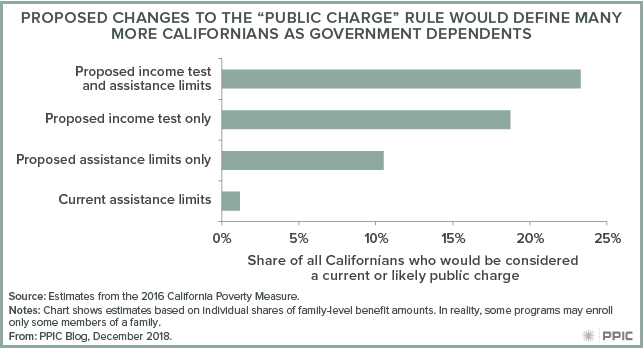
How big of a change is this? While data aren’t available to examine safety net participation among the noncitizens whose immigration cases would be affected by the rule, we estimate that even before including health programs, as many as 23% of all Californians would be considered public charges, or likely to become so—which gives a sense of how broad the proposed rule is. Some 18.7% of Californians would be considered likely to become public charges based on their income level alone. By contrast, at most 1.2% of all Californians receive more than half their income from CalWORKs, GA, and SSI, and would be considered public charges under the current rule. These calculations are based on the California Poverty Measure (CPM), a joint effort of PPIC and the Stanford Center on Poverty and Inequality.
California has more immigrants than any other state—and hence much at stake. For those on visas, the proposed rule would make it harder to qualify for a green card or extend their stay. But in practice, the largest impact would likely be on immigrants and their families who, purely out of caution, forego safety net benefits for which they are eligible. DHS cites this sort of disenrollment as a source of long-term savings—but notes that these savings are liable to be offset by worse public health outcomes and increased poverty rates. Based on studies of welfare reform in the 1990s, the UCLA Center for Health Policy Research estimates that if the rule change takes place, 15% to 35% of families with noncitizens might disenroll from safety net programs. At the high end, as many as 765,000 people could disenroll from CalFresh and Medi-Cal, leading to around $1 billion less in federal aid to California each year.

California’s attorney general and some local governments have already voiced their opposition to the proposed changes, which come at a time when the state has been expanding access to health and social safety net programs. Reduced participation in these programs, whether from reasonable or unnecessary caution, would directly counteract the state’s efforts to reduce poverty. Public comment for the proposal closes on December 10.

Toward Understanding Racial Disparities in Arrests

With tensions between law enforcement and minority communities continuing to make headlines, media outlets and academic researchers both report stark racial and ethnic differences in criminal justice experiences, including sentencing and incarceration. The disparity between African Americans and whites is especially striking. For example, the prison incarceration rate in California is 4,180 per 100,000 residents for African American men, compared with 420 for white men. It is likely that this inequality is significantly affected by the first step in the criminal justice process—arrests.

California’s various law enforcement agencies make a substantial number of arrests each year—1.35 million in 2016. While this is a staggering number, it’s also the lowest number of arrests since 1980 and marks a dramatic decline of more than one million arrests (64%) since a peak in 1990.

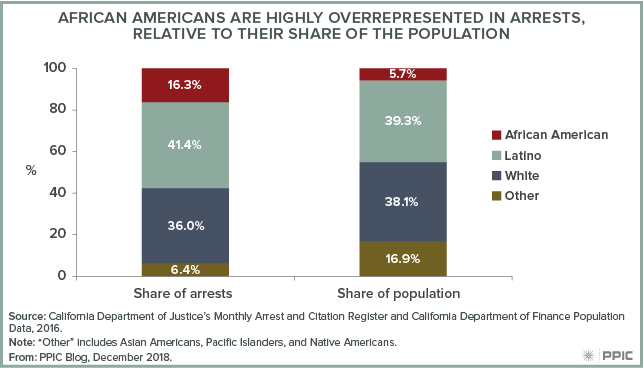
Looking at racial disparities, we find that African Americans are significantly overrepresented among those arrested in California. In 2016, African Americans made up less than 6% of the population but more than 16% of arrests. Latinos were slightly overrepresented in arrests as well, representing 39% of the population but 41% of arrests.

Though much of the penal code is determined by the state legislature, the state does not closely monitor how arrest decisions change over time or vary across jurisdictions, nor how these decisions may affect demographic groups differently. Two efforts—one implemented by the state legislature and one by PPIC—seek to fill this knowledge gap and will bring data-driven information into the broader discussion about policing and community relations.

In 2015, California’s legislature passed the Racial and Identity Profiling Act (AB 953). This legislation requires law enforcement agencies to begin collecting data in 2018 on all initial police interactions with the public, including reason, location, race/ethnicity, gender, and age. While this will provide an opportunity to learn more about law enforcement interactions, the data will not be available for statewide analysis until 2023 or later.

In the meantime, PPIC has launched a project to begin identifying areas in need of attention in California arrests and to frame the conversation for sustainable solutions at the state and local level. In our first report, we examine trends over time and provide a descriptive profile of arrestees, including patterns in race/ethnicity, gender, age, offense type, and the county where the arrest took place. Our interactive tool allows for deeper exploration of arrest rates across California counties.

Over the next two years, we will further examine whether arrestees were booked into jail or cited and released in the field. We will also seek to understand possible contributing factors to these arrest patterns—such as crime rates, law enforcement and correctional resources, economic conditions and expenditures, and demographics. This project uses unique data from the California Department of Justice’s Monthly Arrest and Citation Register (MACR).

As the state and local jurisdictions continue their data collection efforts on police interactions, PPIC’s research will provide a better understanding of long-term trends in arrests and differences throughout the state. Stay tuned for more insights on this critical but understudied aspect of California’s criminal justice system.

Video: Water Advice for Governor-Elect Newsom

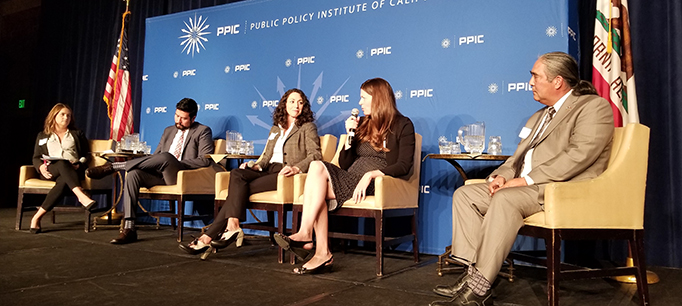
Each fall, the PPIC Water Policy Center hosts a public event to review water policy priorities for the coming year. This year’s panel discussions focused on ways the new administration can promote water policies and practices that benefit the state’s people, economy, and environment. A diverse group of experts on three panels discussed the intersection of water policies with California’s most pressing economic issues; innovations in policy, practice, and technology that offer solutions for key water problems; and steps needed to adapt the state’s water systems to a changing climate.

Each panelist was given an opportunity to make a short “elevator pitch” on water priorities for the governor-elect. Topics included the nexus between water and housing, the challenge of bringing groundwater into balance in the San Joaquin Valley, and improving water management with better data and information technology.

Watch the video to see which water issues these 12 experts think Gavin Newsom should prioritize when he takes over from Jerry Brown in January. And here’s a playlist of all videos from the event.