Video: Californians and Their Government

Californians are increasingly concerned about the cost of housing—a record-high share see affordability as a big problem in their region, and a majority support Governor Newsom’s proposal to put $1.8 billion toward increasing housing production. Dean Bonner outlined these and other key findings of the latest PPIC Statewide Survey at a Sacramento briefing last week.

This month’s survey gauges views on statewide challenges and the governor’s proposals for addressing them. For example, in the wake of last year’s historically destructive wildfires, an overwhelming majority of Californians support the governor’s plan to spend $415 million on wildfire preparedness and forest management. About two-thirds say the gap between rich and poor is widening in their part of the state, and a solid majority favor the governor’s proposal to allocate a billion to expand eligibility for the earned income tax credit.

Other survey highlights:

  • Slim majorities support the governor’s plan to scale back two major infrastructure projects: high-speed rail and the Sacramento–San Joaquin tunnels.
  • When asked whether the penalty for first-degree murder should be death or imprisonment for life with no chance of parole, a record-high 62% of Californians choose life imprisonment.
  • An overwhelming majority oppose President Trump’s declaration of a national emergency over the border wall—but support for the declaration is much higher among Republicans.
  • A majority of residents have a favorable view of the Affordable Care Act and most say that Covered California, the state’s health insurance exchange, has been working well.

Californians’ Views of Immigration Policy—Now and Then

From building a border wall to declaring a crisis at the border, immigration policy proposals from the Trump Administration continue to provoke controversy and stir national debate. How do Californians—who live with the nation’s highest share of immigrants—view such proposals? And more broadly, how have their views of immigration policy changed over time?

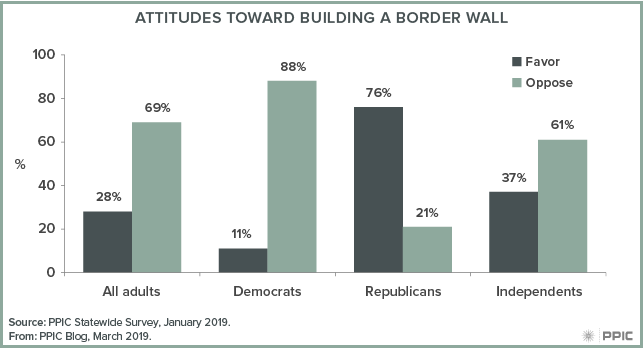
When it comes to a border wall, Californians’ views are decidedly different than those of adults nationwide. Fewer than three in ten Californians (28%) supported building a wall along the entire border with Mexico in our January survey, but twice as many American adults (56%) were in favor of this proposal in a January CNN survey.

However, the wall is a highly partisan issue in California. Support among California Republicans is quite notable, with 76% in favor. Among other partisans—and across regions and demographic groups—support fails to eclipse 40%.

figure - Attitudes Toward Building a Border Wall

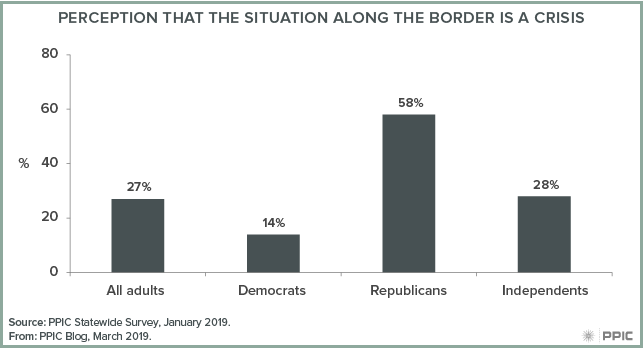
There’s more agreement between Californians and other Americans regarding the situation at the border. Relatively few Californians in our January survey or adults nationwide in a January ABC/Washington Post survey call the situation at the US-Mexico border a “crisis” (27% California, 24% nationwide).

Again, there are stark partisan differences over this topic in California. Republicans (58%) are far more likely than Democrats (14%) and independents (28%) to call the border situation a crisis. Across regions and demographic groups, one in three—or fewer—say this.

figure - Perception that the Situation Along the Border Is a Crisis

Californians’ views of immigration policy have changed a great deal since the passage of Proposition 187 nearly 25 years ago. Supported by 58% of the vote, Prop 187 sought to make undocumented immigrants ineligible for public benefits. Blocked by a federal judge, the measure was never enforced.

Today, 58% of Californians support California’s state and local governments in making their own policies and taking their own actions—separate from the federal government—to protect the legal rights of undocumented immigrants in California.

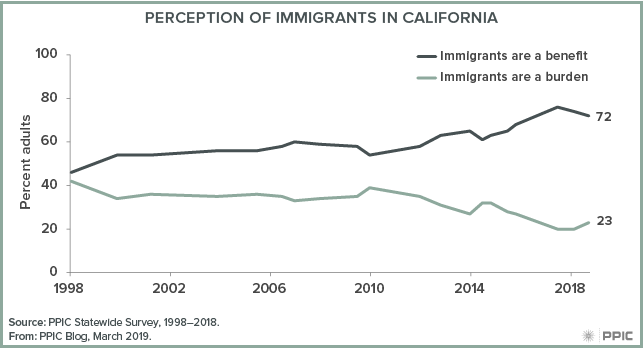
Not only have Californians’ views of immigration policy changed over time, so have their perceptions of immigrants. While state residents have generally held positive views of immigrants, in recent years these perceptions have become much more positive.

figure - Perception of Immigrants in California

Since the PPIC Statewide Survey last talked to Californians, President Trump has declared a national emergency as he seeks funds to build the wall, while California—along with other states—has sued the federal government over this claim. As California and the Trump Administration continue to spar over immigration policy, stay tuned while we track Californians’ perceptions and policy preferences related to this issue.

Californians Deeply Divided on Leaders—But Show Signs of Optimism

With Governor Newsom and President Trump clashing over policy and federal funding, how do Californians view the two leaders? Our January survey found that opinions of the governor and the president are very different—and very partisan. But while the partisan divide runs deep, Californians are unexpectedly hopeful about overcoming political differences and working together.

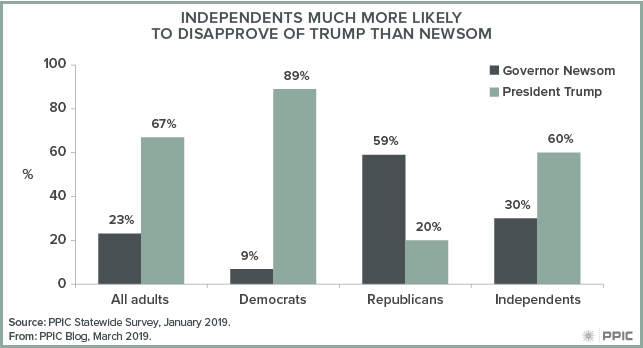
Not surprisingly, newly elected Governor Newsom is far more popular in California than President Trump. Our first reading of Governor Newsom’s approval rating came within the first few weeks of his term. A plurality of Californians said they approve of his job performance, while one in four disapproved and one in three were unsure how to rate him. Meanwhile, three in ten Californians approved of President Trump’s job performance, while two in three disapproved. This question was asked during and after the partial government shutdown in January.

Opinions of both leaders differ widely by party, but President Trump is more polarizing: nine in ten Democrats disapproved of President Trump, while a smaller share of Republicans—six in ten—disapproved of Governor Newsom. Notably, independents were twice as likely to disapprove of President Trump, compared to Governor Newsom.

figure - Independents Much More Likely to Disapprove of Trump Than Newsom

The two leaders couldn’t be in more different positions when it comes to their legislative counterparts. Governor Newsom is working with Democratic supermajorities in both houses, while President Trump has to work with a new Democratic majority in the House of Representatives and a slim Republican majority in the Senate.

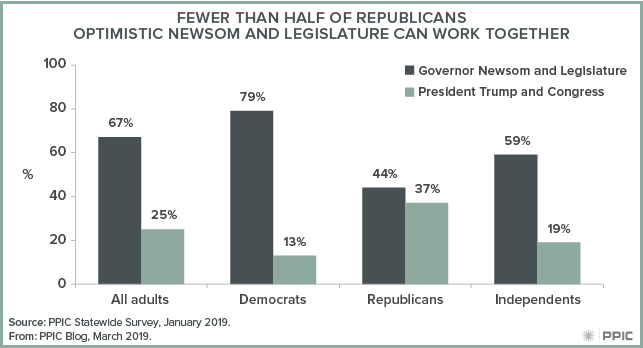
Californians are optimistic that Governor Newsom and the California Legislature will be able to work together and accomplish a lot in the next year. In fact, the share of Californians who are optimistic (67%) is the highest it’s been since we began asking this question in 2006.

In contrast, Californians’ views on the likelihood of cooperation in Washington, DC, are at a record low—with just 25% of Californians optimistic. Notably, Democrats and independents are polarized, while fewer than half of Republicans are optimistic about cooperation at either level.

figure - Fewer Than Half of Republicans Optimistic Newsom and Legislature Can Work Together

Despite the rancorous political environment and the contentious relationship between Governor Newsom and President Trump, most Californians (58%) are optimistic that Americans of different political views can still come together and work out their differences. Notably, about half of Democrats (52%), Republicans (49%), and independents (52%) are optimistic these differences can be overcome. As the governor looks to advance his agenda during his first year in office, we will continue to track Californians’ perceptions of their leaders and monitor attitudes about the state and the nation.

Video: Californians and Their Government

As efforts are gearing up in Sacramento to craft a new state budget, a majority of Californians say they approve of Governor Gavin Newsom’s proposed spending plan. Californians also express optimism about the general direction of the state. These and other key findings of the latest PPIC Statewide Survey were outlined by Alyssa Dykman at a Sacramento briefing last week.

The governor’s budget proposal, which calls for increased funds for education and health and human services, garners support from 70% of California adults. More than three-quarters approve of two key components of the proposal: 77% favor allocating $1.8 billion to expand pre-kindergarten and early childhood programs and facilities, and 78% support an $832 million funding increase for public colleges and universities.

The survey also asked whether Californians believe the state is going in the right direction. A majority of adults (55%) approve of where California is headed. This contrasts with less than a third (30%) saying things are going in the right direction for the country. In addition, a record-low 25% of Californians say that President Trump and Congress will be able to work together and accomplish a lot this year.

Other survey highlights:

  • Asked what the most important issue is for the governor and legislature to address in the coming year, more Californians name immigration and illegal immigration (15% adults) than any other issue.
  • Most Californians (67%) are optimistic that Governor Newsom and the legislature will be able to work together and accomplish a lot in the next year.
  • A strong majority of California adults (64%) say President Trump and Republicans in Congress were primarily responsible for the recent partial shutdown of the federal government. Only 24% say Democrats in Congress were responsible.
  • Only about a quarter of Californians (27%) say the situation with illegal immigration across the US-Mexico border is a crisis.

Californians’ Priorities for Their New Leaders

California enters 2019 with Democratic super-majorities in both chambers of the state legislature and a Democratic governor replacing another for the first time in more than a century. What do Californians want state leaders to prioritize? Although the state is projected to have a budget surplus of $21 billion, many are pessimistic about the state’s short- and long-term economic prospects. These economic concerns are possibly linked to Californians’ policy and spending preferences, and they are likely to inform their attitudes toward the governor’s recently released budget proposal for the next fiscal year.

According to the December 2018 PPIC Statewide Survey, fewer than half of Californians (46%) say the state will have good times financially in the next 12 months. The share of adults holding this view hasn’t been this low since October 2014 (45%).

About one in three (32%) also say California will be a worse place to live in 2025, and 50 percent think children growing up in the state today will be worse off financially than their parents.

When asked what the state government’s most important priority should be in planning for California’s future, 39% of residents say it should be improving jobs and the economy. In the shorter term, what issues should state leaders prioritize in the coming year? Findings from the December survey offer some possible answers.

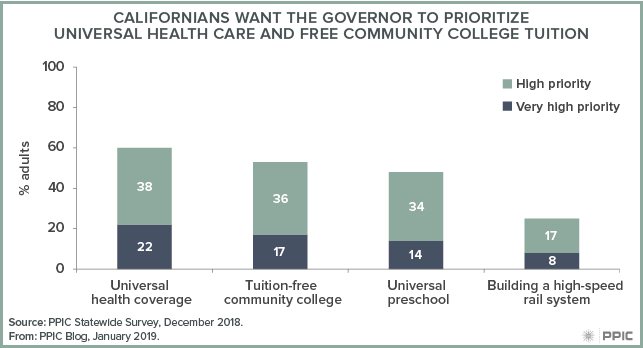
When asked what they would prefer to do with a projected budget surplus, a majority of Californians (57%) say they’d like to increase state funding for education and health and human services. When asked about several potential policies—most of which Governor Newsom highlighted during his campaign—majorities of adults say universal health coverage (60%) and tuition-free community college (53%) should be top priorities for new state funding. Fewer than half (48%) say the same about universal preschool, and one in four (25%) want to prioritize high-speed rail.

These findings underscore Californians’ preferences for programs that can help reduce economic uncertainty. They also indicate that Californians’ priorities are aligned with Governor Newsom’s budget proposal for the next fiscal year. The governor’s budget includes funding for an expansion of Medi-Cal coverage to young adults regardless of immigration status, a second tuition-free year at community college, and steps toward universal preschool for income-eligible four-year old children.

Over the next five months, as the governor and state lawmakers work toward a final budget, Californians will have the opportunity to voice their opinions. Stay tuned to the PPIC Statewide Survey as we track Californians’ attitudes toward new leaders and key policy issues.

Video: Californians and Their Government

As Governor-Elect Gavin Newsom prepares for his first term, half of Californians think he should take a different policy direction than Governor Brown. Four in ten approve of Newsom’s plans and priorities—while three in ten don’t yet know enough to have an opinion. These and other key findings of the latest PPIC Statewide Survey were outlined by Dean Bonner at a Sacramento briefing last week.

The survey asked Californians about four major policy areas that were highlighted in the governor’s campaign. Most see universal health coverage and free community college as top priorities, while fewer see universal preschool as a high or very high priority and only one in four prioritize high-speed rail.

The survey also asked how the state should use the projected surplus in the next budget year. A majority of Californians say they would prefer to use the surplus to increase funding for education and health and human services. Far fewer prefer to use it to pay down debt and build up a reserve or to spend on one-time funding for transportation, water, and infrastructure.

When asked to identify the state government’s highest priority in planning for the future, 39% name improving jobs and the economy, 20% say protecting the environment, and 15% say updating water and transportation infrastructure. Improving jobs and the economy is the highest priority across all parties and demographic groups.

Other survey highlights:

  • Two-thirds of Californians say the state is divided into two economic groups: the “haves” and the “have nots.” Four in ten characterize themselves as haves and 45% say they are have nots.
  • While more than half of Californians think the state is generally headed in the right direction, only about a third are satisfied with the way things are going in the nation. Half have no confidence that President Trump will make the right decisions for the country’s future.
  • Only two in ten likely voters approve of Congress; more than half see the shift in control of the US House from the Republicans to the Democrats as a good thing.
  • Two-thirds of state residents continue to see immigrants as a benefit, and there is still bipartisan support for allowing undocumented immigrants to stay in the US legally if certain requirements are met.

What Approval Ratings Say about Jerry Brown’s Legacy

Perhaps Governor Jerry Brown’s most important contribution—rooted in the higher approval ratings for the executive and legislative branches—was to restore public confidence in state government.

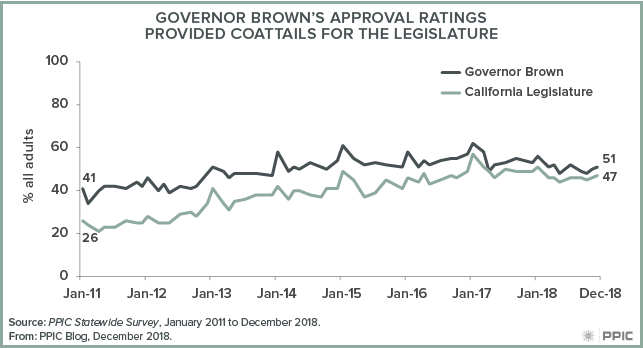
That’s my conclusion after we at the Public Policy Institute of California have taken 64 surveys since Brown took office in January 2011 asking the same question: “Overall, do you approve or disapprove of the way that Jerry Brown is handling his job as governor of California?”

For most of the time since 2011, political gridlock stymied Barack Obama, Donald Trump, and Congress.

But in California, Brown and the state legislature were solving problems. Survey results show that the public responded. Brown’s latest (and our final) approval rating stands at 51 percent. That’s 10 points higher than his approval rating in our January 2011 survey. Brown’s approval rating surpassed 60 percent twice—after his 2014 reelection and after Trump’s election, when our January 2017 survey had the governor at a 62 percent approval rating. Not surprisingly, Brown’s highest approval ratings today are among Democrats and self-identified liberals, 68 percent and 69 percent, respectively, and is least popular among Republicans at 18 percent and self-identified conservatives at 36 percent.

Notably, his canoe theory of politics—paddle to the left, and then paddle to the right—seems to have worked well. About half of independents and moderates approve of the governor. Brown’s approval rating has never dipped below 47 percent since the voters passed his Proposition 30 tax increase in October 2012. The recent campaign for the Proposition 6 gas tax repeal and the race for his successor apparently had no effect on Brown’s popularity.

Brown steered through troubled fiscal waters that damaged other political careers. The approval rating for Gray Davis hit 31 percent in the September 2003 PPIC survey as he faced the recall that ended his time in office. His replacement, Arnold Schwarzenegger, had a 25 percent approval rating in the November 2010 PPIC survey, as the state suffered from massive budget deficits and he and the legislature struggled with unpopular spending and tax decisions.

The state legislature had been mired in low approval ratings for years. Perhaps the legislature rode the coattails of Brown’s success—its approval rating increased by 21 points, from 26 percent in the January 2011 PPIC survey to 47 percent in December. California’s fiscal recovery was certainly tied to more positive views of the governor and legislature. The perception that the state budget situation “is a big problem” fell by 25 points, from 68 percent in January 2011 to 43 percent in January 2018. At the same time, during Brown’s time in office, the belief that the state is generally going in the right direction grew by 16 points to 54 percent in December 2018.

Brown and the legislature took the drama out of the annual budget process, passed popular laws on education funding and climate change, responded to crises such as drought and wildfire, and maintained a united front against Trump’s unpopular policies.

Will Brown be be a hard act to follow for Gavin Newsom?

Maintaining fiscal stability and an effective partnership with the state legislature will be the key ingredients. Jerry Brown will be leaving office with Californians in a better state of mind than they were in eight years ago. His tenure offers a successful model for governing the state in the future.

Election Takeaways: Golden State of Mind

With the release of California’s official Statement of the Vote, the state’s final tally is in for the November 2018 election. This midterm election will mostly be remembered for California’s role in changing party control of Congress. But several other statewide results also stand out:

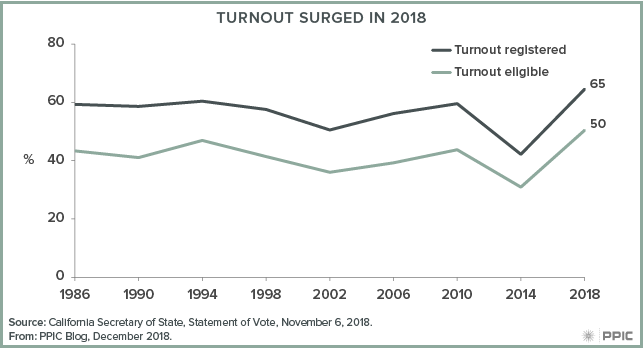
  • High turnout. A record-setting 19,696,371 Californians—78% of eligible adults—were registered to vote by the deadline for the general election. An increase of 1,892,548 registered voters since the 2014 general election represents the biggest surge in voter registration between midterm elections in the past 20 years, according to California’s Secretary of State. The 12,712,542 voters who cast ballots is an all-time high for a midterm and, at 65% of registered voters and 50% of eligible adults, this is the highest midterm turnout in the past 30 years. These increases follow record low turnout in 2014. Many factors were at work in heightening political engagement this fall, including intense media interest in California congressional races that carried over from the June primary; voter participation that was stoked by disapproval of President Trump and dislike of his immigration, environment, and tax policies; and new state laws that are being implemented to make it easier for Californians to register to vote and cast ballots.

  • Blue wave. Democratic candidates won every statewide race and gained enough state legislative seats to have well over a two-thirds majority in the state assembly (60 Democrats, 20 Republicans) and state senate (29 Democrats, 11 Republicans). Democrats also increased their grip on the California congressional delegation (46 Democrats, 7 Republicans). What accounts for this one-party dominance? Midterm elections are often described as a referendum on the president, and President Trump’s approval rating was at 39 percent in the October PPIC survey. PPIC surveys also found an “enthusiasm gap” in voting for congressional candidates, which further skewed the partisan turnout in favor of Democrats. But the difficulties facing Republican candidates go beyond this fall’s political headwinds. The November ballot did not even include Republican candidates for US senator, lieutenant governor, or insurance commissioner—no Republicans made it past the top-two June primary for these offices. The Republicans have not won a statewide race since 2006 and, in this time, their share of the electorate has declined by 10 points (34% to 24%) while their ranks have also diminished (5.4 million to 4.7 million), according to the Secretary of State.
  • Diverse officeholders. Gavin Newsom was elected governor in the only statewide race featuring two white men. California’s other statewide winners were four women, three Latinos, two Asian Americans, one African American, and one openly gay man. Notably, women candidates won all their races while all those who lost—five Republican candidates, the sole No Party Preference candidate, and a nonpartisan candidate—were white men. However, regional diversity was missing, with six successful candidates from the San Francisco Bay Area and three from the Los Angeles region. There were none representing the populous regions of the Central Valley, the Inland Empire, and the South Coast (Orange/San Diego)—or the more sparsely settled central coast and far north.
  • Words matter. Propositions 1 and 2, placed on the November ballot by the legislature, passed—consistent with the historically high pass rate for legislative ballot measures. However, just three of the eight citizens’ initiatives passed, consistent with the historically low pass rate for these types of initiatives. Among the most notable failures were the Proposition 6 gas tax repeal and the Proposition 10 rent control measure. The September PPIC Survey found that about half of likely voters favored the general idea of both the gas tax repeal (50%) and rent control (52%), but only four in ten said they would vote yes when they were read the ballot titles and labels. The defeat of Proposition 6 (56.8% no) and Proposition 10 (59.4% no) once again demonstrates that the devil is in the details when it comes to voter support for citizens’ initiatives on the ballot.

It’s no coincidence—given what PPIC studies say about the profiles of likely voters and nonvoters—that rising political participation in California means that the Democratic Party is becoming more dominant and that statewide officeholders are more likely to reflect the state’s diversity. And it is important to note that Californians continue to be highly selective about making public policy at the ballot box as more and more voters engage with the citizens’ initiative process. Still, millions of Californians are not registered to vote and don’t cast ballots. These residents tend to identify as “have nots” and are often most in need of government services. For this reason, the PPIC Statewide Survey will continue to provide a voice—for all adults in addition to likely voters—on state and national issues. Tracking policy preferences across the broadest swath of Californians is especially critical today, as newly elected state officeholders and state and federal legislators switch from campaign mode to policymaking.

Videos: Higher Education Priorities

Last week in Sacramento, PPIC researcher Lunna Lopes outlined key findings from the latest PPIC Statewide Survey, which focuses on higher education. The following day in San Francisco, PPIC president Mark Baldassare and Monica Lozano, president of the College Futures Foundation, talked about the survey’s implications for governor-elect Gavin Newsom.

The survey finds that most Californians think public higher education should be a high priority for the next governor. For Monica Lozano, this is a key takeaway: “Overwhelmingly, Californians said that a four-year degree is essential to the economic vitality of the state. And, as much as we have considered Jerry Brown a real progressive on lots of issues, there is a sense that he did not do enough on higher education.”

Lozano also noted that Californians are focused on helping students succeed. Their concerns are less about access and enrollment capacity and more about student support: student debt, financial aid, and academic and other kinds of support. “The public is putting students at the center of this equation,” she said.

A majority of Californians see affordability as a big problem. In a state with one of the highest costs of living in the country, residents are divided on whether tuition and fees or housing and living expenses are the bigger burden: 45% say tuition and fees, 34% say housing and living expenses, and 17% volunteer that the two are equally burdensome. As Baldassare put it, “There’s more to affordability than tuition and fees.”

Noting that governor-elect Newsom has an ambitious agenda for “cradle to career” education, Baldassare asked how higher education advocates and experts could help the new administration move forward.

Lozano replied, “Our challenge is to actually help them think about the fundamental issues that surfaced in this survey.” For example, most Californians think state higher education funding is inadequate and many support a funding guarantee for UC and CSU. “If the system of financing higher education has to change so that it’s more predictable—so that there’s some sort of a dedicated revenue stream that’s tied to some accountability measures—how would you actually do that?”

More generally, Lozano and Baldassare agreed that the survey shows how highly Californians value higher education; as Lozano put it, “This survey gives the next governor permission to be bold.”

Californians’ Priorities for the Next Governor

Mark Baldassare, PPIC president and CEO and director of the PPIC Statewide Survey, spoke to the Sacramento Press Club on November 19, 2018 in a post-election discussion with Mark DiCamillo, director of the Berkeley IGS Poll. Here are his prepared remarks.

While we are still counting votes in California, the 2018 election can be called a sweeping success for Democratic candidates in the statewide races. Democrats also won the coveted two-thirds majorities in the state senate and state assembly, and increased their dominance of the California congressional delegation. The Republican Party’s efforts to stem their losses by getting behind what they hoped would be a popular gasoline tax repeal stalled as Proposition 6 fell short (57% no).

In the governor’s race, Democrat Gavin Newsom defeated Republican John Cox by a double-digit margin that was similar to the re-election win of Governor Jerry Brown over Neil Kashkari in 2014 (60% to 40%). Newsom was the leader in eight PPIC Statewide Surveys on the governor’s race conducted since last December. Cox surged to second place after President Trump endorsed him in the June primary, but he was unable to expand his base much beyond the president’s approval rating (39%, October PPIC survey).

What are Californians’ priorities for Governor-elect Newsom? California voters mentioned health care, immigration, the economy, the environment, and gun policy when asked to choose the most important issues facing the country in the exit polls (CNN poll, Fox poll). This list covers most, though not all, of the most important state issues mentioned in 2018 PPIC surveys. It also offers a good starting point for identifying issues that will shape the Newsom era. Here is what the 2018 PPIC surveys have to say about each one:

Health Care. A record-high 59 percent of Californians have a favorable view of the Affordable Care Act (ACA) in the October PPIC survey. While 65 percent think it is the responsibility of the federal government to make sure that all Americans have health coverage, just 34 percent say it should be provided via a single government program instead of the current mix of private and public programs. While 64 percent of adults favor a single-payer state government health plan, support drops to 41 percent if it means raising taxes, according to the May PPIC survey. In the wake of ACA repeal and replace efforts, California’s health insurance exchange and MediCal expansion seem to be generating more public support, while the desire for wholesale change are tempered by concerns about choices and costs.

Immigration. Seventy-four percent of Californians believe that immigrants are a benefit to the state, while 85 percent say that there should be a way for undocumented immigrants to stay in the country legally, according to the May PPIC survey. About three in four (74%) oppose building a wall along the border with Mexico in the October PPIC survey. Nearly six in 10 (58%) favor state and local governments taking action, separate from the federal government, to protect the legal rights of undocumented immigrants in California in the October PPIC survey. Given the large immigrant population and strongly held public views, the next governor will be expected to lead the resistance against federal policies.

The Economy. About half of Californians say they expect good times financially for the state (48%) and the nation (48%) over the next 12 months, according to the October PPIC survey. Still, jobs and the economy tops their list when asked to name the most important issue facing the state in the September PPIC survey. Related to this concern, 60 percent say that the state government should be doing more to reduce the gap between the rich and the poor in California. At least half across demographic groups and regions say the state should do more. The next governor’s challenge in meeting this expectation will be the ambivalence about footing the bill. Fifty percent say they prefer to pay higher taxes and have a state government that provides more services, and 77 percent of them say the state should do more. But of the 44 percent of Californians who would rather pay lower taxes and have fewer services, just 42 percent hold this view.

Environment. A record-high 56 percent of likely voters say that the gubernatorial candidates’ positions on the environment are very important in determining their vote, according to the July PPIC survey. Many Californians say they are concerned about the personal impact of global warming in the wake of a prolonged drought and in the face of growing evidence that extreme weather from climate change is resulting in more severe wildfires. As the federal government has dramatically changed course on environmental issues, most Californians say they want the state government to make its own policies to address global warming, and many say that it is important for California to act as a world leader in fighting climate change. Californians will be looking to the next governor to build on the work in progress, while dealing with environmental crises like the wildfires this fall and with legal challenges from the Trump Administration.

Gun Policy. Most Californians (64%) say the laws covering the sale of guns should be made stricter, according to the October PPIC survey. The belief that gun laws should be stricter was at a record-high 73 percent in the March PPIC survey, shortly after the devastating high school shooting in Parkland, Florida. In the wake of the recent tragic shooting in a bar in Thousand Oaks, California, the public’s belief that gun laws should be made stricter may climb higher. And with the absence of new federal legislation to address gun violence, the governor-elect will be asked to find ways to improve the current laws restricting guns in California.

Californians’ priorities also include big-ticket items such as universal preschool and tuition-free community college that would add up to “cradle to career” education, initiatives to tackle housing affordability and homelessness, and adequate water and transportation infrastructure. The next governor will also be tested by a Democratic-controlled legislature with pent-up demand for spending after eight years of fiscal caution under Governor Brown. The October PPIC survey offers this guidance if voter approval is needed: a majority of California adults prefer a bigger government with more services to a smaller government with fewer services (54% to 39%); however, a majority of likely voters prefer a smaller government with fewer services to a bigger government with more services (53% to 41%).

As the priorities, plans, and programs of the new governor take shape in the next year, the mission of the PPIC Statewide Survey—­­ to provide a voice for all adults and likely voters— is one that we take very seriously during this critical moment of policy development. And as we look to 2020, it’s important to remember that California will be playing an early and outsized role in the presidential election, with an early March 3 primary. PPIC will host a series of one-on-one public forums next year with state and national leaders, to discuss their leadership style and to explore their vision for the state’s and nation’s future.