Two bills recently signed by Governor Brown—AB 91 and 92—will provide drought relief and help to enforce prescriptions for reducing water use that were outlined in the governor’s recent executive order. However most of the bills’ funds are allocated to efforts aimed at improving water management in general. Indeed, most of the funding goes to flood management.
These bills are a reminder that while drought is the crisis of the day, the state must grapple with multiple issues to put water policy on a sustainable and constructive path. These issues include improving water quality, restoring degraded ecosystems, finding new funding mechanisms, adapting to climate change, and reducing the risk of floods.
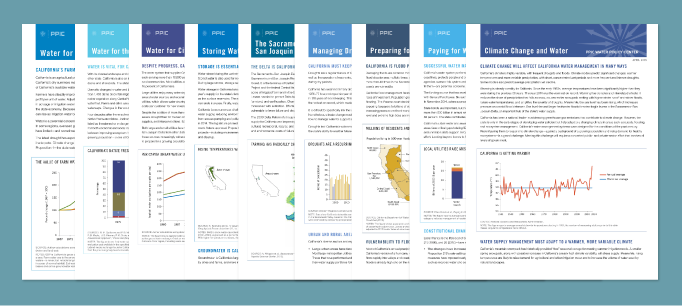
In reality, water management in California is a perpetual work-in-progress—never to be fully resolved. To help inform this process, the newly launched PPIC Water Policy Center has just published California’s Water, a collection of nine short policy briefs. The center’s research network—made up of more than 40 top experts in biology, economics, earth science, engineering, and the law—collaborated to prepare these briefs.
A common theme running through these briefs is California’s tremendous capacity to adapt to changing conditions and tackle new challenges. We hope this collection will be a useful resource for those who wish to become more familiar with California water policy and to join the conversation about solutions.
The nine topics include:
Climate Change and Water. California’s climate is changing, becoming warmer and more variable, while sea level continues to rise. The state is in the early stages of devising water policies to adapt to these changes.
Managing Droughts. The current drought is one of many in the history of the state, with more to come. Reducing harm to cities, farms, and the environment will require creative approaches to improving supply and reducing demand.
Paying for Water. Funding improvements in California’s water management systems has proven difficult, leading to funding gaps of $2-$3 billion annually. Although the recently approved state bond can help, new funding tools are needed to fill critical gaps.
Preparing for Floods. One in five California homes and more than $700 billion in structures are vulnerable to flooding. Reducing flood risk will require improving flood infrastructure while creating incentives to insure existing development against risk and keep new development out of harm’s way.
The Sacramento–San Joaquin Delta. The Delta is the fragile hub of California’s water supply system. The state will need to make strategic decisions about the future of the Delta that consider water supply reliability, ecosystem health, and the Delta economy.
Storing Water. California’s variable climate makes the state very dependent upon storage of water in surface reservoirs and groundwater basins. The state faces big choices in how to increase and manage storage capacity to adapt to a changing climate and shrinking snowpack.
Water for Cities. California’s cities have made considerable progress in managing water resources and reducing per-capita water use. Still, new efforts to reduce demand and to diversify water sources will be needed as the population grows.
Water for the Environment. Forty years after enactment of major environmental laws, California’s freshwater biodiversity is still in decline. Efficient allocation of water for the environment will be one of the biggest water challenges of the 21st century.
Water for Farms. California’s farms are the most productive in the nation, but they are increasingly vulnerable to water shortages. Major changes in groundwater and surface water management, including expanding water markets, will be needed to create a sustainable future for agriculture.




 The
 Since 2000, California voters have approved six water bonds, totaling nearly $20 billion dollars. These bonds looked a little different than Prop 1. Ecosystem improvement and flood protection were the main priorities, with smaller amounts for drinking water quality, integrated management, stormwater, and water supply projects (these bonds also had large amounts for parks and public access). While these bonds provided welcome support to these areas, they also came with fiscal tradeoffs: bonds are repaid with general fund tax dollars that also support other state programs.
 The 2000s were a big decade for water bonds, with approved funds totaling almost three times as much as the three previous decades combined. Even so, bond funds currently only contribute about $1 billion a year to the water sector, a small portion of the $30 billion that is spent annually on the state’s water system.
 For activities that more readily raise funds from local ratepayers—such as water supply and wastewater management—future bond support should be limited to projects that generate broad public benefits. This might include water supply projects that promote better integration of our water system (e.g., by capturing stormwater, which can improve both water supply and prevent pollution) or ecosystem recovery (e.g., by improving the quality or quantity of water to support fish and wildlife).