What’s the Plan to End Groundwater Overdraft in the San Joaquin Valley?

In the midst of the COVID-19 crisis, work on managing groundwater for long-term sustainability continues, as required by California’s landmark Sustainable Groundwater Management Act (SGMA). In January, water users in 21 critically overdrafted basins delivered their groundwater sustainability plans to the state Department of Water Resources. In this series, we examine the 36 plans submitted for 11 critically overdrafted basins in the San Joaquin Valley—California’s largest farming region. PPIC has done extensive work on what SGMA means for this region, where excess pumping is a major challenge. This post examines how the plans propose to end overdraft.

What are the options for ending overdraft?
SGMA requires water users to bring their groundwater basins into long-term balance over the next two decades. Although there are no easy solutions, the math is simple: bringing these basins into balance will require expanding water supplies, reducing water demands, or a combination of these two approaches.

Our in-depth study of water solutions for the San Joaquin Valley found that about a quarter of the region’s 1.8 million acre-feet (maf) of annual overdraft could be filled with new supplies at a cost that local water users can afford. Among supply options, by far the most promising approach is expanding groundwater recharge: storing more of the runoff from large storms in underground aquifers. Filling the remaining three-quarters of the gap will likely require demand reductions. Since agriculture is the predominant water user, this will entail taking some farmland—at least 500,000 acres—out of production. Giving farmers the flexibility to trade water—so it can be used on the most productive lands—can reduce the costs of ending overdraft by two-thirds.

What do the new groundwater sustainability plans propose to do?
As the figure below shows, the plans consider a range of projects on both the supply and demand sides. Together, these projects would yield roughly 2.2 maf per year—in principle, enough to end regional overdraft. However, the plans invert our estimates: they assume that new supplies will account for more than three-quarters of the total, while demand management will save less than one-quarter. In line with our analysis, the single biggest new supply is recharging groundwater basins with more floodwater: the plans target roughly 1 million acre-feet annually, primarily through many small, local projects. Big infrastructure investments—such as new surface reservoirs and regional aqueducts and canals—are largely left out.
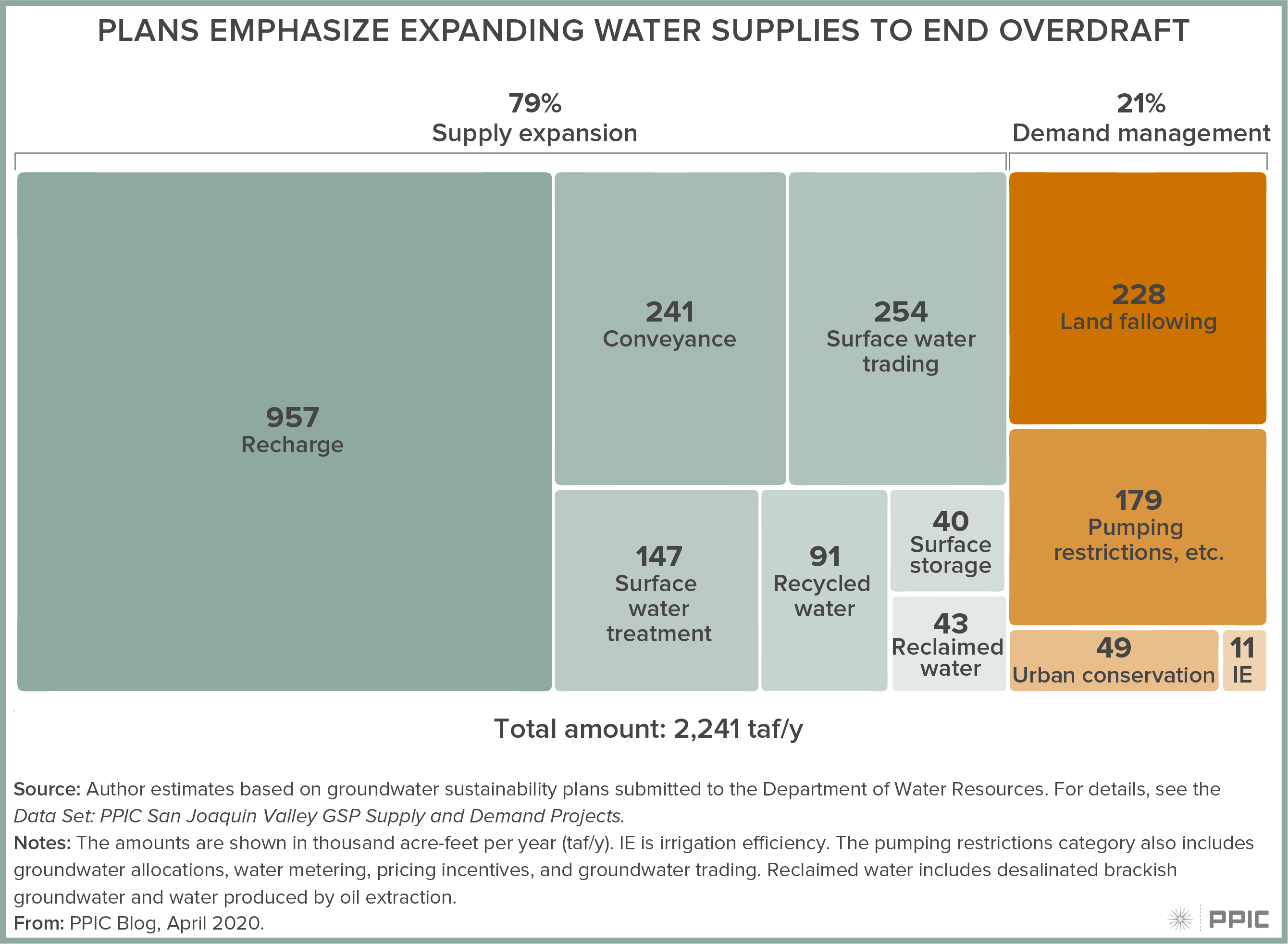
figure - Plans Emphasize Expanding Water Supplies to End Overdraft


Are the goals for expanding supplies realistic?
Probably not. When it comes to recharge, water users will be competing for floodwater that can be feasibly captured—likely a much smaller volume than the total envisaged by the plans. Although that total might be physically available for recharge, there are serious capacity constraints to getting it underground. A central challenge is moving very large volumes of water to storage sites quickly. Addressing this challenge is likely to require regional investments in conveyance, and greater efforts to coordinate the management of surface and groundwater storage infrastructure in order to expand their combined impact. Even then, it is probably not feasible to capture all available water in very wet years.

There are also limitations for the other supply options. Most surface storage and surface water treatment projects will be looking to capture the same high flow water as recharge projects—heightening the competition for these supplies. And most surface water trading and recycled water projects will shift available supplies from some water users to others within the region, rather than causing an overall increase in regional supplies.

What about the plans for reducing demand?
For the most part, the plans fall short on their analysis of demand management. Since reducing water use in this region largely means reducing the amount of irrigated cropland, there’s been reluctance to seriously consider the demand side at this early stage of SGMA implementation. But it’s encouraging that at least some plans are starting to look at such options. Several plans propose tools for managing demand flexibly—for example, groundwater trading, fees tied to volumes pumped, and monetary incentives for land fallowing.

What’s next?
These new plans are an early step on the path toward groundwater sustainability. As implementation gets under way, early actions—such as piloting new approaches to manage demand flexibly and coordinating on smart and affordable supply investments—can lay the foundation for long-term success.

Note: The underlying data and additional notes on supply and demand options identified in these plans can be found in Data Set: PPIC San Joaquin Valley GSP Supply and Demand Projects.

Food Security in a Time of COVID-19 Insecurity: How the Virus Affects Farming

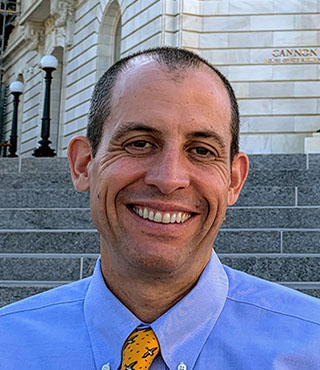
How will the COVID-19 pandemic affect California’s agricultural sector—which is important for food supplies locally, nationally, and in many other countries? We talked to Cannon Michael—a sixth-generation farmer and member of the PPIC Water Policy Center Advisory Council—about the pandemic’s potential to disrupt farming.

photo - Cannon Michael

PPIC: What risks does the virus bring to California’s farm sector?

CANNON MICHAEL: For most farmers, the immediate focus is on our workers—not only keeping them safe from the virus, but also being mindful of the pressures they’re facing at home right now. Most of our workers can’t work from home. Many have kids out of school or partners who’ve lost their jobs.

The big concern going forward is the virus going through our workforce. The disruptions of food supply we’re seeing in stores right now is caused by changes in buying habits and difficulty keeping shelves stocked. But if there’s disruption on farms—if crops don’t get harvested in time or the logistics for getting food to market go down, that would be much scarier. We’re already facing labor uncertainty due to changes to a visa program that allows workers from Mexico and Central America to come here for seasonal farm work. Many of California’s larger farms rely heavily on this temporary labor force. In the early days of the crisis, the H-2A visa program was restricted so that only workers already in the program last year were allowed to come back this year. Rule changes and congestion have made getting across the border harder, too. We’re seeing a slowdown of workers at a time when we may need more. That’s a real concern for the food supply.

There’s a finite pool of people living here to do the hand work required on the state’s farms. There’s a risk that the large companies will do whatever it takes to get those folks if they can’t get seasonal laborers. It could be a threat to smaller farms if larger entities start to pull workers away using incentives that smaller farms can’t match.

The disruption of markets—such as the closure of restaurants and food service operations—is a huge concern for growers. Impacts will vary by region, commodity, and individual company exposure. Western Growers reports that some farmers are heavily embedded in the food service supply chain with crops in the ground now. They have nowhere to put that food, because other growers with retail channels for those commodities are operating at maximum capacity and can’t take any more product into their systems. Other farmers say they may need to scale back acreage. Some crops could be affected by changing international markets or the general financial downturn. There’s the potential for huge swings in marketability and profitability for many farmers.

We’re also not sure if there will be any new requirements for food safety in coming months. There are already good protocols in place for food safety that anyone involved in fresh produce has to comply with, and farmers are accustomed to these high standards. The good news is that food safety experts say there is a low risk of getting the virus from food products or packaging. The advice from the experts is that normal food safety practices will suffice.

PPIC: What steps are being taken to protect farm workers from infection?

CM: We are rapidly approaching the time when most farms will be extremely busy, which means a lot of people on the farm. New state guidance on protecting farmworkers from COVID-19 is being developed. But most farmworkers live in very close conditions and so even with safe practices on the farm, it’s going to be harder to control the risk in their homes and communities under current conditions. If the virus gets into the farmworker population I think we’d see a very fast rise in infection, which would have a dramatic impact on the farm sector and food supply.

On our farm we’re providing regularly updated health information in all the places that people congregate. The California Farm Bureau and industry groups have reacted quickly to make information available in English and Spanish. We’re making sanitation equipment widely available, and presenting guidelines on hand washing and social distancing.

PPIC: What policy changes could help address these risks?

CM: Fixing federal immigration policy is critical. The key point is we need to get food off the farms, and to do that we have to have enough laborers. One hopeful sign is that the federal government recently announced it will relax the new restrictions on the H-2A program. That should help people get here to work.

It’s also critical that rural communities aren’t forgotten in this public health crisis. We need a plan to address the special public health challenges in farm communities.

I don’t want to pound people over the head with this, but the crisis really drives home the importance of agriculture and the value of a stable food supply.

And I’d just like to encourage everyone to reduce the panic buying, which has created big challenges in the supply chain as well as making it harder for more vulnerable people who can’t shop that way. We will produce the food and get it to the markets but we will all be safer if people just buy what they need.


COVID-19: Not a Threat to California’s Water Supply

The COVID-19 health emergency has prompted “panic buying” of bottled water that has emptied store shelves and sown confusion over water safety. We talked to Dave Eggerton—executive director of the Association of California Water Agencies (ACWA) and a member of the PPIC Water Policy Center advisory council—about the state’s municipal water supply in light of the ongoing pandemic. ACWA is a statewide association whose 450 local public water agency members are responsible for about 90% of the water delivered in California.

photo - Dave Eggerton

PPIC: Is the state’s water supply safe?

DAVE EGGERTON: The virus is not a danger to our public water supplies, and buying bottled water in response to it is unnecessary. This has been confirmed by the US Environmental Protection Agency, the Centers for Disease Control, and many local water suppliers. Our treatment plants use a disinfectant process that destroys this virus, along with other pathogens that threaten public health. After the water is treated, chlorine is added during the delivery process as an added precaution.

Our public water systems are comprehensively regulated under state and federal law—including the removal of pathogens. The men and women who operate these plants are highly trained to manage crisis situations like this. These people are real heroes in the work they do, and we’re incredibly proud of them, and of the fact that our water supply remains safe.

In addition to providing this essential service, one of the other important things our water agencies do is continuously provide timely, accurate information to the public. That’s a major focus right now, and it’s key to reducing confusion during a crisis. If you have any questions about water safety, contact your local provider; they stand ready to help.

PPIC: Water systems are critical infrastructure and can’t shut down. What steps will the sector need to take to address this risk?

DE: Like the rest of society, we’re faced with the challenge of protecting our employees from getting sick. Public water systems are in many ways automated, which allows us to operate facilities more or less remotely. But you need essential workers on site to monitor conditions at treatment plants and distribution systems and address issues as they arise. These people must be able to get to work sites. So we have to protect them so they can do their jobs.

That said, the water sector is well prepared for emergencies, so you can be sure these supplies will be delivered to people’s homes. For example, if you look back at some of the recent catastrophic fires we’ve experienced, water workers were at frontlines to protect communities’ supplies. They have an incredible commitment to their work. Responding to emergencies is something our agencies do on a regular basis. We have emergency response plans, and the men and women who operate these systems are trained to handle crisis conditions. During Santa Rosa’s huge fire, for example, operators of a water treatment plant kept it functioning so water could continue flowing to hydrants, even when they were at risk of the rapidly approaching flames.

In addition, our agencies are working together to help each other—we have mutual aid agreements to share supplies and labor as needed. And because our drinking water systems are regulated under state law, the state Division of Drinking Water has continuous involvement with our public agencies. So we have longstanding relationships and paths of communication that enable us to be aware and responsive to new challenges. And on the local side, we have strong, ongoing relationships with county response emergency operation centers, and we’ve planned emergency scenarios with them. That level of communication and trust really helps in times like these.

A Reality Check on Groundwater Overdraft in the San Joaquin Valley

This year marks a new phase in California’s landmark Sustainable Groundwater Management Act (SGMA). At the end of January, water users in 21 critically overdrafted basins delivered their first groundwater sustainability plans to the state Department of Water Resources. In this series, we examine the 36 plans submitted for 11 critically overdrafted basins in the San Joaquin Valley—California’s largest farming region. PPIC has done extensive work on what SGMA means for this region, where excess pumping is a major challenge. This post addresses key questions about groundwater budgets.

What are water budgets, and why do they matter?
Water budgets track the water coming into and going out of the groundwater basin. If more groundwater is pumped than the amount replenished over time, the basin is in overdraft. In our study of the valley’s 30-year water balance (1988‒2017), which used data on inflow and outflow to the San Joaquin Valley as a whole, we found a long-term overdraft of 1.8 million acre-feet per year—about 11% of net water use.

Under SGMA, water users need to bring their basins into long-term balance and avoid undesirable effects from excess groundwater pumping—such as lowering groundwater levels and causing lands to sink. Understanding the extent of the overdraft problem is key to taking appropriate action. As the saying goes, you can’t manage what you don’t measure.

What type of groundwater budgeting does SGMA require?
The regulations require groundwater sustainability plans (GSPs) to include three types of water budgets—historical, current, and projected—but allow a lot of flexibility on the specifics. Historical budgets only need to include 10 continuous years of data, including the most recent years available for that basin. Current budgets need to show present-day conditions, and projected budgets need to look ahead 50 years and consider anticipated changes in population, climate, and other factors that could affect water supplies and demands. The plans can then choose which budget to emphasize for addressing overdraft.

In many basins, water users have opted to develop separate GSPs for different areas. In those basins, the GSPs must use a common timeframe and a common overall budget. But there’s no requirement for consistency across neighboring basins. The regulations also leave it up to locals to choose their methods for elements that must be estimated, such as how quickly groundwater moves from one basin to another. Budgets can look better or worse depending on assumptions about such factors.

The span of years covered by budgets can also matter a lot, given California’s variable climate. Budgets with more wet years will look better than budgets with more dry years. The figure below shows the budget timeframes that the valley’s plans use for their preferred estimates of overdraft. These timeframes vary widely. Basins in the wetter northern part of the valley (the San Joaquin River hydrologic region) are more likely to include the recent drought than are the basins in the drier, more groundwater-dependent southern valley (the Tulare Lake Basin hydrologic region).

figure - Timeframes Used to Estimate Overdraft Vary across Basins


Do the plans acknowledge the valley’s overdraft problem?
In general, yes. As the figure below shows, the plans report a considerable amount of overdraft—around 1.4 million acre-feet (maf) per year. But since they cover different timeframes, it’s misleading to simply add up the totals reported. To compare apples to apples, we looked at the eight years that are included in all of the budgets: 2003‒10. This short period is instructive, because it includes both wet and dry years. The plans estimate around 1.7 maf of annual overdraft in these years—fairly close to our valley-wide estimate of 1.9 maf for the same period. So overall, the plans are telling a story that is broadly consistent with the overall regional water balance. This apples-to-apples comparison also reduces the wet-year bias in many of the Tulare Lake Basin budgets.

figure - Plans Acknowledge Significant Overdraft

Even so, some basins are probably underestimating overdraft. And if the future is drier than the past, the overall challenge for the valley could be greater. We found, for instance, that the region-wide overdraft for 2003‒17—a period that included a record-breaking five-year drought—was 2.4 maf/year—a good deal higher than the 30-year average of 1.8 maf.

What’s next?
Acknowledging overdraft is important, but it’s just the first step. The options to end overdraft include augmenting water supplies, reducing water demand, or some combination of the two. Next week’s post will examine what the plans propose to do.

Note: The underlying data and additional notes on the water budgets used in these plans can be found in Data Set: PPIC San Joaquin Valley GSP Water Budgets.

Why the Big Drop in California’s Colorado River Water Use?

In 2019, California’s use of the Colorado River—a major water source for Southern California’s cities and farms—dropped to the lowest level in decades. We asked John Fleck—director of the University of New Mexico’s Water Resources Program and a member of the PPIC Water Policy Center research network—about the ongoing changes in California’s use of this water, and what it means going forward. He is the author, with Eric Kuhn, of the new book Science Be Dammed: How Ignoring Inconvenient Science Drained the Colorado River Basin.

photo of John Fleck

PPIC: What are the main reasons Californians are using less Colorado River water?

JOHN FLECK: The biggest reason for the recent drop is that Metropolitan Water District (MWD)—the state’s biggest urban user of the river—didn’t need to take as much water in 2019. But this decline also reflects a longer term trend. Prior to the early 2000s, MWD generally took the maximum it could from the Colorado River, usually more than a million acre-feet per year. In recent decades, it has substantially reduced its dependence on the Colorado, only taking a full supply in years of State Water Project shortage. Water conservation has been an enormous success in Southern California. There was a lot of progress in conservation during the latest drought, and even after it ended. We’re seeing a lot more effective use of water in the basin, with a growing emphasis on groundwater recharge, stormwater capture, and reuse efforts. The excellent snowpack in the Sierra in 2019 meant the agency got a good water allocation from the State Water Project, meaning it needed less from the Colorado.

The other part of this story is the conservation success in the Imperial Irrigation District (IID)—the largest user of Colorado River water in the entire basin. On-farm water conservation was part of transfer agreements with Southern California’s urban water suppliers. IID is now using 600 thousand fewer acre-feet per year than before those transfers took place. The agricultural community took cuts and was compensated for them. Farmers have adapted well: revenue has held up even as they’re irrigating less land. What we’ve seen is an increase in acreage in high-dollar crops like winter lettuce and vegetables, and a reduction in alfalfa and forage crops, which bring in less revenue per unit of water and area of land.

figure - Use of Colorado River Water Is Dropping, Especially in California

PPIC: Do you expect similar drops in coming years in California or the six other basin states?

JF: We’re going to have ups and downs—especially because MWD use of Colorado River water tends to go up when its supplies from the Sierra are low. But California has really demonstrated that it needs less Colorado River water. It’s taken awhile, but it’s been a really successful adaptation. Scarcity is the norm now in the basin, so the fact that California can succeed in using less imported water is incredibly important. It shows how we can find opportunities for more flexible problem-solving going forward.

We’re seeing similar things going on across the basin. California isn’t giving up water so others can use more. Nevada is using substantially less than they used to—their use peaked in the early 2000s and has dropped since then. Arizona’s use is down, too. And we’re seeing really flat to declining use in all the other basin states. So the notion that economic and population growth means an increase in water use just isn’t the case in the basin.

PPIC:  What does this change mean for efforts to bring the basin into balance?

JF: Because we made mistakes over a century ago in allocating more water than the river can provide, these successes are important, but not enough. We’ll need to see more reductions, especially in the lower basin states.

The next steps require renegotiating the rules that govern the basin’s water allocation to solve the basin’s problems. The Bureau of Reclamation is spending 2020 reviewing how the current rules are working, with the expectation that negotiations on new rules will begin soon after that review is complete. There will be a lot of give and take in how that will play out, and we have to let that happen. Once farmers and communities have a clear idea on how much water they will get, they’re pretty good at figuring out what steps are needed to work within those limits. Various options that might come into play include compensating farmers to use less water, additional conservation, and more expensive options like increasing the use of recycled water and building desalination plants. The negotiations will be hard, but the successes we’ve seen in California and elsewhere around the Colorado River Basin suggest that we have the tools needed to respond to the challenges to come.

California Agriculture in 2050: Still Feeding People, Maybe Fewer Acres and Cows

Water supply concerns, regulations, labor issues, tariffs, climate change, and other challenges have prompted some rather dire predictions about the future of California agriculture. We talked to Dan Sumner—director of the UC Davis Agricultural Issues Center and a member of the PPIC Water Policy Center research network—about his research on California agriculture in 2050.

PPIC: How do you think California agriculture will change in the next few decades?

DAN SUMNER: The value of farm production in California has been growing for a very long time and is likely to continue to grow. Farmers have been shifting land and water to crops that generate more revenue per acre and per acre-foot of water. Tree and vine crops have replaced annual crops. For example, cotton acreage collapsed from more than 1.2 million Central Valley acres 30 years ago to just 260,000 now. And these days Central Valley farms are getting twice as much revenue from pistachios as from hay. The pace of the shift to crops that bring higher revenue per unit of land and water will likely slow in the coming decades simply because much of the transition has already occurred.

For many years now, California’s most valuable agricultural industry by gross revenue has been dairy. But the dairy industry has stopped growing—partly because it is expensive to haul hay in from places that have adequate water.

California dairy is also under pressure from economic implications of state regulations on climate and other environmental issues. Californians demand attention to environmental concerns, labor market conditions, energy costs, and other issues that generate regulation, and such regulations can be costly for farms. The result is some commodities that had been important in California will be grown elsewhere.

PPIC: How will climate change affect the state’s farms?

DS: It will drive many adaptations, including shifts in locations as farms plant crops better suited to new climate and market conditions. We also expect different pest problems. But given the close attention of researchers and growers to these issues, I don’t see unmanageable challenges in the next few decades.

It is important to recognize that global markets and climates interact, and so what economists call “comparative advantage” remains crucial to economic success. Let’s say climate change makes table grapes more expensive to grow here or moves the season earlier. But if climate change affects Mexican growing conditions even more, climate change could cause grapes to become more profitable and therefore expand in California. The crucial issue looking forward is what will grow well in California compared to other places and compared to other crops.

PPIC: What are important policy or regulatory drivers that could help the farm sector adapt to changing conditions?

DS: We’ll need all sorts of innovations in every sector, from banking, government institutions, and science to farm management. California agriculture is already innovative and flexible, but we’ll keep moving rapidly to adapt to the economic and environmental changes on the horizon. Regulations are a part of what is changing and a part of what agriculture is adapting to.

Farm labor cost and availability remain crucial drivers of the future of California agriculture. We need innovations to reduce labor per unit of output, but we also need policy and regulations that allow immigrants to continue to work in California.

The climate-water nexus is probably where we can gain the most from innovative regulations and adaptations. Climate change and water regulations, including groundwater regulations, will reduce California irrigation water availability. We’ll need to consolidate water use to fewer acres, possibly convert some land to dryland farming, and even idle some land. Fortunately, the Sustainable Groundwater Management Act (SGMA) is encouraging people to value water that once was taken for granted.

With far-sighted regulations, California can find more effective ways to store more water underground, and use it most effectively. For example, markets are crucial to provide incentives for groundwater recharge in the winter. If regulations continue to limit transfer of water among farms and from one year to the next, we will severely restrict incentives to adjust to climate change.  I am confident that California will find a regulatory path to allow continued farm adaptation and flourishing.

Commentary: Newsom’s Water Framework Is Imperfect but Necessary. The Alternative Is Further Deterioration of the Delta

This commentary was published in CALmatters on February 10, 2020.

Gov. Gavin Newsom has put forward a framework for managing water and habitat in the Delta and its watershed. As far as we can tell, no one is very happy with the framework—and that may be a good sign.

The framework is the product of years of effort to negotiate an agreement among water users, other stakeholders, and regulatory agencies. Details are yet to be worked out, including firm commitments for water and funding, along with critical negotiations with the federal government on how to cooperatively manage upstream dams and the Delta pumps. Ultimately, the package has to be acceptable to state and federal regulators.

The scope of this effort is vast.

Over the next 15 years, the proposal is to spend more than $5 billion on new river and floodplain habitat to benefit salmon and other native fish species.

This funding will also pay for a mix of new water projects, water purchases, and fallowing of farmland will provide additional water for the environment. Additionally, new governance and science programs will manage the water and habitat in the Delta, as well as the rivers that flow into it.

For many years and in multiple publications by the Public Policy Institute of California, we have been calling for a negotiated agreement in the Delta and its watershed. This agreement needs robust management that includes shared governance, reliable funding, strong science support, and regulatory backstops if parties fail to live up to their obligations.

These must-haves are outlined in our recent report: A Path Forward for California’s Freshwater Ecosystems.

It is also time to shift away from the traditional approach to addressing environmental concerns in the Delta, which has overemphasized a handful of endangered fishes and a single management tool: the volume of water dedicated to these fishes.

Success will require a broad portfolio of actions to manage the connections between water, land, and the many species—including humans—who rely on healthy ecosystems. The proposed framework makes an earnest attempt to take this broader approach.

A negotiated agreement will, by necessity, be imperfect and controversial. That’s because it is just not possible to satisfy all interests in the Delta. The trade-offs are real, sometimes painful, and can only be resolved through compromise.

Many Delta combatants are dug in, committed to fighting the same battles with the same arguments that they have been using for decades.

We can appreciate why many parties would want to hold out for a better deal, and absent that, turn to the courts in the hopes of getting their way. But as seasoned veterans of the Delta know well, the delay-and-litigate strategy has inherent risks because the outcomes are hard to predict.

In the meantime, the Delta and its watershed are changing rapidly—faster than science and management can keep up.

Many factors are to blame, including current and historic land and water management, the introduction of innumerable non-native species, declining water quality, the inexorable rise of sea level, and the changing climate.

This important ecosystem needs attention now, before conditions deteriorate further.

An agreement, with all its imperfections, provides some measure of certainty to water users and the environment alike.

If a coalition of interests sign on, even if reluctantly, the likelihood of success goes up, because all parties will have an interest in making the agreement work.

Perhaps most importantly, an agreement is the only way to comprehensively address the Delta’s problems. Drawn-out legal battles over how much water is allocated to the environment ignore all the other factors that affect ecosystem health.

We are not endorsing the specific contents of the Newsom Administration’s proposed framework. But we believe it has the “bones” of an eventual agreement that can be durable and binding, avoiding lengthy delays in addressing the Delta’s many problems.

The many Delta interests should persevere and try to make this agreement happen.  This is an opportunity—the kind that comes along rarely—to shift from fighting about the Delta’s future to actually shaping it.

Fighting Sea Level Rise the Natural Way

How will rising seas affect the state’s freshwater ecosystems, and what role do these systems play in managing the coming changes? We talked to Letitia Grenier—a member of the PPIC Water Policy Center research network and a senior scientist at the San Francisco Estuary Institute—about this issue.

photo - Letitia Grenier

PPIC: How will sea level rise affect California’s freshwater systems?

LETITIA GRENIER: We tend to think of climate change as causing a slow, linear rise in sea level, but it’s definitely not always gradual. Depending on a host of local and global factors, we could see quick changes and sudden jumps in sea level.

Rising seas will affect how we manage runoff from major storms. It’s not enough to manage water coming down rivers and rising from groundwater—we also have to account for concurrent king tides and storm surges. It won’t work to build infrastructure that only addresses sea level rise—it must also take into account flooding coming from behind and below.

Rising seas will also push salty water farther into estuaries, including the Delta. The levee system throughout the Bay‒Delta is fragile, and could fail in big storms or earthquakes. That would allow a lot more salt water to come in, which could affect the water supply for Southern California.

PPIC: Talk about the potential for “natural infrastructure” to address rising seas.

LG: Our water infrastructure was developed to address specific issues, piece by piece. No one was responsible for figuring out how to make the overall watershed work well for all the things we need it to do. Instead, we optimized the system in each location for one function—water supply, flood control and other tasks. It’s like having many people each design one part of a car without thinking of the whole vehicle—it doesn’t work very well.

This approach to managing freshwater ecosystems changed key natural processes that actually worked for us—we interrupted the flow of sediment down rivers, blocked salmon from migrating upstream, and drained wetlands. There is huge potential to redesign systems to let natural processes help us solve some of our complicated problems. For example, if we realigned a creek so that it could move sediment to the coast, it can help rebuild marshes that would protect the urban shoreline and bring a host of other benefits.

PPIC: What are the advantages of using natural infrastructure options?

LG: Bringing more benefits is the big one. Engineered solutions are mostly designed to bring just one benefit. Compared to a concrete flood basin, a marsh provides not just flood protection but also creates habitat for at-risk species, protects the shoreline, sequesters carbon, filters and breaks down contaminants, and creates recreational opportunities. And traditional engineered infrastructure has a lifespan. Over a 50-year lifespan, will it be flexible enough to adapt to climate change? Usually not. Engineered solutions also cost more over their lifetime to maintain and upgrade. In contrast, ecosystems are always changing; they can adapt in ways that engineered solutions can’t. Let’s restore these systems so they can continue to do useful work for us.

PPIC: How do we get there?

LG: We have a lot of knowledge of freshwater ecosystems, but knowing how to use them as part of our water infrastructure system is pretty new. So we need to test more, and build more. We’re doing it too slowly and at too small a scale.

We also need to work across jurisdictions. We haven’t set ourselves up socially to do this. Our current system has too many agencies with missions that aren’t well aligned. So we’ll need to voluntarily coordinate to make our watersheds work as they should—and provide incentives to bring agencies together over watershed planning. It will take time to make this change, and we’re very short on time. I think these big social challenges are harder to resolve than the science side.

Many people think of ecosystem restoration as something that is “nice to have,” not “have to have.” But growing extremes in fires, floods, and droughts are bringing people around to the realization that we’re dependent on ecosystems, and it matters if they’re healthy.  I hope that leads to the understanding that natural infrastructure is worth investing in and can perform better than traditional infrastructure in many cases. Climate change will require us to rebuild or fix a lot of our existing infrastructure. It’s a great opportunity to make transformational change.

Governor’s Budget Addresses Growing Wildfire Risks

This is the final post in a two-part series on how the governor’s budget proposal addresses natural resources. The first post looked at water and climate issues.

In recent years, California has experienced some of the worst wildfires on record, and the risk is increasing as the climate warms and precipitation becomes more variable. Governor Newsom’s proposed budget supports an array of tools for reducing the threat of wildfire. Funding for these investments would come from the state General Fund, a proposed climate resilience bond, and the greenhouse gas reduction fund (GGRF). The budget prioritizes three wildfire-related areas:

  • Boosting fire suppression resources: The budget would increase the California Department of Forestry and Fire Protection’s (Cal Fire), annual budget by $120 million. It would also add 677 staff positions over five years—an 11% increase in the state’s permanent firefighting force. These investments would improve Cal Fire’s ability to ramp up fire suppression efforts through a longer fire The budget also provides $9 million for the development of an interagency center to improve wildfire detection and responsiveness, as required by SB 209 (2019).
  • Bolstering community resilience: The budget proposes significant funding increases to make homes and community infrastructure less vulnerable to wildfire damage. It earmarks $500 million to reduce fire risks to community infrastructure, including drinking water systems, emergency shelters, and public medical facilities. It also includes $25 million for a pilot program that would provide financial assistance for home hardening (for example, switching to fire-resistant roofing) in low-income communities, as required by AB 38 (2019). Another $25 million is proposed for community resilience planning, including the development of local wildfire emergency plans. And the California Office of Emergency Services would get $50 million to help local governments prepare for, respond to, and mitigate the impact of wildfire-related power outages.
  • Improving forest health: Actions that help the state’s forests withstand high-severity wildfire, drought, and pests are essential to reduce wildfire threats. The budget builds on past efforts by allocating $165 million to Cal Fire’s forest health grant program. It also includes $250 million to supplement existing forest health programs funded by the GGRF. Finally, the $80 million allocation for the development of statewide LiDAR maps can help the state target its investments in forest management.

Managing the state’s climate-fueled wildfire threat requires both emergency fire suppression and risk reduction actions. Governor Newsom’s budget continues to move the state toward a useful balance of these efforts.

Governor’s Budget Seeks to Build Water Resilience

Earlier this month the Newsom administration laid out its vision for addressing the linked issues of water and climate in two key policy documents: the much-anticipated draft of its Water Resilience Portfolio (WRP) and the governor’s budget proposal. The WRP, which resulted from an April 2019 executive order, was developed with extensive input from state agencies and stakeholders from around California. It outlines more than 100 actions designed to ensure that communities, the economy, and ecosystems across California’s diverse regions are able to weather our increasingly volatile climate. The January budget provides a roadmap of the administration’s initial spending priorities in this area.

The big ticket item is the $4.75 billion Climate Resilience Bond, which could appear on the November 2020 ballot. More than 60% of the bond amount would directly support actions in the WRP—including integrated regional water projects, safe drinking water, flood protection, and environmental stewardship. The remainder would address other climate resilience issues for California communities—including reducing risks from wildfire, sea level rise, and extreme heat—and closing the funding gap for restoration efforts in the troubled Salton Sea.

General obligation bonds—which are repaid through the state General Fund—have been a key tool for funding water and environment initiatives over the past two decades. Although they usually pass (eight of nine have been approved since 2000, totaling $39 billion in today’s dollars), voters rejected the most recent water bond—an $8.9 billion bond on the November 2018 ballot.

The administration also proposes a modest allocation of General Fund dollars to near-term actions on the portfolio’s long to-do list. Key areas of investment include:

  • Groundwater sustainability: Groundwater is an essential drought reserve. This year, local agencies and water users in the state’s most stressed basins will begin implementing the landmark Sustainable Groundwater Management Act to bring their basins into balance. The budget proposes to spend $60 million on the hard work of reducing water demand in ways that support local communities and economies, such as water trading and making the best use of fallowed cropland.
  • Better data for decision making: The WRP emphasizes the importance of modernizing data use to make the most of our water resources, and acknowledges the key role of the state as a data collector and developer. Of note is the proposed allocation of $80 million toward development of statewide LiDAR maps—landscape contour images that can help guide investments in habitat improvements and efforts to reduce risks from flooding and sea level rise.
  • Cutting “green tape”: The WRP also stresses the importance of improving the approval process for projects designed to enhance the natural environment, which is especially vulnerable to climate change. The current process, which involves many agencies, causes lengthy and costly delays. The budget proposes to reduce “green tape” by allocating $4 million for new staff positions to help make the approval process more efficient. Even modest additional resources, coupled with strong direction from state leadership to agency staff, could help California move toward truly coordinated, expedient, and effective stewardship of our natural environment.

The administration’s proposals provide much food for thought about state priorities in the California water arena. The WRP in particular emphasizes the state’s role in facilitating and supporting efforts at local and regional levels, where most water investments take place. In the coming months, there will no doubt be a lively debate about the specifics of the Climate Resilience Bond—which must be finalized by early summer to qualify for the ballot—as well as the other ways the Newsom administration and the legislature can help the state’s communities, economies, and environment build water resilience.