Connecting the Drops in Watershed Management

The interrelated nature of water issues has given rise to a management approach that integrates flood control, environmental water, and water supply. The Yuba Water Agency manages its watershed in this kind of coordinated manner. We talked to Curt Aikens, the agency’s general manager, about the lessons they’ve learned from this “integrated management” approach.
PPIC: Your agency manages the watershed for hydropower, water supply, flood control, and ecosystem health. What are some key elements to making it all work together?

Curt Aikens: I think the most critical elements to making this work for us are employing science and broad collaboration to sustainably manage all of the resources.

We try to make the most of every drop of water we touch—this infographic highlights how we do that. Our water provides recreation, carbon-free electricity, habitat for fish and wildlife, and a sustainable water supply for farmers and the 80% of our population that relies on groundwater for drinking water. In drought years, we transfer water to the state for use in the Central Valley and Southern California. We use the proceeds from those transfers and from hydropower sales to invest in reducing flood risk in Yuba County and other environmental, water supply, and public safety projects.

In managing this integrated system, we’re fortunate that our agency’s boundary fully contains our groundwater basins and most of the Yuba River watershed. The river flows right down the middle of the county.

We worked hard to get where we are today. In the 1990s we were involved in a contentious debate with conservation groups and state agencies over environmental flow requirements for the Lower Yuba River to support salmon and steelhead trout. To resolve the situation, we developed a collaborative, science-based settlement called the Yuba Accord. This agreement, which improved salmon and steelhead habitat, is a foundation for our success, because it helped us solve a number of problems collaboratively.

We try to ensure that everything we do has multiple benefits and comes from a strong collaborative effort. The Feather River Setback Levee is a great example of that. After Yuba County flooded in 1997, we commissioned a comprehensive flood study that presented half a dozen options to reduce future risk. Working with local conservation groups, we eventually settled on a program to set the levees back and strengthen them. This significantly lowered flood risk while producing ecological benefits for the river. The community gained a new, stronger levee, a significantly lower flood risk, and real ecological benefits.

PPIC: Is it harder to address multiple problems with one project?

CA: Today, it’s actually harder to implement a project with a single purpose. We live in a world with multiple interests, and we’ve found that multipurpose projects are a much better way to get things done. The Yuba River has more human impacts than most other rivers in the state. So we try to get ecosystem benefits out of most of our projects, whether it’s improving fishery habitat in our flood control work or strengthening water supply management through a project to build forest health.

Collaborative, science-based initiatives cost more and take more time upfront, but in the end you can get better results and more durable, sustainable solutions.

PPIC: Can this approach work well for water agencies that share a watershed with other entities or have other complicating factors in how they manage their system?

CA:  I think it absolutely can. There are many examples of multiple jurisdictions working together to resolve common water or natural-resource challenges. For example, the work being done on the voluntary settlement agreements in the Bay-Delta has brought together a really diverse group of conservation and water interests working toward an innovative solution. This approach is collaborative and science based. It also presents the opportunity for fish and wildlife habitat creation, new flows to support fish, and funding to help finance these activities.

Collaborative agreements, rather than a mandated regulatory approach, offer much greater promise for California’s environment and economic stability. This is exactly our experience with the Yuba Accord.  Continued leadership from Governor Newsom and his administration can help California create a sustainable solution for the entire Bay-Delta watershed.

Colorado Drought Deal Close, But Not Done

Last week Arizona and California missed a deadline to submit final plans for how they will manage water shortages in the Colorado River Basin over the coming decades to prevent Lake Mead levels from dropping so low that water cannot be released from the dam. The other five states that share the river’s waters have already submitted their drought contingency plans. We talked to John Fleck—director of the University of New Mexico’s Water Resources Program and a member of the PPIC Water Policy Center research network—about the situation.

photo of John Fleck

PPIC: What is the drought contingency plan intended to do?

John Fleck: The key problem on the Colorado is that the basin’s water is over-allocated. It was really wet in 1920 when the allocation rules for the river were developed. So the rules allocated extremely large water shares to the “lower basin states”—California, Arizona, and Nevada—that hydrologic reality can’t support. We’ve been struggling ever since to come to terms with that reality.

The drought contingency plan is a voluntary program involving the lower basin states to decrease their use of the river’s water in an attempt to reduce the over-allocation problem. There’s an overall agreement describing the conditions that would require each state to use less water. Then each state has to have its own separate internal set of agreements on how to share those cuts.

There are a couple of different ways you can approach this over-allocation problem. The federal government can just reduce everyone’s allocation. Or you can have the water users themselves acknowledge the problem and agree to a voluntary, collaborative approach. The latter approach is far more likely to succeed, so I definitely think this was the better way to go.

Even though the lower basin states are close to having final plans, federal officials have said that “close isn’t done.” The states now have until March 4 to submit their final plans. No one wants to have an imposed federal solution—and I don’t think we’ll end up there—but it’d be better than doing nothing. The threat alone might push people to finish up.

PPIC: What are some important steps the states have agreed to?

JF: The agreements reduce water use in the lower basin by 1.5 million acre-feet per year; it’s a very big deal. Arizona has now agreed to a plan that could eventually reduce the Central Arizona Project’s flow of Colorado River water into the valleys of Tucson and Phoenix by nearly half of current levels. They did this voluntarily, without any litigation. That’s real progress. And Imperial Irrigation District (IID)—the biggest agricultural user of California’s allocation of Colorado River water—has already given up 500,000 acre-feet a year, which is a huge amount of water.

One of the complications of reductions in Colorado River water is the drying of the Salton Sea, which relies principally on runoff from farms in IID. California promised to mitigate the public health and environmental problems associated with the shrinking of the sea, particularly the air quality impact on poor communities. Solving this problem is a work in progress made more challenging by reductions in Colorado River water.

PPIC: Do you think the states’ plans go far enough, given the warming climate?

JF: We can’t be sure, because we don’t know how much impact climate change will have, on what time scales. Since we don’t really know where the bottom is for the Colorado River, hydrologically speaking, we don’t how far we’re going to have to go with water cutbacks in the long run. Drought planning is a really important step to prepare for a climate-challenged future—it creates a framework for deeper cuts.

It’s important to see the drought contingency planning as the latest development in the evolution of long-term management of the river’s waters. There are a bunch of unresolved problems—both hydrologic and institutional―and a lot of work remains to be done, but we can’t solve all these problems at once. Though drought planning is an incredibly important step, it’s certainly not the last one.

Fleck is a co-author (with Eric Kuhn) of the upcoming book Science Be Dammed: How Ignoring Inconvenient Science Drained the Colorado River, to be published this fall by the University of Arizona Press.

A Momentous Water Year

California was bookended by extreme events last year―from the Southern California mudslides in January to the disastrous wildfires north and south in November, and in between, a bout of record-breaking heat in Los Angeles. These events are all connected to policy challenges that California water managers and decision makers are grappling with—issues that are front and center in our work at the PPIC Water Policy Center.

  • Climate change is bringing multiple climate pressures that affect the state’s water supplies and complicate water management. We assembled a team of 30 experts in climate science, hydrology, ecology, engineering, economics, and law to review the weak points in the state’s water system and recommend actions to build its climate resilience. Our new report―published as Governor Brown’s Global Action Climate Summit kicked off in September―provided an accessible analysis of how climate change will affect droughts and summarized reforms needed to better manage future droughts and adapt the state water system to a more volatile climate. Next up is a research project on how to manage wastewater as the climate changes.
  • Two years of tragic, extreme fires stirred debate on how best to address this growing risk, and productive change is already underway. Our ongoing work has guided the development of significant reforms to improve forest health and reduce wildfire risk. Governor Brown directed state agencies to increase forest management in accordance with some of our recommendations. And a new law reflects a number of our suggested reforms to help headwater landowners better manage their forests. New federal and local policy changes will also help. We’ve begun a deeper dive into the benefits—and beneficiaries—of improved forest management as a next step to identifying durable funding solutions.
  • The San Joaquin Valley―California’s largest agricultural region—faces major challenges in managing its groundwater, a critical drought reserve. Our research on recharging groundwater basins laid out key problems that must be addressed to capture more water for underground storage and described what can be done to advance recharge efforts. Next month we’ll release a comprehensive review of solutions to the San Joaquin Valley’s many water and land management challenges that will help the valley continue on a prosperous path for the next century.
  • We hosted a large public event in November to identify water priorities for the new governor. A group of 16 experts discussed how the Newsom administration can promote water policies and practices that benefit the state’s people, economy, and environment. We also updated and expanded our policy briefing kit, California’s Water, to inform newly elected leaders on key water issues—including a new brief on providing safe drinking water. We look forward to working with the new administration to develop meaningful, lasting, forward-looking water policies.

As we move into our fifth year, the PPIC Water Policy Center looks forward to being part of the effort to find creative and collaborative solutions to California’s most difficult and pressing water challenges. And as always, we thank our supporters who enable this important work.

With best wishes for 2019,

Ellen Hanak

P.S. You can sign up for our weekly blog post. And you can learn more about how to support the center’s work.

Reducing Drought Risks in Rural Communities

Disadvantaged rural communities are disproportionately exposed to drinking water risks in California. Too many experience insecure supplies and contamination of their water sources. While there are growing efforts by policymakers to address water contamination, many communities will need further help to prepare for future droughts. Improved planning efforts could help avert water shortages.

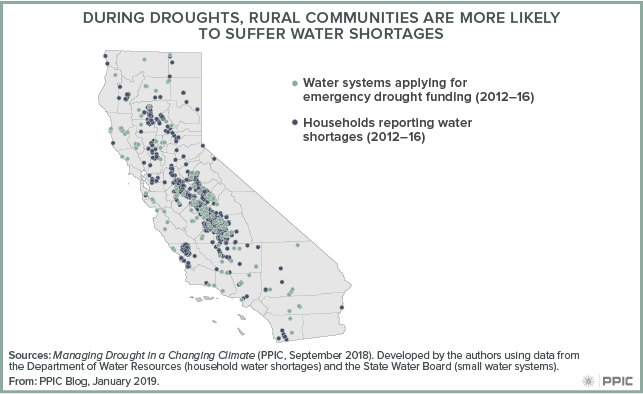
Rural residents are more vulnerable to running out of water during droughts because they are more likely to rely solely on groundwater from small community wells or domestic wells. These wells tend to be relatively shallow, so they are susceptible to running dry when pumping lowers groundwater levels. During the 2012‒16 drought, farmers and cities pumped extra groundwater to make up for surface water shortages. Thousands of wells went dry―mostly domestic drinking water wells in rural communities, especially in the San Joaquin Valley. And roughly 150 small community water systems sought emergency assistance to keep the taps flowing.

Although the state’s Sustainable Groundwater Management Act (SGMA) is expected to lead to balanced groundwater use and reduce over-pumping in the long term, California’s highly variable climate means that groundwater levels will still drop during droughts. This could result in more drinking water wells going dry. In a recent submission to the California Water Data Challenge, several colleagues from UC Davis and I found that a drought similar to the latest one could cause more than 4,000 domestic wells to go dry in the Central Valley.

A recent PPIC report on managing drought in a changing climate offers two ideas for reducing these risks:

  • Develop drinking water plans for rural communities and identify durable funding sources. Small rural systems do not have the financial capacity for drought planning and mitigation. State and local partners should use their experience from the recent drought to identify communities at highest risk, connect them to larger systems where feasible, and devise drought response programs for the others with reliable funding sources. The newly formed groundwater sustainability agencies, working with local partners such as counties and agricultural and urban dischargers, could help coordinate actions and streamline funding mechanisms.
  • Ensure groundwater sustainability plans include mitigation actions for dry drinking wells. Sustainability plans should describe preparation for groundwater drawdowns during severe drought similar to the one in 2012‒16. For instance, as groundwater sustainability agencies develop their plans, mapping drinking water wells that might be at risk for different drought scenarios and proposing mitigation actions that proactively decrease the risks are both imperative.

Studies of institutional responses to the latest drought largely find that planning for drought response and recovery paid off. Making an action plan to avoid further water-supply risks in disadvantaged rural communities―as well as identifying reliable funding mechanisms to implement it―should be top priorities for California policymakers.

Commentary: Peace in California’s Water Wars is Within Grasp

This commentary was published in CALmatters on December 19, 2018.

Dare we say it? The outlines of a truce in California’s unending water battles began to come into focus last week, though not everyone is willing to sign the treaty. The State Water Board adopted the first phase of a far-reaching revision to the Water Quality Control Plan for the Sacramento‒San Joaquin Delta and its watershed.

This is an effort to improve conditions for dwindling populations of endangered native fish such as salmon and steelhead. It also means an increase in water scarcity for farms and cities.

The mere adoption of the plan was significant. But something else happened in the board meeting that may in fact be more important and longer-lasting: state officials presented the framework of a peace treaty for Central Valley water wars.

With support from Governor Jerry Brown and Governor-Elect Gavin Newsom, most of the combatants negotiated the outlines of a comprehensive settlement agreement.

The Natural Resources Agency—including the Department of Water Resources and the Department of Fish and Wildlife—spent countless hours over several years convincing water users to develop a voluntary approach to improve ecosystem conditions for native fishes.

The approach state officials presented to the board would increase flows in rivers and the Delta and make major investments in habitat. And perhaps most important, it would create sustainable funding for these efforts (including fees on water diversions), while improving scientific research on and governance of restoration efforts.

To be clear, a framework was presented, not an actual settlement. But the framework contains commitments of water, habitat restoration and funding.

It also includes timelines for action from water users across the greater Sacramento–San Joaquin River watershed, and a willingness to get this settlement completed by the end of 2019. A few districts—such as the Oakdale, South San Joaquin and Merced Irrigation Districts—balked at the framework and are threatening litigation. But most of the watershed has signed on.

If this settlement is achieved and adopted by the board, it will be a major step forward in water management in the Central Valley. But a lot of work lies ahead. Water and habitat commitments—along with sources of funding—need further negotiation, and a robust governance and science program still needs to be designed. Additionally, many of the non-governmental environmental organizations that were mostly left out of negotiations need to be more involved.

Finally, the federal government can either be a partner or a roadblock to this effort. Federal representatives actively participated in negotiations and helped spur innovative approaches along the way.

But after the State Water Board’s vote, the US Bureau of Reclamation threatened litigation, and the Trump administration is seeking to roll back environmental standards in the Delta. Both actions have the potential to undo the settlements.

Despite these hurdles, there’s reason for optimism that there can be a truce in California’s water wars. What’s clear is that negotiated solutions to water conflicts are fairer and longer-lasting than top-down regulatory solutions or, worse yet, litigated solutions where judges end up trying to manage water.

Incoming Governor Newsom’s support and involvement will be essential to carry this effort to a positive conclusion. It should be a priority for his new administration.

Adapting to an Uncertain Water Future

As the world’s biggest climate meeting continues in Poland this week, the growing threats from climate change―and the lack of large-scale action to match the risks―have been much in the news. Global, national, and statewide assessments all point to severe consequences if greenhouse gas emissions are not greatly reduced. Evidence is growing that climate change is a “threat multiplier,” increasing the frequency and intensity of natural disasters worldwide and here in California. And just this past week, the Global Carbon Project reported that emissions are rising rapidly, making it even more difficult to meet the goals of the Paris Agreement and heightening the possibility of more-frequent and more-damaging climate impacts.

These reports all point to the same policy direction for California. While it is important that the state continue its leadership on reducing greenhouse gas emissions, it is time to greatly increase efforts at adaptation.

Water is where climate change is having its most direct and measurable impact in California. A recent PPIC report found that five climate pressures—warming temperatures, shrinking snowpack, shorter wet seasons, more volatile precipitation, and rising seas—affect all aspects of water. We recommended a suite of integrated reforms to adapt to these changes. These include better planning for water use in cities and farms, and for the environment; upgrading the state’s water management infrastructure; improving the way the state allocates water; and coming up with innovative new funding mechanisms.

Although all of the reforms are important, two—upgrading infrastructure and providing adequate funding—are the most critical. California’s water management infrastructure is vast and complex. Nearly 1,500 dams and reservoirs provide numerous services, some of which are at cross purposes with each other: they store water, reduce flood risk, generate electricity, help maintain downstream ecosystems, and provide recreation. Large volumes of existing and potential storage occur in more than 500 groundwater basins.

The above- and below-ground storage is linked from far-northern California to the suburbs of San Diego by a network of thousands of miles of canals and aqueducts, as well as rivers that function as aqueducts. California could not function without this networked “grid.” This grid is the state’s most valuable asset for adapting to an uncertain climate future.

We recommend that this grid be upgraded. A top priority includes repairing or strengthening dams, canals, and aqueducts—most of which were designed and built more than 50 years ago using outdated hydrology that doesn’t reflect a changing climate. Another upgrade is adding connections to the grid so that water can be conveyed more easily to where it’s needed for replenishing groundwater storage or to support water trading. And integrating operations of the grid, possibly involving a wholesale change in the way it is managed and governed, should also be prioritized.

But talk about upgrading the grid will be insufficient if the state does not find a way to pay for it. The defeat of the statewide water bond, Proposition 3, in November may be an indication of “bond fatigue.” Instead, the burden for paying for this upgrade is likely to fall upon local communities, who already shoulder about 85% of the costs for water management every year. This will be a contentious but necessary public debate. Without new resources, upgrading the grid will be very difficult.

The climate is changing, and the direction of change poses great challenges for California water management. But the state has a very large portfolio of assets to help adapt to this change. If these assets are managed well—and California makes well-funded investments in upgrades and focuses on sustainability—the state can weather these changes with minimal social and economic disruptions.

Video: Water Advice for Governor-Elect Newsom

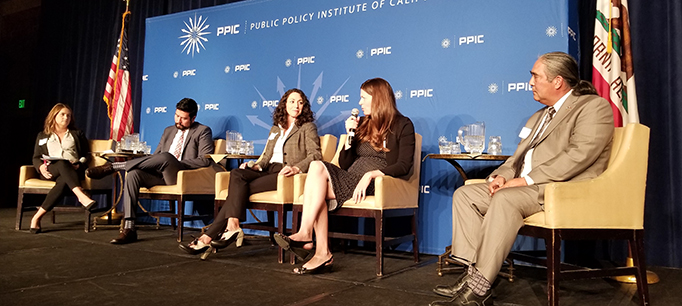
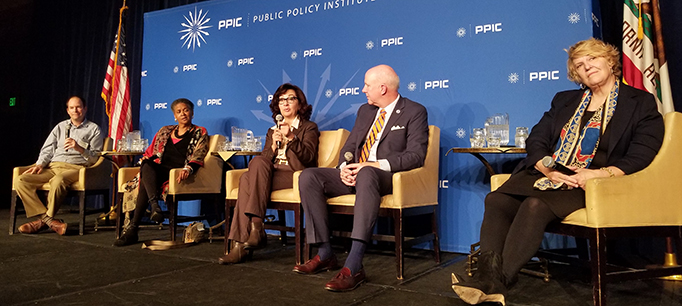
Each fall, the PPIC Water Policy Center hosts a public event to review water policy priorities for the coming year. This year’s panel discussions focused on ways the new administration can promote water policies and practices that benefit the state’s people, economy, and environment. A diverse group of experts on three panels discussed the intersection of water policies with California’s most pressing economic issues; innovations in policy, practice, and technology that offer solutions for key water problems; and steps needed to adapt the state’s water systems to a changing climate.

Each panelist was given an opportunity to make a short “elevator pitch” on water priorities for the governor-elect. Topics included the nexus between water and housing, the challenge of bringing groundwater into balance in the San Joaquin Valley, and improving water management with better data and information technology.

Watch the video to see which water issues these 12 experts think Gavin Newsom should prioritize when he takes over from Jerry Brown in January. And here’s a playlist of all videos from the event.

Video: Water Priorities for California’s Next Governor

California’s many water challenges are complex, with many possible solutions and even more opinions about best approaches. How can a new governor forge a path forward in this critical area?

The PPIC Water Policy Center assembled a group of 16 experts this week for a half-day workshop in Sacramento to discuss how the new administration can promote water policies and practices that benefit the state’s people, economy, and environment. Lively discussions addressed three overarching topics: how local and state water policies intersect with California’s most pressing economic issues; innovations in policy, practice, and technology that offer better solutions for key water problems; and steps needed to adapt the state’s water systems to a changing climate.

Ellen Hanak, director of the PPIC Water Policy Center, summarized some major water challenges the new administration will face, including increased risks of drought and floods; poor water quality and drying wells in disadvantaged rural communities; and finding durable ways to pay for needed water system improvements. Leadership will be key to advancing solutions, she said.

“California has been a leader both nationally and internationally” on climate change mitigation and reducing emissions, Hanak said. “We think California has the potential to be a leader when it comes to climate adaptation as well.” She noted that water is a lynchpin issue for addressing the effects of a changing climate.

The first panel shed light on the links between water and the state’s leading economic challenges, from housing affordability to jobs. For example, growing water scarcity in the San Joaquin Valley—one of California’s fastest-growing areas―will affect plans to build new housing there. And regulation can complicate efforts to build affordable housing. Dan Dunmoyer of the California Building Industry Association noted that some water-related regulations—such as strict rules to prevent runoff from construction sites during the rainy season—can significantly increase building costs. Panelists agreed that better coordination could help open up many of these bottlenecks.

Denise Fairchild of Emerald Cities Collaborative highlighted the potential for job training programs in the water sector—which is grappling with the “silver tsunami” of an aging workforce—to create economic opportunities for low-income communities. “If we take this opportunity to rebuild California’s water infrastructure, it has great job generation potential” in communities affected by a historical lack of water sector investment.

The next panel looked at technical and policy-related innovations that can improve water management, such as weather forecasting tools that enable more nimble water management in dams—key to adapting to an increasingly volatile climate. Also, better information on agricultural water use can “empower communities to stop arguing about numbers and start working on solutions,” said Robyn Grimm of Environmental Defense.

The final panel explored opportunities to modernize the state’s water “grid”—its vast network of reservoirs, aquifers and conveyance systems—to make it more resilient in the face of five climate pressures: warming temperatures, shrinking snowpack, shorter and more intense wet seasons, more volatile precipitation, and rising seas. Improving water conveyance and reworking the current system would enable the state to “take advantage of bigger storms” linked to climate change by capturing their water for recharge, said Ashley Boren of Sustainable Conservation.

Each panel discussion included a quick round of “elevator pitch” advice for the governor-elect. Jennifer Pierre of the State Water Contractors captured the mood of the group with her pitch: “In water, flexibility is the name of the game—we need it for managing the existing grid, and for grid improvements. Don’t wait for the perfect plan; we’ll suffer every year that we delay.”

We invite you to watch the videos from this event and hope you find the discussions helpful:

Groundwater Management is Key to Adapting to Climate Change

California relies heavily on groundwater for its water supply, particularly during drought.  Climate change is increasing drought intensity, making groundwater―with its immense potential for low-cost storage―an ever more important water source. Sustainable groundwater management will be vital to adapting to a warmer future and should be a top policy priority for the next administration.

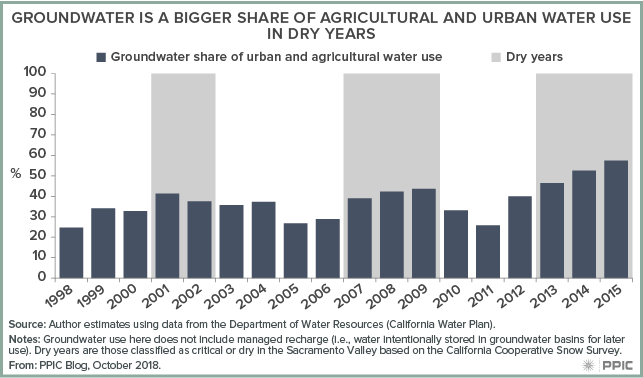
In non-drought years, groundwater supplies approximately one-third of urban and agricultural water use in California, but its share rises during droughts, when snow and surface water are scarce. In severe drought years, it provides more than half of urban and agricultural water use.

A recent report by the PPIC Water Policy Center and a large team of experts highlighted the impacts of climate change on water supply and ecosystem management during drought. As winter precipitation shifts from snow to rain in a warming climate, a key issue will be adapting the management of the state’s water storage system. A more volatile climate and changes in precipitation could shift the use of large multipurpose reservoirs from water storage to protection against flood risk, thus reducing the water available from reservoirs in some years―and making groundwater storage even more important.

In some regions, including the San Joaquin Valley, groundwater overdraft—taking more water out of aquifers than is put back—has been going on for decades. This has increased the cost of groundwater pumping, dried up wells in many rural areas, and caused land to sink, damaging infrastructure.

But the greatest long-term impact of unsustainable groundwater use is the loss of stored water that can be economically pumped during dry periods. This makes the state increasingly vulnerable to drought in a changing climate.

The 2014 Sustainable Groundwater Management Act (SGMA) requires water users and other stakeholders to self-organize into groundwater sustainability agencies (GSAs) and prepare and implement plans to achieve sustainability in the next 20 years. Done well, these efforts will restore the capacity of the state’s groundwater basins to supply water during drought.

GSAs have begun the hard work of developing their sustainability plans—due in January 2020 for critically overdrafted basins and two years later for the rest. The Department of Water Resources is providing technical and planning assistance, and the State Water Board―which has ultimate authority over these plans―is offering policy and legal guidance where it can.

Making SGMA a success will require additional action in the following four areas:

  • Advance planning. At the top of the list is expanding state and regional support for groundwater sustainability plans. Factoring in the predicted effects of climate change and developing robust water accounting and regional strategies for managing scarcity will be key.
  • Modernizing the water grid. A major priority for helping groundwater basins achieve sustainability is to upgrade and modernize the state’s water “grid”―the network of reservoirs, canals, rivers, and groundwater basins that store and convey water. Improving the grid’s capacity to move surface water into groundwater storage during wet periods is essential.
  • Updating water allocation rules. For the improved grid capacity to function well, the state will need to make it easier to recharge, trade, and bank groundwater.
  • Finding the money. Finding the money for groundwater sustainability programs will be crucial. The best solutions focus on expanding funding from local water bills and taxes—which currently fund roughly 85% of water management expenditures—and using state general obligation bonds to fund projects with clearly defined public benefits.

Achieving sustainable groundwater management is one of the most important things California can do to prepare for a warming climate. Getting there will require a suite of actions―including some reforms beyond those called for under SGMA. Better planning, modernizing the grid, streamlining water allocation, and finding program funding can help us manage this critical water supply.

Tackling Safe Drinking Water in the San Joaquin Valley

Unsafe drinking water is a significant problem in parts of California, especially in small, disadvantaged rural communities. We talked to Maria Herrera—a California water commissioner and community development manager at Self-Help Enterprises—about how to tackle this ongoing problem.

Maria HerreraPPIC: What’s behind California’s safe drinking water problem?

Maria Herrera: Too many California residents still lack access to safe drinking water. In the San Joaquin Valley, drinking water delivered by small water systems and private domestic wells is contaminated by many natural and manmade contaminates. Typical water quality issues for valley communities are contamination from nitrate, arsenic, uranium and a chemical called 1,2,3-TCP. Small community systems and private well owners often don’t have the resources to address these issues. They face a lot of challenges—for starters, they have little to no staff and lack the resources to maintain or upgrade aging infrastructure. Some rely on just one or two wells. Historically, these communities haven’t been prioritized for state funding or in planning processes.

PPIC: How should we be tackling this problem?

MH: I grew up in communities experiencing these problems and have worked on these issues for more than 10 years, and I’ve seen a big shift in visibility over safe drinking water in recent years. California has taken a number of steps to address the problem, especially with the passage of the human-right-to-water law (AB 685), which makes it state policy that every Californian should have safe and affordable drinking water. That was the biggest signal that this issue is now being prioritized. Also, Proposition 1 prioritized safe drinking water in disadvantaged communities by increasing technical assistance funding and giving communities an opportunity to hire consultants to develop shovel-ready projects and fund safe drinking water projects.

We need to continue on that path in order to make these communities less vulnerable to drought. We need to not only fund mitigation of contaminated wells and treatment plants, but also help communities develop redundant water sources, promote consolidation of small systems to larger ones, and help them with drought contingency planning. Communities need guidance and technical assistance in order to develop solutions and participate in water planning.

This year California came close to establishing a safe drinking water fund, which would have created an ongoing fund for disadvantaged communities to improve their water infrastructure and clean up contamination. A safe drinking water fund is still a priority for drinking water advocates going forward.

PPIC: How might the Sustainable Groundwater Management Act (SGMA) affect the safe drinking water effort?

MH: SGMA creates a good opportunity for people to come together and identify ways to protect and improve drinking water supplies. But achieving sustainability will bring some tough decisions and will have some impact on agriculture. We want farmers to thrive—and rural communities to have adequate water supplies. SGMA provides groundwater sustainability agencies (GSAs) an opportunity to play a very meaningful role in improving groundwater supplies. We’d like to work with GSAs and communities to develop joint solutions, improve coordination between GSAs and the agencies that work on water quality, and ensure that good information is available regarding groundwater supplies used by these communities. We’d like to encourage GSAs to look more closely at domestic wells. We’re trying to encourage them to develop more protections for vulnerable communities. Our ultimate objective is to ensure that rural communities have the information and resources they need to play a meaningful role in developing and implementing their groundwater sustainability plans.

PPIC: What gives you hope?

MH: I’m inspired by the interest of rural residents in building capacity and leadership skills to engage on water issues. There’s a new generation of young adults that know the issues, have lived in impacted communities, and are now ready to a make change in their communities by participating in water management and planning. I’m also energized by the partnerships we’ve helped establish between the communities, irrigation districts, cities, and agencies. It gives me hope that they are interested in finding common ground. And, I’m  encouraged by the attention the issue is getting at the state level—the legislature, governor, the voters have all shown interest in funding propositions and programs that will help bring safe water to these communities.

Watch a video with Maria Herrera and other panelists discussing managing drought in a changing climate.