The Connection between Groundwater and Surface Water

When the California Legislature created the “modern” water rights regulatory system more than a century ago, it focused exclusively on surface water, exempting groundwater from the permitting system. Yet in most watersheds, surface water and groundwater are closely linked. Actions that change one often have an impact on the other. The arbitrary legal divide has made it harder to manage the state’s water. But a recent law and a new court decision have done a better job of connecting surface water and groundwater.

When rain falls or snow melts in the foothills and mountains of California, water follows several pathways downhill and into rivers and streams. Some water moves across the land or through deep soils and weathered bedrock, arriving in rivers hours to weeks after rain or snowmelt. And some percolates deep into the ground, becoming groundwater.

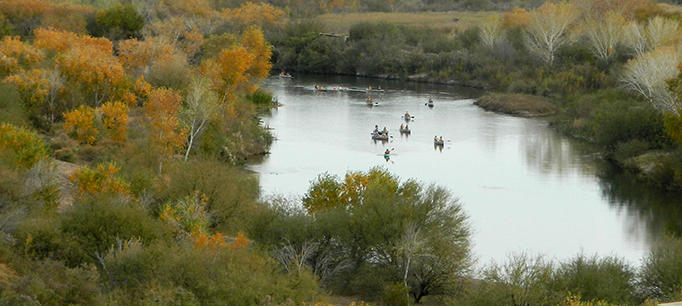
As groundwater tables rise in winter and spring, they discharge water into rivers and streams, either directly through river beds and banks or indirectly through springs. This is why many of California’s rivers and streams flow long after the rain stops.

The exchange between surface water and groundwater continues when rivers emerge from mountains and flow across the state’s large valleys. Winter flooding, along with rainfall in the valleys, recharges groundwater during the winter. Some of that groundwater moves back into rivers and helps maintain flow in the dry season. Shallow groundwater also supports wetlands and riparian vegetation.

Groundwater pumping alters the exchange between surface water and groundwater. In many of the state’s large valleys, such as the Central Valley and valleys in the Central Coast and Southern California, streams and rivers that historically flowed all year are now intermittent due to lowered groundwater tables. In many cases, groundwater tables are so far below the surface that water only flows one way: from the river bed to the aquifer.

The arbitrary legal divide between surface water and groundwater has begun to change. A big step was the 2014 enactment of the Sustainable Groundwater Management Act (SGMA). SGMA requires water users in overdrafted groundwater basins to develop and implement groundwater sustainability plans to bring groundwater use and recharge into balance by 2040. SGMA mandates that these plans include measures to avoid undesirable effects from pumping, such as reduced stream flows and harm to groundwater-dependent ecosystems like wetlands. This is one of the few explicit legislative acknowledgements of the links between groundwater pumping and surface water flows.

Additionally, the California Court of Appeal recently added an important legal connection between groundwater pumping and surface water uses. In litigation to protect salmon and steelhead in the Scott River, the court ruled that the public trust doctrine―which protects the public’s right to use waterways for navigation, fishing, boating, natural habitat protection, and other activities―applies to groundwater pumping that adversely affects a navigable river or lake. The court also held that SGMA doesn’t override the public trust doctrine in groundwater cases.

These developments will have far-reaching implications for how California’s groundwater will be managed in the future. They also bring the law closer to hydrologic reality, which is likely to improve the effectiveness of both surface water and groundwater management.

A more extensive analysis of the Scott River decision by PPIC senior fellow Brian Gray was published on the California WaterBlog. Richard Frank, a UC Davis law professor and a member of the PPIC Water Policy Center’s research network, has also written a summary of the case.
New Laws on Drought, Forests, and Safe Drinking Water

The legislative session that just wrapped up addressed a number of water and forest management issues. Progress was made in three major areas—urban drought management, forest health, and safe drinking water.

Urban water use efficiency and drought management: Assembly Bill (AB) 1668 requires the State Water Board and the Department of Water Resources to adopt long-term efficiency standards for residential water use and efficiency metrics for commercial, industrial, and institutional water use by June 2022. The law complements Senate Bill (SB) 606, which requires urban water suppliers to develop local water use budgets by November 2023. Progress toward those objectives will be overseen by state agencies. SB 606 also strengthens local drought planning requirements and increases transparency of information about drought risks and responses. The law requires suppliers to regularly analyze the risk of a five-year severe drought and report short-term water shortage risks and responses to the state each spring. Suppliers must also revamp their drought response plans to include new elements such as descriptions of supply forecasting procedures, new ways of reporting water shortage levels, and protocols for communicating with customers during droughts. AB 1668 also includes provisions to increase drought preparedness for small rural water systems and large agricultural water suppliers.

Wildfires and forest management: SB 901 takes substantive steps toward reducing wildfire risks by increasing the pace and scale of forest health improvements. Cal Fire will have access to new, stable funding from cap-and-trade revenues—$200 million per year for five years—to pay for forest management. The law also helps lower management cost barriers for family forest owners, which occupy about one-quarter of the state’s headwater forests. It relaxes some timber harvest regulations to make it easier for these owners to reduce wildfire risk. A provision that increases the size of trees owners can harvest should expand their ability to raise funds from selling timber. The law also allows multiple landowners to work under the same timber harvest permit. Finally, SB 901 includes provisions that apply to forests managed by the US Forest Service, which make up more than half of our headwater forests. In particular, it streamlines California’s environmental permitting process for collaborative fire risk reduction projects on federal lands that are approved under the federal National Environmental Policy Act.

Safe drinking water for vulnerable communities: Drinking water received significant attention this year, as lawmakers attempted to fill the funding gap for small disadvantaged communities facing water quality and quantity problems. Proposals to tap urban water customers and agricultural fertilizer users for safe drinking water funds ultimately failed in the legislature. However, new laws signed by the governor will strengthen tools for addressing drinking water quality issues. AB 2501 increases the State Water Board’s ability to require the consolidation of vulnerable water systems with larger, more reliable systems. The new law expands the board’s authority to require the consolidation of communities served by domestic wells. AB 2501 also extends the board’s authority over support services to help communities provide safe drinking water where consolidation is not an option. Another new law, AB 2541, gives severely disadvantaged communities expanded access to the Drinking Water State Revolving Fund for water infrastructure projects. The law makes it easier for the board to provide full grant funding in addition to low-interest loans.

The governor also signed more than a dozen other bills related to water, in areas such as sewer system consolidation, on-site treatment regulations and rules for the reuse of non-potable water, and the establishment of an office within the State Water Board to help address water-rights matters.

We will keep track of updates and new proposals in 2019.

Groundwater and the Colorado River

Like so many rivers, the Colorado is closely linked to groundwater. A US Geological Survey study found that more than half of the streamflow in the upper Colorado Basin originates as groundwater.  We talked to Doug Kenney—director of the Western Water Policy Program at the University of Colorado and a member of the PPIC Water Policy Center research network―about managing groundwater in the basin. Kenney organized a conference in June that covered these issues in depth.

PPIC: What is the status of the basin’s groundwater?

Doug Kenney: That’s difficult to answer, in part because there’s a lack of good information on groundwater in many areas. Also, there is no one groundwater source—the Colorado Basin has multiple aquifers, with different types of connections to surface waters and different uses for the water. Some aquifers provide potable water, while others are too salty or polluted to use for drinking. We have a number of huge aquifers, and some very tiny ones.

Some places have a very tight physical connection between groundwater and rivers. In those areas, if you drill a lot of wells and the water table drops, streams can dry up. The connection goes the other way as well—when there’s a lot of water flowing in streams, some seeps into aquifers. In other places, there may not be a physical connection but groundwater use impacts overall water management. The key is that if you manage groundwater poorly, surface water will ultimately suffer―and vice versa.

PPIC: What are the big challenges for managing groundwater in the basin?

DK: While it’s hard to generalize, the trend is increased pressure on groundwater, just as with the basin’s surface water. In some aquifers, depletion is a really acute problem. The management challenge is that with so many differing circumstances, you need a unique approach for each one. Each state in the basin has come up with its own groundwater laws and policies, but each state also recognizes that managing groundwater at the state level is too broad―you still need solutions tailored to local conditions.

Managing groundwater is just inherently difficult—you can’t see it and it’s hard to measure. And there’s a time lag: bad groundwater management today often creates slow-moving problems that might not be felt for many years. In those cases, there’s no constituency to protest groundwater mismanagement because those constituents haven’t been born yet. With surface water, if someone is using water in a way that harms another user, that user will draw attention to the problem.

The Colorado River is governed by a compact between states, and there’s a body of law to help manage its surface waters. But the river’s compact doesn’t deal with groundwater, and it’s always been left out of the discussion. You can get away with that for a while, but once it affects surface-water allocations, that’s where agreements start to fall apart—as has happened on the Rio Grande, the Arkansas, and the Republican Rivers. These are just three examples where the Supreme Court had to get involved. I worry that’s going to be the future for the Colorado too.

PPIC: What strategies hold promise for improving groundwater management in the future?

DK: I’d say 80% of good groundwater management is just making the effort. It will always be a difficult endeavor, but you have to try.

In many respects, groundwater management has become more innovative than for surface water. For example, there are more experiments with market-based approaches in groundwater. In places as diverse as the Diamond Valley in Nevada and in the San Luis Valley in Colorado, new incentive structures are being tried to reward people for not depleting the aquifer. In both places, prospects for maintaining the agricultural economy are much better than before; people have had to innovate or die. In surface water, it’s more about clarifying who has what rights to water and enforcing them—there’s not as much innovation. But in groundwater people are trying creative things and it’s encouraging.

What Motivates People to Use Less Water?

During a drought, households can be inundated by messages to conserve water. We talked to Katrina Jessoe—an economist at UC Davis and a member of the PPIC Water Policy Center’s research network―about new research on what motivates people to conserve water.

PPIC: Talk about your recent research on water conservation messaging. What did you learn?

Katrina Jessoe: We partnered with a municipally owned water and electric utility to see how people would respond to additional water conservation messaging during summer 2015―at the height of the latest drought. These households were already receiving statewide and utility messages and incentives to conserve water. Our focus was to gauge if social comparisons would lead to additional conservation.

The utilities sent bi-monthly home water reports to a random sample of households. These reports compared a household’s water use to that of neighbors, gave recommendations on how to conserve water, and provided information on particular conservation programs being used by that utility.

We looked at how people responded and found that households that got these reports saved more water than those that didn’t. The reports prompted a reduction in water use of 3 to 4.5%, on top of water savings already prompted by other conservation programs. Interestingly, these water reports led to reduced electricity use as well—participating households used 1.3% to 2.3% less electricity that summer.

Similar home energy reports, which are being deployed throughout the US, are typically cited as leading to 1.3% to 2.5% reduction in energy use. These home water reports reduced electricity use by similar amounts as the energy reports while also reducing water use—even though electricity use wasn’t the target.

We were also able to see that people reduced their electricity use during peak hours—which is when electricity is most expensive and less likely to be produced from clean energy sources like renewables. This has ramifications for greenhouse gas emissions and the cost of providing energy. So this program was providing more bang for the buck than just water conservation.

Why should policy makers care? If you think about this from a cost effectiveness angle, saving water alone may not justify these kinds of interventions. But with the additional electricity savings, it increases the net benefit of these reports by almost two-thirds. We talk a lot about the water-energy nexus, but typically it’s about “embedded” energy savings—if you reduce water use by a gallon, what is the energy savings from treating and moving that water. This research documents the end-use savings in electricity from a water conservation instrument.

PPIC: What other tools show promise for encourage conservation?

KJ: We’ve looked at the City of Modesto, which moved from a flat fee type of billing to charging per unit of water. The utility took a unique approach to rolling out its pricing change. About every six months the utility switches a number of households to the new volumetric pricing system. Households receive a letter informing them when they will be switched to volumetric prices. For two billing periods they also receive a hypothetical bill informing them what their bills would be under the new system, though they continue to pay a flat rate for water.

We find that households reduce water use in response to both the actual price change and the earlier message with the hypothetical price change. The reduction in water use persists for more than two years after the switch to volumetric pricing. While still preliminary, these results highlight that when customers are informed about price changes, they respond to them. This suggests that price may be an effective tool to manage water use, if customers are well informed about the change.

Video: Managing Drought in a Changing Climate

As San Francisco began welcoming visitors arriving for this week’s Global Action Climate Summit, the PPIC Water Policy Center hosted an event on the impact of climate change on California’s water system.

The Monday event brought together a panel of experts to discuss reforms that could improve resilience and galvanize action to prepare for future droughts. The panelists were Maria Herrera, who works on water issues for Self-Help Enterprises and is a member of the California Water Commission; Felicia Marcus, chair of the State Water Board; Cannon Michael, president of Bowles Farming Company; and Tim Ramirez, a member of the Central Valley Flood Protection Board. The panel was moderated by Greg Dalton, founder and host of Climate One.

Ellen Hanak, director of the center, kicked off the evening with a summary of new research by PPIC on managing drought in a changing climate. After noting that California is already seeing changes from a warming climate, she said that “a lot of things we’re recommending are going to be very important and very useful as soon as we can do them.” She reviewed the report’s four main suggested areas of reform: plan ahead, modernize the water grid, update water allocation rules, and find the money to pay for these reforms. “It’s a plan that would be great for the next governor,” she said.

Dalton launched the panel discussion with a question about the need to modernize the state’s water grid—the network of above- and below-ground storage and conveyance systems that connects most water uses in the state. Ramirez said that the conveyance system needs updating because it is “totally insufficient for the precipitation we have now.” For example, the San Joaquin River system “was plumbed for snowmelt―very predictable, slow runoff―but that’s not what happens anymore.” He discussed the need for expanded floodplain capacity to help absorb floods.

Marcus said, “The answer is to maximize every drop—figuring out how every molecule of water … can be used over and over again and used for multiple things.” She said improved information and modernizing our thinking about infrastructure are steps toward achieving this goal.

Herrera noted that disadvantaged rural communities, which are most likely to face drought-related water shortages, find it difficult to engage in discussions about the water system. She called for ensuring that local communities are included in decision making about water grid upgrades, and added that they should have a say in “where to place storage, how water that is stored gets used and allocated, and for what benefits.”

Other topics of discussion included addressing growing wildfire risk; ensuring safe, reliable drinking water for the most vulnerable communities; advice for the next governor on managing climate volatility (Marcus: “the key is to pick up the baton and run with it.… [Water] is an issue on which leadership can make a difference on so many things”), and ways to reduce conflict over water.

Cannon Michael seconded the need for leadership to tackle climate change—and urged all Californians to heed that call. “We need to think about the California we have, what an amazing state this is, and lead from that. We’ve got to push past the voices that are trying to drag us apart, and work on solutions from the middle. We can solve any problem that we all put our minds together on.”

Make California’s Water Grid Climate-Ready

Next week people from around the globe will gather at the Global Climate Action Summit in San Francisco to explore solutions to climate change. California has long played a leadership role in reducing climate emissions. But the state has a crucial weakness in its climate readiness: its vast water system. Modernizing California’s “water grid”―the linked network of above- and below-ground storage and conveyance systems that connects most water use in the state―can help reduce the costs and impacts of a changing climate.

The PPIC Water Policy Center put together a team of experts in climate science, hydrology, ecology, engineering, economics, and law to review the weak points in California’s water system and recommend actions to build the system’s climate resilience. The focus of the work was on managing water scarcity, using lessons learned from California’s most recent drought.

We found that five climate pressures will seriously impact the state’s water system: warming temperatures, shrinking snowpack, shorter and more intense wet seasons, more volatile precipitation patterns, and rising seas.

During drought, California relies heavily on its water grid to manage supplies. This system will become even more important for managing more intense droughts of the future. Yet elements of this grid are in trouble, and climate pressures will make it harder to manage competing demands—particularly the need to store more water for drought while also capturing high flows to reduce flood risk, while also protecting freshwater ecosystems.

California’s climate is changing and drought intensity is increasing. Adapting to and preparing for change will require a more robust, better-integrated water grid. This should be a top priority for the next governor.

To make the grid climate-ready, the new administration should undertake a thorough assessment of weaknesses in the state’s storage and conveyance system—including important canals and aqueducts that help recharge groundwater, deliver surface water, and manage floods―and launch a major upgrade of this network.

The state’s many underground basins have a much large capacity for storage than surface reservoirs and will become much more important as a drought reserve. Strategic investments are needed to help California store water more effectively and take better advantage of opportunities to trade and share it—an important way to reduce the social, economic, and environmental costs of using less.

Adapting to a more volatile climate—including more intense winter storms—will also require more operational flexibility to enable storage and conveyance facilities to work together as an integrated water supply and flood management system. Investments will be needed to update hydrological assumptions for reservoirs, and improve water accounting in all sectors, including groundwater recharge and use.

This water infrastructure revolution won’t just be technically challenging: it will also require finding reliable funding to pay for necessary investments. Californians will need to look beyond general obligation bonds and develop long-term funding sources to adapt the water grid to a changing climate.

Strong leadership from state and local institutions has guided the development of the water system that California relies on today. Despite its many problems, this system has mostly served the state well, even in the face of occasional severe drought. Leadership—an essential ingredient for continued progress in water management—is a key requirement to prepare for droughts of the future.

Connecting Water Systems for Safe Drinking Water

Although most Californians have safe drinking water supplies, pockets of unsafe or inadequate water remain in parts of the state. Persistent water quality challenges mostly affect smaller, economically disadvantaged rural communities. About 90% of the affected water systems distribute water to fewer than 3,300 people each; most are very small, serving fewer than 500 people. Some small communities also face water shortages because their wells went dry during the latest drought. Solutions are financially out of reach for many poor communities, which lack resources and economies of scale to pay for expensive new treatment and supply facilities.

However, the state is actively encouraging one solution: the consolidation of smaller systems into larger ones. Consolidation can occur physically, by extending service connections to these communities, or administratively, by sharing managerial resources. Both approaches can improve the reliability and quality of water in a cost-effective, long-term manner. A 2015 law gives the State Water Board authority to mandate mergers if necessary. There have been 11 mandatory consolidations since then and more are pending. Voluntary consolidations are also on the rise: since the beginning of 2017, there have been 72 mergers.

Although consolidations can reduce costs over the long run, they entail some up-front expenses. Financial assistance is available in the form of state bonds, revolving funds, and some federal programs. Proposed legislation would create a new source of funding (from a voluntary donation on water bills and fees on agricultural chemicals) that would also provide resources. Several state bonds approved over the past decade dedicate funds for this purpose, and Proposition 3 on this November’s ballot would allocate an additional $500 million for infrastructure improvements that ensure access to safe drinking water.

To receive state funding, a water system that plans to extend safe water to a disadvantaged community typically applies for grants that support planning and construction costs as well as technical assistance. The Drinking Water State Revolving Fund (DWSRF) has supported a number of successful consolidation projects, such as one in Sutter County, where four water systems—including an elementary school—had ongoing arsenic and nitrate violations. DWSRF grants, in addition to funds from Yuba City, were used to finance the connection to Yuba City’s public water system, giving 995 people access to clean and reliable drinking water.

Getting grants can be challenging. The application for planning and construction is a complex, multi-year process, and many small, disadvantaged communities lack the capacity to navigate the application process. The State Water Board, along with some local organizations and programs, are helping affected communities with this process. The State Water Board also offers financial incentives to larger water systems that voluntarily consolidate with these communities, but additional support may be needed to encourage more widespread participation in consolidation programs.

While there are sources to finance capital improvements, other important needs are currently overlooked, including support for operation and maintenance costs, protections against unaffordable water rates, and legal services for consolidation.

Drinking water vulnerabilities in disadvantaged rural communities could worsen with climate change, and more can be done to encourage and streamline the consolidation process. There is growing awareness and action around providing safe and reliable drinking water to all Californians. With dependable funding and a clear state-level action plan, this goal could be achieved in the near term.

Voters Favor New Water Bond. What Are They Missing?

One of the most surprising findings in the July PPIC survey is the strong support for an $8.9 billion state water bond among California likely voters (58%). Support for the bond―Proposition 3 on the November ballot―comes close on the heels of California voters passing a $4.1 billion state water and parks bond in June. What’s going on?

Majorities of California likely voters across partisan and demographic groups and the state’s regions say that water supply is a big problem in their part of California. Water supply and drought were the number one environmental problem named by likely voters in the survey (24%). Since Governor Brown took office in 2011, water supply and drought have been among the top environmental issues named by likely voters, and since 2014, together they have been named the most important environmental issue facing the state.

Majorities of likely voters across demographic groups and regions―including most Democrats (72%), nearly half of independents (48%), and four in ten Republicans (43%) and self-described conservatives (46%)―support Proposition 3.

PPIC surveys in the past five years show that support for state water bonds has remained high since the severe drought of 2012–16; voters are anxious about its return in light of other signs of climate change. Since 2014, at least half of California likely voters have said they would vote yes on various state water bonds. Moreover, an earlier PPIC survey found that most likely voters prefer bonds (44%) over fees (25%) and taxes (13%) as the means to fund water infrastructure projects.

What are the voters missing?

State bonds are important, but they actually play a relatively minor role in funding California’s water. Bonds provide at most $1 billion of the more than $30 billion in annual water-related spending. Local revenue—from water and sewer bills to taxes—provides the lion’s share. In addition, bonds are not a reliable long-term funding source, and they generally don’t cover operating and maintenance costs. State bonds don’t directly raise fees or taxes—which may make them more popular with voters than these alternatives. But they are not free. Every year bonds are repaid with significant interest from the state General Fund, which can reduce funding available for other important budget areas, such as education and health and human services.

California faces critical water funding gaps—totaling about $2–$3 billion annually—across several essential areas: safe drinking water in small, disadvantaged communities; flood protection; control of stormwater and other polluted runoff; and management of freshwater ecosystems and headwater forests. Limited financial capacity of low-income communities, legal constraints on local funding, a shrinking federal contribution, and unreliable state support contribute to the shortfall. There have been efforts to fill the gaps in other ways—especially for safe drinking water—but new sources of funding such as a surcharge on water bills haven’t enjoyed the same broad support as state bonds.

In California’s $2.7 trillion economy, filling the gaps for water’s “fiscal orphans” should be manageable. But this will require a focused effort and leadership at all levels. Bonds can help, but they can’t do it alone. Looking beyond bonds to find more durable ways to pay for essential water services—including with new fees and taxes―must be a top priority going forward.

Four Ways to Foster Cooperation over Groundwater

Last summer, some 250 local groundwater sustainability agencies (GSAs) were formed―the first step in meeting the requirements of California’s historic Sustainable Groundwater Management Act (SGMA).  Now these agencies face the difficult task of developing and implementing plans to bring their groundwater basins into balance over the next 20 years.

A recent event by the Groundwater Resources Association of California explored groundwater governance, and laid out ways that locals will need to cooperate to manage groundwater for long-term sustainability. Here are four key takeaways.

Coordination within GSA boundaries: GSAs must have strong internal cooperation to be effective. Many GSAs are composed of multiple public agencies (water districts, cities, and counties). Those agencies have to set up a new governance structure—agreeing on how to make joint decisions, and deciding how to split up the costs of management. And all GSAs must seek to involve a broad spectrum of stakeholders in the sustainability planning process—for example, domestic well users in disadvantaged communities, who have historically been left out of water planning processes.

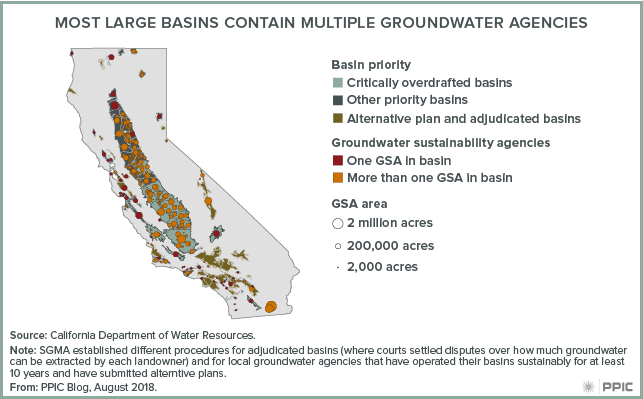
Coordination within basins: Equally important will be collaboration across GSAs within the same basin. SGMA authorized the creation of more than one GSA per basin—and most of the larger basins have multiple GSAs (see map). But SGMA requires them to work together—either to develop a single sustainability plan, or to ensure consistency if there is more than one plan. GSAs will have to make sure that they speak a common language—including common metrics for their groundwater budgets and indicators of sustainability.

Coordination across basins: GSAs will need to collaborate across basins as well. GSAs in adjacent basins should be able to understand how their plans work regionally, and how their management actions affect their neighbors. This is important hydrologically—because groundwater often moves across the basin boundaries established by SGMA. But it is also important for developing projects and actions to attain sustainability.  For instance, one of the most promising ways to augment supplies in depleted basins is by capturing high flow water and recharging it into aquifers. In the San Joaquin Valley, conveying that water to the best recharge locations could generate benefits for multiple basins—but this can’t happen without regional cooperation.

Coordination with counties: Both within and across basins, GSAs will also need to involve relevant agencies that may not be part of the GSA. In particular, county officials have responsibilities and policy instruments that can help in groundwater management. For example, Stanislaus County—which overlies four basins—used its authority to adopt a well moratorium that limits unmanaged expansion of groundwater use. Kern County’s land use planning office implemented a new land use management plan—including updated zoning—to help the community of Indian Wells Valley reduce water use to bring its groundwater resources into balance.

SGMA gives local agencies and water users tremendous responsibility and unique opportunities to manage shared groundwater resources for the long term. It will take time to get the groundwater governance right. Developing strong lines of cooperation early in the planning process will set GSAs up for success.

How Wildfires Affect California’s Water Supply

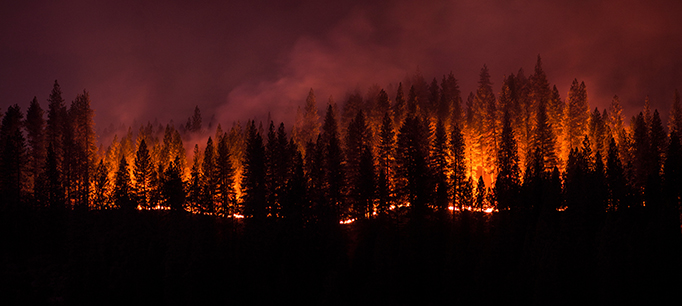
Summer marks the traditional beginning of California’s fire season, although the warming climate has stretched the season considerably. Until the winter rains arrive, wildfires will burn forests and grasslands throughout the state. Since January 1, about 3,700 fires have consumed more than 111,000 acres of land—outpacing 2017, the most destructive and deadly fire season in state history.

While public safety and economic costs deserve and receive a great deal of attention, wildfires also have consequences for the management of water—including the amount and quality of supply, and the potential for flooding.

Fire can bring short-term water supply benefits by increasing runoff for downstream use. Most precipitation that falls on hillsides is captured by plants and soils and sent back into the atmosphere. By removing vegetation and reducing the ability of soils to hold water, most burns lead to an increase in runoff. The amount of increase depends on the type of vegetation that is burned. In Sierra conifer forests, reducing tree cover by about 40% may result in a 9% increase in water yield. Conversely, burning grasslands leads to negligible increases in water supply.

Managing forests with mechanical thinning and prescribed burning simulates the effects of low- and moderate-severity wildfire—creating opportunities to improve forest health while increasing water supply. But before concluding that forest fires and active management can reliably increase water supply, it’s worth noting that increases in water can be short-lived as vegetation rapidly grows back. And in drier forests like those of the southern Sierra Nevada, most downstream users are unlikely to see increased yields.

Wildfire can also bring some serious water management challenges.

Intense fires remove vegetation that prevents excessive erosion. Soils burned at high severity can also lose the ability to absorb water for a few years after a burn. When rain falls on these fire-ravaged slopes, the fast-moving runoff can erode soils and ash, transporting them into rivers. These flows threaten drinking-water quality and fill water supply and hydropower reservoirs with sediment. Following a series of severe wildfires in the American River headwaters, Placer County Water Agency experienced significant damage to its water supply and hydropower infrastructure, including costly impacts from increasing sediment and debris. The agency is now working with multiple partners to reduce wildfire risk above two reservoirs using prescribed burning and mechanical thinning.

The damaged soils and loss of vegetation following a severe burn can also increase the threat of downstream flooding and landslides. In some cases, these slides can become “debris flows”—fast-moving rivers of mud, rock, and other materials that can take out everything in their path. These are one of the most dangerous types of flash floods in California. The most recent and deadly example of this was in Montecito following the December 2017 Thomas Fire (the largest fire by area in state history). In early January 2018, record-high rainfall fell on the fire-scarred slopes above Montecito. The resulting debris flows killed 23 people and damaged or destroyed 400 homes.

Experts are predicting another year of intense wildfire activity. Water managers in affected regions will need to address the impacts of fire on local water supply and flood hazards, and must also account for such impacts in future planning.