COVID-19 Shutdown Forces Colleges to Ramp up Online Learning

[vc_row][vc_column][vc_column_text]California colleges are moving classes online in response to the COVID-19 pandemic, which means most students at most colleges will take classes remotely. For example, the entire University of California and California State University systems have moved almost all undergraduate education to online settings. Such a dramatic change is necessary for public health, but may interfere with student access and success.

California’s community colleges can offer others a lesson in effective practices for distance education. These schools have been at the forefront of remote learning for more than four decades, from correspondence courses in the early days to instructional television and video cassettes in the 1980s. In the early 2000s, community colleges began to offer internet-based online courses.

The availability and popularity of distance courses have exploded with the internet, as have course success rates. The share of enrolled students completing and passing a course has skyrocketed, narrowing the gap in success between online and in-person courses substantially.
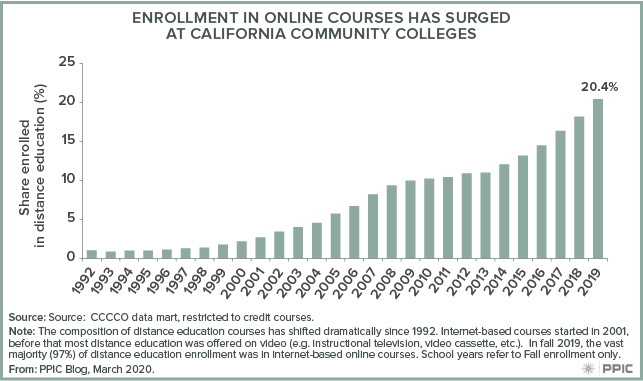
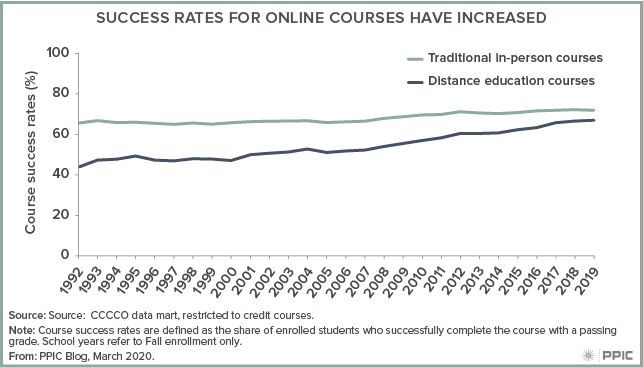
figure - Enrollment in Online Course Has Surged at California Community Colleges

figure - Success Rates for Online Courses Have Increased

Policies around closing the success gap were intentional, with the Community College Chancellor’s Office leading efforts to improve online courses through the Online Education Initiative and the California Virtual Campus. Resources available to administrators and faculty include modules on effective course design, remote tutoring, student services, and even proctoring of exams.

Effective practices involve more than moving a face-to-face course online. Success means providing faculty support and training, setting appropriate student expectations, and promoting interaction among faculty, students, and course materials.

Better software has also cleared paths to and shifted the debate around online pedagogy. Instead of discussing how to replicate face-to-face learning, educators are examining the advantages of online learning over the traditional model. By identifying student needs, personalizing learning, and giving instant feedback, teachers may have more avenues to eliminate the online performance gap.

Still, problems remain. Students with limited technology, such as those without access to broadband, may not be able to access online courses. In community colleges, Latinos are less likely to enroll in online courses than other groups, which may reflect the digital divide. And while course success rates have improved across the board, equity gaps remain large.
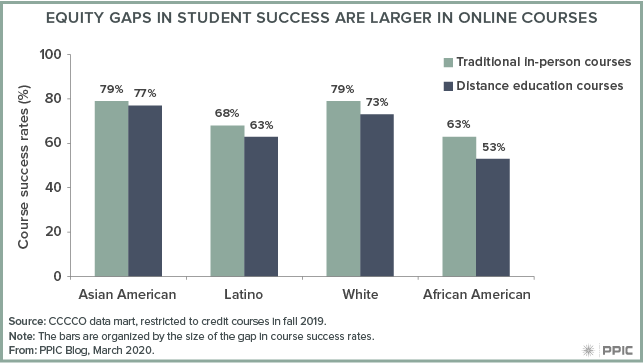
figure - Equity Gaps in Student Success Are Larger in Online Courses

The COVID-19 crisis is unprecedented, and California’s colleges deserve credit for quickly moving courses and student supports to online platforms. Clear and effective communication with students remains key. More than ever colleges must also identify and reach out to vulnerable students—low income, food insecure, and homeless—who face challenges transitioning online and need extra support.[/vc_column_text][/vc_column][/vc_row]

How California’s Digital Divide Affects Students

As the internet becomes increasingly essential for student learning and testing, California’s digital divide threatens to exacerbate preexisting inequities in education.

The good news is that K‒12 schools have largely made the digital transition. In 2018, 90% of California schools met the Federal Communications Commission’s (FCC) minimum threshold for digital learning and had the internet resources necessary to administer the state’s online assessment.

But at home not all students have reliable internet access or a traditional computer, such as a desktop or laptop. Overall, 16% of school-aged children in California do not have any internet access at home, and 27% do not have a high-speed connection, meaning they rely on slower connections like dialup or satellite. In addition, nearly 10% access the internet with a cellular data plan, which usually means slower speeds and suggests they are relying solely on a smartphone or tablet.

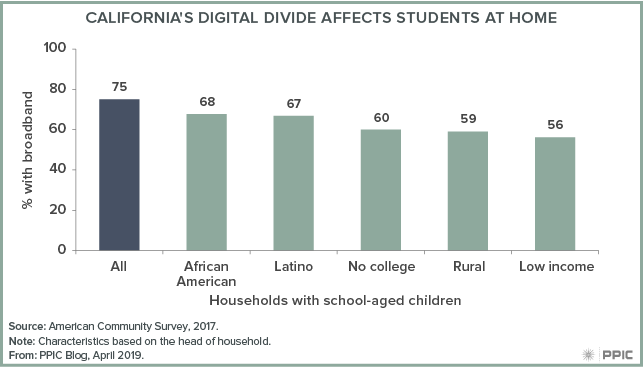
Gaps exist for several demographic groups. For example, 56% of low-income households with school-aged children have broadband subscriptions, compared to 75% of all households with school-aged children.

figure -California’s Digital Divide Affects Students at Home

This digital divide in broadband access at home—known as the “homework gap”—may affect student learning. An analysis by the Pew Research Center found 17% of teens say they are often or sometimes unable to complete their homework due to a lack of reliable internet or computer access, with about a quarter of low-income and African American teens saying this. Another study shows that eighth graders who do not have internet access at home score lower on national exams in reading and math than their peers. Similarly, students without computers at home score lower in their ability to use computers and other digital devices. These factors may worsen the disadvantages faced by lower-income students, who have lower high school graduation rates and lower standardized test scores than their wealthier peers.

While there are discounts available to lower-income families struggling to afford internet access, three in four California households without broadband are unaware of these discounts, according to a Berkeley Institute of Government Studies poll—suggesting that federal and state policymakers can do a better job promoting these programs.

Some districts have developed innovative approaches to address the digital divide. For example, a few years ago Coachella Valley Unified outfitted school buses with Wi-Fi and parked them throughout the district’s rural neighborhoods to serve as mobile hotspots. As more schools embrace digital learning, developing new ways to broaden internet access is key to closing equity gaps and ensuring that learning continues outside the classroom.

What Does the Repeal of Net Neutrality Mean for California Schools?

As the Federal Communications Commission’s (FCC) repeal of net neutrality phases in, concerns that Internet service providers (ISPs) could speed up or slow down traffic from certain websites or prioritize certain content loom large. Changes to Internet service, if any, will probably be slow and gradual; however, the repeal has potentially important implications for the digital divide in and outside of California’s schools.

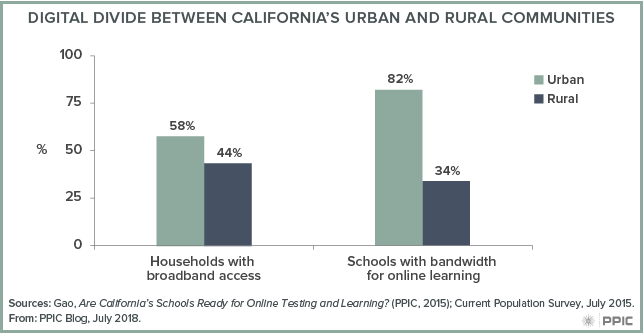
K‒12 schools rely increasingly on online content and management systems to deliver instruction (e.g., blended learning), administer standardized tests (e.g., Smarter Balanced assessments), and manage educational data (e.g., cloud computing). As online learning becomes ubiquitous, access to high-speed Internet is no longer optional—it’s a necessity. Most schools receive discounted Internet services through the federal E-rate program, but if providers decide to introduce tiered pricing based on content, students and educators could lose access to quality education programs. Tiered pricing could also exacerbate the digital divide between urban and rural districts. PPIC research shows that close to 70% of rural districts lack sufficient bandwidth for digital learning, compared to 18% of urban districts. If this gap persists or widens, students in rural areas may be left behind in the digital race.

Another concern is the homework gap. The FCC reports that 70% of teachers assign homework that requires access to broadband, while an estimated 860,000 (22%) households with school-age children in California do not have home Internet service. For many of these households, the cost is too high. Low-income families may get government subsidies (e.g., the Lifeline program) or discounts from ISPs. However, if providers create a fast lane for customers who pay premiums and a slow lane for those who don’t, the homework gap may widen. Rural residents may be particularly affected by these changes, because they tend to have more limited Internet access and fewer ISPs.

Federal and state policymakers have placed net neutrality near the top of their agendas. A major legislative effort to restore net neutrality fell short in the US House of Representatives. In California, two Senate bills (SB 822 and SB 460) that would establish a stringent net neutrality regime are being considered in the state legislature. Other states, including Montana, New York, and Oregon, are taking similar legislative or executive action

Five Factors for Successful Online Learning

Governor Brown’s budget proposal requested a $100 million initial investment, along with $20 million annually, to establish a new online college that would be part of the state’s community college system. This college would initially focus on short-term certificate programs for non-traditional students ages 25–34 who are already in the workforce. In the long term, this college would seek accreditation, provide pathways to transfer to a four-year college, and compete with established online course providers like Arizona State Online and the for-profit University of Phoenix.

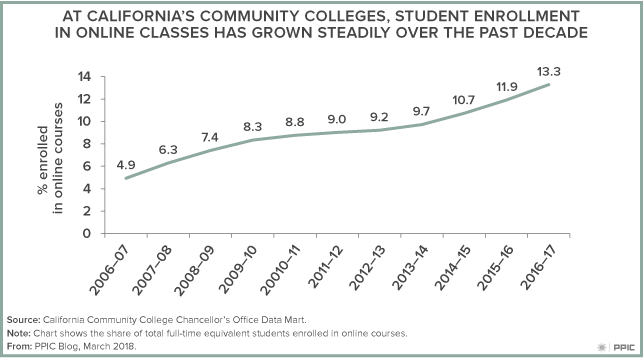
Tens of thousands of students already take online courses offered by California’s community colleges. In fact, the share of student enrollment in these courses has increased 9 percentage points over the past decade to more than 13% in 2016–17. The new online college, if established, is likely to accelerate this trend.

Previous PPIC research has identified five key factors to help ensure student success in online programs:

  1. Use a systems approach to course design. In this model, an instructional designer works with faculty, media developers, and programmers to develop an online course. This approach recognizes the fundamental differences between online and face-to-face instruction and allows instructors to focus on the subject matter and student engagement.
  2. Provide professional development. Effective online instruction requires distinct strategies. For example, to guide discussion online, instructors must gauge student engagement and develop appropriate norms without the usual visual and auditory cues. Rapid changes in technology and the isolated nature of online instruction also make professional development and mentorship particularly important.
  3. Set student expectations. There is a common misconception that online courses are easy. On the contrary, students in online courses often struggle with the autonomy, time management, and digital literacy necessary to succeed. Successful online programs use orientation courses to set expectations and clarify the differences between online and face-to-face education.
  4. Create community. Communication is essential to foster a constructive learning environment and positive peer interactions. Online courses that encourage regular and effective communication among students and between students and their instructor develop a better sense of community and improve the likelihood of student success.
  5. Take advantage of the online environment. Online tools offer unique insights not available in face-to-face pedagogy. Data on student engagement (e.g., did students view the syllabus or access additional course resources?) can provide clues for how to improve student outcomes. Online learning also facilitates personalization and can be adapted to different learning styles and special needs.

In 2013–14, the community college system launched the Online Education Initiative (OEI), which promotes these best practices and has established online course standards and faculty training in pedagogy and course design. As the state moves forward with its proposal to create a new online college, the OEI could play a key role. Overall, the line separating online and face-to-face learning is not as stark as many suppose. Most college courses already incorporate some online aspects, whether it’s an online course management system, chat room, or video conferencing. As the online and face-to-face worlds continue to merge, furthering our understanding of best practices for online instruction will be critical to student success in higher education as a whole.

Computer Science in California’s K–12 Schools

Assembly Bill 2329—just signed by the governor—requires the state superintendent of public instruction to convene an advisory panel to develop computer science standards for California’s public schools. A look at the current state of computer science education reveals that this effort will entail a number of challenges and opportunities.

More Students Than Ever Are Taking AP Computer Science Exams

In 2015, a record-high 7,254 students from California’s public schools took the AP computer science exam, an eightfold increase from 2004. Test participation has grown across major demographic groups. After adjusting for fluctuations in student enrollment, particularly in grades 11 and 12 when students typically take the exam, white and Asian students made the most progress, with participation rate up by 800% or more. Growth has been slower among African American (690%) and Latino students (550%).

Test Performance Has Improved for Most Racial/Ethnic Groups

Although increasing numbers of Latino students are taking the exam, passage rates for this group have declined. In May 2004, 44% of Latino exam takers passed, compared to 34% percent in 2015. Performance has improved modestly among Asian and white students. The trend for African American students is less meaningful, because very few of them took the exam (fewer than 50 African Americans took the test before 2013).

More Girls Are Taking Computer Science Exams

In 2015, 26% of AP Computer Science exam takers were female, up from 19% in 2004. Over time both girls and boys have seen an improvement in performance. The gender gap, after some fluctuations, has largely remained unchanged.

Few Schools Offer Computer Science Courses, and Quality Varies

Few schools statewide are offering computer science courses and many of the courses that are offered—popular classes such as computer literacy and computer lab—are not rigorous enough to prepare students for college and beyond. In addition, finding teachers, especially for rigorous computer science courses, remains a challenge. For instance, out of 1,601 high and K–12 schools in California, only 142 offered computer programming courses, half of which are not meeting UC/CSU entrance requirements (author calculation using 2014–15 data from the California Department of Education).

California’s new law is an important first step to expand computer science education across the state. A recently introduced K–12 computer science framework developed by a national coalition of states, districts, and computer science organizations may be helpful as California develops its own standards. At the same time, continuing gaps in performance and variation in course access and quality represent an ongoing challenge.

Learn more

Read the report Upgrading Technology Infrastructure in California’s Schools and the fact sheet “Digital Learning in California’s K–12 Schools”

Online Learning and College Costs

As the price of attending college has risen and access to higher education has declined, policymakers are looking to online learning as a way to better serve student needs, increase access—and lower the costs of higher education. In California, the state’s community colleges have taken the lead in online learning, with total course enrollment reaching about one million. We have been able to study the impact of online education on hundreds of thousands of students at the state’s community colleges. What we found points to important issues in the discussion of higher education access and costs.

It is easy to understand why online education is being championed as a cost-saver. Online courses do not require classroom space, and the cost of developing courses can be amortized over time. Savings could come through economies of scale, including centralization of online student services. If faculty members do not have to invest as much time designing, facilitating, and seeking approval for individual online courses, the colleges’ overall labor costs could drop.

But at this point, these savings are theoretical. So far, there is no empirical evidence that online learning is less expensive than face-to-face learning. In fact, research shows that preparing an online course is usually more time consuming—and therefore expensive—than preparing a traditional class.

And there are other drawbacks to online education as it’s currently practiced. In California’s community colleges, online student success rates are lower than success rates in traditional courses. Success rates for African American and Hispanic students are significantly worse. If these gaps persist and online enrollment continues to increase, then community colleges will be less equitable. The result will be increased costs to students and the state—and a failure to realize the promise of online education.

Despite these drawbacks, certain online courses are highly successful. Our analysis of these courses led us to recommend that the colleges move away from the current model, which relies on an individual faculty member to design and deliver an online course, and adopt a more systematic approach to creating online courses. A team that supports faculty members—including administrators, media developers, and information technology experts—would be better able to maximize the potential of the online learning environment.

However, it is unclear how moving to a team model would affect costs. Incorporating specialists in course design would raise upfront costs. Regularly updating software and updating course material could quickly exceed any savings from economies of scale. Providing essential student support services, such as technical support, online tutoring, and counseling, might also significantly raise costs.

But online learning is an important tool for improving access to higher education in California, even if it does not cost less. Online classes are increasingly popular in the community colleges—which are the higher education institutions most likely to serve nontraditional students. Incorporating best practices into these courses would improve the colleges’ ability to serve the state’s diverse students.

The community college system’s Online Education Initiative is an important step in the effort to accommodate demand for online learning and improve student outcomes. If it is successful, it can serve as a model for other online learning programs in higher education.

Improving Online College Courses

Not all online college courses are alike. In fact, students in California community colleges are more likely to be successful in courses that have been designed recently than ones that are much older. And success varies by course topic, but not always in ways you might expect.

Hans Johnson, PPIC senior and Bren fellow, identified some elements important to a successful online course at a briefing in Sacramento last week. The research suggests that courses designed by a team—including media developers and information technology experts, as well as instructors—are better able than a single faculty member to take advantage of the online medium.

Online learning is an important topic throughout higher education. The report—Successful Online Courses in California Community Colleges—points out the increasing popularity of online offerings at the community colleges. Online learning reaches students who aren’t able to attend classes in traditional settings, Johnson said, and improving it is key to improving student success.

Video: Online Testing and Learning in California Schools

California is rolling out a new online testing system in K–12 schools this year in conjunction with the new Common Core curriculum standards. Are schools prepared?

At a recent briefing in Sacramento, PPIC researcher Niu Gao answered the question with findings from her new study. She found that there is a wide variation in readiness across the state. Many district technology officers express confidence in the quantity and quality of their hardware and network capabilities. But they are much less confident of their ability to handle software issues, such as the installation of secure browsers, distribution of IDs, and quick log-ins for students. Most districts also report that they do not have enough staff to provide technical support or do not provide sufficient training for teachers and IT staff.

Gao concludes that in the longer term, virtually all schools will need to upgrade their technology to adopt and fully benefit from digital learning—video conferencing, virtual field trips, and personalized audio-visual instruction.

Gao’s report is titled Are California’s Schools Ready for Online Testing and Learning?

Delivering on the Promise of Online Education

Zócalo Public Square, which combines live events and journalism, asked PPIC senior fellow Hans Johnson and other experts to answer this question: How will technology—from massive open online courses and web-based textbooks to big data collection—change universities? Here is his response. Visit Zocalopublicsquare.org to read what others had to say.

A popular prediction is that new technology will revolutionize higher education, making traditional brick and mortar colleges obsolete. Certainly, new technology offers tremendous potential—democratizing access to college, enhancing instruction, and improving graduation rates, to name a few. But before we jump on the bandwagon of declaring a new era in higher education, we should assess the degree to which new technology can address fundamental challenges in higher education.

Perhaps the greatest challenge of all is to ensure that higher education serves as a ladder for economic and social mobility rather than simply reinforcing economic and class divides. By that standard, we can dismiss most Massive Online Open Courses offered in conjunction with the nation’s elite universities. Most of those courses are taken by people who already have a college degree, and the vast majority of students who enroll in such courses never finish them.

A different experiment in online learning, and one that serves hundreds of thousands of students who come from disadvantaged backgrounds, is taking place at California’s community colleges. With over one million course enrollments, California’s community colleges are the largest public provider of online education in the country. They are the gateways to higher education for low-income and nontraditional students—those with jobs and family obligations.

At the Public Policy Institute of California, we examined student success in online courses in the state’s community colleges. In our study, we found that course completion and passage rates are substantially lower in online courses than in traditional ones, even though students in online courses tend to be more advantaged and academically prepared. Moreover, gaps in academic performance that we see among demographic groups in real-life classrooms are exacerbated in the online setting.

What these early findings demonstrate is not failure, but the need to improve both technology and the way it is used in instruction. If we can get it right at the community colleges, we can deliver on the promise of online education.

The Future of Online Education in Public Colleges

Policymakers and educators have a lot of questions these days about whether new communication technologies can be helpful in higher education. Will they lower the cost of teaching, provide access to those who are otherwise left out, or provide more effective individualized instruction? With encouragement from Sacramento, California’s three public higher education segments are pursuing new initiatives in online education. On Tuesday, PPIC hosted a lunch event on this topic.

Hans Johnson, PPIC Bren Fellow, talked about his recent study, co-authored with PPIC research associate Marisol Cuellar Mejia, about online education in the state’s community colleges. The study found that participation in online courses has soared in the last decade but that success rates—in terms of course completion and passing grades—are lower for online students.

An expert panel expanded the discussion, with Joseph Moreau, executive sponsor of the Online Education Initiative at the California Community Colleges; Ashley Skylar, quality assurance manager for academic technology services at the California State University; and Arnold Bloom, who teaches an online course in climate change at UC Davis. Panelists talked about efforts to improve the quality of online instruction—the course materials and training of instructors. They also said it is too soon to tell whether online education may save money, but the size of California’s higher education systems provides opportunities for collaboration among campuses, which may produce more cost-effective education.