High Housing Costs Hurt College Affordability

A majority of Californians say affordability is a problem in the state’s public colleges and universities, according to the PPIC Statewide Survey. In addition, three-quarters of residents in the survey agree that the price of college prevents students who are qualified and motivated from going to college. Not surprisingly, state leaders are exploring new strategies to help students and families better cope with college costs. Most current approaches, such as state and institutional financial aid, focus primarily on tuition relief. This makes sense, as tuition more than doubled at California universities from 2006 to 2012—and is on the rise again.
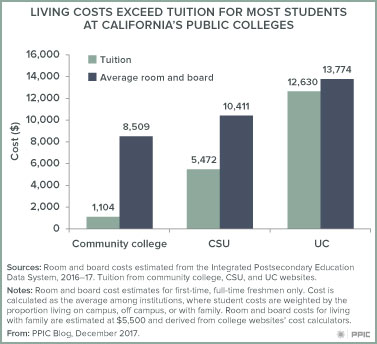
However, housing costs also play a significant role in the total cost of attending college. Californians are well aware of the issue: 85% of residents in the PPIC survey say colleges and universities should do more to make sure that all students have affordable housing options. Indeed, even with the rapid increases in tuition, living costs for many students exceed tuition at California’s public institutions—the state’s community colleges, California State University (CSU), and the University of California (UC). Average room and board costs also differ substantially across the three systems, from $8,509 per year at the community colleges to $13,774 at UC.

These differences in costs are related to whether students live on campus, off campus on their own, or off campus with family. Estimated average costs of housing and food for students living on campus top $13,000 per year, and those living off campus pay an average of $10,000 to $13,000 in room and board. The costs associated with living with family are not estimated in the available federal data, but most college websites suggest these costs range from $5,000 to $6,000—about half the cost of living on or off campus.

Students’ housing choices also partially depend on where they go to school. Only nine cities in California have UC campuses (excluding UCSF which only enrolls graduate students), and most UC freshmen live on campus in their first year. Historically, the 113 community colleges and 23 CSU campuses have been seen as local and low-cost options. Indeed, both systems show about 30% or more of freshmen living with their families, which helps keep average room and board costs lower than at UC. But it is worth noting that the share of CSU freshmen living on campus may grow. More dorms are being built on CSU campuses as administrators see on-campus housing as a strategy to increase graduation rates. Data on students’ living arrangements are based on institutional reporting on freshmen who receive some sort of federal financial aid, which includes more than 60% of students at most institutions.

As state leaders reexamine the goals in the 1960 Master Plan for Higher Education and consider changes to financial aid, they should take into account the role that living costs play in the total cost of education.

Learn moreRead the PPIC Statewide Survey: Californians and Higher Education
Visit the PPIC Higher Education Center

Video: Top Goals of Higher Education Leaders

California’s higher education system is not keeping up with the economy’s changing needs, PPIC research has shown. Falling behind in creating a skilled workforce could curtail economic growth, limit economic mobility, and increase inequality in the state. The leaders of the California Community Colleges (CCC), California State University (CSU), and University of California (UC) are essential in the effort to increase the number of educated workers, because the vast majority of the state’s college students attend public colleges and universities.

Hans Johnson, director of the PPIC Higher Education Center, summarized this research, and the three leaders of the higher education system sat down last week with Mark Baldassare, PPIC president and CEO, to talk about their goals before a large Sacramento audience.

The first question: What are your top goals in the next decade?

Eloy Ortiz Oakley, CCC chancellor, said it is a critical time for the 113-campus system. “We connect with so many Californians at a time when the economy is changing before our eyes, and the default to get into the workforce is no longer a high school diploma. Some sort of post-secondary credential is essential. That is our focus.”

He said he is working with the other higher education branches and the K–12 system to integrate them into “one public system of education, not four separate systems.”

Timothy White, CSU chancellor, had a similar focus on results. “Our number -one priority in the years ahead is to improve the success rates of our students,” he said, adding that just 20 percent of CSU students earn their degrees in four years. He said he wants to make sure CSU students have access to courses when they need to take them, as well as sufficient faculty and academic support.

Janet Napolitano, UC president, said, “My vision is that the University of California remain the top public university in the world.” Citing the recent growth in enrollment of in-state students, she said that sustaining academic excellence, increasing diversity, and producing students who will be the next generation of California’s leaders are all key parts of this vision.

Learn more

Visit the PPIC Higher Education Center

Californians Favor Higher Taxes over Higher Tuition

After six years without tuition increases, California’s public universities are considering proposals to modestly raise tuition for California residents. The University of California (UC) has proposed increasing systemwide tuition and fees for undergraduates by $336 to a total of $12,630 for the academic year. The California State University (CSU) has proposed increasing in-state student undergraduate tuition by $270 to a total of $5,742 for full-time students. Campuses at each system charge additional fees, which currently average about $1,200 at UC and $1,400 at CSU.

A recent PPIC Statewide Survey on Californians and higher education indicates that these proposals are likely to be unpopular with the public. The survey found that Californians are concerned about the cost of college: 57% said that the overall affordability of California’s public colleges and universities is a big problem. Only 23% of Californians would be willing to increase student fees in order to increase funding for California’s public higher education system.

This is not the first time Californians have voiced disapproval of tuition increases. Before UC and CSU raised tuition in 2011, PPIC’s 2010 higher education survey found that only 35% of Californians favored increasing student fees as a way to maintain higher education funding levels in the face of state budget cuts. In 2011, our survey found that 65% of Californians were very concerned about increasing student tuition and fees as a way to deal with decreased funding.

Today, when many policy preferences are often divided along party lines, there is partisan consensus on this issue: at least 70% of Californians across parties say they would be unwilling to increase student fees to fund higher education. Indeed, less than a third of Californians across all regions and demographic groups say they would be willing to increase student fees.

At the same time, a majority of Californians (67%) believe that the current level of state funding for public colleges and universities is inadequate. So what are Californians willing to do to increase funding for public higher education? Overall, they are twice as likely to say they are willing to pay higher taxes as to say they are willing to increase student fees (48% to 23%). However, and perhaps unsurprisingly, we see notable partisan differences when it comes to willingness to pay higher taxes. While 68% of Democrats say they would be willing to pay higher taxes to increase funding for public colleges and universities, only 20% of Republicans say the same.

Another way to increase funding for California’s public colleges and universities would be to admit more out-of-state students, who pay higher tuition. Californians are somewhat divided on this issue, with half saying they would not be willing to admit more out-of-state students, while 46% say they would be willing to do so. However, only 21% of Californians support admitting more out-of-state students if this would mean admitting fewer in-state students. This view holds across party lines: only one in four Republicans (25%), and even fewer independents (21%) and Democrats (16%), are willing to admit more out-of-state students if this would mean admitting fewer in-state students. UC has proposed increasing systemwide out-of-state tuition and fees by over $1,600 to almost $40,000.
Our survey findings suggest that the proposed UC and CSU tuition and fee increases may be unpopular among Californians of all political persuasions—and that Californians’ reluctance to increase the financial burden on the state’s students may be driven by concerns about access and affordability.

Learn more

Read the PPIC Statewide Survey: Californians and Higher Education
Find out more about the PPIC Statewide Survey
Visit the PPIC Higher Education Center

College Costs Could Rise for Some Students

The governor’s budget proposal includes increased funding for UC and CSU but likely not enough to keep the systems from raising tuition—which the governor said he expects. The proposed tuition increases (about 5% at CSU and 3% at UC) are modest compared to the large increases from 2006 to 2011 (104% at CSU and 92% at UC). PPIC has shown that while financial aid increases protect most students from low income families from tuition hikes, students from middle- and upper-class families see their costs increase.

The governor’s proposed budget also phases out the Middle Class Scholarship program. Created by the legislature in 2013—after CSU and UC costs climbed rapidly—this program aimed to help students from families too wealthy to receive Cal Grants (state grants that cover tuition for low-income students). The scholarships cover 10% to 40% of tuition (depending on family income and assets) for eligible students from families with incomes up to $156,000. About 37,000 students benefitted from the scholarship this year.

How much do middle-class students pay?
To characterize what a student pays to attend college, we often use the term “net price”—a comprehensive accounting of student costs and assistance. To determine the net price, we add books, room and board, and other expenses to tuition, and subtract federal, state, institutional, and local grants and scholarships (money that a student doesn’t have to pay back).

Students who receive some form of federal financial aid (grants, loans, work study, etc.) generally pay much less than the full cost of college. For students from families making less than $80,000, federal, state and local grants usually cover at least the full tuition at both CSU and UC—but these students pay a net price that could be as high as $11,000 a year at CSU and $13,000 at UC in order to cover expenses other than tuition. Students from families making $75,000 to $110,000 are generally too wealthy for federal and state grants; they pay a much higher average net price of about $16,000 at CSU and $21,000 at UC. (Also, many students pay close to the full cost because they do not apply for and/or are ineligible for federal aid.)

The most recent cost data is from 2013‒14—this was the first year of the Middle Class Scholarship program. Average awards that year were $1,100 or less, and once the program was fully implemented awards were slated to range from $1,300 and $5,400 at UC and $700 and $2,700 at CSU, depending on the income and assets of eligible students and on the number of applicants.

Not surprisingly, the phasing out of the Middle Class Scholarship and the impending tuition increase are expected to have a disproportionate impact on middle- and upper-class students. As a result, those students will probably pay more for their degrees.

Learn more

Read “Higher Education in California: Student Costs”
Visit the PPIC Higher Education Center

Video: Grading the Higher Education System

Californians give positive grades to the three branches of the state’s public higher education system—the community colleges, California State University, and the University of California. But the PPIC Statewide Survey on higher education shows that they have big concerns about affordability. Most California adults—regardless of political party, income, or age—see it as a big problem. And when Californians are asked to name the most important issue facing the state’s public colleges and universities, affordability leads the list.

“This is really the issue that’s at the forefront of people’s minds when you’re talking about higher education,” said PPIC researcher Lunna Lopes, who presented the findings at a Sacramento briefing last week.

Two out of three Californians say state funding of public colleges and universities is inadequate. While most would support a state construction bond to fund higher education projects, there is much less consensus on other ideas to increase revenue.

Learn more

Read the December PPIC Statewide Survey: Californians and Higher Education
Find out more about the PPIC Statewide Survey

Free University Tuition: How Many California Students Would Benefit?

During this election cycle, several candidates have proposed making public college tuition free. While some at the state and national levels are supporting tuition-free community college, Hillary Clinton has outlined a plan that includes four-year colleges—she proposes free tuition for students whose families earn less than $85,000. By 2021 that income threshold would rise to $125,000. How many students in California might benefit from such a plan?

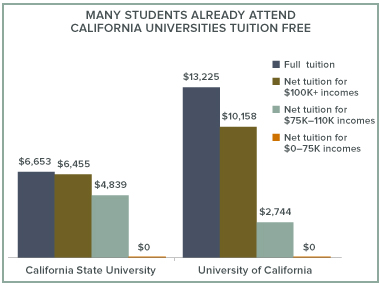
Many students already attend California universities tuition free

California’s financial aid program, Cal Grants, provides grants (funding that students do not have to pay back) for full tuition for the state’s lowest-income students, as well money toward books and living expenses for some of them. Through a combination of Cal Grants, federal aid, and institutional aid, UC’s Blue and Gold Opportunity plan guarantees free tuition for any family making $80,000 a year or less. CSU has a similar plan, the State University Grant, which bases the amount a family will pay on a number of factors. On average, students who receive financial aid pay no tuition at UC or CSU if their families make $75,000 or less.
Expanding free tuition could impact thousands of California families

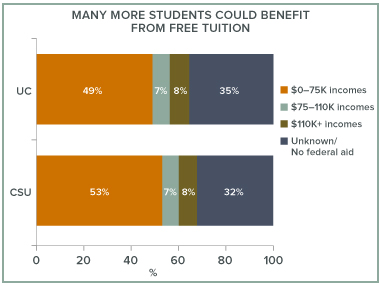
While the data on family income are not perfect, they can help us estimate how many students we might expect to benefit from free tuition. Right now, students from families in the $0 to $75,000 range make up about 49% of entering students at UC and 53% at CSU.

Raising the cap to $110,000—or beyond—would cover at least another 7% of students entering UC (2,300 students) and CSU (3,900 students) in 2014. The average student whose family income is between $75,000 and $110,000 would save about $4,839 at CSU or $2,744 at UC, resulting in more than $25 million in combined tuition savings for those thousands of families.

These estimates may be low, as many middle-class students who currently do not qualify for financial aid may have income levels that that would fall below the cap of an expanded program. Also, a nationwide free tuition program might encourage many low-income students who are currently scared off by the high sticker prices to apply to college or university.

The details of the plan would matter, of course. But if the federal government were to cover all of the $25 million needed to expand full-tuition guarantees at UC and CSU, it’s possible that thousands of low- and middle-income California students could benefit.

Notes: Data for both figures are from IPEDS for entering first-time California resident freshmen in fall 2014. Net tuition applies only to students who received some form of federal aid (grants or loans), which includes 68% of students at CSU and 65% of the students at UC.

Learn more

Visit the PPIC Higher Education Center

Does Guaranteed Tuition Lower College Costs?


This post is part of an occasional series examining how California can learn from policies in other states.

California’s public universities have a volatile tuition history. Stretches without increases are followed by sharp tuition hikes. The most recent increases in 2008—during the Great Recession—followed a pattern seen throughout the US: recessions generally cause states to allocate less money to their public universities, and the universities respond to the lost revenue by increasing tuition. Other states with similar tuition volatility have enacted policies to make tuition more predictable for students and their families.

Policy: Illinois Undergraduate Guaranteed Tuition Program

Since 2004, Illinois law has guaranteed that students who enroll in any of the state’s public universities pay the same tuition for four years. Any tuition increases that occur during those four years affect only the new class of freshmen. This allows students and their families to plan for the four years of college financially. But the policy covers only tuition—so students are still subject to yearly increases in other costs, such as room and board, other fees, and books. These additional expenses represent a large portion of the overall cost of college but are generally less volatile than tuition.

How does guaranteed tuition in Illinois compare to year-to-year tuition in California? A University of Illinois Urbana–Champaign student starting in 2008 and finishing in four years knew in advance that tuition would be $9,242 for all four years, leaving the student with an overall bill of $36,968. For an incoming UC Berkeley student, tuition was a relatively low $6,262 in 2008, but that student did not know that tuition would increase 79% by the fourth year and would add up to more than $34,000.

Policy Impact

Institutions that guarantee the same tuition for four years risk bearing the cost of inflation and other external factors (such as a reductions in state funding). This risk could be handled in many ways, including dramatically increasing tuition for the newest class of students, accepting more out-of-state students (who pay much higher tuition), or setting tuition at a higher level than necessary in the first year of a student’s enrollment. In fact, a recent study suggests that colleges affected by the Illinois guaranteed tuition law have raised tuition for incoming students by 26% to 30%—or about $1,500. This has resulted in students paying about 7% more tuition on average than they would have paid without the policy. In short, these students may have traded affordability for predictability.

Lessons for California

A similar policy in California would make tuition predictable for students, but public universities would still be at the mercy of the state budget process, recessions, inflation, and other factors. The universities would have to plan very carefully or risk not having enough revenue. The current practice of setting tuition year to year may allow the state’s universities to be more flexible and responsive to changes in revenue. This practice makes tuition volatile, but it may offer students a cheaper degree.

Learn more

Visit the PPIC Higher Education Center

Does Free Community College Grow Enrollment?

This post is the first in an occasional series examining how California can learn from policies in other states.

Tuition-free community college has garnered increasing political support over the past two years. In his recent budget requests, President Obama proposed legislation entitled America’s College Promise to make community college free nationwide. Three states—Oregon, Minnesota, and Tennessee—already have free community college programs, while nine more are considering legislation to create similar programs.

Supporters say that making community college more affordable will increase enrollment and graduation. But will free community college increase overall college enrollment, or will it merely shift enrollment from four-year colleges to two-year colleges?

Policy: Tennessee’s College Promise
Tennessee’s College Promise program—the model for the federal America’s College Promise program—offered its first scholarships to students starting college in the 2015–16 academic year. This program is part of a larger effort to increase the state’s percentage of college graduates from 32% to 55% by 2025.The program provides “last-dollar” scholarships that cover the remaining cost of tuition after a student has used all other available federal, state, and local grant and scholarship aid. Funded by state lottery revenues, Tennessee’s College Promise program will cost an estimated $12 million and provide scholarships to nearly 15,000 students in its first year.

Policy Impact
Initial results suggest that free community college may shift enrollment, rather than growing enrollment. According to an article in the Tennessean, community college enrollment rose by nearly 14% following the program’s implementation, while enrollment at the state’s public four-year institutions decreased. At the University of Tennessee at Martin, enrollment declined by 13% in one year. The University of Tennessee at Chattanooga also saw declines in freshmen enrollment, while two nearby community colleges saw dramatic increases.These preliminary results run counter to national trends, which have shown a shift in enrollment away from community colleges to public four-year institutions since 2010.

Lessons for California
California’s community colleges play an essential role in our higher education pipeline. They often serve non-traditional and underserved minority students, and provide workforce training to help students ascend the economic ladder. If providing free community college increased enrollment and graduation, this could lead to higher earnings, more tax revenue, and reduced demand for social services in the state.

But there’s a chance the policy could limit degree production. According to our research, students who begin their postsecondary career at a four-year college are much more likely than those who enroll at a community college to earn a bachelor’s degree, even when controlling for student characteristics. For example, students from low-income families who begin at a four-year college are, on average, two to three times more likely to finish their bachelor’s degree, regardless of their high school GPA.

Other approaches to making college more affordable might have a bigger impact. In California, two-thirds of students already receive free tuition, and about 90% of the cost of attending community college comes from living expenses. Increasing state awards for non-tuition educational costs would be a logical step to improve student access and educational attainment. The Cal Grant B access award currently provides low-income students with up to $1,656 to help pay for items like books, housing, and food. If funding for this award, which started in 1969–70, had kept up with inflation, it would currently by worth over $6,000, nearly four times its current value.

Compared to other states, California ranks 47th in sending our high school graduates to four-year colleges. Improving access and affordability is vital, but California should make sure that policies also increase students’ likelihood of earning a bachelor’s degree, so that more individuals have the opportunity to realize the myriad benefits—economic and otherwise—that these degrees confer.

Figure source: Author’s calculations based on logit regression models using College Futures Foundation student data. Students followed for six years. Data and methods available in Technical Appendix A of the report Making College Possible for Low-Income Students.

Learn more

Visit the PPIC Higher Education Center

Reducing Tuition Volatility at California’s Universities

After sharp increases in tuition during the recent recession, the California State University (CSU) and University of California (UC) systems made an agreement with the state to freeze tuition in exchange for increases in state funding starting in 2012. However, state support has not returned to pre-recession levels and the agreement runs out after this school year. It’s clear that the universities will raise tuition, but it’s not clear when or by how much.

The history of tuition increases at UC and CSU shows that periods of low or no tuition growth are often followed by large spikes in growth, most recently in response to declines in state support. California’s universities are not guaranteed a part of the budget (as K–12 and the community colleges are), so declines in state revenue (such as during a recession) often result in declines in state allocations for higher education. Universities raise tuition to make up the lost revenue, leading to volatility in tuition increases from year to year.

Instead of instating abrupt tuition increases, universities could rely on gradual, scripted changes, which would benefit students who are planning their finances around spending the next four (or more) years at a university. What kind of gradual change have we seen historically? Since 1979, tuition and fees have risen considerably at both UC and CSU—on average, about 8.6% annually at UC and about 11.3% at CSU. Some have suggested tying tuition increases to inflation, which over the same period, rose only about 3.1% yearly. In 2014, UC considered a plan to increase tuition at 5% each year for five years in an effort to make tuition increases transparent and steady—rather than unpredictably sudden and large. This plan was highly controversial at the time, but it would have resulted in yearly tuition increases that were lower than the average yearly increase across the last 35 years.

It is impossible to predict when the next recession will hit or what it will do to state revenues and higher education support. Steady increases could provide a cushion for universities if a drop in state funding occurs, and may allow them to keep to their planned tuition increases—but that depends on how the legislature responds to increases in tuition and the next recession.
When tuition does rise, the state and university systems should work together to make sure college is affordable for low-income students, especially considering PPIC projections that show a need for more college educated workers by 2030. The state’s generous financial aid programs mostly kept up with the sharp tuition increases from 2007 to 2011, but some low-income families had to pay more than they did before those increases.

The state could take steps of its own to make funding for the university systems less volatile. For example, some have suggested a dedicated funding stream, such as Proposition 98’s provision for community colleges and K-12, could limit cuts in state support for the university systems during recessions and improve their ability to plan for the future.

Chart source (TOP): University of California, California State University, Bureau of Labor Statistics. Chart source (BOTTOM): University of California, California State University.

Learn more

Read Higher Education in California: Making College Affordable
Visit the PPIC Higher Education Center

How Does UC Compare in Enrolling Nonresident Students?

Record-high numbers of out-of-state students are enrolling in the UC system. Estimates show that one out of every five freshmen starting at a University of California campus this fall will be a student who attended high school in a state outside of California or outside of the U.S.

Nonresident students pay about three times the tuition of a California resident. Since the state’s deep cuts to higher education budgets, the UC system has increasingly relied upon nonresident student enrollment as a source of revenue. In fact, Senator Kevin de León recently suggested raising tuition on nonresidents to increase revenue for UC. Several other legislators and members of the public have criticized the increased recruitment and admission of nonresidents. All of which raises a question: How does UC’s enrollment of nonresident students compare to that of similar universities in other states?

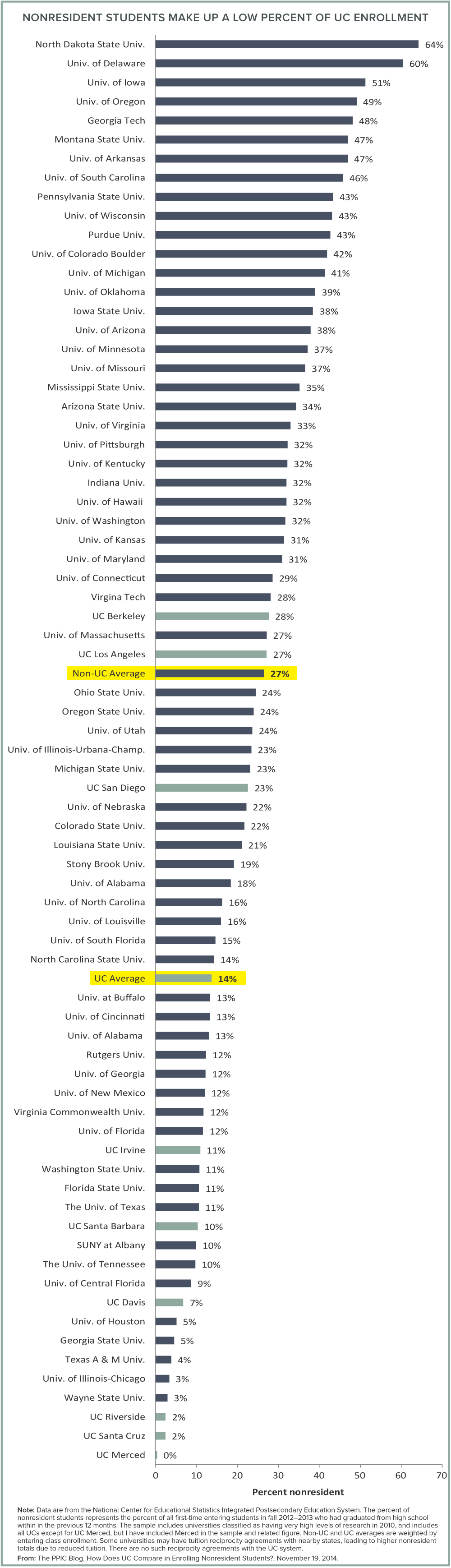
Among public, four-year research universities nationwide, only UC Berkeley and UCLA are above the national average in the proportion of students paying out-of-state tuition. The UC average is well below the national average for similar universities. In fact, the UC system claimed six of the bottom 17 spots, as the following chart demonstrates.

Looking at the trend over time, the UC system has enrolled relatively low levels of nonresident students compared to other similar universities, but that average has been increasing sharply since 2010. However, nonresident enrollment is also increasing at other top-tier, public universities throughout the nation—likely because of budget woes in other states. In the most recent two years, there has been no national data for a comparison, but UC provides the number of students intending to register each year, which is likely an upper bound for nonresident enrollment. The number of nonresident students has continued to climb, especially at UC Berkeley and UCLA, where they are estimated to make up 29.8% and 30.1% of 2014 freshmen enrollees, respectively. But even with these increases, nonresident enrollment is still likely lower at UC Berkeley and UCLA than it is at many prestigious public four-year universities, and the UC system is likely well below the national average for similar schools.

UC President Janet Napolitano has stated that she has considered limiting the number nonresident students in the UC system. But instead of setting system-wide limits, and relying on some universities to have fewer nonresidents to balance Berkeley and UCLA, the president and board of regents may consider setting enrollment limits for nonresident students for each university in the system. The full board of regents meets Thursday to vote on a plan for raising tuition at UC. If UC cannot increase revenue through tuition increases or from the state, they may seek to enroll more nonresidents, as they have done in the past. Even though the UC system has a relatively low proportion of nonresident students compared to the nation, such a move would still likely generate controversy.

Note: (BOTTOM CHART) Data are from National Center for Educational Statistics Integrated Postsecondary Education System (IPEDS) and the UC Office of the President. Solid lines indicate data retrieved from IPEDS; dotted lines indicate estimated enrollments based on UC Office of the President’s reported Statement of Intent to Register (SIR). The percent of nonresident students represents the percent of all first-time entering students in fall 2012–2013 who had graduated from high school within in the previous 12 months. The IPEDS sample includes universities classified as having very high levels of research, and includes all UCs except for UC Merced, but I have included Merced in the sample and related figure. Non-UC and UC averages are weighted by entering class enrollment. Universities are not required to submit nonresident counts to IPEDS in odd years, and some do not. Those odd year values are imputed from the even years surrounding them.