Testimony: Ensuring That More Students Succeed in College

Hans Johnson, director of the PPIC Higher Education Center and PPIC senior fellow, testified before the Assembly Budget Subcommittee Number 2 on Education Finance in Sacramento today (March 9, 2017). Here are his prepared remarks.


Thank you for the opportunity to testify this morning. My name is Hans Johnson and I am the director of the Higher Education Center at the Public Policy Institute of California. PPIC is a nonpartisan policy research organization and does not take positions on legislation. My comments are based on research we have conducted at PPIC on California’s higher education system.

Providing affordable higher education opportunities for all Californians, especially those with limited resources, is essential if we are to realize the benefits of higher education for our state and its residents. Higher education is not only the single best predictor of an individual’s wages and income, but also the strongest determinant of a society’s economic well-being. PPIC has estimated that California’s colleges and universities are not producing enough bachelor’s degrees and will fall 1.1 million degrees short of economic demand by 2030 unless we improve access to and completion in our higher education systems. While economic gains are strongest for workers with at least a bachelor’s degree, recent PPIC research has also shown strong gains for many—but not all—students who complete vocational programs in the state’s community colleges.

One of the central challenges facing higher education today is ensuring that college serves as a ladder for economic and social mobility. This challenge is especially acute in California, where 60% of high school students are identified by the California Department of Education as socioeconomically disadvantaged (meaning they are eligible for free or reduced-price lunch or come from a family in which neither parent has graduated high school). To close the workforce skills gap, California needs to find ways to improve college completion among students from underrepresented groups, including Latino, African American, low-income, and first-generation students.

The good news is that, compared to other states, California’s public colleges and universities enroll a diverse population. Recent research by the Equality of Opportunity Project shows that California’s public universities enroll more low-income students than comparable colleges in the rest of the country. For example, among elite colleges, UCLA ranks first in the nation in the share of students from low- and middle-income backgrounds. Among all large public universities, Cal State Los Angeles ranks 2nd (after City College of New York) in economic mobility, propelling students from lower-income families into middle- and upper-income groups.

The challenge is ensuring that even more students succeed in our higher education systems. The University of California has an excellent track record of graduating low-income and underrepresented students, and California State University has made significant progress in improving graduation rates for all groups. But graduation gaps remain at both institutions. CSU has developed a new and ambitious graduation initiative that would substantially increase graduation rates and completely close graduation gaps by 2025. However, neither institution has been able to fully enroll all qualified applicants. In recent years, thousands of qualified Californians—both freshmen and transfer applicants—have been turned away from UC and CSU due to a lack of funding.

Of the state’s three systems of public education, our community colleges best represent the diversity of young Californians. The state’s community colleges provide higher education opportunities for almost two million students, a majority of whom are from low-income families or other underrepresented groups. However, far too many students who enter community colleges do not succeed: most never transfer to a four-year college or earn a degree or certificate. Hundreds of millions of dollars have recently been invested in efforts like the Basic Skills Initiative (BSI) and the Student Success and Support Program (SSSP) to improve student outcomes at California’s community colleges. These and other efforts—such as Guided Pathways, a new initiative to help students establish clear objectives and provide support to achieve their goals—hold a great deal of promise for improving student outcomes.

Expanding access to our public universities and improving outcomes throughout our higher education system will almost certainly take more resources. But using current and new funding to improve student outcomes in the most efficacious manner possible must be a high priority. Better coordination between UC, CSU, the community colleges, and our K–12 system can be a cost-effective way of providing students with a seamless pathway from high school to a higher education degree or certificate. Improving access and programs, including financial aid and student support services, to students with the most need can also help reduce gaps in educational attainment and economic success. The role of higher education officials and state legislators is to ensure that resources are spent on programs that really work for students. PPIC is already working on a number of projects that focus on improving student success, and we look forward to continuing to contribute to such efforts.

Californians Favor State Action on Climate, Immigration

The Trump administration has set a new course on two issues that have deep roots in California politics and policy: climate change and immigration. As state policymakers consider responses to the federal government on these issues, our most recent PPIC Statewide Survey finds that Californians are broadly supportive of the state taking its own action.

In PPIC surveys dating back to 2005, strong majorities of Californians have said that global warming is a threat to the state’s future economy and quality of life. Over the same period, majorities have said that they favor the state government making its own policies to address the issue of global warming: 63% said so in the January survey. When it comes to specific action the state has taken on climate change at least two-thirds have said since 2006 that they favor AB 32, the state’s landmark law limiting greenhouse gas emissions.

Many Californians also want to see state action on immigration. When asked the most important issue for the governor and legislature to work on this year, immigration was the most common response (tied with jobs and the economy). Furthermore, 65% of Californians favored state and local governments making their own policies and taking action to protect the legal rights of the undocumented. This is the first time we’ve asked about state and local action on immigration, so we don’t know how Californians might have answered under previous presidential administrations. We can, however, look to some longstanding attitudes toward immigrants in the state.

Consistent with what we saw in PPIC surveys over the previous year, an overwhelming majority (85%) said in January that there should be a way for undocumented immigrants to stay in the country legally if certain requirements are met. In surveys since 2013, we have also found at least 60% of Californians saying that immigrants are a benefit to California because of their hard work and job skills, rather than a burden because they use public services.

On climate change and immigration, we find wide differences between the parties, with Democrats and independents far more likely than Republicans to be in favor of independent state action. Among Trump voters, few want state action on either issue, but they are more likely to favor state policymakers acting on global warming (26%) than to protect the rights of the undocumented (16%). On both issues, majorities of Californians across regions of the state want independent action, though residents of the Central Valley are among the least likely to be in favor.

While President Trump has been in office for just over a month, he already has state and local policymakers in California considering responses to his early actions. We currently find widespread support for state action on climate change and immigration, and we will continue to monitor public opinion on these issues as federal policy changes and California responses unfold.

Learn more

Read the January PPIC Statewide Survey: Californians and Their Government
Find out more about PPIC Statewide Survey

Video: Reaching Children in Poverty

Despite California’s strong economic growth, 750,000 children under age 5 live in poverty, and they live in nearly every region of the state. Their economic circumstances vary, a new PPIC report finds. The authors of the report, Geography of Child Poverty in California, conclude that approaches that take local differences into account could reach poor families more effectively. In conjunction with the release of the report, PPIC convened a panel of service providers from around the state in Sacramento to describe lessons they have learned.

Liza Bray, executive director of Partners for Children South LA, said her organization uses a “collective impact” model and works with 16 organizations to link families to services in parts of Watts and Compton. The goal is reducing the risk of involvement in the child welfare system. She said the effort began by surveying residents to assess their top concerns. Leading the list: addressing developmental delays in children, housing, child care, and access to social safety net programs such as CalFresh, or food stamps.

Sabrina Kelley, resident services manager of the Fresno Housing Authority, underscored the importance of partnerships and surveying families about their needs. Her organization provides housing subsidies to about 50,000 people, half of them children under 8, in the city and county of Fresno. Her organization learned residents’ needs by initiating neighborhood walking tours. “We just walked the life of the residents,” she said. A conversation with children playing in a vacant lot led to the creation of the Almy Street Playground—designed in a neighborhood workshop and funded after the children wrote letters to the city council and potential corporate partners. Crucial to the effort was a partnership with Habitat for Humanity and other organizations.

Speakers at the PPIC event said that local solutions need the support of state policymakers. Suzan Bateson, executive director of the Alameda County Community Food Bank, said distributing food—while essential—is not the best way to alleviate poverty. Families are better served by maintaining and funding programs like CalFresh, she said.

“We are absolutely not going to ‘food bank’ our way out of this.”

Learn more

Read the report Geography of Child Poverty in California
Learn about poverty throughout the state with the accompanying interactive map

Bridging Equity Gaps in Health Career Training

California’s community colleges are the largest providers of workforce training in the state, offering a wide variety of career technical education (CTE) programs. Career training in health is particularly promising for students, as the health industry offers many in-demand, well-paying jobs for Californians with less than a bachelor’s degree. Health programs have higher completion rates than other CTE programs and attract a large and diverse student population. But gaps in achievement across student groups are a persistent problem.

PPIC’s latest report on career technical education in health provides detailed insights into the nature of equity gaps in student achievement. African American students are nearly 12 percentage points less likely to complete a health credential than their white peers. Latino students are about 6 points less likely.

To better understand racial/ethnic achievement gaps—and identify potential solutions—we examined three possible explanations: socioeconomic factors, program choice, and course-taking patterns. Individual demographic factors like age, immigration status, and economic disadvantage do matter, but cannot explain away the achievement gap. A student’s choice of health program also matters—that is, African American and Latino students are less likely to be enrolled in the health CTE programs with the highest completion rates, such as registered nursing and dental hygiene. But even after for controlling for socioeconomic factors and program choice, the racial/ethnic achievement gap persists (7 percentage points for African American students and 3 percentage points for Latino students).

By far the most consequential factor driving the racial/ethnic achievement gap in health programs is course-taking patterns—in particular, course progression patterns that are linked to student success. African American and Latino students are less likely to enroll full-time or in consecutive terms—these two patterns are strongly related to college completion. In addition, they are less likely to complete 30 or more units before entering the health program, another factor linked to future success. Finally, compared to white students who are otherwise similar, African American and Latino students are less likely to receive financial aid. Simply put, we find that if students entered similar programs and made similar progress course by course, the racial achievement gap would disappear.

These results suggest that there are many steps community colleges can take to alleviate completion gaps. In fact, systemwide efforts to support full-time attendance to and to guide students on choosing a program of study are among the reforms implemented through the Student Success effort in recent years. Our results suggest that efforts to enable underrepresented students to devote more time to their courses of study and pick up momentum toward their educational goals will do the most to reduce completion gaps. More information about the programs with the best completion rates and earnings potential can empower students to decide which career pathways to pursue. By identifying and addressing the drivers of inequity in CTE—in health as well as other programs—colleges can help more students take the crucial first step of earning a credential and then move along well-paying career pathways.

Learn more

Read the report Career Technical Education in Health: An Overview of Student Success at California’s Community Colleges
Visit the PPIC Higher Education Center

Commentary: Cooperation Needed on San Joaquin Valley Water


This commentary was published in the Sacramento Bee on Thursday, March 2, 2017.

Recent rains have not washed away the growing threat of water scarcity in the San Joaquin Valley, California’s largest agricultural region. Over time it could bring disruptive changes not only to the region’s farmers but also to rural communities, the local economy, and the state as a whole. Resolving this problem will take creativity and cooperation.

Read the full commentary on sacbee.com.

Groundwater: Act Locally, Think Sustainably

The complex challenges that the state’s Sustainable Groundwater Management Act aims to resolve don’t lend themselves to quick fixes. With the deadline for the first major step—forming “groundwater sustainability agencies” in affected basins—coming up in June, we asked Karen Ross, secretary of the California Department of Food and Agriculture, about progress to date.

PPIC: How are California communities doing in implementing the law so far?

Karen Ross: I’ve been very impressed with how implementation is progressing. Clearly, people realize it’s time to address groundwater sustainability, and they are working together at the local level because they prefer that to state action. This is a big undertaking because to address groundwater covers areas like land use and economic development for cities and counties. So the progress made on establishing the governance structure is just the first step. The next step is the hard part: putting together plans that will bring basins back into water balance. That will require very difficult decisions about how the resource is allocated and managed.

The state is supporting this process in a number of ways. Our colleagues at the Department of Water Resources (DWR) have a huge role to play in supporting the process by establishing guidance for governance structures and the criteria for what constitutes a sustainable groundwater plan. The state is backing that up with facilitation and financial support. For example, DWR awarded $6.7 million in grants last year to 21 counties for groundwater planning projects, and just last month the Department of Food and Agriculture and DWR announced a joint $6 million water efficiency grant program for agricultural water suppliers and farmers.

PPIC: What big challenges do you think will result?

KR: Some of the critically overdrafted basins will have challenges getting back into balance, and many of these areas are dependent on agriculture as the primary engine for their local economy. The state of the basins is directly impacted by the lack of surface water over time. Tough decisions will have to be made about demand management, potential fallowing, and how to balance the human impacts we saw during the drought, like drinking water supplies and jobs.

It won’t be easy to bring all parties to the table to address these issues―not to mention the specific trade-offs needed to bring the water supply back into balance. But we must ensure that all have a voice in determining the governance structure and taking part in the planning process. That is critical to success.

PPIC: What kinds of opportunities do you think will arise for communities implementing the law?

KR: I see a unique opportunity to unite communities in a deep and lasting way. This is a chance to help determine the future of their community. People must work together to maintain a thriving local economy, their quality of life, and environmental quality. What these communities face is daunting. While it is easy for me in my position to be optimistic about future progress in maintaining sustainability in a special part of California, we must all recognize that building resiliency for the long term will be hard work. But future generations will thank us—just as we owe previous generations a debt of gratitude for the vision, the leadership, and the investment they made in the infrastructure for agriculture and rural California that we enjoy today.

Learn more

Watch “Implementing the Sustainable Groundwater Management Act,” a video featuring Secretary Ross and other panelists (October 21, 2016)
Read “Reforming California’s Groundwater Management,” (PPIC fact sheet, June 2015)
Visit the PPIC Water Policy Center

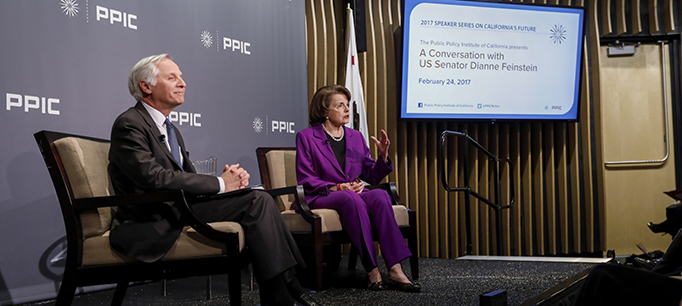
Video: Feinstein on Her Role in a New World

Senator Dianne Feinstein was clear about the challenges ahead for a California Democrat in contentious times.

“Here we are: outnumbered, outvoted, in the West, fairly liberal,” she said.

Speaking before an energetic capacity crowd in San Francisco, Feinstein said her office had received more than a million phone calls about Trump’s cabinet nominees. She described her approach to them: careful evaluation, rather than blanket opposition—an approach too conciliatory for some sign-carrying audience members. Feinstein said that in her role on the Senate Judiciary Committee, she needed to work with the administration officials in charge of national security and felt she could work with Trump appointees James Mattis, defense secretary; John Kelley, secretary of homeland security; and Mike Pompeo, CIA director. But she opposed other nominees because they lacked credentials for the job or they aren’t right for the county, she said. Nevertheless, they went on to win approval.

“The key for me is to figure out how we can begin to win some of these battles.”

Asked about Trump’s nominee to the Supreme Court, Neil Gorsuch, Feinstein wouldn’t say how she would vote. She said she will be particularly interested in his views on gun laws and on women’s reproductive rights.

Feinstein’s visit was greeted by dozens of protesters who marched outside, upset that she had not hosted a traditional town hall. Inside, Feinstein touched on a range of issues from climate change to immigration to health care, in a wide-ranging conversation with Mark Baldassare, PPIC president and CEO. His questions included a number that PPIC solicited online in advance of the event.

Moving up the Health Career Ladder

Upward mobility is inextricably tied to educational attainment in today’s economy. How do California’s educational institutions foster upward mobility for their students when developing their programs of study? One way community colleges across the country are working to do so is through the development of training pathways that allow students to “stack” multiple credentials. The idea is that students can earn certificates or degrees sequentially and move up a career ladder—upward mobility in action. For example, a student who completes a certificate in medical assisting can return to complete additional training and earn a degree in registered nursing—an occupation that offers large wage returns.

Despite the promise of “stackable credentials,” our analysis of students enrolled in health programs at California’s community colleges finds that among those who earn one credential, most don’t go on to get another. We followed the 85,000 students who earned their first health degree between 2000 and 2009. Only 13 percent completed a second health credential within six years. This isn’t terribly surprising since about half of health students in California’s community colleges initially earned an associate degree—the highest level award that is offered. Many associate degrees in health lead to well-paying jobs such as registered nurse or dental hygienist. But even among students who earned a shorter-term, lower-return credential, only 20 percent returned to earn another health credential.

However, the evidence suggests that students who do stack multiple health credentials see sizable economic returns eventually (see figure). Median earnings are similar across the two groups of students before starting their health training programs and while they are in school. The wage trajectories diverge, however, after degree completion. Students completing a single award—most often an associate degree—earn more than $15,000 per quarter just one year after finishing their health degree. In comparison, those completing multiple awards—a shorter-term, lower-return certificate is the most prevalent first degree—earn only $8,000 a year out. This difference narrows considerably over a five year period when students completing a second health credential see a larger gradient in their earnings.

Currently, most students who “stack” health credentials ultimately attain an associate degree in nursing—one of the highest value awards offered in the community college system. It’s plausible to imagine building pathways that allow students to meaningfully stack credentials to other high-value, in-demand careers. But to do so, colleges must carefully align program curricula to ensure that skills gained along the way are sequential or complementary, while at the same time making sure that each credential has standalone value in the labor market. This is not an easy task but one our community college system is currently focused on, given state and federal investment in growing career pathways.

At the same time, community colleges are investing in ways to support students as they explore pathways to well-paying careers. All of these efforts, taken together, hold promise for increasing the number of students who improve their economic standing through engagement with training pathways available through California’s community colleges.

Learn more

Read the report Health Training Pathways at California’s Community Colleges
Visit the PPIC Higher Education Center

The High Cost of Fixing Levees

The crisis at Oroville brought dams to the forefront of state and national discussions about aging infrastructure. Now, as full dams release high flows into rivers hemmed in by levees, this element of the state’s flood management system is in the spotlight.

Many of our levees are very old—much older than most of the state’s dams—and in need of modernization. Nowhere in California is the issue more important—or more challenging—than in the Central Valley, and particularly, the Sacramento-San Joaquin Delta.

The levees of the Central Valley are being tested this winter by sustained high flows. Some have failed, resulting in evacuations—including along the Cosumnes and San Joaquin Rivers. More challenges are in store in the Delta as flood waters move downstream later this week and into the spring.

The scale of modernization needed to avoid damaging floods—particularly as the climate changes and population on the floodplain grows—is vast. At least 1,600 miles of levees line the rivers and flood bypasses upstream of the Delta, forming the federally authorized Central Valley Flood Control Project. The most robust levees in this project protect cities like Sacramento, involving hundreds of millions of dollars’ worth of upgrades. But most of the project has weak and outdated levees that are unreliable in large floods.

The Delta has its own unique network of more than 1,100 miles of levees, which ring islands that lie well below sea level. The Delta levees are the least reliable in the Central Valley and are under threat from sea level rise, continued sinking of the islands, and earthquakes.

The good news for Central Valley levees is that there is consensus that the system needs a substantial upgrade, and there has been significant progress in envisioning what that might entail. In 2006, the legislature instructed the Department of Water Resources to develop a comprehensive plan for improving flood management within the region. The Central Valley Flood Protection Plan—released in 2012 and updated every five years—identifies a range of options, including new infrastructure, updated operation systems, and land use changes that could improve flood protection for the Sacramento and San Joaquin Valleys.

In the Delta, a 2009 law instructed the Delta Stewardship Council to develop a plan for prioritizing state investments in levees, balancing local needs with statewide interests. A draft plan now under review is expected to be adopted later this year.

The bad news is that doing anything about these levees is going to be difficult for three reasons: it would be very expensive, take a very long time to implement, and be very controversial. The Central Valley plan has a price tag of $17–$21 billion over 30-plus years. For the Delta, the council has identified more than $2 billion in high-priority upgrades.

These costs far outstrip the resources of local flood management entities—particularly in the Delta, where low land values and farm revenues make it hard to generate funds for major upgrades. State bonds and some federal dollars have provided key support, but there is still a large gap—in the range of $800 million to $1 billion annually. Indeed, flood management remains one of the water sector’s most prominent “fiscal orphans,” with one of the biggest funding gaps compared to need.

State policymakers will need to assess what is achievable with known or likely resources and make tough choices about priorities based on state interests and public safety. This is not an easy task. There is usually strong local pressure to do something for as many people as possible with the limited funds available. While this approach appears equitable, it is unlikely to yield significant reductions in flood risk. Investments will need to be concentrated to be effective.

As noted in our recent blog post, the silver lining of this winter’s flooding is renewed attention to the urgent need to modernize the state’s flood management infrastructure. These discussions have begun in the legislature. Sustained leadership on this issue will be needed to sustain the urgency to act once the sun shines again. The good news is that the legislature has taken the all-important first step in tackling this difficult but very important problem.

Learn more

Visit the PPIC Water Policy Center flood resources page
Read California’s Water: Paying for Water (from California’s Water briefing kit, October 2016)

Video: An Early Look at Views of President Trump

The January PPIC Statewide Survey asked Californians for to assess their new leaders in Washington and found that just a third of Californians, or 30%, approve of the way President Trump is doing his job. Californians gave Congress a similar rating.

Dean Bonner, associate survey director, presented these and other key findings at a briefing in Sacramento. The survey also examined contentious issues that are the focus of national debate.

  • Solid majorities of Californians favor state action—independent of the federal government—to protect the rights of undocumented immigrants and to address global warming.
  • About half of Californians have favorable opinions of the Affordable Care Act, and a slight majority oppose repealing it.
  • Most Californians—across political parties—say the government should not interfere with a woman’s access to abortion.

The survey also looked at views of Governor Brown’s job performance and his proposed budget. The governor job approval rating is at a record-high 66%. But his budget proposal and his plan to fund maintenance of the state’s roads, highways, and bridges fares less well. Just under half of residents support his budget plan and 41 percent support his transportation proposal.

Learn more

Read the January PPIC Statewide Survey
Learn more about the PPIC Statewide Survey