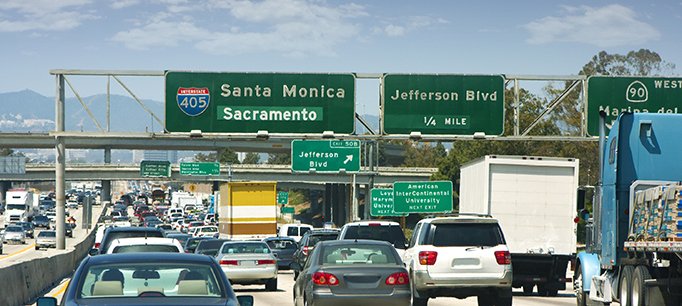

In PPIC’s most recent statewide survey, 61% of Californians say that spending more money on the maintenance of roads, highways, and bridges is very important for California’s future quality of life and economic vitality. At the same time, a majority of Californians (54%) oppose the governor’s proposal to do so. His transportation funding plan would provide $43 billion of additional spending for state and local transportation projects, with money coming from a new $65 vehicle fee and an increase in gasoline and diesel taxes. Republicans are overwhelmingly opposed to the governor’s proposal and independents are divided. Among Democrats, a slight majority (53%) favor the plan while 42% oppose it.
Californians’ reluctance to support the governor’s plan is understandable in light of another survey finding: many are not satisfied with the way transportation funds are being spent now. When asked what is most needed to improve the quality of California’s roads and surface transportation, 51% of adults choose the wiser use of existing funds. This response contrasts with what Californians said when asked a similar question about higher education funding in December. Just a little over a third (36%) said that the wiser use of existing funds alone would significantly improve the quality of public higher education.

Among Californians who oppose the governor’s proposal, 64% say that the wiser use of existing funds is the best way to significantly improve the quality of the state’s roads. Only 30% say that both wiser use of existing funds and more state funding is needed.
Across parties, 80% of Republicans and 69% of independents who oppose the governor’s plan think that the wiser use of existing funds is the best approach. Notably, Democrats who oppose the governor’s plan are far more likely than those who support it to say that the wiser use of funds alone is a way to improve California’s roads, highways, and bridges (55% to 31%). If the governor hopes to win the support of some of those 42% of Democrats who oppose his plan, he will likely have to overcome the perception that transportation funds are not being put to good use now.
Read the January PPIC Statewide Survey: Californians and Their Government
Find out more about the PPIC Statewide Survey



 A
A 


 Immigrants to California from the seven countries that are the focus of President Trump’s executive order —Iran, Iraq, Libya, Somalia, Sudan, Syria, and Yemen—also tend to be highly educated. According to the 2015 American Community Survey, California is home to 305,000 immigrants from these countries—35% of the total number of immigrants from these countries in the nation—with most (213,000) from Iran. Altogether, almost half (47%) of adult immigrants (ages 25‒64) from these countries have a bachelor’s or graduate degree, including 54% of those from Iran.
 Today, when many policy preferences are often divided along party lines, there is partisan consensus on this issue: at least 70% of Californians across parties say they would be unwilling to increase student fees to fund higher education. Indeed, less than a third of Californians across all regions and demographic groups say they would be willing to increase student fees.
 Another way to increase funding for California’s public colleges and universities would be to admit more out-of-state students, who pay higher tuition. Californians are somewhat divided on this issue, with half saying they would not be willing to admit more out-of-state students, while 46% say they would be willing to do so. However, only 21% of Californians support admitting more out-of-state students if this would mean admitting fewer in-state students. This view holds across party lines: only one in four Republicans (25%), and even fewer independents (21%) and Democrats (16%), are willing to admit more out-of-state students if this would mean admitting fewer in-state students. UC has proposed increasing systemwide out-of-state tuition and fees by over $1,600 to almost $40,000.
 The most recent cost data is from 2013‒14—this was the first year of the Middle Class Scholarship program. Average awards that year were $1,100 or less, and once the program was fully implemented awards were slated to range from $1,300 and $5,400 at UC and $700 and $2,700 at CSU, depending on the income and assets of eligible students and on the number of applicants.