Parents Have High Educational Hopes for Their Children—Can California Keep Up?

The most recent PPIC Statewide Survey on Californians’ views on education finds that the vast majority of parents (83%) hope their children will obtain at least a bachelor degree—in fact, nearly half (48%) want their children to earn a graduate degree. These parental aspirations are relatively constant across race/ethnicity, political ideology, and income. They are also fairly consistent across regions—although, among the regions represented in the survey, parents in the Central Valley are the least likely (77%) and San Francisco Bay Area parents are the most likely (96%) to want their children to earn college or graduate degrees. These parental aspirations may be linked to student course taking and performance in high school. Over the past decade, there has been a 48% increase in completion of the coursework that makes California high school graduates eligible for UC or CSU; in 2015, 43% of the state’s graduating class met this eligibility requirement.

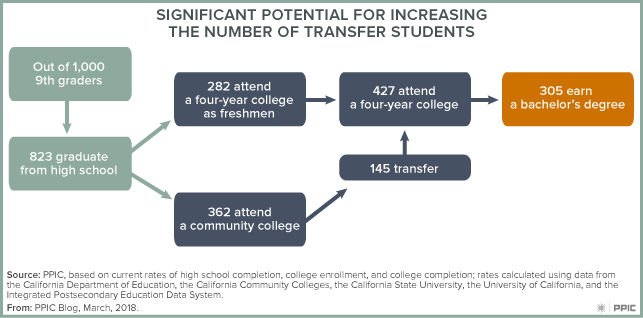
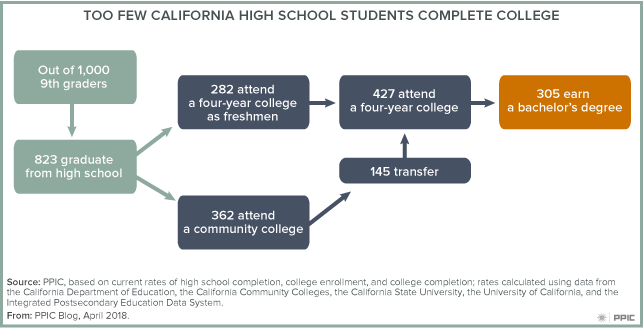
Moreover, these aspirations are aligned with urgent state needs. If current economic and educational trends persist, California will fall 1.1 million bachelor’s degrees short of economic demand by 2030. The state economy is increasingly reliant on high-skill workers, but most K–12 students do not stay on track to obtain a bachelor’s degree, let alone a graduate degree. Previous PPIC research has shown that for every 1,000 9th graders in California, only 305 will earn a bachelor’s degree at UC or CSU.

Parental Aspiration Figure

California has a long way to go in meeting demand for higher education, but there are signs of progress. The state has been reinvesting in public higher education, increasing undergraduate enrollment, and improving student outcomes—and the public education systems are increasingly willing to work together to streamline the higher education pipeline. California will need continued innovation and significant investment in facilities and faculty in order to accommodate the kind of enrollment growth that can keep up with economic demand and individual aspirations. Moreover, given the large share of Californians who see advanced degrees as important, the state may want to begin a more robust discussion about graduate school, along the lines of its recent focus on career technical education.

Testimony: Reforming Key Policies at the Community Colleges

Olga Rodriguez, research fellow at the PPIC Higher Education Center, testified before the Assembly Higher Education Committee in Sacramento today (April 3, 2018). Here are her prepared remarks:

Thank you for the opportunity to testify this afternoon. My name is Olga Rodriguez and I am a research fellow at the Public Policy Institute of California. PPIC is a nonpartisan policy research organization and does not take positions on legislation. My comments are based on research we have conducted at PPIC on California’s community colleges.

Every year, California’s community colleges identify hundreds of thousands of students as not ready for transfer-level courses in math and English. Since these courses are required to transfer to a four-year college, students deemed underprepared are placed in developmental (also known as remedial or basic skills) courses to prepare for college work. These placement decisions have profound effects: our study finds that 80% of entering students take at least one developmental course in math, English, or both, and very few of those students complete a college-level math or English course, or transfer to a four-year college after six years.

Despite the critical role of assessment and placement, historically there has been little clarity about how colleges across the state assess and place students into math, English, and English as a Second Language (ESL) sequences. The overwhelming majority of colleges do not have this information publicly available in their college catalog or on their website. To help fill this information gap, in spring 2016 we surveyed all 113 community colleges in the state; 82 of the colleges participated in the survey. They reported on the policies used to assess and place students into transfer-level math and English as well as the highest level of ESL during the 2014–15 academic year. The broad goal of the survey was to provide policymakers and practitioners with a descriptive landscape to improve understanding of the policies used across the state to assess and place students into math, English, and ESL courses. These results provide an important baseline prior to the implementation of assessment and placement reforms. I describe our findings below.

  • First, community colleges varied in how they identified college-ready students. We find that the use of assessment tests was widespread; 100% of colleges reported using assessment tests for math, English, and ESL placement. However, there was variation in the types of tests used and how they were used. For example, while more than half of colleges reported using the Accuplacer test to assess college readiness in math, cut scores ranged from 25 to 96 out of 120. A student with a score of 58 (the median score used by colleges) would be deemed college ready at half of these colleges, but not at the other half. The lack of consistency means that access to college courses—credit-bearing courses that students need in order to transfer to four-year colleges—is determined not only by students’ performance on the test, but also by the policies at the college where they enroll. This wide variation may be especially challenging for the 40% of students who eventually enroll in more than one community college campus, as they could be deemed college ready at one college but referred to remediation in another. These policies end up undermining opportunities to transfer between campuses and provide mixed signals about what it means to be ready for college-level courses. Furthermore, assessment and placement practices have implications for equity. Students of color are more likely to attend colleges that set higher math cutoff scores, which means these students have less access to the math classes they need to advance.
  • Second, the use of multiple measures was sparse and unsystematic. In California, the use of other measures in addition to placement exams (known as multiple measures) is mandated by law. In fact, research shows that measures such as high school achievement data do a comparable or better job at predicting college success compared to assessment tests. But while assessment tests were standard practice, there was substantial variation in the types of other measures used across colleges and across subjects. Additional measures included high school GPA, grades in prior English and math coursework, results from the Early Assessment Program (EAP), and counselor or instructor recommendations, among others. Overall, we find that 61% of colleges used grade in last math course, and 40% used grade in last English course; but only about one-third of colleges used high school GPA for placement into math and English courses. Even fewer colleges used these measures for ESL placement (8–12%). In addition, while some colleges used multiple measures in a systematic way for all students, up to 30% of colleges only used multiple measures if students requested it or challenged their placement. Uneven implementation of multiple measures may aggravate inequities if students with cultural and social capital are more likely to take advantage of these policies.
  • Third, assessment and placement in ESL needs more attention. Each year, about 30,000 students enroll in ESL, and these students may be especially disadvantaged by current policies. Compared to English and math, in ESL, fewer colleges offered exemption opportunities and test preparation activities. Additionally, our findings suggest that a lower proportion of colleges used high school achievement data for ESL placement, indicating that English Learners may not be benefitting from one of the most promising methods of improving placement accuracy.
  • Finally, ongoing reforms aim to promote more consistent and accurate placement policies. With the support of the governor, the legislature, and the system office, a significant amount of resources have been devoted to improving assessment and placement at community colleges. The passage of Assembly Bill 705 will help address this issue by mandating that all colleges use high school achievement data for the assessment and placement of all students. Still, if colleges have the autonomy to set their own rules for placement, and if colleges do not fully inform students of their placement rules, this will be a cause for concern as uneven access to transfer-level courses has significant implications for student success.

In sum, assessment and placement policies should help students reach their academic goals—not stand in the way of those goals. As colleges work to enhance the efficacy of developmental education, implementing evidence-based practices that accurately assess students’ college readiness will be critical. A more equitable and efficient system for assessment and placement is a vital step in helping all students achieve their academic goals.

Five Factors for Successful Online Learning

Governor Brown’s budget proposal requested a $100 million initial investment, along with $20 million annually, to establish a new online college that would be part of the state’s community college system. This college would initially focus on short-term certificate programs for non-traditional students ages 25–34 who are already in the workforce. In the long term, this college would seek accreditation, provide pathways to transfer to a four-year college, and compete with established online course providers like Arizona State Online and the for-profit University of Phoenix.

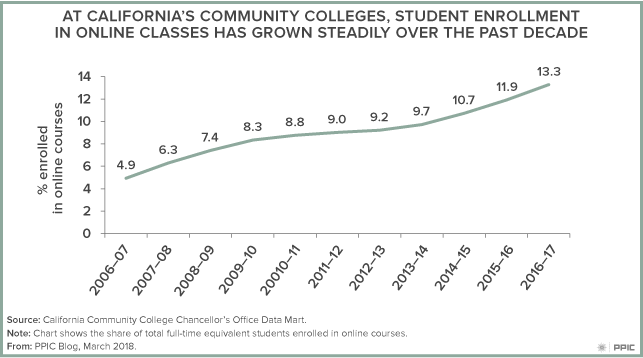
Tens of thousands of students already take online courses offered by California’s community colleges. In fact, the share of student enrollment in these courses has increased 9 percentage points over the past decade to more than 13% in 2016–17. The new online college, if established, is likely to accelerate this trend.

Previous PPIC research has identified five key factors to help ensure student success in online programs:

  1. Use a systems approach to course design. In this model, an instructional designer works with faculty, media developers, and programmers to develop an online course. This approach recognizes the fundamental differences between online and face-to-face instruction and allows instructors to focus on the subject matter and student engagement.
  2. Provide professional development. Effective online instruction requires distinct strategies. For example, to guide discussion online, instructors must gauge student engagement and develop appropriate norms without the usual visual and auditory cues. Rapid changes in technology and the isolated nature of online instruction also make professional development and mentorship particularly important.
  3. Set student expectations. There is a common misconception that online courses are easy. On the contrary, students in online courses often struggle with the autonomy, time management, and digital literacy necessary to succeed. Successful online programs use orientation courses to set expectations and clarify the differences between online and face-to-face education.
  4. Create community. Communication is essential to foster a constructive learning environment and positive peer interactions. Online courses that encourage regular and effective communication among students and between students and their instructor develop a better sense of community and improve the likelihood of student success.
  5. Take advantage of the online environment. Online tools offer unique insights not available in face-to-face pedagogy. Data on student engagement (e.g., did students view the syllabus or access additional course resources?) can provide clues for how to improve student outcomes. Online learning also facilitates personalization and can be adapted to different learning styles and special needs.

In 2013–14, the community college system launched the Online Education Initiative (OEI), which promotes these best practices and has established online course standards and faculty training in pedagogy and course design. As the state moves forward with its proposal to create a new online college, the OEI could play a key role. Overall, the line separating online and face-to-face learning is not as stark as many suppose. Most college courses already incorporate some online aspects, whether it’s an online course management system, chat room, or video conferencing. As the online and face-to-face worlds continue to merge, furthering our understanding of best practices for online instruction will be critical to student success in higher education as a whole.

Testimony: Transfer Is Key to Closing the Workforce Skills Gap

Hans Johnson, director and senior fellow at the PPIC Higher Education Center, testified March 20, 2018, before the Senate Select Committee on Student Success.

Here are his prepared remarks.

California faces a shortage of highly educated workers. Specifically, economic projections to 2030 show that about two in five jobs will require at least a bachelor’s degree, while demographic projections suggest that only about one in three Californians will attain this level of education. This shortfall equates to 1.1 million workers. To close the gap, all higher education systems will need to play a role, increasing access, transfer, and completion. Improving access and outcomes among groups historically underrepresented in higher education—including low-income students, first-generation college students, Latinos, and African Americans—is essential if we are to close the workforce skills gap.

The good news is that California’s students are rising to the challenge. College preparation among high school graduates has increased, with the share of students completing the college preparatory requirements of UC and CSU now at an all-time high. Strong demand for UC and CSU is likely to continue as college preparation improves and the transfer pathway becomes more efficient and effective. In addition, new initiatives, including reforms in remedial education at the community colleges and CSU, have the potential to substantially improve student success rates and boost transfer. Finding ways to accommodate all these students remains a central challenge, but one that must be met in order to ensure a better future for all Californians.

In this testimony, I will focus on the importance of transfer. California enrolls a disproportionate share of students in community college. We rank 47th in the nation in the share of recent high school graduates enrolling in four-year colleges and 5th in the nation in the share enrolling in community colleges. This means that we must do more to ensure that community college students reach their educational goals—since the vast majority of recent high school graduates attending community colleges say that they want to transfer and earn a bachelor’s degree. As shown in the chart below, there is a lot of room for improvement—only 40% of recent high school graduates who go to community college will end up transferring to a four-year institution.

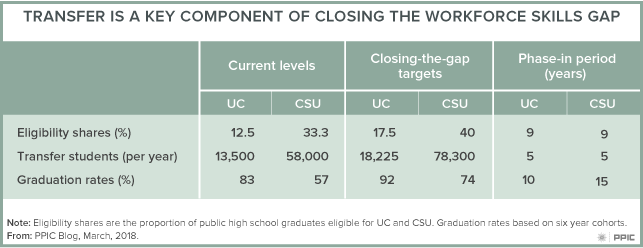
PPIC has identified ambitious targets that would close the workforce skills gap. As shown in the table below, doing so will require large increases in access to UC and CSU, both for first time freshmen and for transfer students. In its Vision for Success, a blueprint for improving student outcomes, the community colleges have established new goals for transfer that align exactly with the PPIC targets. Those targets include a 35% increase in the number of transfer students at UC and CSU, increasing from about 72,000 combined in 2015 to almost 100,000 by 2020.

I’m pleased to say that the colleges are currently on track to meet those targets. We are now two years into PPIC’s projections, and both UC and CSU have met the closing-the-gap targets (see charts below). The concerted efforts of policymakers, higher education officials—including staff and faculty—and, of course, students have led to these early gains.  State general fund allocations for each system have increased since the Great Recession, allowing for increased enrollment. At UC, those budget allocations were partially tied to increasing enrollment, hence the sharp rise in transfers from 2015 to 2016.  New articulation agreements, such as the Associate Degree for Transfer (ADT), have streamlined the pathway from community colleges to four-year colleges, especially CSU. And an increased focus on improving student outcomes in the community colleges has led to multiple substantive reforms designed to increase persistence and completion (including transfer).

These early successes are very promising. Still, California needs to build on them if it is to close the degree gap.  We offer the following recommendations for moving forward:

  • First, the state should work with the systems to ensure that students who are eligible for transfer successfully make the transition. Some students who are eligible to transfer never even apply to do so. More work needs to be done to understand factors that prevent those students from moving on, including an assessment of equity implications. At the same time, many transfer-eligible students do apply to transfer, but are not admitted because of insufficient resources at UC and CSU. Because of budget constraints, CSU reports turning away more than 32,000 transfer applicants from 2013–14 through 2016–17, even though they had met CSU admission requirements (based on systemwide unduplicated counts of California resident applications). UC does not report how many qualified applicants have been turned away, partly because UC eligibility is less clearly defined. UC has general transfer requirements, including courses and grade point average requirements, but advises students that “meeting these basic requirements doesn’t guarantee admission to the campus or major of your choice.” Enrolling more students will almost certainly require more funding, either from the state via the general fund or from students and their families through tuition increases.
  • Second, the pathway from community college to UC and CSU needs to become systematically and comprehensively streamlined. The Associate Degree for Transfer is a step in the right direction. Students earning an ADT are guaranteed admission to CSU in a major aligned to their course of study. But these degrees are offered only in some majors at some colleges. While the number of students earning an ADT has grown rapidly, it is still the case that the majority of transfers to CSU do not have the degree. As shown in the chart below, institutional participation in the program varies by college and by major. Some majors, including engineering, have no ADT at all.  Moreover, UC does not formally participate in the ADT guarantee. At UC, transfer admission requirements vary by campus and by majors within campuses.  For example, UC Berkeley’s College of Engineering has much higher standards than the UC minimum requirements for transfer, including a 3.5 grade point average and the completion of courses that are not offered at all community colleges.

  • Third, the state and its higher education institutions need to plan for potentially large increases in the number of community college students prepared and ready to transfer. New reforms in the community colleges hold the promise of dramatically increasing persistence and completion. Assessment and placement reform, spurred by AB 705, is likely to lead to an enormous increase in the number of students placed directly into college-level English and math courses—bypassing traditional remedial classes that have been the single largest impediment to student success. Other new initiatives, including “guided pathways” intended to provide a clear road map to students on courses of study and the supports needed to succeed, could lead to further gains. Because most transfer students enroll in CSU and UC, capacity issues at those institutions must be addressed. The state’s private nonprofit colleges are also an important destination for transfer students, and continued efforts should seek to gain greater participation and enrollment in that vital sector.

Through thoughtful planning—and yes, additional funding—closing the workforce skills gap is possible. Improving the transfer pathway is a necessary and critical component. And because community colleges are highly representative of California’s economic and demographic diversity, improving transfer pathways will ensure that more low-income, first-generation, and underrepresented students have access to a four-year degree.

Video: Improving English Courses at California’s Community Colleges

California’s community colleges are in the midst of numerous reforms to improve developmental—or remedial—education. Developmental education is supposed to help prepare students for college work but it has long been an obstacle to student success: most students in developmental classes never go on to complete a college-level course in English or math. A recent report by the Public Policy Institute of California (PPIC) looks at the effectiveness of some of these reforms in English. It finds that one reform in particular shows real promise. Called one-semester acceleration, it’s a highly intensive course that leads directly to a college composition class. Still, there is much room for improvement, especially for underrepresented students.

PPIC researcher Marisol Cuellar Mejia presented findings from the report in Sacramento this week. In a discussion following the presentation, panelists talked about promising initiatives underway in developmental education. Many of the current efforts to more accurately place students in appropriate classes and transform course sequences are motivated by AB 705, a legislative proposal signed into law by Governor Jerry Brown last fall. Assemblymember Jacqui Irwin, who authored the bill, said it provides flexibility to the state’s individual community colleges “but with clear requirements that colleges use the best of multiple measures—including high school performance—in placing students.” The bill also instructs colleges to maximize the possibility that students pass a transfer level class within a year.

Laura Hope, executive vice chancellor for educational services at the California Community Colleges Chancellor’s Office, described the central challenge involved in full-scale implementation of reforms across the state’s 114 community colleges as an instructional paradigm shift. “It’s about changing minds and hearts about student capacity and the belief that they don’t come to us just a jumble of deficits . . . It’s about shifting that mindset away from fixing students into activating students.”

Summer Serpas, assistant director of the California Acceleration Project, underscored the professional support that teachers will need as a larger and more diverse group of students move out of developmental courses and into transfer-level ones: “These students are capable of doing the work, but they come in needing [additional] support.” Serpas said it will be critical to learn from colleges that have already adopted successful reforms, including accelerated pathways and the “co-requisite” model, in which students enroll directly in college composition with concurrent support.

Retraining Workers for the Future Economy

As the economy continues to shift toward computers and digital technology—and braces for a potential future with more robots—workers have been called upon to adapt and learn new skills. New industries and new kinds of jobs may lead to economic growth, but whether these gains are shared by all of California’s workers depends critically on their retraining. And that retraining, in turn, depends on the ability of educational institutions to also adapt to new labor market needs.

While workers can sometimes learn new skills on the job or on their own, other times retraining means obtaining a new credential and returning to the classroom. That’s especially true for people who work in technical industries that are being reshaped by forces like routinization, automation, and outsourcing.

California’s higher education system has an important role to play in delivering retraining options. The state’s community colleges are the primary provider, with hundreds of programs in skilled trades and applied sciences and technologies. Notably, community colleges offer retraining options at a much lower cost to students than do private for-profit two-year colleges, another major provider. In addition, many community college programs show substantial economic returns for students—especially in health professions.

Effective retraining through the state’s colleges would help ensure that all Californians are productive and self-sufficient, which would benefit not just families but also employers and the state economy. However, the current model of higher education was largely built for 18-year-old, first-time freshmen and does not necessarily work for older, returning students, who are almost certainly balancing training with career, family, and other demands.

Flexible course scheduling—for example, through online courses or “distance” education—is one way to better reach workers. California’s community colleges are the clear leader in offering online options. PPIC research has highlighted some limitations to online training and outlined ways to improve student outcomes. Online courses for technical programs may require additional innovation, especially those that require hands-on training. Governor Brown’s proposed budget for fiscal year 2018–19 includes funding for a fully online community college that has the potential to bring innovation to how retraining opportunities (and educational opportunities, broadly speaking) are offered to Californians.

For individuals or training programs not amenable to online options, expanding course offerings near job centers is key. Cal State Los Angeles’s satellite campus in downtown LA aims to do exactly this. Information about the job market is also crucial—and California’s community colleges have taken a big step in the right direction by providing easily accessible information on the labor market outcomes of different colleges and programs across the state.

Retrained workers may pursue all kinds of new skills, but career technical programs, most of which are in community colleges, are particularly important because they offer short-term credentials in industry-relevant fields. Efforts to make career technical programs more flexible—through, for example, online courses, convenient locations, and partnerships with employers—are critical to filling student, employer, and state needs in a rapidly changing workplace.

Learn more
Visit the PPIC Higher Education Center


Testimony: How Can California Produce More College Graduates?

Hans Johnson, director and senior fellow at the PPIC Higher Education Center, testified today, February 6, 2018, before the Assembly Budget Subcommittee No. 2 on Education Finance and the Assembly Higher Education Committee. The master plan defined a strategy to meet the state’s education needs in 1960—but today, California faces new challenges. The topic of today’s hearing: how to meet the state’s future economic need for more college graduates. Here are his prepared remarks.

PPIC’s work has revealed a serious gap between the number of highly educated workers that California’s future economy will need and the number the state is on pace to produce. We call this the workforce skills gap—and it’s quite large. To meet economic demand and secure a more prosperous future for our state, California’s higher education institutions will need to produce 1.1 million more college graduates by 2030.

Admittedly, doing so is an ambitious goal. But there is significant room for improving how many students graduate from college—especially if we consider that currently only about 30 percent of California’s 9th graders will earn a bachelor’s degree.

PPIC has quantified the role of each university segment—the University of California, the California State University, and private nonprofit colleges in California—in closing the workforce skills gap. Overall, the number of bachelor’s degrees would need to increase by about one-third over baseline projections. Almost half of the gains would need to occur at CSU, the nation’s largest public university system. UC and private nonprofit colleges would also play an important role.
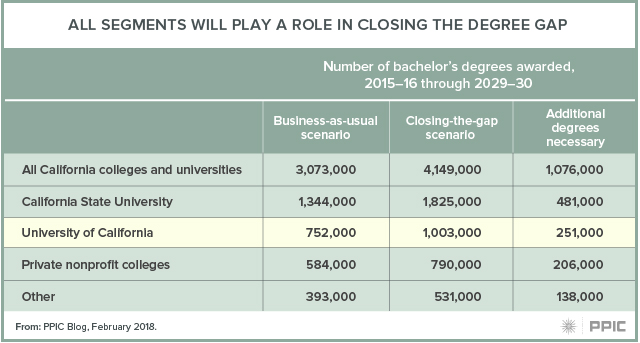
Most immediate to today’s conversation about goal setting for the state’s public systems, PPIC has identified the combination of increases in freshman eligibility, transfer, and completion rates necessary to close the gap.

Our preferred approach—a closing-the-gap scenario—combines increases in eligibility, transfer, and graduation rates, as shown below. Along with increases in enrollment and completion at private institutions, reaching these targets would fully close the workforce skills gap.
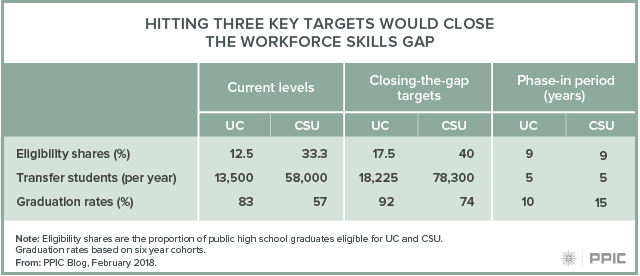
In our scenario, each target would be reached gradually through a phase-in period. In the first few years, projected increases would be minimal as the systems would enroll more students and implement policies to improve completion and transfer. But within five years, the increases would become quite large. By 2020–21, CSU would award almost 25,000 additional bachelor’s degrees; UC would award more than 12,000.
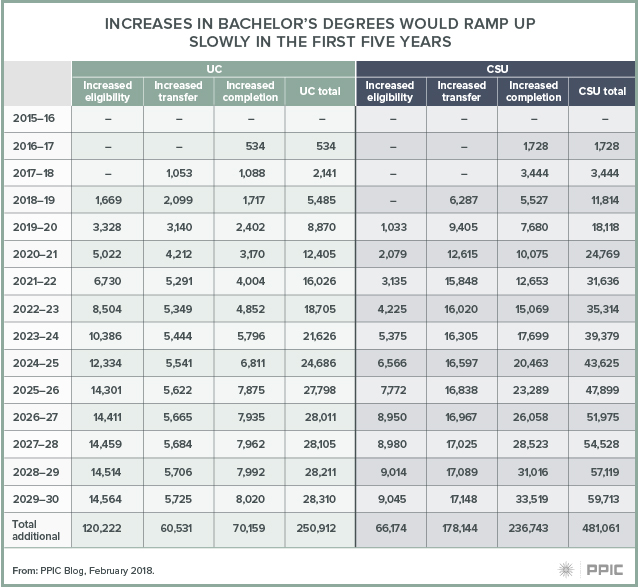
For the purposes of setting annual goals, we are identifying annual targets in new freshmen enrollment, transfer, and completion rates that would match the closing-the-skills gap degree targets. Enrollment and transfer targets depend on graduation rates and time to degree—meaning that enrollment increases could be lower if graduation rates improve and students complete their degrees more quickly. For example, students who take 12 units per semester will take five years of continuous enrollment to earn the 120 units necessary for graduation.  If those students instead took 15 units per semester, they would graduate in four years and free up additional space for other students.

It has been a couple years since PPIC first developed our projections, and we’ve now been able to chart early progress by the systems. Later you will hear in detail from the segments about their plans, but right now I am happy to report some good news: the number of bachelor’s degrees awarded at UC and CSU is actually higher than our initial scenario called for.
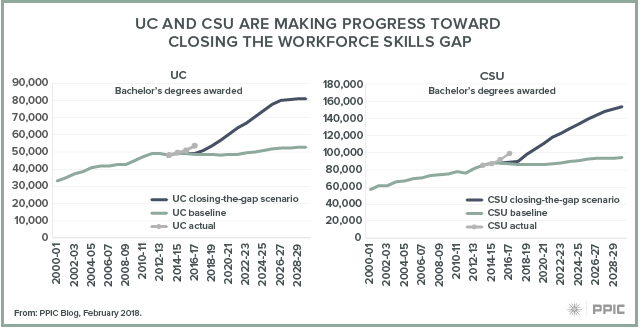
Of course, we are just at the start of our projection period, and to close the gap the numbers must ramp up quickly after the first few years. Nonetheless, growth in graduation rates and enrollment has led to a notable expansion in degrees awarded at both systems. Over the past two years, UC and CSU combined have awarded 295,000 bachelor’s degrees—21,000 more than in our closing-the-gap-scenario and 23,000 more than in our baseline scenario. In addition, the number of transfer students has increased 8%, also higher than in our closing-the-gap scenario.

In addition, community colleges and CSU have adopted new goals for student success that are entirely consistent with PPIC’s closing-the-gap scenario. CSU’s new graduation initiative calls for reducing time to degree and increasing both four-year and six-year graduation rates. CSU’s goal of a 70% six-year graduation rate by 2025 is in line with and in fact slightly more ambitious than our scenario. In their new “Vision for Success,” the community colleges have adopted a goal to increase transfer to UC and CSU by 35% over the next five years, a goal that is entirely consistent with our work.

There is an important additional benefit of meeting these goals: reducing equity gaps. Today, students who have been underrepresented in higher education—including Latino, African American, low-income, and first-generation students—make up a majority of California’s high school graduates. Strong increases in college preparation among the state’s high school graduates are expanding the pool of potential college graduates, with the share of students—including African American and Latino students—completing the college preparatory requirements of UC and CSU reaching an all-time high. Ensuring that the growing number of prepared high school graduates have meaningful access to and success in higher education will not only help California meet its economic challenges, it will ensure that higher education continues to serve as a ladder of economic and social mobility.

Our focus at PPIC has been on college graduates with at least a bachelor’s degree, but we acknowledge the importance of other postsecondary training. We have a series of reports and ongoing projects that identify successful vocational pathways and high value awards (certificates and associate degrees) offered by the state’s community colleges. Lande Ajose of California Competes will discuss in more detail the need for sub-baccalaureate post-secondary education. We also acknowledge the importance of post-baccalaureate education, including professional and academic graduate degrees offered primarily by UC and the state’s private nonprofit colleges. Those degree holders have the best labor market outcomes in the state.

Figuring out how to pay for all these increases is no easy task and will be discussed later in this hearing.  Let me alert you to two projects underway at PPIC that will help shed light on this issue. One will examine the role that tuition policy could play and the other will focus on capital finance. In addition, we will continue to monitor affordability issues, including student debt, identified by respondents to the PPIC Statewide Survey as the number one higher education issue.

Finally, it is worth noting that the governor has proposed a funding formula for the community colleges that for the first time will provide additional funding based on student outcomes and enrolling low-income students. PPIC has argued that this approach has the potential to incentivize investment by the state’s higher education systems in areas that further state priorities.

 

Bricks and Mortarboards: Capital Investment in Colleges

PPIC has documented California’s need to increase the number of resident college graduates to meet the economy’s future needs. While the state’s public higher education systems are taking steps to increase the number of students who complete their degrees in a timely manner, these improvements alone will not fill the gap. At some point, the UC and CSU systems will have to expand their capacity, and such an expansion is likely to require long-term capital investment in buildings, technology, and campus infrastructure.

It is important to note that capital investment encompasses more than new classrooms or dormitories. Earlier this week, the College Futures Foundation released a report by Patrick Lenz in which the California Community Colleges, the University of California (UC), and the California State University (CSU) estimate that they will need a combined $47.2 billion to modernize and maintain their facilities in the next five years alone. Their needs include ensuring the safety and accessibility of aging buildings and investment in the less visible systems—heating, cooling, electrical, and water—that enable a campus to function.
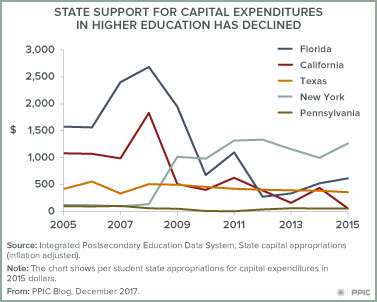
A look at some historical data suggests that economic pressures and policy decisions have led California to underinvest in higher education infrastructure over the past decade compared to four other large states. From 2005 to 2015, the period for which we have data, state support for capital investment in both California and Florida dropped sharply as a consequence of the Great Recession. Interestingly, New York increased its support, while support in Pennsylvania and Texas stayed the same.

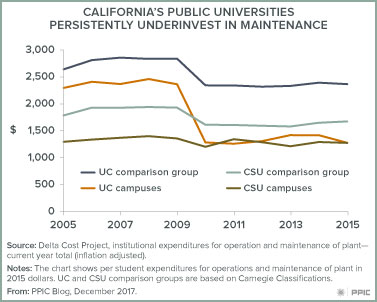
In 2000, California voters approved Proposition 39, which makes it easier for community colleges to pass bond measures. Since then, local community college districts have been relatively successful in funding their capital needs. The state’s four-year universities, however, face a different situation. To compare how much UC and CSU spent (per student) on maintaining and operating their campuses between 2005 and 2015, we separated and compared each system to a nationwide group of similar institutions. As the state cut its investment in higher education infrastructure, UC cut its infrastructure spending dramatically, while CSU’s spending remained relatively constant. But average maintenance spending by both systems was significantly below that of their peers.

These comparisons suggest that California has been systematically underinvesting in its higher education infrastructure, at least at its four-year public universities. Even if California were not facing a degree gap, it could benefit from rethinking its higher education capital finance strategy. But a new approach becomes imperative when one considers that larger shares of high school graduates are expected to complete the a–g requirements and that many of those students will seek admission to UC and CSU. Efforts by the state’s community colleges to increase the number of students who transfer to four-year institutions will also heighten the need to expand capacity, necessitating further capital investment.

Over the coming months, PPIC will be focusing on capital finance, a key component in maintaining access for all students and producing an educated workforce. We hope to inform state decision making in this critical area.

Learn more
Visit the PPIC Higher Education Center

Video: Keeping Students on Track for College

Only about 30% of California 9th graders are expected to earn a bachelor’s degree—a startling statistic in a state that faces a shortfall of college graduates. A new PPIC report finds that the vast majority fall off the path to a college degree in the last two years of high school or the first two years of college.

Report coauthor Niu Gao presented the analysis in Sacramento last week, along with recommendations for tackling the problem. Among them: updating high school graduation requirements, offering more of the college preparatory courses required for admission to California State University (CSU) or the University of California (UC), and improving placement policies in both high schools and community colleges to ensure that students take the classes needed to progress.

Gao’s presentation was followed by a panel discussion among experts who work in this area. In a conversation moderated by Hans Johnson—report coauthor, and director and senior fellow at the PPIC Higher Education Center—participants touched on challenges, as well as potential solutions.

Jorge A. Aguilar, superintendent of the Sacramento City Unified School District, noted that while more students are completing college prep courses—known as a–g courses—many aren’t making it to or through college. Part of the problem, he said, is the “fundamental disconnect between K–12 and higher education.” Having worked in both sectors, he noted there are insufficient incentives for school districts to focus on persistence in higher education and for higher education to work with K–12 on the issue.

Kimberly Rodriguez, chief education advisor to Kevin de León, state senate president pro tempore, addressed one of the report’s key recommendations: increasing state high school graduation requirements in math. She noted that requiring a–g courses for graduation has been much discussed at the state level.

“The biggest barrier has always been money,” she said. “Because once you require it, the state is on the hook.” Implementation is also complicated, she said, requiring planning and attention to infrastructure—as districts that have already adopted these requirements have found.

The third panelist, Jim Dragna, talked about a promising initiative. Known as the “graduation czar” at CSU Sacramento, he supervises the Finish in Four program. Students are asked to pledge to take 15 credits a semester—the number needed to graduate in four years—and are provided extra resources to ensure they stay on track.

“Student progression problems have been with us so long that they’ve become part of the culture,” he said. So, he continued, “we tackled the culture.”

California Needs More College Prep Courses

Most California high school graduates are not ready for college. Despite the steady improvements over the past decade, less than half of graduating seniors in the class of 2016 completed the a–g requirements, the set of courses high school students must complete to be eligible for admission to the University of California (UC) or California State University (CSU). The completion rate is substantially lower among Latino (37%), African American (34%), economically disadvantaged (37%), and English Learner (10%) students.

PPIC’s new report looks at the role of several institutional factors that may improve the completion rate, including high school graduation requirements, course placement policies and practices, and academic counseling and advising. But there is another significant barrier: not every high school in California offers the full a–g course sequence.

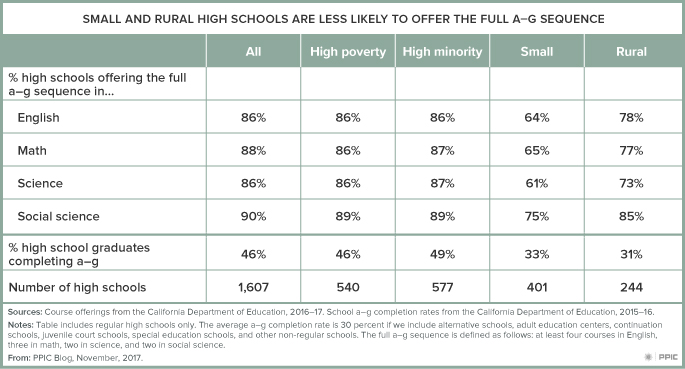
During the most recent school year (2016–17), 12% of California high schools did not offer the full math sequence, which includes algebra 1, geometry, and algebra 2. Similarly, 14% of high schools did not offer four years of a–g approved English courses. High-poverty schools (where more than 75% of students are eligible for free or reduced-price lunch) and high-minority schools (where more than 75% of students are African American or Latino) were just as likely as schools overall to offer the full sequence. But small schools (those at the bottom 25th percentile of the enrollment distribution) and rural schools were much less likely to do so. Close to 40% of small schools did not offer the full science sequence, which includes two years of approved science courses, and more than a third did not offer the full math or English sequence.

The difference in course offerings has contributed to low a–g completion rates at small and rural schools. For instance, the average a–g completion rate is 46% among all high schools, but only 30% or so among small or rural schools.

College Prep Blog Table

To improve student readiness for college, districts and schools need to increase the number of a–g approved courses. However, some schools may face capacity and resource limitations, such as not having enough qualified teachers. One solution is to establish a regional or statewide virtual school network so students in small or rural schools can enroll in online courses offered by other districts. Several states—including Florida (Florida Virtual Education), Wisconsin (Wisconsin Digital Learning Collaborative), Texas (Texas Virtual School Network), and Georgia (Georgia Virtual School)—have in recent years partnered with school districts to provide academic courses and test prep for all middle and high school students. California’s UC Scout program is a step in the right direction, providing a full set of online a–g courses accessible at no cost to students at participating schools.