Video: Making College Possible

At a time when California’s economy needs more college graduates, a new PPIC report examines the role of grants and scholarships in making higher education both accessible and helping students graduate. Hans Johnson, the report’s author and PPIC Bren Fellow, talked about his findings at a briefing last week in Sacramento.

He found that although total financial assistance available through federal grants, Cal Grants, institutional aid, and private scholarships has increased, it has not kept pace with the actual cost of attending California State University and community colleges. These are the California colleges that enroll most low-income students in California—a state in which nearly 60 percent of K–12 students qualify for free and reduced price lunch programs.

“If we want the economic ladder to success to work in California, we need more students to go to and complete college,” he said. “And given our student population, a lot of those students will be from very low-income families.”

He recommended strategies to make college more affordable and accessible. They include directing any additional aid to low-income students and helping more students complete financial aid forms.

California’s New Leaders Focus on Poverty

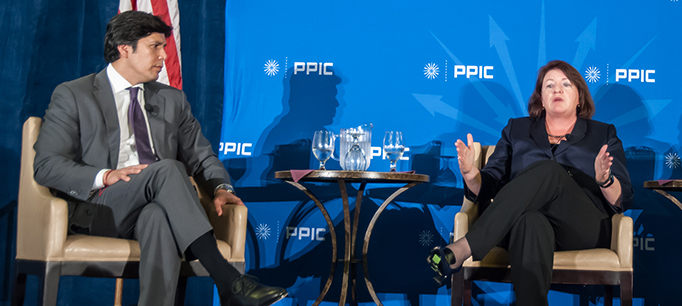
Assembly Speaker Toni Atkins and Senator Kevin de León, who will take over as senate president pro tem later this month, each told a Sacramento audience about growing up in poverty and the role it has played in their shared view of the state’s responsibility to those in need.

“We share similar values and similar stories that have made us care about the values and the issues that we’re talking about today,” said Atkins, who was raised in a poor, rural Virginia family and now represents the San Diego area. De León, who was born in San Diego and represents Los Angeles, said he is the youngest child of a single immigrant mother and the only family member to graduate from high school. Atkins and de León, both Democrats, were elected by their respective legislative chambers earlier this year to serve as leaders.

Both lawmakers cited a recent PPIC report — Child Poverty and the Social Safety Net in California by Caroline Danielson and Sarah Bohn — that said about 50% of California children live in poverty or near-poverty. The remarks, part of the PPIC 2014 Speaker Series, were made to a capacity audience of about 400 in the ballroom of the Sheraton Grand Hotel. The discussion was moderated by PPIC President Mark Baldassare and streamed live to hundreds more.

The wide-ranging conversation touched on a number of major issues—including health care, the drought, immigration, and taxes. Both leaders said that they believe the state should talk about changes to the state tax structure and consider whether to extend the temporary taxes that voters passed in Proposition 30. Atkins cautioned that it will be difficult to gain support from voters for an extension of the taxes.

De León expressed strong support for affirmative action, which he credited for his ability to attend college and become a legislator. He also said California should continue to lead on immigration issues because the federal government has been unable to pass a reform plan. And he noted that polls suggest Californians support health coverage for undocumented residents.

Atkins, meanwhile, encouraged more cities to follow San Francisco and San Jose, which recently increased the minimum wage. Both leaders also said they have worked together in the past and believe they will have a good working relationship going forward.

The Future of Online Education in Public Colleges

Policymakers and educators have a lot of questions these days about whether new communication technologies can be helpful in higher education. Will they lower the cost of teaching, provide access to those who are otherwise left out, or provide more effective individualized instruction? With encouragement from Sacramento, California’s three public higher education segments are pursuing new initiatives in online education. On Tuesday, PPIC hosted a lunch event on this topic.

Hans Johnson, PPIC Bren Fellow, talked about his recent study, co-authored with PPIC research associate Marisol Cuellar Mejia, about online education in the state’s community colleges. The study found that participation in online courses has soared in the last decade but that success rates—in terms of course completion and passing grades—are lower for online students.

An expert panel expanded the discussion, with Joseph Moreau, executive sponsor of the Online Education Initiative at the California Community Colleges; Ashley Skylar, quality assurance manager for academic technology services at the California State University; and Arnold Bloom, who teaches an online course in climate change at UC Davis. Panelists talked about efforts to improve the quality of online instruction—the course materials and training of instructors. They also said it is too soon to tell whether online education may save money, but the size of California’s higher education systems provides opportunities for collaboration among campuses, which may produce more cost-effective education.

Fulfilling the Promise of Online Education

Online learning has become a topic of great debate in higher education. Its advocates have high hopes that it will expand opportunities and rein in costs. Policymakers in Sacramento have taken note. The new state budget provides tens of millions of dollars to support online learning.

When most people think of on online education, they think of MOOCs—massive open online courses—which provide free access to classes taught by faculty from the nation’s top universities. MOOCs have garnered headlines and been the subject of much debate about their potential to reinvent higher education. Meanwhile, California’s community colleges have quietly created an extensive set of offerings in online education. They now provide more online credit courses than any other public higher education institution in the country—a testament to the community colleges’ willingness and ability to innovate.

Enrollment has soared from just a few thousand students a dozen years ago. By 2012, online course enrollment in the state’s community colleges totaled almost one million, representing about 11 percent of total enrollment. Among students taking credit courses in 2011–12, one of every five took at least one online course. Indeed, practically all of the community college enrollment increases over the past ten years have occurred in online courses.

The Public Policy Institute of California has completed an analysis of student success in these courses that points out both the opportunities and challenges in providing online education. We found that online courses are providing some students with an important and useful tool that helps them achieve their community college goals. For example, students who take at least one online course are more likely to earn a degree, transfer to a four-year college, or earn a certificate than students who take only traditional courses.

But there are significant problems. First, the digital divide is evident. Latino students are less likely than students from other ethnic groups to take online courses. Moreover, the achievement gap is exacerbated in online settings. African Americans and Latinos have lower success rates in traditional classes than Asians and whites, and the achievement gaps are even wider in online courses.

And finally, even though online students tend to be stronger academically, they are less likely to successfully complete online courses than traditional courses. This lower course success rate is true across all types of students, a wide set of subjects, and almost all colleges. Indeed, once we controlled for student characteristics—such as overall grade point averages and other factors such as colleges and course subject—students are at least 11 percentage points and as many as 14 points less likely to successfully complete an online course than otherwise similar students in traditional format classes.

California’s community colleges need both more information and a more strategic approach before online learning can fulfill its promise. Little is known about the cost of developing and providing online courses. We won’t know if online learning is less expensive than traditional course work—as some of its advocates believe—unless we begin to systematically collect cost information.

The colleges won’t be able to improve outcomes for the rich diversity of their students unless they take a number of steps. They need to evaluate the online courses being taught now, identify the most successful instructional and technological approaches, and provide professional development for faculty to create and deliver high-quality online learning. They need to provide services for online students to help improve success rates. And they can use the power of technology to track students’ progress in detail, and offer instruction that is more targeted and customized.

Once high quality courses are identified and developed, it will be a challenge to ensure that those courses are readily available to students across California’s vast community college system. The community college’s Online Education Initiative is an important step in the right direction. Its goals are consistent with our recommendations to identify best practices and implement them widely. Its success will depend on identifying and implementing effective policies and programs that improve student outcomes. Going forward, a strong strategic approach will help California to make the most of its investments in online learning.

Online Courses and Achievement Gaps

This commentary was first published in the Sacramento Bee on May 15, 2014.

Online learning is a hot topic in higher education. Certainly the MOOCs, massive open online courses offered for free and featuring faculty from top universities in the country, have garnered a lot of attention. But perhaps more important has been the rise of online courses—for credit—in the nation’s accredited public colleges. Here in California the state’s community colleges have taken the lead, with course enrollments of about 1 million—more than in any other public higher education system in the nation.

Online learning offers the promise of expanded access to and success in higher education. To truly fulfill that promise, it must do so across the diverse population of California students. Currently, it’s falling short.

At the Public Policy Institute of California, we have recently completed an analysis of student access and success in online courses offered by the state’s community colleges, an important access point for students who are underrepresented in higher education. Online courses offer convenience to students who are often juggling family and work responsibilities. The rapid growth in enrollment in online courses, from just a few thousand 10 years ago to around 1 million today, is a testament to the increasing demand for higher education. Enrollment has grown rapidly among all the state’s ethnic groups. But in a reflection of the state’s digital divide, growth among Latinos has lagged that of other groups.

Perhaps most troubling, achievement gaps are exacerbated in online courses. Completion and success rates for traditional courses are lower among Latino and African American students than among white and Asian students. That gap is even wider online. In traditional classes, the achievement gap between white and African American students is 12.9 percentage points. It is 17.5 percentage points in online courses. Similarly, the gap between whites and Latino students is 7.3 percentage points in traditional courses, but is 9.8 percentage points in online courses. In contrast, white students tend to perform slightly better than Asian students in traditional courses, with an achievement gap of 1.4 percentage points. But they do slightly worse than Asian students in online courses, with an achievement gap of -1.4 percentage points.

Achievement gaps exist among other groups as well. Our research found that older students—those over 25—perform better than younger students in traditional courses. This performance gap widens in online courses, from 10.2 percentage points to 14.8 points. The achievement gap between female and male students is 1.9 percentage points in traditional courses and 3.1 percentage points in online ones. In other words, when demographic groups differed in their performance in traditional courses, these differences tend to be magnified online.

For online learning to reach its full potential, California’s community colleges need deliberate strategies and plans to improve student outcomes in online courses, with a special focus on narrowing achievement gaps among underserved and underrepresented students. Community colleges need to ensure high standards of quality for online courses and provide professional development for faculty to design and deliver them. They also need to incorporate student support tools—both technical and instructional. The community colleges’ new Online Education Initiative is currently pursuing these strategies.

There are ways in which online learning has the untapped potential to yield better student outcomes than the traditional setting does. Online courses can enable instructors to track students’ progress in detail and provide more targeted and effective guidance—potentially offering customized instruction that can address achievement gaps.

Online learning is here to stay.  With smart and informed policies and programs, it can reach many more students and do so much more effectively.

Visit the PPIC Higher Education Center.

Is College the Answer to Income Inequality?

In both California and the nation, income inequality is at or near record levels. Educational attainment is by far the single most important determinant of an individual’s income. A key question, then, is whether improvements in educational outcomes can reduce inequality. In a recent commentary for EdSource, we conclude that increases in college completion will increase wages, but will not significantly narrow the income gap. Here’s why:

College graduates earn a lot more than workers with less education. For example, workers with a bachelor’s degree earn 57 percent more on average than similar workers with only a high school diploma. But the range in wages for college graduates is much greater than the range for less educated workers. For example, among workers with a graduate degree, the top wage earners (those in the 75th percentile) earn $33 more per hour than those at the bottom of the wage distribution (25th percentile). Wage gaps are much lower among less educated workers – only $11 among workers with a high school diploma. Moreover, during the past three decades wage gaps have increased dramatically among college graduates. The large and growing variation in wages among college graduates leads to higher inequality.

This does not mean we should abandon policies to increase college enrollment and completion. Inequality at relatively high wages is better than low wages for everyone, and improvements in educational attainment will lead to higher incomes on average. But don’t expect to substantially reduce income inequality simply by increasing the rate of college graduation.

UC President Napolitano on Tuition, Online Learning, and the Role of the University

image

Janet Napolitano, the new president of the University of California and the former U.S. secretary for Homeland Security, said Monday that she told President Obama that the United States cannot thrive unless California thrives—and California cannot thrive unless the University of California thrives. Napolitano was responding to a question about why Californians should care about the public university system. Her comments were part of PPIC’s 2014 Speaker Series on California’s Future, which drew an online and in-person audience of nearly 500 to a conversation with PPIC President Mark Baldassare at the Sheraton Hotel in Sacramento. The wide-ranging discussion opened with a presentation from Hans Johnson, PPIC senior and Bren fellow, who provided context about the state’s need for educated workers.

The UC president, who also served as governor of Arizona, talked about tuition and budget issues, as well as online education, access for low-income students, and the lessons she’s learned since starting this job about six months ago. Napolitano said there was much the university is doing well: 42 percent of UC students are eligible for grants to low income students, 46 percent are the first generation in their families to go to college, and more than one-third are from families where English is not the primary language. She also said no public research university in the country is more efficient at helping students graduate within four years.

Still, she talked at length about the changes underway in funding for higher education and the need for new models. She emphasized that tuition will not increase for the 2014-15 school year and said that the university is dedicated to a tuition rate that is “as low and predictable as possible.” She also said she hoped to increase the university’s financial connection to philanthropy and the private sector. She said the state could do more and it should do more to support higher education.

Speaking about the future of higher education, Napolitano said online learning “is a tool in the tool box,” not a silver bullet. She said it is not necessarily cheaper than traditional classroom instruction and—despite some claims—no more effective at remedial education. She said, however, that it could get students access to classes not available on their campus.