“The Central Valley Needs a New Narrative”

photo of Dan Dooley
Dan Dooley’s expertise on the nexus between water and agriculture runs deep: fifth-generation Tulare County rancher, water lawyer, former deputy director of the California Department of Food and Agriculture,  former chair of the state Water Commission, and former member of the National Academy of Sciences’ board on agriculture. So when he says the Valley needs a new narrative on water, we’d be wise to pay attention.

I’ve had the privilege of working with Dooley during one of his most recent gigs, as head of external affairs for the University of California, and we are fortunate to have him as an inaugural member of the PPIC Water Policy Center’s Advisory Council. Recently, I held a conversation with him following his recent lecture on the future of agriculture in the Central Valley, an event hosted by the Water Education Foundation.

Dooley began by describing key drivers of change that are already affecting farming in the Central Valley—and the San Joaquin Valley, in particular—from declining groundwater and less-reliable surface water, to a fast-growing population. Add to that the various water stressors that climate change is expected to bring, and it’s clear that change is inevitable. The billion-dollar question is how best to manage these changes well.

Especially during the drought, good management has not always carried the day. He emphasized that long-term over-drafting of groundwater can’t be sustained and regretted that farmers missed their opportunity to be more involved in last year’s legislation to regulate groundwater. “The new state law on groundwater could result in a 15-20 percent contraction in agricultural water use in the Southern San Joaquin valley,” he said.

At the same time, Dooley notes, water demand has “hardened” because of conversion of row crops (which can be fallowed in dry years) to perennial crops. The growth in dairies has also had a big impact on groundwater.

Despite these major challenges, Dooley emphasized that the Valley is an incredibly productive place, teeming with innovation and able to adapt to scarce water. His main point—that the Central Valley needs a new narrative—is a positive one.

As we talked about potential solutions, a few beacons of hope stood out. First, these myriad challenges are likely to force change in some of the state’s outdated policy and regulatory approaches to water. New policies will be needed to incentivize more efficient water use, and to improve the marketing of conserved water to others with unmet demand. Second, better integration of surface and groundwater—critical to sustainable management—is inevitable in light of tight supplies and the new groundwater law. Third, the culture of innovation that has made the Valley an agricultural powerhouse can serve the region well as it adapts to water scarcity, population growth, and a changing climate.

His big-picture advice to both his fellow farmers and water-law colleagues: Get more involved in groundwater management and manage it for the long-term. Stop scapegoating the environment. Stop the skirmishing, keep your eyes on where you want to be 10 years from now, and implement practical solutions.

Learn more about the annual Anna J. Schneider lecture series and its focus on water law.

Testimony: Improvements Needed in Water Information

How is the state government handling the drought? And what more could be done? A hearing convened by the Senate Natural Resources and Water subcommittee earlier this week delved into the topic, with updates by leaders from the administration on the implementation of drought actions in the urban and rural sectors and in the state’s diverse ecosystems. In a second panel, I joined several other non-governmental experts to describe additional ways forward to solve our short- and long-term water challenges.

My testimony focused on a number of policy priorities that we highlighted in a recent report on drought management. In particular, I emphasized the need for better information as a basis for better water management.

Compared to most other western states and other dry places like Australia, California’s water monitoring and accounting systems are primitive, with significant gaps in information. Without a better understanding of how much water is available in our rivers and groundwater basins, as well as who’s using what, we’re saddled with inefficiencies, inadequate transparency, and greater potential for conflict. This especially matters during droughts, when every drop counts.

On the plus side, the state has recently made some progress in improving water information. Legislation enacted in 2009 requires all surface-water users to report the volumes of water they divert and also requires local agencies to report groundwater levels. Since the drought emergency was declared in January 2014, the State Water Resources Control Board has progressively amped up water-use reporting requirements.

But more should be done to fill the gaps. This includes gathering information on groundwater use—an important component of overall water use, especially during droughts. We also need to account for the volumes of water that cities and farms discharge back into streams as treated wastewater or irrigation runoff; these discharges make up a large share of water supplies in some of our rivers and streams.

Because information is only really useful if it is well organized, the state needs to pay particular attention to developing a coherent water information management system. Currently, agencies and offices that oversee different pieces of the puzzle have different tracking systems and accounting standards, which makes it very hard to get an overall picture of what’s happening in anything close to real time. The last official estimates of water supply and water use for California date back to 2010.

Funds from the state water bond could help pay for this work. In devising our system, we should draw lessons from other states and countries that are further along in this area. And given that California is a global center for the information economy, it may make sense to tap into local “big data” expertise to help build data solutions.

There’s a saying that “You can’t manage what you don’t measure.” The drought is making it ever more important to manage our scarce water supplies for the benefit of our economy, society, and the environment. So we’d better get better at measuring it.

Watch the hearing on Cal Channel.

Video: Alternatives to Incarceration

Under continuing pressure to reduce its prison and jail populations, California is expanding alternatives that hold offenders accountable, are cost-effective, and do not harm public safety. At a Sacramento event last week, PPIC researcher Brandon Martin summarized a new PPIC report about the potential impact of this expansion. His presentation was followed by panel discussion in which state and local corrections officials talked about their own experience and provided examples of success.

Jeremy Verinsky, undersheriff of Santa Cruz County, said his department has long had a work release program— having offenders clean up graffiti in county parks, for example. The county has increasingly paired work release with home detention and electronic monitoring since corrections realignment began in 2011. Offenders in Santa Cruz are required to be involved in programs based on their needs and risk factors, Verinksy said.

“We aren’t putting people out on a monitor so they can stay home and play Xbox all day,” he said.

Carol Paris of the Sacramento County Probation Department says her department has expanded its use of adult day reporting centers, which provide resources for offenders. Asked how her department handles probation violations, she said the strategy is to engage early. Intake officers visit prisons to meet with inmates before their release to talk about specific needs and housing issues. Offenders are also transported directly from custody to the probation office for assessment—an effort “to counteract those days of the person being released at one o’clock in the morning,” she said.

Robin Harrington, chief deputy warden of the Female Offenders Programs and Services/Special Housing Mission at the California Department of Corrections and Rehabilitation, described the department’s alternative custody programs. Eligible offenders can apply to serve their sentences—supervised and electronically monitored—at home, in a private alternative custody program, or in a training and employment program.

New Strategy, New Challenges for the Delta

Last week, Governor Brown announced a new approach to managing the Sacramento-San Joaquin Delta. For the past eight years the state’s focus has been on the highly controversial Bay Delta Conservation Plan (BDCP). That plan was intended to be a “big fix,” simultaneously improving the health of the troubled Delta ecosystem and the reliability of water supplies for the cities and farms in the Bay Area, Southern California, and the San Joaquin Valley that depend on water exported from the Delta.

The BDCP was intended to meet the 2009 Delta Reform Act’s requirement to manage the Delta for co-equal goals of water supply reliability and ecosystem health. To achieve these goals, the BDCP aimed to restore more than 100,000 acres of habitat and build tunnels underneath the Delta to ship water that now goes through the Delta’s channels to the giant pumps at the Delta’s southern edge. The tunnels would improve the quality of water exports and, importantly, make exports less susceptible to disruption from levee failures. By taking a comprehensive approach to ecosystem restoration, BDCP hoped to receive a 50-year permit for water exports.

But in the end, uncertainty over the benefits of the restoration—particularly in light of a changing climate—made a 50-year permit unacceptable to federal and state regulators.

The governor’s new strategy is to disentangle ecosystem restoration from water supply infrastructure improvement. Under a new program, entitled California Water Fix, the state would proceed as planned with the tunnel project, and with restoration of 2,000 acres of habitat to mitigate the impact of construction. As before, the tunnels would be funded by the water users who use Delta exports.

To improve the health of the Delta, the state will implement California EcoRestore, a scaled-down effort that focuses on completing or improving projects already required by federal regulators to reduce the environmental impacts of water exports. This effort would begin restoring 30,000 acres of high-value habitat in the next three years—an ambitious timeline. The funding for this work is already available—largely from the same water users. (It is worth noting that funding for ecosystem restoration under BDCP had yet to be identified.)

Both Water Fix and EcoRestore face daunting challenges. For Water Fix, financing may become an issue. Under BDCP, the 50-year permits would have provided greater regulatory certainty and thus greater water supply reliability for those who depend on water exports. Reverting to the regulatory status quo—and associated uncertainties—reduces the overall value of the project and may make some water suppliers reluctant to invest.

For EcoRestore, the key challenge lies in meeting the ambitious three-year time frame for initiating restoration projects. Our recent assessment of environmental stressors affecting the Delta found that institutional fragmentation is a major obstacle to improving ecosystem health.

For example, one of the proposed projects that has been in the works for years—restoration of McCormack-Williamson Tract, an island in the northern Delta—will require the acquisition of 10 permits, consultations on 10 statutes, and demonstration of consistency with nine programs under 18 state, federal and local agencies. (An overview of the numerous agencies that need to provide regulatory approval and oversight for Delta projects can be found in Stress Relief: Prescriptions for a Healthier Delta Ecosystem, see Table 4, page 19).) The current timetable for EcoRestore has this project beginning early next year—a tight timeline indeed.

As we’ve described elsewhere, the BDCP’s original habitat restoration goals were likely too ambitious—conditions in the Delta limit the availability of lands likely to have a major impact on ecosystem health. So it is reasonable to scale back from the original plan. But to successfully improve habitat in anywhere near the timeframe proposed, EcoRestore must be accompanied by significant reforms that integrate and streamline management, most notably the permitting process (see our recommendations).

Presumably, these and many other issues will be addressed in the environmental documentation that will be released in June. However, as commonly occurs in management of the Delta, changing course is never easy, and always brings new challenges.

Half a Million New Enrollees in Covered California

The 2015 enrollment period for Covered California is wrapping up, and the state appears to have exceeded its forecast of 500,000 new enrollees. According to the most recent available data, more than 495,000 people signed up for private plans through the exchange during open enrollment, and another 93,000 signed up during a special enrollment period from February to April 30. Among those who enrolled before February 22, approximately 88 percent were eligible for federal subsidies to help pay for premiums. In addition, more than 780,000 people enrolled in Medi-Cal, bringing total Medi-Cal enrollment to slightly more than 12 million.

In addition to working to increase total enrollment, the state prioritized outreach to the Latino and under-35 populations during the second open enrollment period. Among subsidized enrollees, the share that are Latino rose from 31 percent to 37 percent, and the share that are under 35 rose from 29 percent to 34 percent.

Peter Lee, Covered California’s executive director, had announced the special enrollment period for uninsured Californians who were surprised to learn that there’s a tax penalty for remaining uninsured. Residents who didn’t have health coverage in 2014 owed $95, or 1 percent of their income (whichever is higher). Those who are uninsured in 2015 face a higher penalty: $325, or 2 percent of income.

The special enrollment period resulted from a discussion about the misalignment of the Covered California enrollment period and the April 15 deadline for filing taxes. Many Californians were unaware of the tax penalty for being uninsured in 2014 until after the February open enrollment deadline. This year’s special enrollment period allowed people who were still unaware of the tax penalty to avoid paying it in 2015—more than 33,000 of those who signed up during this period indicated that they were unaware of the tax penalty.

Even though the 2015 open enrollment period is over, there are pathways for some individuals to obtain healthcare through Covered California or Medi-Cal. For example, individuals may sign up for or change private plans within 60 days of a “life-changing event” such as getting married or having a baby. And Californians who are eligible for Medi-Cal can enroll year-round.

Looking forward, the state will continue to face the challenge of ensuring access to providers for Medi-Cal recipients. California’s reimbursement rate for providers is among the lowest in the nation, leading many doctors to turn away Medi-Cal patients. Several bills have been proposed in the state assembly and senate to raise these rates. AB 366, which would prohibit the application of existing reductions to reimbursement rates, has moved into appropriations after unanimously passing the health committee. We’ll be tracking its progress throughout the term.

Automatic Voter Registration Is No Panacea

This commentary was published on Tuesday, May 5, 2015, in the Sacramento Bee.

California voter turnout has reached record lows. Only 18 percent of 24 million eligible adults cast ballots in the June 2014 primary and only 31 percent last November. As a result, state lawmakers and good government groups are searching for new ways to increase participation in elections.

One proposal that is gaining traction—and was discussed at a recent Public Policy Institute of California event with Secretary of State Alex Padilla and other officials—is to import an automatic voter registration system from Oregon.

There’s no question that such a system would swell California’s voter rolls. But would it significantly increase turnout? That’s much less clear.

(continue reading at sacbee.com)

Video: Addressing California’s Water Challenge

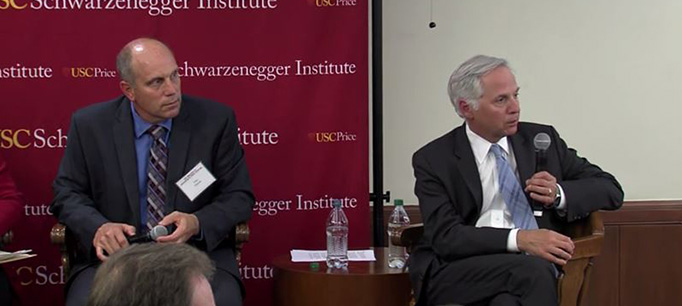
Last week the PPIC Water Policy Center partnered with the USC Schwarzenegger Institute for an important and timely discussion on the current drought and long-term solutions to California’s water challenges. The forum brought together water, business, university, and community leaders from around the state. Former governor Arnold Schwarzenegger, whose remarks opened and closed the event, emphasized the need for a big vision to tackle the drought, accompanied by strong leadership to ensure the timely implementation of creative solutions.

The event provided an opportunity to go beyond the current finger-pointing of who uses how much water, resulting in a more productive conversation about what can be done in key sectors and regions of California. In her presentation introducing key facts about the state’s big water issues, Ellen Hanak, director of the PPIC Water Policy Center, introduced two main themes that helped guide further discussions: “We’re all in this together” and “There are no silver bullets” to tackle major droughts. There was widespread agreement among speakers that a more sustainable future for water in California will benefit both our economy and environment, but we need an “all of the above” approach. We need to increase supplies, reduce demand, and modernize our approach.

More than 20 participants shared their views in a series of three panel discussions, including two members of the PPIC Water Policy Center advisory council, Tim Quinn and Lester Snow, and a member of our research network, Dan Sumner. Mark Baldassare, president and CEO of PPIC, served as moderator for a discussion on the state’s most important drought-based challenges, the role of agriculture, and solutions for addressing the drought.

Video: Press Club Focuses on Water

California’s drought has gone on long enough that many of the state’s reporters­—whether or not they cover the environment—have found they need to learn more about how water is managed in the state. The Sacramento Press Club helped close this information gap yesterday by hosting PPIC’s Water Policy Center director Ellen Hanak, who talked about the five things you need to know about water.

One of her points, that there are no silver bullets to solve our long-term water policy challenges, prompted the most conversation. While many reporters in the room may have already understood this, their questions were tinged with hope that there might be some solutions that could help make this drought go away (silver-plated bullets, perhaps?).

What about desalination, one reporter asked? The constraint, noted Hanak, is the cost. Seawater desalination is still a very expensive option for most water agencies. Using recycled wastewater (including to recharge groundwater) is a somewhat cheaper way to get “more water” for parched urban areas. But in some areas—like San Diego and some Central Coast communities—residents are already willing to pay the higher price tag for desalination to improve reliability Hanak said.

Another member of the audience asked about two proposed storage reservoirs, Temperance Flat (Fresno County) and Sites (Colusa-Glenn counties), both of which would be built off-stream in the Central Valley. “Our current system of reservoirs can collect roughly 40 million acre-feet, or about what we use in a year, statewide,” Hanak said. “Our groundwater basins can store at least three times that amount, and they can be recharged.” Hanak noted that storage investments will be needed to capture more water in wet years and make up for the shrinking snowpack. Surface reservoirs provide more flexibility, but groundwater storage is often much less costly. Operating the two types of storage in combination—and putting more drought storage into the ground—is an especially promising approach. “We need to think about managing water as a system.”

Another immutable water fact that Hanak shared is that the situation is hard but not hopeless. California has made steady progress in improving water management and systems, though much remains to be done—especially for maintaining healthy ecosystems and the wildlife they support. Water used to maintain environmental stability has become quite contentious, yet there are some promising stories, including in the Sacramento area. She described how water managers have introduced more natural flows in Putah Creek (a major stream that is part of the greater Sacramento River watershed)—using much less water than nature used to provide—with the result that native fish species are doing much better. This past year, even salmon returned after many decades’ absence.

Good reporting on the current drought, and on longer term water challenges, can help us all gain greater understanding of the highly complex world of water use in the state. We thank the Sacramento Press Club for the opportunity to help take the conversation forward.

ABOVE: PPIC’s Ellen Hanak greets Juliet Williams, Associated Press correspondent and president of the Sacramento Press Club, at the recent Press Club event. Photo: Phil Kampel Photography8.

Local School Funding & the Exclusive Electorate

State funding for K-12 public education has been rising, but 70 percent of public school parents say it is “not enough” in our April PPIC Survey. Are California voters likely to heed these parents’ calls and support local ballot measures for school funding?

It doesn’t look likely. To begin with, likely voters are much less likely (54%) than public school parents to say that the state’s funding for their local schools is not enough. More important, in our recent poll likely voters and public school parents have starkly different views about specific ways to increase funding—local bonds and local parcel taxes—for their local public schools. Specifically:

  • When it comes to local school bonds, 75 percent of public school parents would vote yes if their local school district had a bond measure on the ballot to pay for school construction projects. But only 53 percent of likely voters would do so—lower than the 55 percent required to pass a local school bond.
  • As for funding schools through local parcel taxes, 61 percent of public school parents would vote yes. But just 49 percent of likely voters would. A two-thirds majority yes vote is needed to pass a local parcel tax for schools.
  • What about lowering the majority needed to pass local parcel taxes—from two-thirds to 55 percent? This tax reform is rated as a good idea by 57 percent of public school parents. Only 44 percent of likely voters agree—less than the majority required to make this change.

The poll’s findings reflect the fact that California’s “exclusive electorate” controls the fate of ballot measures for local school funding. Today, many public school parents are nonvoters. And most likely voters are not public school parents. According to a PPIC report, likely voters are disproportionately white and tend to be homeowners, older, college graduates, and affluent.

Latinos, renters, and the younger, less educated, and less affluent are strong supporters of local bonds and local parcel taxes for local schools. They also favor lowering the vote threshold for passing local taxes. But these groups are outnumbered among those who cast ballots in elections.

It’s not impossible to pass local bonds and parcel taxes for school funding. CaliforniaCityFinance.com reported last December that eight in 10 local bonds and 6 in 10 local parcel taxes for local public schools have passed since 2001. But funding advocates have to carefully pick and choose the timing and location of these local school funding measures in deference to the higher vote thresholds required and the propensities of California’s exclusive electorate. A PPIC study concludes that the overall fiscal impact of parcel taxes has been fairly limited statewide.

School funding proponents want a state bond measure on the November 2016 ballot. The presidential election will attract the largest and most diverse electorate. It would take a simple majority vote to pass a state school bond. Our poll finds that 55 percent of likely voters and 77 percent of public school parents would vote yes on a state bond for school construction projects.

Meanwhile, the governor has stated that local voters should be deciding if they want more local school funding and that state voters should not be asked to pass state school bonds. This idea of local control resonates with Californians, who generally distrust the decisions made in Sacramento. But as our survey suggests, likely voters are unwilling to lower the local two-thirds threshold for passing local parcel taxes, leaving it easier to pass school funding measures at the state level than at the local one.

In other words, the state is likely to continue to play an oversized role in local school funding—until the California electorate reflects the will of the people who are relying on local public schools to improve their children’s futures.

Video: Water in Silicon Valley

Once a productive farming region, today Silicon Valley is a high-tech hub for the world, and a major driver of the state’s economy. As the valley has transitioned from fruits and nuts to bits and bytes, its water challenges have evolved—along with the approaches to dealing with them.

To explore how the region is coping with the current drought and preparing for future challenges, the PPIC Water Policy Center, with Cal Water and the Silicon Valley Leadership Group, hosted an event on April 24 with local leaders and experts. Ellen Hanak, center director, set the stage with an introductory talk on the statewide drought, opportunities for more water conservation in Silicon Valley, and regional climate-related concerns such as floods and sea level rise.

The mayor of San Jose, Sam Liccardo, brought it back to the local perspective. To achieve its 30% conservation target for 2015, he noted that the city of San Jose is taking innovative small and large steps, including a summer jobs program for youth focused on turf removal and the development of city-wide recycled water re-use system. The mayor emphasized that strong leadership at the local and statewide levels is needed to remove barriers to better-integrated and more advanced water management that can sustain the region through the coming challenges.

A panel of experts then offered wide-ranging views on the current drought, and posed a host of common-sense solutions, from increased public education to greater adoption of proven technologies such as using recycled wastewater to recharge groundwater basins. The impact of climate change on water systems, from increased temperatures to a reduced snowpack, was a major topic, with panelists agreeing that we will need to adjust to a new normal.

The participants were Angela Cheung, deputy operating officer of the Santa Clara Valley Water District; Juliet Christian-Smith, climate scientist at the Union of Concerned Scientists; and David Sedlak, co-director of the Berkeley Water Center at UC Berkeley. The panel’s moderator was Paul Rogers, an environment writer with the San Jose Mercury News and managing editor of the KQED Science Unit. As the drought continues, the PPIC Water Policy Center will be partnering with other local organizations and experts to bring similar conversations to other parts of the state.