Video: Assessing California’s Redistricting Commission

The creation of the Citizen Redistricting Commission (CRC) in 2008 marked a radical departure for California. This shift of responsibility for drawing state assembly, state senate, and US congressional districts from the state legislature to an independent commission also put California ahead of the national curve. Very few states have adopted a similar model, though many may be considering it—particularly in light of two US Supreme Court cases that could establish a legal standard for partisan gerrymandering. For California and for other states, partisan fairness and competitiveness should be important aims of redistricting reform.

A new PPIC report examines whether the commission’s first plan achieved these aims by analyzing recent election outcomes and putting them in national context. Researcher Eric McGhee described his analysis in Sacramento last week and outlined some key findings.

  • The CRC largely satisfied expectations that it would draw state legislative and congressional districts that are fair to the major parties and increase electoral competitiveness.
  • While Democrats have a greater advantage under the CRC plan than they did under the 2001 plan drawn by the legislature, this advantage is very small.
  • The CRC districts are somewhat more competitive than the districts drawn by the legislature. Competitiveness in state legislative districts remains low compared to other states, but the CRC congressional plan is among the most competitive in the country.

The report also notes that the CRC has moved California in the opposite direction from the rest of the country: other state plans are on average more favorable to Republicans and less competitive than plans from the last round of redistricting.

McGhee recommends that future commissions use more data to help them produce competitive and fair maps. He also recommends using sophisticated methods for automatically drawing redistricting plans.

Testimony: Transfer Is Key to Closing the Workforce Skills Gap

Hans Johnson, director and senior fellow at the PPIC Higher Education Center, testified March 20, 2018, before the Senate Select Committee on Student Success.

Here are his prepared remarks.

California faces a shortage of highly educated workers. Specifically, economic projections to 2030 show that about two in five jobs will require at least a bachelor’s degree, while demographic projections suggest that only about one in three Californians will attain this level of education. This shortfall equates to 1.1 million workers. To close the gap, all higher education systems will need to play a role, increasing access, transfer, and completion. Improving access and outcomes among groups historically underrepresented in higher education—including low-income students, first-generation college students, Latinos, and African Americans—is essential if we are to close the workforce skills gap.

The good news is that California’s students are rising to the challenge. College preparation among high school graduates has increased, with the share of students completing the college preparatory requirements of UC and CSU now at an all-time high. Strong demand for UC and CSU is likely to continue as college preparation improves and the transfer pathway becomes more efficient and effective. In addition, new initiatives, including reforms in remedial education at the community colleges and CSU, have the potential to substantially improve student success rates and boost transfer. Finding ways to accommodate all these students remains a central challenge, but one that must be met in order to ensure a better future for all Californians.

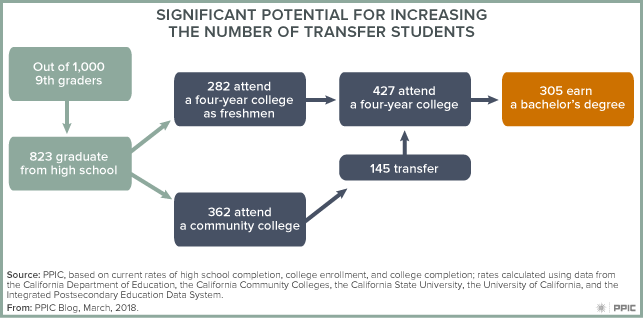
In this testimony, I will focus on the importance of transfer. California enrolls a disproportionate share of students in community college. We rank 47th in the nation in the share of recent high school graduates enrolling in four-year colleges and 5th in the nation in the share enrolling in community colleges. This means that we must do more to ensure that community college students reach their educational goals—since the vast majority of recent high school graduates attending community colleges say that they want to transfer and earn a bachelor’s degree. As shown in the chart below, there is a lot of room for improvement—only 40% of recent high school graduates who go to community college will end up transferring to a four-year institution.
PPIC has identified ambitious targets that would close the workforce skills gap. As shown in the table below, doing so will require large increases in access to UC and CSU, both for first time freshmen and for transfer students. In its Vision for Success, a blueprint for improving student outcomes, the community colleges have established new goals for transfer that align exactly with the PPIC targets. Those targets include a 35% increase in the number of transfer students at UC and CSU, increasing from about 72,000 combined in 2015 to almost 100,000 by 2020.
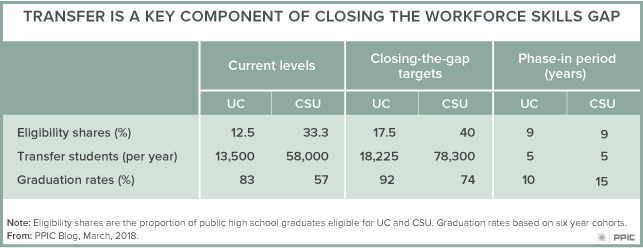
I’m pleased to say that the colleges are currently on track to meet those targets. We are now two years into PPIC’s projections, and both UC and CSU have met the closing-the-gap targets (see charts below). The concerted efforts of policymakers, higher education officials—including staff and faculty—and, of course, students have led to these early gains.  State general fund allocations for each system have increased since the Great Recession, allowing for increased enrollment. At UC, those budget allocations were partially tied to increasing enrollment, hence the sharp rise in transfers from 2015 to 2016.  New articulation agreements, such as the Associate Degree for Transfer (ADT), have streamlined the pathway from community colleges to four-year colleges, especially CSU. And an increased focus on improving student outcomes in the community colleges has led to multiple substantive reforms designed to increase persistence and completion (including transfer).

These early successes are very promising. Still, California needs to build on them if it is to close the degree gap.  We offer the following recommendations for moving forward:

  • First, the state should work with the systems to ensure that students who are eligible for transfer successfully make the transition. Some students who are eligible to transfer never even apply to do so. More work needs to be done to understand factors that prevent those students from moving on, including an assessment of equity implications. At the same time, many transfer-eligible students do apply to transfer, but are not admitted because of insufficient resources at UC and CSU. Because of budget constraints, CSU reports turning away more than 32,000 transfer applicants from 2013–14 through 2016–17, even though they had met CSU admission requirements (based on systemwide unduplicated counts of California resident applications). UC does not report how many qualified applicants have been turned away, partly because UC eligibility is less clearly defined. UC has general transfer requirements, including courses and grade point average requirements, but advises students that “meeting these basic requirements doesn’t guarantee admission to the campus or major of your choice.” Enrolling more students will almost certainly require more funding, either from the state via the general fund or from students and their families through tuition increases.
  • Second, the pathway from community college to UC and CSU needs to become systematically and comprehensively streamlined. The Associate Degree for Transfer is a step in the right direction. Students earning an ADT are guaranteed admission to CSU in a major aligned to their course of study. But these degrees are offered only in some majors at some colleges. While the number of students earning an ADT has grown rapidly, it is still the case that the majority of transfers to CSU do not have the degree. As shown in the chart below, institutional participation in the program varies by college and by major. Some majors, including engineering, have no ADT at all.  Moreover, UC does not formally participate in the ADT guarantee. At UC, transfer admission requirements vary by campus and by majors within campuses.  For example, UC Berkeley’s College of Engineering has much higher standards than the UC minimum requirements for transfer, including a 3.5 grade point average and the completion of courses that are not offered at all community colleges.

  • Third, the state and its higher education institutions need to plan for potentially large increases in the number of community college students prepared and ready to transfer. New reforms in the community colleges hold the promise of dramatically increasing persistence and completion. Assessment and placement reform, spurred by AB 705, is likely to lead to an enormous increase in the number of students placed directly into college-level English and math courses—bypassing traditional remedial classes that have been the single largest impediment to student success. Other new initiatives, including “guided pathways” intended to provide a clear road map to students on courses of study and the supports needed to succeed, could lead to further gains. Because most transfer students enroll in CSU and UC, capacity issues at those institutions must be addressed. The state’s private nonprofit colleges are also an important destination for transfer students, and continued efforts should seek to gain greater participation and enrollment in that vital sector.

Through thoughtful planning—and yes, additional funding—closing the workforce skills gap is possible. Improving the transfer pathway is a necessary and critical component. And because community colleges are highly representative of California’s economic and demographic diversity, improving transfer pathways will ensure that more low-income, first-generation, and underrepresented students have access to a four-year degree.

California Makes Progress on Water Accounting

California’s water accounting system—the balance sheet of where and when water is available and how it is being used—lacks common standards, suffers from major data gaps, and is in need of modernization. A 2016 law, the Open and Transparent Water Data Act (AB 1755), directed several state agencies to improve this system. The Department of Water Resources (DWR)―in concert with other state agencies, non-governmental organizations, and universities―is taking the charge seriously and has set ambitious objectives to be completed within a tight timeframe.

The law requires California to create a statewide system for organizing and sharing water data by September 2019. Currently, water-related datasets are stored in many ways, including on public websites, on non-public servers, and even in paper filing systems. The proposed system will make it easier to find and use the data needed for water management, consolidating datasets into several agency-level collections and allowing users to search from a centralized search engine―similar to how an inter-library loan system works.

DWR collaborated with several research institutions to develop guidance for implementing AB 1755. The researchers examined how local, state, and federal water managers, businesses, community groups, and environmental organizations currently use water data to make decisions. Their findings highlighted situations where better data organization could lead to more efficient and effective decision making.

“We recommend that the new system be designed to reflect real-world water management decisions, to ensure that the final product is relevant and useful to water managers and other stakeholders,” said Alida Cantor of Portland State University, who led the research on behalf of UC Berkeley’s Center for Law, Energy & the Environment.

Beyond problems of data organization, California also has some major data gaps, including accounting for groundwater use and recharge, managing water for ecosystems, and assessing rural communities’ access to safe drinking water.

While AB 1755 doesn’t require the state to fill these data gaps, the new guidance by research institutions has improved understanding and flagged some specific gaps that hinder management decisions.

For example, information on surface water rights and the location of many groundwater wells is not in easily accessible formats. And streamflow monitoring is unavailable for many important aquatic ecosystems. These three data gaps make it difficult for regulatory agencies to permit water trading between water users and the environment—a way to dedicate water to improve the in-stream environment. A current legislative proposal would have the state take a closer look at where more stream gages are needed.

AB 1755 is a “foundational first step” in the path toward better accounting for California’s water, according to Mike Kiparsky, director of UC Berkeley’s Wheeler Water Institute, who helped develop the new guidance. DWR and its partners will prepare a final strategic plan for the new statewide data system in spring 2018. This may also be an opportune moment to take a closer look at high-priority data gaps and develop concrete plans to address them.

Learn more


The Rising Cost of College: Student Fees

Students, parents, and lawmakers often express concern about tuition increases at California’s public universities. But tuition is not the only college cost that has been rising. Students also pay fees that cover many non-instructional costs, and between 2013 and 2016, student fees increased an average of 21% at both the UC and CSU systems, even as tuition itself stayed flat.

UC charges a systemwide fee ($1,228 for 2017‒18) to cover student affairs operations, and UC campuses can assess their own fees. CSU does not assess a systemwide fee; instead, the Chancellor’s Office allows campuses to decide how much to charge for each of seven fee categories, ranging from health services and facilities to instructionally related activities to the student association. When students vote to approve referenda, they are agreeing to implement fees for new or expanded services.

Fees typically pay for things like student affairs services, health center services, campus gym services and facilities (initiated at UCLA and UC Irvine in the early 2000s), and student union seismic retrofit fees. Today, student-advocated fees commonly pay for expanded psychological health services and recruitment and retention centers.

Campus-based and systemwide fees add from 15% to 25% to tuition at UC and 15% to 65% at CSU. Total fees assessed in 2017‒18 range from $1,759 (UCLA) to $2,949 (UC Santa Barbara) in the UC system and from $843 (Fresno State) to $3,718 (Cal Poly San Luis Obispo) at CSU schools.

While financial aid protects low income students from tuition increases, it doesn’t always cover fees. State and institutional aid programs cover only tuition and systemwide fees, so most campus-based fees must be paid by all students. This lack of coverage is becoming a bigger issue now that fees are on the rise. The UC Regents systemwide fee increased more than 10% from 2013 to 2016, and campus-based fees increased an average of 24%. At CSU, campus-specific fees increased by an average of 23%. This has increased the total cost of attending college even though the state and the two systems made a deal to freeze tuition.

Fees have become an important source of revenue for campuses, enabling them to provide non-instructional services. But, along with high housing costs, rising college fees are having an impact on students and families. As policymakers consider revising the master plan and the administration of state financial aid, they need to address growing non-tuition costs.

Learn more


Video: Implementing New K–12 Science Standards

California’s K–12 schools are implementing the Next Generation Science Standards (NGSS) to improve the way science is taught. The standards, adopted in 2013, represent a paradigm shift for science education. Although awareness of the new standards is high, implementation has been uneven, according to a new PPIC report.

Report coauthor Niu Gao presented the analysis in Sacramento last week. She said many districts report that instructional materials are a big challenge, and most also struggle with inadequate science labs and equipment. Insufficiently credentialed science teachers and challenges in professional teacher training are two other ongoing concerns. These problems are exacerbated by California’s chronic teacher shortage.

Gao concluded with a brief summary of the report’s policy recommendations, which include a greater emphasis on science in the early grades and three science courses—instead of two—as a high school graduation requirement. Gao’s presentation was followed by a discussion among a panel of experts who work in this area.

Jessica Sawko, executive director of the California Science Teachers Association, explained the rationale for teaching science in the early grades. Since NGSS builds upon the previous years’ instruction, this can put older students at a disadvantage if they’re not taught science early. “If you’re not teaching science in grade two, then you’re underpreparing students” for courses taught in grades three to five, she said.

When asked about the upcoming field test of the NGSS, Trish Williams, a member of the California State Board of Education, called it a “great opportunity” to collect data and get a snapshot of where we are—and what to do next. But she acknowledged that test results could vary. With a large state like California, Williams said, we can’t expect everyone to “knock it out of the park” on the first try. She also expressed concern about economic issues that put “low-performing districts at a terrible disadvantage.”

Stacey Lerma, a professional development specialist with the Moreno Valley Unified School District, added, “It’s going to take time for teachers to be comfortable with everything the test is assessing and for students to be prepared” for the new standards. Despite the challenges ahead, Lerma expressed deep support for the NGSS. When kids are dreaming about what to do when they grow up, “they need to think of things besides teacher, fire fighter, police officer, and think astronaut, scientist, and engineer.”

Californians and the Gas Tax Repeal

Governor Brown’s 2018–19 budget proposal includes a large boost to transportation funding because of recently passed legislation. In 2017, California raised the gas tax for the first time in 23 years, increasing gasoline and diesel fuel by 12 and 20 cents per gallon, respectively. The state also created a new annual fee based on vehicle value. The taxes and fees are estimated to raise over $4.6 billion in the next year to repair state and local roads, highways, and bridges, and to strengthen mass transit. However, a Republican-led initiative to repeal the bill continues to collect signatures to qualify for the November ballot.

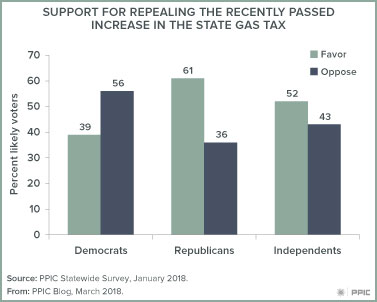
In January, the PPIC Statewide Survey asked whether Californians favor a repeal of the recently passed increase in the gas tax. We found California’s likely voters are divided, with 47% favoring repeal and 48% opposed. But there are partisan differences: 61% of Republican and 52% of independent likely voters favor a repeal, compared to 39% of Democrats. Regionally, Republican (68%) and independent (60%) likely voters on the southern coast are the most likely to favor a repeal, while inland Democrats (62%) are the most likely to oppose it. We also saw strong partisan disparities on the importance of repeal in our December survey: among likely voters, Republicans (85%) were far more likely than independents (46%) and Democrats (36%) to say repeal of the recently passed gas tax was very important to them.

Opponents of the repeal argue that the gas tax increase was necessary to fund much-need repairs to the state’s infrastructure. Conversely, proponents—in addition to generally opposing tax increases—reason the state is well situated to fund transportation projects through other funding sources. For example, Republicans in the state assembly have introduced a measure that would dedicate at least 2% of General Fund revenues to infrastructure projects.

Changes to federal policy could also affect the state’s transportation funding. Last month, the White House released a plan that aims to generate an unprecedented $1.5 trillion—including an allocation of $200 billion in federal spending over the next decade—to repair and upgrade the nation’s infrastructure. To be eligible for matching federal funds, California would need its own state and local revenue streams, whether through the new gas tax or other sources. The White House also expressed interest in raising fuel taxes by 25 cents per gallon to help pay for the plan. This would represent the first increase at the federal level since 1993 and could create an additional burden for Californians, who already face one of the highest gas prices in the nation.

As California engages in its ongoing debate over how best to fund transportation projects, upcoming federal and state policy decisions may have major consequences for residents.

An Alternative Approach to Managing the Delta

The State Water Board is updating the water quality plan for the Sacramento–San Joaquin Delta. This plan sets flow and water quality standards for the Delta and its watershed, affecting water supply to more than 25 million Californians and millions of acres of Central Valley farmland. Parties that would be affected by this plan—water suppliers, fish and wildlife managers, environmental nonprofits—are negotiating voluntary agreements to present to the board for consideration.

Members of Governor Jerry Brown’s administration asked PPIC to assemble a small group of independent experts on the Delta to develop ideas about how to resolve the linked challenges of water quality, habitat, and water supply in the Delta and its watershed. This group—most of whose members are in the PPIC Water Policy Center research network—proposed a new approach, detailed in three commentaries posted on UC Davis’s California Waterblog. The recommendations are summarized below.

Tackle a manageable set of problems. Rather than trying to solve all of the Delta’s problems simultaneously, the board and those involved in negotiations should identify a smaller, well-defined set of issues that can be addressed over the next 15 years through this plan. Priorities include: (1) reversing declines in food resources for the Delta ecosystem, (2) maximizing a high-quality habitat that favors native plants and animals, and (3) managing nutrient pollution to reduce harmful algal blooms. Given the inadequacies of past efforts focused on single species recovery, these actions should instead focus on improving overall ecosystem function and condition.

Coordinate the management of freshwater flows, tides, and changes in the landscape. Traditional approaches to improving habitat in the Delta have tended to focus separately on freshwater flows and landscape changes. Where possible, an integrated, ecosystem-based approach—in which freshwater flows, tidal flows, and landscapes are managed together—is more likely to be successful and to result in a more efficient use of water and financial resources. Efforts should be concentrated in the north Delta and Suisun Marsh, and include strategies for reducing harmful algal blooms.

Bolster current science programs to guide implementation of the plan. Although there is a strong scientific basis for undertaking the approach outlined here, there are still many uncertainties about which specific strategies will bring success. This is why a robust science effort is needed to guide actions and evaluate progress. Scientific research on the Delta and its watershed is not well organized to do this. A new program—housed within the state’s existing Delta Science Program—should develop the science necessary to implement the Water Quality Control Plan. To make this program successful, a Delta Science Joint Powers Authority (JPA)―made up of the various agencies engaged in Delta management―should be established. The JPA would pool resources to fund the Delta Science Program and broader efforts in Delta science. The JPA would also be a forum for agencies, water users, and other stakeholders to develop consensus on science-based management. This will increase the efficiency of scientific efforts and reduce conflict over findings.

Is this ecosystem-based approach legal? In a word, yes. Management of the Delta needs to shift away from efforts to recover a few species of endangered fish and toward improving ecosystem conditions to meet a broader range of objectives. If the regulatory agencies can document the benefits of this approach, there are no barriers under current law.

These recommendations challenge some historical approaches to management of the Delta.  But ecosystem-based approaches that use an array of tools have the prospect of being a more efficient use of resources—including the critical resource of water for the environment—with broad benefits for fish and wildlife as well as the people who rely on Delta water.

Learn more
Read California’s Water: The Sacramento–San Joaquin Delta (PPIC Briefing Kit)
Watch a short video on the Delta
Visit the PPIC Water Policy Center’s Delta resource page

Californians and Immigration Policy

During President Trump’s first year, perhaps no issue caused more conflict between the state and federal government than immigration. In January, California became a sanctuary state. Yesterday, the US Justice Department filed a lawsuit against California over three state immigration-related laws that were passed by the California Legislature in 2017. How do residents feel about the state and local governments making their own policies and taking actions, separate from the federal government, to protect the legal rights of undocumented immigrants?
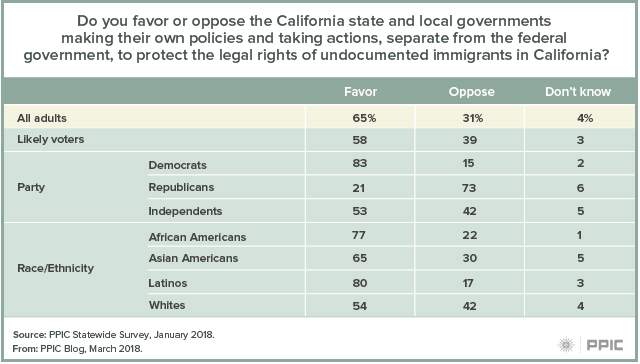

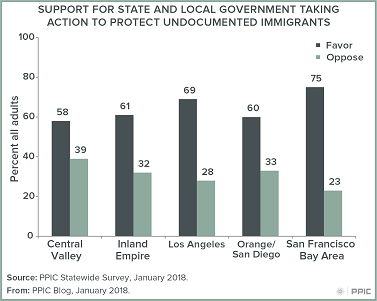
In January, we found that most Californians are in favor (65% adults, 58% likely voters), as we also found a year ago (65% adults, 58% likely voters). Today, eight in ten Democrats are in favor, compared to half of independents and two in ten Republicans. Majorities across regions support state and local government action.

We also find support across age, education, income, and racial/ethnic groups. Latinos and African Americans are more likely than Asian Americans and whites to be in favor.

Read “Californians and DACA” (PPIC blog, February 6, 2018)


Prioritizing Computer Science in California Schools

More than half of the fastest-growing and highest-paying jobs nationwide require computer science (CS) knowledge. To help students acquire the skills they need to thrive in a technology-driven world, many states have added computer science to the roster of courses that satisfy high school graduation requirements. California has a way to go before it can join these states.

Currently, California has no statewide CS requirement. Individual school districts can allow CS course credit to substitute for math, science, or some other graduation requirement. In some districts, such as San Francisco Unified, CS classes can satisfy the “college preparatory elective” requirement but can’t replace classes in core subject areas.

In 23 other states and the District of Columbia, CS courses can count toward high school math requirements; nine of these other states also allow CS classes to count toward science requirements. For example, one of three required science courses may be a CS class, as long as the other two cover traditional science subjects. Half of the states that include CS in their high school graduation requirements require three years of math, while the other half require four years. Moreover, these states require students to complete foundational coursework in math and science before they can take CS courses that count toward high school graduation.

Before California can add CS to its high school graduation requirements, it needs to make several other changes. To ensure that students have the foundational knowledge required to do CS coursework, the state must increase the number of required math and science classes—its current requirement of two years in each subject is among the lowest in the nation.

California also needs to increase the number of rigorous CS courses taught statewide. Statewide CS course offerings are low and most courses are not rigorous enough to prepare students for college and beyond. During the 2016–17 school year, fewer than half (49%) of K–12 schools offered computer education courses. Furthermore, most courses do not meet the University of California or the California State University entrance requirements.

Finally, the state needs to dedicate funding to teacher professional development. Currently, schools and districts struggle to find qualified CS teachers. From 2000 to 2016, the number of computer education teachers remained around 3,000, while the number of teachers in other subject areas has grown substantially.

California can improve and broaden computer science education in its K–12 schools. But the experience of other states underlines the need for a multi-pronged effort.


Video: Improving English Courses at California’s Community Colleges

California’s community colleges are in the midst of numerous reforms to improve developmental—or remedial—education. Developmental education is supposed to help prepare students for college work but it has long been an obstacle to student success: most students in developmental classes never go on to complete a college-level course in English or math. A recent report by the Public Policy Institute of California (PPIC) looks at the effectiveness of some of these reforms in English. It finds that one reform in particular shows real promise. Called one-semester acceleration, it’s a highly intensive course that leads directly to a college composition class. Still, there is much room for improvement, especially for underrepresented students.

PPIC researcher Marisol Cuellar Mejia presented findings from the report in Sacramento this week. In a discussion following the presentation, panelists talked about promising initiatives underway in developmental education. Many of the current efforts to more accurately place students in appropriate classes and transform course sequences are motivated by AB 705, a legislative proposal signed into law by Governor Jerry Brown last fall. Assemblymember Jacqui Irwin, who authored the bill, said it provides flexibility to the state’s individual community colleges “but with clear requirements that colleges use the best of multiple measures—including high school performance—in placing students.” The bill also instructs colleges to maximize the possibility that students pass a transfer level class within a year.

Laura Hope, executive vice chancellor for educational services at the California Community Colleges Chancellor’s Office, described the central challenge involved in full-scale implementation of reforms across the state’s 114 community colleges as an instructional paradigm shift. “It’s about changing minds and hearts about student capacity and the belief that they don’t come to us just a jumble of deficits . . . It’s about shifting that mindset away from fixing students into activating students.”

Summer Serpas, assistant director of the California Acceleration Project, underscored the professional support that teachers will need as a larger and more diverse group of students move out of developmental courses and into transfer-level ones: “These students are capable of doing the work, but they come in needing [additional] support.” Serpas said it will be critical to learn from colleges that have already adopted successful reforms, including accelerated pathways and the “co-requisite” model, in which students enroll directly in college composition with concurrent support.