In our most recent PPIC Statewide Survey, we found a record-high share of adults (58%) saying that global warming is a very serious threat to the state’s economy and quality of life. This view is strongly related to Californians’ broad support for state climate change policies, and it is most commonly held among millennials—adults age 35 and younger. Millennials also stand out in their support for state actions to address climate change:
- Seventy-five percent of millennials favor the state making its own policies, separate from the federal government, to address global warming.
- Eighty percent support the new greenhouse gas emission reduction goal (SB 32) that updates California’s landmark climate change legislation, and 84% support a new target of 100% renewable electricity by 2045.
- Seventy percent favor the state’s cap and trade system after hearing a brief description of it. In contrast, fewer than half of baby boomers (ages 53 to 71) favor the cap and trade system, in which the state enforces “caps” on greenhouse gas emissions by issuing permits that can be traded among companies.
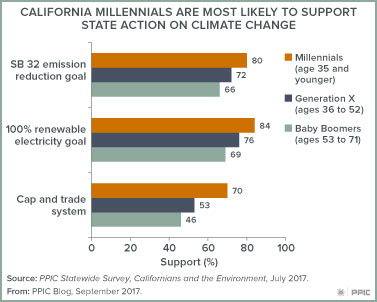 California millennials are about as likely as older adults to expect higher gas prices as a result of state climate change policies (52% millennials, 53% generation X, 55% baby boomers). But among those who expect higher gas prices, millennials are more likely than older adults to support the policies named above. Indeed, 73% of millennials expecting higher gas prices support SB 32, compared to 63% of gen Xers and 59% of baby boomers.
Also of note, majorities of younger adults support these policies, regardless of whether they call themselves liberals, moderates, or conservatives. For example, 61% of conservative millennials support cap and trade, compared to 25% of conservative baby boomers. Similarly, at least 7 in 10 millennials support SB 32, whether they are white or Latino, whether they have a college degree or not, and regardless of their income group.
Such broad support for the state’s climate change policies among younger Californians suggests that, if these opinions hold, Californians’ desire for state action on climate change is not likely to diminish in the years ahead.
Read PPIC Statewide Survey: Californians and the Environment.
Find out more about the PPIC Statewide Survey.


 One of the most important issues for Californians in the first year of the Trump administration is changing federal immigration policy. Immigrants are a significant presence in California, and even more so in Los Angeles County. Los Angeles, the state’s most populous county, is home to more than 10 million people, including more immigrants than any other California county.
 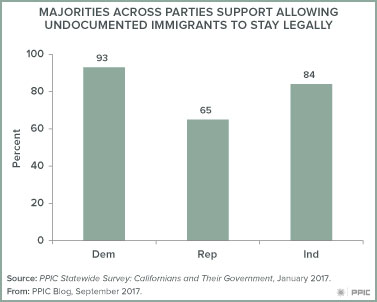 As the federal policy landscape shifted this year, PPIC Statewide Surveys continued to find majority support for a path to citizenship for undocumented immigrants who are living in the US: in our



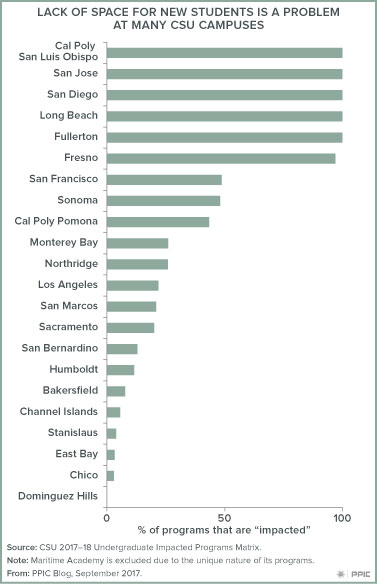 The state’s most recent budget aims to alleviate overcrowding at CSU, a problem that stems from an enrollment policy dating back to 2000. Under this policy, campuses established local admissions criteria that went beyond systemwide requirements for high-demand academic programs like nursing, business, and psychology. Currently, 6 of the 23 campuses are what CSU calls “fully impacted,” meaning that admissions requirements for local students in every major are significantly higher than those required systemwide. At Fresno State, 32 of its 33 programs are impacted. With higher admissions requirements, impacted programs often turn CSU-eligible students away. However, the rest of CSU campuses have fewer than half of their academic programs impacted. Six campuses—Bakersfield, Channel Islands, Stanislaus, East Bay, Chico, and Dominguez Hills—have less than 10% of their academic programs impacted. Unfortunately, unlike the University of California system where eligible applicants to an oversubscribed campus are referred to open campuses, CSU applicants who were eligible systemwide but did not meet the admissions criteria of their chosen impacted major or campus were denied admissions and not referred to a non-impacted campus.