Climate Change, Fracking, and Drought—Oh My!

Last week’s release of the PPIC Statewide Survey: Californians and the Environment prompted a discussion of several major policy issues under consideration in Sacramento. A panel convened by PPIC talked about the survey’s findings on climate change policy, particularly public attitudes toward a potential increase in gas prices when new regulations for transportation fuels begin next year.

PPIC research associate Sonja Petek set the stage for the panel discussion by presenting the survey findings. The panel included Assemblyman Richard Bloom (D-Santa Monica); Anne Baker, a senior advisor at the Center for Energy Efficiency and Renewable Technologies; and Rob Lapsley, president of the California Business Roundtable. The panelists said they supported the goals of the state’s climate change policies. They encouraged a public education effort about the extension of the cap-and-trade program to transportation fuels. The survey found that most Californians also support the policy change, but support drops sharply if it means higher gas prices.

The panel was divided on the state’s approach to fracking, a controversial process for extracting underground oil. Bloom is the author of a bill calling for a moratorium on fracking. Lapsley described the economic benefit of having more in-state oil production. The survey found most Californians opposed to fracking.

The panel also discussed water policies and the drought. In the survey, Californians name water as the number one environmental issue this year, and a narrow majority of likely voters support an $11.1 billion bond that is scheduled for the November ballot. Support is higher for a lower bond amount, something that is under discussion in the Capitol.

Californians and the Carbon Tax

California is leading efforts to address climate change, and public support for state action on this policy has been strong and steadfast. In the July PPIC Survey, six in 10 likely voters say that global warming’s effects have already begun and favor the state’s requirements that greenhouse gas emissions be reduced to 1990 levels by 2020.

The landmark law laying out these efforts—AB 32—relies on a “cap-and-trade” program for companies to reduce their greenhouse gas emissions. The state government currently enforces emissions “caps” by issuing permits that can be “traded” among companies at quarterly auctions. The state is getting ready for the AB 32 legislation to impact transportation fuels in 2015, with costs—which are unknown—likely passed on to Californians at the gas pump. Under these circumstances, some policymakers are having second thoughts about the cap-and trade program and are reconsidering a carbon tax on companies for their greenhouse gas emissions.

In our polling over the past five years, Californians have been more likely to express support for a carbon tax than a cap-and-trade system. In the July PPIC Survey, 54 percent of likely voters favor a carbon tax on companies’ greenhouse gas emissions—identical to the support that we found in July 2009. By comparison, 43 percent of likely voters favor the current cap-and-trade system when read a description in the July PPIC Survey—similar to the 44 percent who supported this proposal in July 2009. This support for a carbon tax doesn’t appear to be a simple reflection of a desire to tax business. A carbon tax on companies is a more popular proposal than raising overall state taxes paid by California corporations, which had a mixed response (48% favor, 47% oppose) in the March PPIC Survey.

What are the attitudes underlying majority support for a carbon tax on companies? Most likely voters are concerned about global warming and want the government to take action. Those who express the most concern and support tend to favor a carbon tax over the cap-and-trade system. For example:

  • Of those who believe the effects of global warming have already begun, 75 percent favor a carbon tax and 56 percent favor the cap-and-trade system.
  • Of those who believe that global warming is a very serious threat to the state’s economy and quality of life, 78 percent favor a carbon tax and 55 percent favor the cap-and-trade system.
  • Of those who favor the state law to reduce greenhouse gas emissions to 1990 levels by 2020, 76 percent favor a carbon tax and 57 percent favor the cap-and-trade system.

There is also a political dimension, reflecting the partisan differences in levels of concern about climate change and support for state action. Democrats are more likely to favor a carbon tax (72%) than a cap-and-trade system (54%), with similar trends for independents (56% carbon tax, 42% cap-and-trade). Republicans show similarly low support for either approach (32% carbon tax, 27% cap- and-trade).

The July PPIC survey also found that potential consumer costs play a striking role in views of climate change policies. Among likely voters, 70 percent, favor requiring oil companies to produce transportation fuels with lower emissions; however, favor for this policy declines to 41 percent if it means an increase in gas prices. What is noteworthy is that most higher-income Californians support lowering emissions—even if gas prices rise. In light of California’s uneven economic recovery, this finding suggests that the state lawmakers should be focusing on ways to limit the financial impacts of new global warming regulations on the state’s less affluent residents, not abandoning current efforts to reduce greenhouse gas emissions that enjoy solid support.

If policymakers are going to debate the pros and cons of these two policy options, it would be worth taking the time to better explain them to the state’s residents—especially since gas prices could increase with either option. Most likely voters have heard only a little or nothing at all about these competing proposals for reducing greenhouse gas emissions. One in four likely voters say they have heard a lot about the cap-and-trade system (24%) and awareness is similarly low for the carbon tax (28%) in the July PPIC Survey. Californians care about climate change and would likely welcome the chance to learn more about the decisions that are being made today to address the challenges of the future.

Drought Watch: Water for the Environment

This is part of a continuing series on the impact of the drought.

The ongoing drought has heightened tension over how water is allocated in California. In our recent publication on overall water use in California, we show that the environment uses the largest share—50%—of the state’s water. In contrast, agriculture uses 40% and urban users account for only 10%.

The amount going to the environment may look surprisingly high, but this number is not as straightforward as it may seem. Most of what we call “environmental” water is simply too remote for people to use—or is actually reused for irrigation, drinking water, or other human benefits. In other words, most of the water that goes to the environment does not significantly detract from the overall amount of water available for other purposes.

Here, we look more closely at how the California Department of Water Resources breaks down environmental water use (also see related figure below):

  • Managed wetlands make up state and federal wildlife refuges and account for only 4% of total environmental water use. These wetlands provide critical habitat for migratory and resident birds, along with fish, plants, and other wildlife. Some provide other important ecosystem services like flood protection.
  • Delta outflow accounts for 16% of total environmental water use. The state sets standards for how much water should flow into the Delta from the Sacramento and San Joaquin Rivers, and how much should flow out of it, into San Francisco Bay. These standards seek to meet two primary objectives: protection of native fishes listed under state and federal Endangered Species Acts, and maintenance of water quality standards within the Delta—most notably for salinity—to allow irrigation of farms in the Delta and exports of water to cities and farms elsewhere.
  • Instream flows constitute 18% of statewide environmental use. These are minimum river levels set by state regulatory agencies to meet habitat needs for fish and wildlife in waterways.
  • Rivers designated as “Wild and Scenic” use the bulk of water assigned to the environment—63%. Under federal and state laws, these rivers are protected from the construction of water resources projects—such as dams or diversions—that would adversely impact them. However, most of these rivers are in the state’s remote north coast, where there is little agricultural or urban demand for water and no economically viable way to use it elsewhere. Outside of the north coast, most water in Wild and Scenic Rivers (such as those on the west slope of the Sierra Nevada) is captured in downstream reservoirs and used again for hydropower generation, irrigation, and drinking water.

As this discussion shows, the allocation of limited water supplies is not a matter of simple tradeoffs between the environment and humans. Sometimes, water counted toward environmental use gets used again for something else. Other times, there is no practical alternative use (such as in the north coast). Understanding these basic facts is essential to resolving differences over how to manage water in California.

Drought Watch: Our Thirsty Lawns

This is part of a continuing series on the impact of the drought.

The unprecedented restrictions on outdoor water use that the state enacted this week send a message that Californians need to conserve more water. But we can do more to move toward sustainable consumption. To help the state get through this drought—which may continue into 2015—and prepare for a future that will include repeated droughts, local agencies should go further to encourage long-term changes in how we use water outdoors.

Outdoor water demands—which account for roughly half of all urban water use—are highest during the hot, dry summer months. Experts regularly cite reductions in landscape watering as “low hanging fruit” during droughts. But, as we’ve learned, it is not enough to just ask people to cut back: during the 2007–2009 drought, outdoor water use did not significantly decline despite repeated calls for conservation.

The main culprit is Californians’ love affair with lawns. Not only do lawns require a lot of water to look good, but people also tend to overwater them. Water agencies should seize the opportunity presented by the drought—and the publicity surrounding the new restrictions—to offer incentives for switching out thirsty lawns. For instance, Long Beach has a turf buyback program that offers rebates to customers who replace grass lawns with low-water-using plants—which have the added benefit of lending themselves to more-efficient irrigation systems. Finding attractive alternatives to lawns is easier than ever before, now that major garden retailers offer a range of California-friendly plants. Gone are the days of cacti and gravel being the only options.

Water pricing can also motivate customers to make the switch. Tiered rate structures—which charge a higher price per gallon for higher use—help send a message about the real costs of our landscaping choices. More than half of urban water agencies currently have some form of tiered rates, though recent legal challenges to their constitutionality under Prop 218 threaten to undermine these very important tools.

During droughts, it makes sense for water agencies to charge higher prices per gallon than they do in normal years. This provides additional conservation incentives while ensuring that agencies bring in enough to cover costs when they are selling less water. The city of Roseville, for example, implemented a temporary 15 percent drought surcharge starting in June. But according to a State Water Resourses Control Board survey, only 7 percent of agencies have enacted drought pricing strategies this year.

So far, no region has reached the governor’s 20 percent conservation goal, and water use has actually increased in some regions. Over the next few months we will see whether increased watering restrictions and threat of fines can deliver the conservation message to all Californians.

Drought Watch: Putting Some Myths to Rest

This commentary was first published by the Sacramento Bee on July 6, 2014. Drought Watch is a continuing series on the PPIC Blog.

As the effects of the drought worsen, two persistent water myths are complicating the search for solutions. One is that environmental regulation is causing California’s water scarcity. The other is that conservation alone can bring us into balance. Each myth has different advocates. But both hinder the development of effective policies to manage one of the state’s most important natural resources.

Let’s consider the first myth, that water shortages for farms are the result of too much water being left in streams for fish and wildlife.

Continue reading on Sacbee.com.

Drought Watch: Regional Solutions

This is part of a continuing series on the impact of the drought.

Across California, local water agencies are scrambling to apply for new state matching grants authorized under February’s emergency drought legislation. The program aims to accelerate the use of remaining state bond funds for integrated regional water management: activities in which local agencies team up to generate mutual benefits. One example—water suppliers and stormwater agencies that work together to incorporate captured stormwater into local water supplies. Such projects can simultaneously enhance water supply reliability and the quality of water in rivers and coastal areas.

Regional integration has already led to some significant successes, most notably the enhanced ability of urban water suppliers in Southern California and the Bay Area to cope with the current drought. Successes include ramping up water conservation and recycled wastewater storage to increase supplies in storage, and building new connections between local water systems to enable emergency sharing. Outside funds are often needed to jump start these collaborations, both to encourage innovation and to enable some partners—such as stormwater agencies – to participate even if they don’t have the necessary funds.

But as we showed in our study Paying for Water in California, integrated regional water management is on the brink of fiscal failure because state bond funds are running out. Both the legislature and local water agencies have pushed the idea that bonds should continue to provide these dollars, and the major bond proposals under consideration include substantial new funds for this purpose.

But there might be a better way: adding a small statewide surcharge on water use to support regional projects. Local water agencies have often rejected this idea, arguing that if they send money to Sacramento they won’t see it again. But what if the funds go directly to the regions?

Here’s how we think this could work. The legislature (or state voters) would pass the surcharge and set broad criteria for funding eligibility. The funds would be apportioned to the state’s 12 principal hydrologic regions—the large basins that are already used to divvy up bond funds. But rather than having state agencies award the grants, this task would go to new Regional Water Commissions—regional counterparts to the California Water Commission, the state body tasked with awarding matching grants for storage projects under most bond proposals.

Though more politically tricky to pass than a bond, the statewide water surcharge would have numerous advantages. The revenues would be more reliable than bond funds. And relying on Regional Water Commissions to allocate these dollars could encourage broader collaborations than we have seen from the state-sponsored grant program, which has nearly 50 planning regions, often too small to reap the real benefits of integration. Many groundwater basins, for instance, have different boundaries than the current planning regions, and groundwater agencies could use assistance from these regional funds to support better management.

Finally, this statewide option is preferable to creating local or regional surcharges, which can be difficult to raise without approval of two-thirds of local voters. To raise $200 million annually—the amount that’s been available through bonds—a surcharge 7.5 cents/1,000 gallons on urban water bills would suffice. This would increase the average cost of tap water by just 2.8 percent, while creating a valuable incentive fund that helps local water managers enhance the quality and reliability of regional water supplies. As part of a package with a new bond devoted to areas of true statewide need, a statewide water surcharge would help ensure that our water system can support a healthy economy, society, and environment.

PPIC Honors Statesman George Shultz

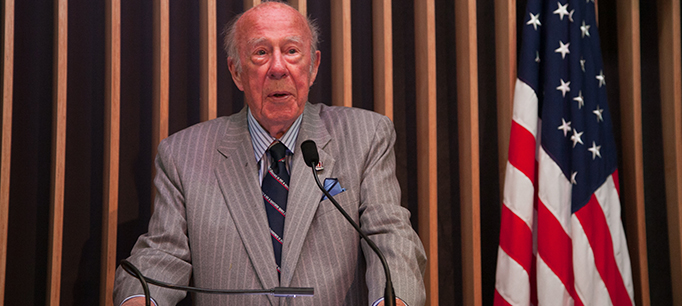
PPIC yesterday dedicated the George P. Shultz Forum at its Bechtel Conference Center, in honor of the U.S. statesman, economist, and businessman.

Shultz attended the dedication in the Bechtel Conference Center, a meeting and learning space located on the ground level at PPIC’s San Francisco headquarters. The George P. Shultz Forum is the main convening area at the conference center.

Mark Baldassare, PPIC president and CEO, noted that the George P. Shultz Forum will be a gathering place for a growing number of civic-minded groups. Speaking to an audience that included the PPIC board of directors, staff, donors, and special guests, Baldassare said, “This is a fitting way to honor George Shultz’s remarkable career in public service and his reputation for bridging policy divides on issues ranging from climate change to nuclear proliferation. It will be an inspiration to our guests.”

Senator Dianne Feinstein, speaking on video from Washington, noted key accomplishments in Shultz’s career. “When it comes to public policy and public service, there is no better model than George Shultz,” she said.

Shultz, who has a Ph.D. in industrial economics, was appointed secretary of labor in 1969, director of the Office of Management and Budget in 1970, and secretary of the treasury in 1972. He was president of the Bechtel Group from 1974 to 1982. He also served as chairman of the President’s Economic Policy Advisory Board from 1981 to 1982 and secretary of state from 1982 to 1989. He was awarded the Presidential Medal of Freedom, the nation’s highest civilian honor, in 1989. Since then, he has been a distinguished fellow at the Hoover Institution at Stanford University.

In his comments, Shultz reflected on lessons he had learned in his career of government service—including the importance of nonpartisanship. He said it is important that “PPIC keep the nonpartisan spirit alive.”

“Democracy is not a spectator sport,” he added. “And nonpartisan work is a very important part of it. You identify problems, get the facts straight, figure out how people feel, and put the information forward in a way that people can understand.”

The PPIC event also included a conversation between Lieutenant Governor Gavin Newsom and Baldassare. They talked about climate change and energy policy—issues that Shultz has focused on for many years. Newsom noted that Shultz’s career is a reminder that environmental stewardship and sustainability used to be bipartisan issues. He also said California needs to step up its leadership on climate policies and work to expand the clean technology sector.

Other guests at the event included former San Francisco mayor Willie Brown; Stephen D. Bechtel, Jr., retired chairman and a director of the Bechtel Group, Inc., and his family; and John Gunn, chairman emeritus of Dodge & Cox.

The Bechtel Conference Center was made possible by a gift from the Stephen Bechtel Fund in 2009. Its design and operation reflect PPIC’s focus on neutrality, consensus building, and respect for different perspectives. And the center’s LEED Gold certification highlights the emphasis that both PPIC and the Bechtel family place on environmental and technological innovation. This year, a group of donors led by Stephen D. Bechtel, Jr., provided a gift to dedicate the forum to Shultz. The gift will be used to upgrade the technology in the forum and establish a fund to make the space available to and affordable for other civic-minded organizations.

May Survey Looks at Views on Budget, Drought

The May edition of the PPIC Statewide Survey, Californians and their Government, explores attitudes toward the governor’s latest proposed budget and gauges preferences in the gubernatorial primary. It also examines opinions on health care reform, the drought, poverty, and climate change.

PPIC research associate Dean Bonner presented the results of this wide-ranging survey at a lunch briefing in Sacramento last week.

Drought Watch: Groundwater, Our Hidden Asset

This is part of a continuing series on the impact of the drought.

The drought has brought the term storage to the forefront of political debate over how to manage water in California. Water scarcity during this drought is perceived by many, including prominent elected officials, as a failure of government to build sufficient storage.

For most, storage refers to water kept in reservoirs behind dams. People tend to forget that we also store water underground, in the state’s many aquifers. And during a drought, this groundwater storage is usually much more important.

Managed well, groundwater is the state’s best hedge against drought. The volume of potential groundwater storage in California is several times greater than surface storage. On average, about 35 percent of annual water use for cities and farms comes from groundwater, and 60 percent or more in some important agricultural regions such as the Tulare Basin and the Central Coast. During a severe drought such as this one, when groundwater pumping increases, this share can go up significantly. But groundwater is not easing the effects of this drought as much as it could because we don’t manage it as drought storage.

A fundamental principle of sustainable groundwater management is that you allow water to accumulate in aquifers during wetter years so that you can pump it out during the dry years when surface water sources are insufficient. In most of California’s main agricultural areas—especially the southern Central Valley and parts of the Central Coast—the total water demands are so great that we have stopped allowing groundwater levels to recover during the wetter years. Instead, we are “mining” groundwater, treating it like oil and gas, extracting it as if it was a non-renewable resource never to be replaced.

This mining—or overdraft—reduces the available supply of groundwater during dry years. It raises the costs of remaining supplies, as wells need to be drilled deeper and electricity bills rise because water has to be pumped from deeper depths. Unsustainable pumping also creates a host of other problems, including dewatering of rivers and wetlands that support fish and wildlife as well as land sinking—or subsidence—that damages roads, bridges, canals, and flood control infrastructure.

Some of California’s large urban areas—including much of Southern California and Silicon Valley—provide valuable lessons on how to move toward more sustainable management of groundwater basins. In these areas, acute groundwater overdraft spurred groundwater users—often with the aid of the courts or the state legislature—to develop management schemes that work. These groundwater basins are overseen by court-appointed water masters or special management agencies that can collect fees, monitor use, and allocate pumping rights. Most important, they can compel users to store water during wet times, so it is available when drought strikes.

A silver lining of the current drought is that it has brought focus to how we manage groundwater, the other water storage in California. Innovative proposals for comprehensive reform are coming from the Brown administration and from grassroots efforts orchestrated by the Association of California Water Agencies and the California Water Foundation. These proposals have the common goal of creating sustainable groundwater management by

  • providing local agencies the tools necessary to manage groundwater sustainably, and
  • giving the state the power to ensure that these standards are achieved if local agencies fail to act.

Now is the time to move forward on this issue, while the consequences of groundwater overdraft are at the center of debate and impacting so many.

Drought Watch: Improving Environmental Management

This is part of a continuing series on the impact of the drought.

In the previous Drought Watch we examined the need to modernize the way we track water supply and use to better manage droughts. California also needs to modernize how we manage water for the environment during droughts.

By reducing the quality and quantity of habitat, drought poses a broad ecological challenge to California’s fish and wildlife. The stress is particularly acute in watersheds where native species compete with the demands of cities, farms, and forestry for critical land and water supplies. In many watersheds, remaining habitat has become more suitable for invasive, non-native species, which also compete with native species in various ways. The net result can be significant reductions in populations of native species during severe droughts. Recovery can take years.

In a recent blog post, we joined colleagues from UC Davis, UC Hastings, and Stanford to call for reform in the way the state manages the environment during drought. A common approach is to relax flow and water quality standards prescribed for species protection to make more water available for human needs. This year, the State Water Resources Control Board has already done this on numerous occasions, with the concurrence of state and federal fish and wildlife agencies.

This is not necessarily bad drought policy. Regulators have to make difficult choices when there simply is not enough water to go around. However, the process could be improved. Flow and water quality standards for critically dry years are set well in advance of a drought and involve extensive scientific review. In contrast, relaxing standards receives little review, and the process typically does not incorporate plans to mitigate for the consequences, either during or after the drought.

This same ad hoc approach applies to well-meaning efforts to conserve species during a drought. In late April, the governor released an executive order that instructs the California Department of Fish and Wildlife to help endangered fish species, through actions such as monitoring winter run Chinook salmon, improving habitat on state lands, and seeking cooperation from landowners. These are common-sense measures, but if they had been planned for before the drought, they could have been implemented more quickly.

Money for environmental management during a drought is also an afterthought. In his latest state budget, to be considered by the legislature this summer, the governor has proposed approximately $40 million be made available to support actions contained in his executive order. This is a significant increase over the $2.3 million total allocated in emergency state funding in February. Still, this money will not arrive soon enough to make a major difference for this year. Again, planning ahead to raise such funds would be preferable. (See one alternative approach here.)

Good environmental drought policy must anticipate actions that may be necessary to balance human uses of water with the long-term needs of fish and wildlife. The criteria and scientific basis for the relaxation of flow and water quality standards should be developed, reviewed and adopted before a drought emergency. This includes identifying funding mechanisms for emergency responses and mitigation actions that reduce harm during the drought and lead to recovery of species afterward. If California is lucky enough to get through this drought without significant new harm to our native fish and wildlife, let’s make sure we prepare better before the next drought strikes.