Video: Managing Drought in a Changing Climate

As San Francisco began welcoming visitors arriving for this week’s Global Action Climate Summit, the PPIC Water Policy Center hosted an event on the impact of climate change on California’s water system.

The Monday event brought together a panel of experts to discuss reforms that could improve resilience and galvanize action to prepare for future droughts. The panelists were Maria Herrera, who works on water issues for Self-Help Enterprises and is a member of the California Water Commission; Felicia Marcus, chair of the State Water Board; Cannon Michael, president of Bowles Farming Company; and Tim Ramirez, a member of the Central Valley Flood Protection Board. The panel was moderated by Greg Dalton, founder and host of Climate One.

Ellen Hanak, director of the center, kicked off the evening with a summary of new research by PPIC on managing drought in a changing climate. After noting that California is already seeing changes from a warming climate, she said that “a lot of things we’re recommending are going to be very important and very useful as soon as we can do them.” She reviewed the report’s four main suggested areas of reform: plan ahead, modernize the water grid, update water allocation rules, and find the money to pay for these reforms. “It’s a plan that would be great for the next governor,” she said.

Dalton launched the panel discussion with a question about the need to modernize the state’s water grid—the network of above- and below-ground storage and conveyance systems that connects most water uses in the state. Ramirez said that the conveyance system needs updating because it is “totally insufficient for the precipitation we have now.” For example, the San Joaquin River system “was plumbed for snowmelt―very predictable, slow runoff―but that’s not what happens anymore.” He discussed the need for expanded floodplain capacity to help absorb floods.

Marcus said, “The answer is to maximize every drop—figuring out how every molecule of water … can be used over and over again and used for multiple things.” She said improved information and modernizing our thinking about infrastructure are steps toward achieving this goal.

Herrera noted that disadvantaged rural communities, which are most likely to face drought-related water shortages, find it difficult to engage in discussions about the water system. She called for ensuring that local communities are included in decision making about water grid upgrades, and added that they should have a say in “where to place storage, how water that is stored gets used and allocated, and for what benefits.”

Other topics of discussion included addressing growing wildfire risk; ensuring safe, reliable drinking water for the most vulnerable communities; advice for the next governor on managing climate volatility (Marcus: “the key is to pick up the baton and run with it.… [Water] is an issue on which leadership can make a difference on so many things”), and ways to reduce conflict over water.

Cannon Michael seconded the need for leadership to tackle climate change—and urged all Californians to heed that call. “We need to think about the California we have, what an amazing state this is, and lead from that. We’ve got to push past the voices that are trying to drag us apart, and work on solutions from the middle. We can solve any problem that we all put our minds together on.”

Strong Support for California’s Climate Leadership

From September 12 to 14, Governor Jerry Brown will co-chair the Global Climate Action Summit in San Francisco. This gathering of world leaders will review achievements to date and discuss next steps in meeting the international goals established to reduce greenhouse gas emissions. How do Californians feel about their state playing such a prominent role in the global warming policy arena?

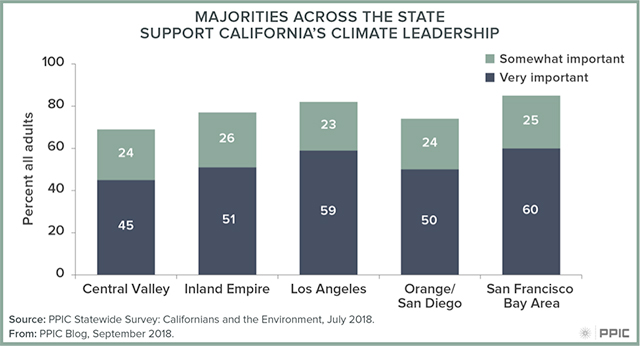
In the July PPIC Statewide Survey, a majority of California adults told us that California’s climate change leadership around the world is very (54%) or somewhat (24%) important to them; findings are similar among likely voters (51% very, 22% somewhat). Last July, after the Trump Administration’s decision to exit the Paris Agreement on climate change, a similar proportion of adults (58% very, 23% somewhat) and likely voters (52% very, 20% somewhat) said the state’s leadership was important. Today, overwhelming majorities of Democrats (95%) and independents (78%) and 41% of Republicans say it is important that California acts as a leader around the world. Majorities across age, education, gender, income, racial/ethnic groups, and regions of the state say this is important. Six in ten or more Latinos (68%) and African Americans (65%), Democrats (67%), San Francisco Bay Area residents (60%), and those with children under 18 (60%) say this is “very” important.

blog figure: Majorities across the state support California's climate leadership

These views are aligned with Californians’ willingness for the state to determine its own destiny in this policy arena. In the July survey, majorities of Californians (65% adults, 62% likely voters) favor having the state government make its own policies, separate from the federal government, to address the issue of global warming. Since we first asked this question in July 2005—throughout changes in presidents, governors, and party leadership in Washington, DC and Sacramento—more than half of Californians have favored state action on this issue.

blog figure: Majorities of Californians favor state action on global warming

Today, solid majorities of Democrats (82%) and independents (61%) and 29% of Republicans favor the state government making its own global warming policies. Majorities across age, education, gender, income, racial/ethnic groups, and regions of the state are in favor. Seven in ten or more are in favor among residents in Los Angeles (73%) and the San Francisco Bay Area (73%), Asian Americans (71%) and Latinos (70%), those under age 35 (75%), and college graduates (73%). Majority support has also been consistent for state policies (i.e., AB 32, SB 32) aimed at reducing greenhouse gas emissions.

What explains this California “exceptionalism” when it comes to climate change actions? In the July PPIC survey, two in three Californians (67% adults, 69% likely voters) say the effects of global warming have already begun. In thinking about the possible impacts of global warming in California, most residents express concerns about more severe wildfires (62% very, 23% somewhat), ocean warming (50% very, 28% somewhat), and rising sea levels (45% very, 29% somewhat). More than eight in ten Californians say that the issue of global warming is personally important to them (28% extremely, 34% very, 20% somewhat). These findings suggest that recent weather events—combined with a growing body of scientific evidence on climate change—have tapped into the long tradition of environmental stewardship in California.

This global meeting occurs at a critical moment for the state. PPIC is hosting related events and, along with many Californians, we look forward to learning more about what Governor Brown called “the existential threat of climate change” in convening this summit.

Make California’s Water Grid Climate-Ready

Next week people from around the globe will gather at the Global Climate Action Summit in San Francisco to explore solutions to climate change. California has long played a leadership role in reducing climate emissions. But the state has a crucial weakness in its climate readiness: its vast water system. Modernizing California’s “water grid”―the linked network of above- and below-ground storage and conveyance systems that connects most water use in the state―can help reduce the costs and impacts of a changing climate.

The PPIC Water Policy Center put together a team of experts in climate science, hydrology, ecology, engineering, economics, and law to review the weak points in California’s water system and recommend actions to build the system’s climate resilience. The focus of the work was on managing water scarcity, using lessons learned from California’s most recent drought.

We found that five climate pressures will seriously impact the state’s water system: warming temperatures, shrinking snowpack, shorter and more intense wet seasons, more volatile precipitation patterns, and rising seas.

During drought, California relies heavily on its water grid to manage supplies. This system will become even more important for managing more intense droughts of the future. Yet elements of this grid are in trouble, and climate pressures will make it harder to manage competing demands—particularly the need to store more water for drought while also capturing high flows to reduce flood risk, while also protecting freshwater ecosystems.

California’s climate is changing and drought intensity is increasing. Adapting to and preparing for change will require a more robust, better-integrated water grid. This should be a top priority for the next governor.

To make the grid climate-ready, the new administration should undertake a thorough assessment of weaknesses in the state’s storage and conveyance system—including important canals and aqueducts that help recharge groundwater, deliver surface water, and manage floods―and launch a major upgrade of this network.

The state’s many underground basins have a much large capacity for storage than surface reservoirs and will become much more important as a drought reserve. Strategic investments are needed to help California store water more effectively and take better advantage of opportunities to trade and share it—an important way to reduce the social, economic, and environmental costs of using less.

Adapting to a more volatile climate—including more intense winter storms—will also require more operational flexibility to enable storage and conveyance facilities to work together as an integrated water supply and flood management system. Investments will be needed to update hydrological assumptions for reservoirs, and improve water accounting in all sectors, including groundwater recharge and use.

This water infrastructure revolution won’t just be technically challenging: it will also require finding reliable funding to pay for necessary investments. Californians will need to look beyond general obligation bonds and develop long-term funding sources to adapt the water grid to a changing climate.

Strong leadership from state and local institutions has guided the development of the water system that California relies on today. Despite its many problems, this system has mostly served the state well, even in the face of occasional severe drought. Leadership—an essential ingredient for continued progress in water management—is a key requirement to prepare for droughts of the future.

Video: A Conversation with Congresswoman Nancy Pelosi

As part of our Speaker Series on California’s Future, PPIC is inviting elected leaders across the political spectrum to participate in public conversations. The purpose is to give Californians a better understanding of how our leaders are addressing the challenges facing our state.

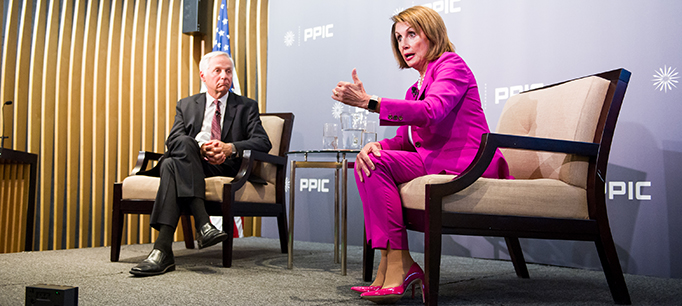
House Democratic Leader Nancy Pelosi and PPIC president Mark Baldassare had a wide-ranging conversation in San Francisco on Wednesday. They focused on the relationship between California and the federal government in a number of areas, including economic and tax policy, immigration, health care, and environmental issues.

Not surprisingly, Pelosi’s take on the state-federal relationship differs from that of her Republican counterpart, Kevin McCarthy, who fielded virtually the same questions from Baldassare in mid-August. In her view, this is an unusual time: “We haven’t had a time where the president has so targeted a state, in tax policy, environmental policy, trade policy.” Californians need to know about the statewide impact of these policies, and their elected leaders need to “try to work as much as possible in a bipartisan way to withstand that.”

She criticized the new federal tax law for significantly increasing the national debt without promoting growth. In fact, she continued, one of the best ways to promote economic growth is to enact comprehensive immigration reform. Asked what this would look like, she cited the bipartisan immigration bill that the Senate passed several years ago as one possible model. She deplored the current “uncivilized, inhumane” policy of separating families at the border. But she argued that while Trump-era ICE policies need to be changed, abolishing ICE is “not the answer.”

Pelosi, who played a major role in the passage of the Affordable Care Act, described health care reform as a “pillar of health and economic security for America’s working families.” She also characterized health care as a major issue in the November midterm elections. “The cost of health care is a very major issue in people’s lives, so we want to work in a bipartisan way, wherever possible, to reduce those costs.”

While she is concerned that Congress is not doing enough to ensure the integrity of the midterm elections, Pelosi is excited about the number of women who are running. “When I went to Congress, there were 12 Democratic and 11 Republican women.” Now, she added, “the majority of the people in our caucus are women, people of color, LGBTQ [. . .] and we want more!”

Why does she want to be Speaker? The short answer: “None of us is indispensable, but I think I’m probably the best person for the job.”


Video: A Conversation with Congressman Kevin McCarthy

As part of our Speaker Series on California’s Future, PPIC is inviting elected leaders across the political spectrum to participate in public conversations. The purpose is to give Californians a better understanding of how our leaders are addressing the challenges facing our state.

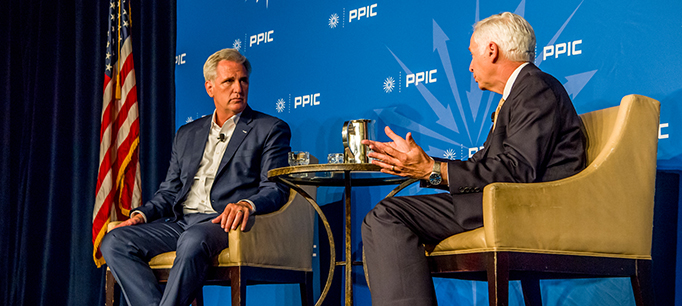
House Majority Leader Kevin McCarthy and PPIC president Mark Baldassare had a wide-ranging conversation in Sacramento last week. They focused on the relationship between California and the federal government in several areas, including tax reform, immigration, health care, water policy, wildfire management, and fuel emissions standards.

When asked about the impact of the recently passed federal tax law on Californians, he emphasized the bigger economic picture. The focus, he said, should be on the overall Republican agenda and whether it inspires optimism about the future: “Do you feel better off? How many quarters of economic growth have you had?”

McCarthy criticized the state’s leadership for its “backwards thinking” on the gas tax and other issues, and its oppositional stance to the Trump administration. He also talked about the need for bipartisan compromise in Congress. “I try to work with everybody,” he said, citing the work he did with Senator Feinstein to pass “the first major piece of water legislation in quite some time.” He returned to this theme after the conversation was briefly interrupted by a pro-DACA demonstration, asking why we can’t “sit down and communicate with one another” and decrying “elected officials who stand up and say ‘Divide us, not unite us’.”

Nonetheless, he seemed confident about finding ways to address major issues. About immigration policy, he said “I think we’re going to solve this problem” in the next congressional session. Asked about the 2020 Census, he said that Congress is making sure there will be an accurate count. “It is a big job,” he added, “and this is always the big fear before a census—are we prepared for it?”

Finally, when asked why he wants to become Speaker of the House, he said, “I want to make sure a Republican can be Speaker,” so that the party can continue to enact its agenda. He went on to describe the electoral landscape leading up to the November midterms, offering up a key takeaway: “This will be the year of the woman.”

Managing Forests to Reduce Wildfire Risks

California’s record-breaking fires have prompted a serious public discussion on how to reduce the risk of extreme wildfires. At the core of the debate is the role of vegetation management to reduce fuels. Some argue that California is not doing enough to manage its forests and that more trees must be removed. Others are concerned that this approach could result in a weakening of important environmental protections.

Both perspectives are grounded in real concerns. That said, Californians need to find common ground, because the state is in the grip of a crisis fueled by a warming climate, drought, and decades of management practices that have resulted in extensive areas of unhealthy, overly dense forests. Identifying overlapping objectives can help move stakeholders beyond conflict toward ecologically sound forest management. Here are a few observations that might help advance the conversation.

  • There are no one-size-fits-all solutions. Devastating wildfires have occurred recently in oak woodlands, scrub and chaparral, and mixed-conifer forest. Fuel reduction tools like prescribed burning and mechanical thinning may reduce wildfire threats in some ecosystems but not others, depending in part on land use practices and the frequency of fire before and after people began changing the landscape. Improving public understanding about the applicability of each approach can help move the debate forward.
  • Where fuel reduction is a viable tool, we aren’t doing enough. It has been estimated that fuel reduction on US Forest Service (USFS) lands in the Sierra Nevada would need to increase two- to six-fold to meaningfully improve forest resilience. Cal Fire (the state’s fire protection and forest management department) and USFS have both pledged to dramatically increase the amount of fuel reduction over the next few years. First priority should be given to locations where all parties can agree on management actions.
  • Mechanical thinning and logging serve different purposes. Both approaches can reduce fire risk in the Sierra’s mixed-conifer forests, and both usually require heavy equipment, access roads, and expertise in forest dynamics. But they are different in intent and design. Mechanical thinning is a forest management tool for selectively reducing forest vegetation—including small trees, shrubs, and groundcover―that can fuel dangerous fires. It is designed to retain large fire-resistant trees and to create a mosaic of trees and openings as was once common. By contrast, most commercial logging operations are more like crop farming: they aim to harvest enough trees to maximize net returns while stewarding the land for future harvests. These approaches leave very different looking forests. The costs and benefits of each approach should be at the center of discussions about which to use where.
  • Expanding forest management doesn’t require dropping environmental protections. State and federal laws require evaluations of the impact of proposed forest management projects on air, water, and sensitive species. These projects can be accomplished under current rules, but it costs time and money. Dedicating additional federal resources to environmental compliance will enable an increase in the pace of management in national forests. Small private forest owners need help negotiating the permitting process.

California’s pioneering efforts to address climate change won’t solve the wildfire problems we face today. Forest management can have an immediate impact, and it can be implemented under existing environmental laws. Defining a common set of long-term objectives and working together to increase trust and transparency can help stakeholders and forest managers move past conflict to reconciliation on this critical issue.

Environmental Priorities and the Midterm Election

Just three months ahead of a consequential midterm election, California and the federal government continue to move in very different directions on environmental policy. Last week, the Trump administration’s efforts to roll back strict automobile emission standards were strongly criticized by the Brown administration. State officials have also pushed back on federal efforts to increase offshore oil drilling and the president’s decision to exit the Paris Agreement on climate change. Meanwhile, personal experiences with a prolonged drought and recent severe wildfires are raising Californians’ awareness about the impacts of climate change. Where do California voters stand on environmental issues and what are the implications for November?

Californians’ support for environmental protection runs deep. Consider emissions standards. In the July PPIC survey, 60% of California registered voters say that they are in favor of setting higher emissions standards for automobiles. Majorities of voters across age, education, gender, income, and racial/ethnic groups support this environmental policy. Majorities of Democrats (74%) and independents (62%) and 34% of Republicans are in favor. Notably, 52% of registered voters living in the nine competitive House districts—as rated by the Cook Political Report—favor higher auto emission standards.

Or take another area of state-federal policy conflict over the environment, offshore oil drilling. Sixty-six percent of California registered voters are opposed to more drilling off the California coast. Opposition is high among Democrats (82%) and independents (66%), and reaches 40% among Republicans. Majorities oppose it in both the coastal and inland regions of the state and across age, education, gender, income, and racial/ethnic groups. As for the registered voters living in the nine competitive House districts, 56% are opposed to allowing more offshore drilling off the California coast.

These views on particular environmental policy issues are similar to larger concerns related to global warming. About two in three California registered voters believe that global warming has already begun (67%), say that they are very concerned about its possible impact on more severe wildfires (64%), and favor the state law that requires California to reduce its greenhouse gas emissions (67%). Majorities of Democrats and independents share these views, along with substantial proportions of Republicans and majorities of voters across regions and age, education, gender, income, and racial/ethnic groups. In the nine competitive House districts, majorities of registered voters believe that global warming has already begun (59%), say they are very concerned about the impact of global warming on more severe wildfires (56%), and favor the state law that requires greenhouse gas emission reductions (62%).

Personal views about global warming could shape the size and profile of the electorate this year. Majorities of California voters say that the issue of global warming is extremely or very important to them personally (62%). If this high level of personal concern motivates voter turnout, it will provide a partisan advantage (80% Democrats, 61% independents, 29% Republicans). It could also serve as a catalyst in several Democratic-leaning groups with a low propensity to vote (64% under age 35; 68% earning less than $40,000; 69% renters; 70% Latinos). Moreover, in the nine competitive House districts, majorities of registered voters (55%) say that global warming is extremely or very important to them personally.

In the midterm election context, Californians are indicating strong opinions on environmental matters. A record-high number of registered voters say that the gubernatorial candidates’ positions on the environment are very important in determining their vote (39% 2002, 46% 2006, 42% 2010, 40% 2014, 53% 2018).

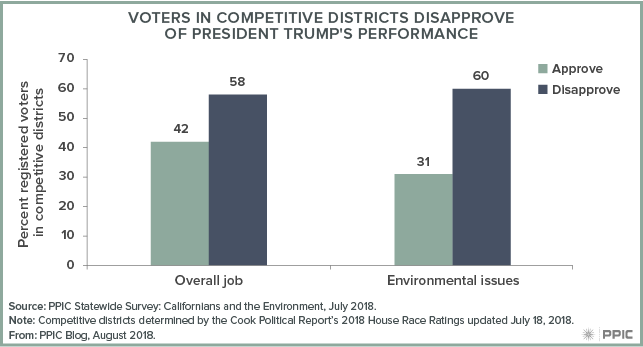
California voters say that they want statewide candidates to push back rather than work with the Trump administration on environmental issues (53% to 40%), and a majority disapprove of the way that President Trump is handling environmental issues (67%). Since the midterm elections are in part a referendum on the president, it is perhaps most significant that a majority of registered voters living in the nine competitive House districts disapprove of President Trump’s handling of environmental issues (60%)—similar to their disapproval of his overall job performance (58%).

Californians’ environmental priorities are high on our list of political wildcards in this important midterm election. Stay tuned as the PPIC Statewide Survey monitors this trend and other topics in our pre-election polling.

Video: Californians and the Environment

With the November election less than four months away, Democrat Gavin Newsom leads Republican John Cox by 24 points in the governor’s race—and nearly all likely voters see the candidates’ positions on environmental issues as important. In the US Senate race, Dianne Feinstein continues to lead fellow Democrat Kevin de León by double digits. These and other key findings in the July PPIC Statewide Survey were presented by researcher Alyssa Dykman at a Sacramento briefing last week.

Californians are much more likely than adults nationwide to say that global warming is extremely or very important to them personally. A majority of likely voters see global warming as a very serious threat to California’s economy and quality of life, and a solid majority say that the effects of global warming have already begun. This may help explain why most Californians are in favor of the state making its own policies to address climate change.

Other survey highlights:

  • Approval ratings for the president and Congress—both overall and on environmental issues—remain far lower than those for the governor and state legislature.
  • There are wide partisan differences in views on climate change and what the state should do about it.
  • Likely voters see drought and water supply as the top environmental issue facing the state; a majority support a water bond on the November ballot.
  • A majority of likely voters favor higher emissions standards for automobiles as well as state laws that aim to reduce greenhouse gas emissions in other areas.

How Wildfires Affect California’s Water Supply

Summer marks the traditional beginning of California’s fire season, although the warming climate has stretched the season considerably. Until the winter rains arrive, wildfires will burn forests and grasslands throughout the state. Since January 1, about 3,700 fires have consumed more than 111,000 acres of land—outpacing 2017, the most destructive and deadly fire season in state history.

While public safety and economic costs deserve and receive a great deal of attention, wildfires also have consequences for the management of water—including the amount and quality of supply, and the potential for flooding.

Fire can bring short-term water supply benefits by increasing runoff for downstream use. Most precipitation that falls on hillsides is captured by plants and soils and sent back into the atmosphere. By removing vegetation and reducing the ability of soils to hold water, most burns lead to an increase in runoff. The amount of increase depends on the type of vegetation that is burned. In Sierra conifer forests, reducing tree cover by about 40% may result in a 9% increase in water yield. Conversely, burning grasslands leads to negligible increases in water supply.

Managing forests with mechanical thinning and prescribed burning simulates the effects of low- and moderate-severity wildfire—creating opportunities to improve forest health while increasing water supply. But before concluding that forest fires and active management can reliably increase water supply, it’s worth noting that increases in water can be short-lived as vegetation rapidly grows back. And in drier forests like those of the southern Sierra Nevada, most downstream users are unlikely to see increased yields.

Wildfire can also bring some serious water management challenges.

Intense fires remove vegetation that prevents excessive erosion. Soils burned at high severity can also lose the ability to absorb water for a few years after a burn. When rain falls on these fire-ravaged slopes, the fast-moving runoff can erode soils and ash, transporting them into rivers. These flows threaten drinking-water quality and fill water supply and hydropower reservoirs with sediment. Following a series of severe wildfires in the American River headwaters, Placer County Water Agency experienced significant damage to its water supply and hydropower infrastructure, including costly impacts from increasing sediment and debris. The agency is now working with multiple partners to reduce wildfire risk above two reservoirs using prescribed burning and mechanical thinning.

The damaged soils and loss of vegetation following a severe burn can also increase the threat of downstream flooding and landslides. In some cases, these slides can become “debris flows”—fast-moving rivers of mud, rock, and other materials that can take out everything in their path. These are one of the most dangerous types of flash floods in California. The most recent and deadly example of this was in Montecito following the December 2017 Thomas Fire (the largest fire by area in state history). In early January 2018, record-high rainfall fell on the fire-scarred slopes above Montecito. The resulting debris flows killed 23 people and damaged or destroyed 400 homes.

Experts are predicting another year of intense wildfire activity. Water managers in affected regions will need to address the impacts of fire on local water supply and flood hazards, and must also account for such impacts in future planning.

A Balancing Act for the Colorado River

The Colorado River―a critically important water supply for seven western states, including California―has been in drought for nearly two decades. We talked to Bonnie Colby, a professor of natural resource economics at the University of Arizona and a member of the PPIC Water Policy Center research network, about conditions in the basin and next steps for improving shared management of the river.

PPIC: What concerns you most about the river’s condition?

Bonnie Colby: We’re in a more difficult situation than in previous droughts because the major reservoirs—Powell and Mead—are so low. It’s unprecedented in my 35 years of working on water. Low reservoir levels increase the potential for conflict and make it harder to balance supply and demand. But our collective capacity to address these kinds of conflicts is growing as well.

Regionally, groundwater levels are falling dramatically from increased pumping during drought. That strategy brings hazards over time because river flows and groundwater are intricately connected, and overdrafting groundwater reduces water flowing into rivers. California is now working on groundwater sustainability, which is promising. Arizona has done a great job managing groundwater in heavily pumped areas (known as “active management areas”), but there are other places where groundwater use is not regulated to manage overdraft.

PPIC: What are your biggest concerns about current efforts to manage the river?

BC: There’s a fundamental conflict over who’s going to cut back on water use. Cities and environmental groups hope irrigated agriculture will use various proven strategies to free up more water for cities and the environment, giving up use of some of its water for fair payment. Some farmers are willing to cut back for a few years, but many are reluctant to do that indefinitely. No one can be sure whether this drought will extend for years or decades. The overall drying trend in the basin should alert us that the future will not merely repeat past drought patterns. Once we start reducing crop water use year after year in farming regions, it’s hard to maintain the agricultural economy and related infrastructure.

Delays in the “drought contingency plan” process are another concern. These plans lay out commitments by the states regarding specific steps to cut water use and help maintain reservoir levels during drought. Water conflict is a very hard puzzle to solve. It’s difficult to decide which groups will bear the economic pain and impact to their quality of life. If there are cutbacks for multiple years in a row, how drastically should cities be asked to reduce water use? How should we deal with water for golf courses, for farms? Until the states can finalize drought contingency plans, we can’t finalize a number of important policy agreements—for example, new agreements with Mexico over sharing the river’s waters.

PPIC: What are some positive things about the state of the basin?

BC: The state of Colorado has shown a lot of leadership in making arrangements with farmers to use less water without causing significant economic disruption. These on-farm collaborative arrangements are where the basin can make substantial progress. If we put farmers’ and irrigation district managers’ knowledge and experience to use through voluntary collaborative programs, we should be able to reduce farm water 5% while only seeing a 1% drop in farm income, with only minor effects on food and fiber production. Farmers won’t, and shouldn’t have to, do this at their own expense―compensation for farm income losses is necessary.

On another hopeful note, we’ve seen the conversation start to shift so that more people in the region see the river as a connected system, from its headwaters in Wyoming and Colorado to its estuary in Mexico’s Sea of Cortez. There’s more understanding about the importance of changes in snowpack patterns, long-term water scarcity, and other key issues. A better informed constituency is a very good thing for tackling basin-wide challenges.