New Laws Strengthen State’s Water Safety Net

Governor Brown signed nearly 60 new bills this year that will influence how California goes about the business of managing water. Several of these new laws will expand and strengthen the water safety net for disadvantaged communities. A suite of bills signed in recent weeks will bring a much-needed assist for communities lacking reliable access to safe and affordable drinking water.

While the vast majority of residential water customers in California have access to safe drinking water, several hundred small communities still struggle to provide drinking water that meets basic health standards. In addition, the drought has resulted in more than 2,000 domestic wells across the state going dry and shortages in 100 small rural water systems. Small water districts serving low-income communities are not like their much larger counterparts—their rate bases are smaller, costs per household are higher, and their customers can’t afford high rates. In addition, these communities tend to have a shortage of managerial and technical expertise. These interrelated challenges constrict small districts’ ability to fund and maintain new pipelines, wells, and water treatment plants. Recognizing that there is no “one-size-fits-all” solution, the state has recently begun to experiment with regulatory, administrative, and financial tools to help solve the problem.

Consolidating small water districts into larger ones is a relatively low-cost and durable solution that can bring lower per unit costs and improved levels of service to small, disadvantaged communities. The State Water Board has exercised the authority granted last year to mandate such mergers with six consolidations in the Central Valley. The state also covers some costs for consolidations. One of the most notable examples is the voluntary merging of 1,800 water-stressed homes in unincorporated East Porterville with the larger and more resilient water system serving the nearby city of Porterville.

The suite of bills signed this year—Senate Bill (SB) 552, SB 1263, and SB 1456—builds on past progress to strengthen the water safety net in several ways.

  • Improving access to funding: SB 1456 makes it easier for water systems serving small, disadvantaged communities to use state financing for capital improvements such as drinking water treatment plants. The bill extends this benefit to professional water service providers that serve small disadvantaged communities across the state.
  • Enhancing technical and managerial capacity: Even where financial resources are available, a small water system lacking experienced managers or expert technical staff may struggle to maintain water treatment and distribution systems. SB 552 offers a remedy by allowing the State Water Board to hire a third-party administrator to manage the water system on behalf of the community. The administrator can set and collect water rates and apply for other funding to build water treatment plants and cover operations and maintenance costs. This new tool potentially offers a long-term solution for small water systems, especially when the community doesn’t have any neighboring systems to easily connect with.
  • Preventing new unsustainable systems: SB 1263 aims to prevent communities from developing unsustainable water systems in the first place. The bill authorizes the State Water Board to deny permits for new water systems if the applicants cannot demonstrate adequate capacity to produce reliable and safe drinking water for at least 20 years under a variety of hydrologic conditions. Instead, it encourages them to partner with neighboring water suppliers that can.

These new tools for addressing drinking water issues in disadvantaged communities show that the state is both conscious of the complexity of the situation and willing to experiment with new approaches. We’ll be keeping track of legislative developments related to water in future blog posts.

Learn more

Read “Drinking Water Quality: Perceptions and Challenges” (PPIC Blog, September 6, 2016)
Read “California’s Water Quality Challenges” (PPIC Water Policy Center fact sheet, October 2015)
Read “Building a Better Water Safety Net” (PPIC Blog, October 21, 2015)

Video: Assessing Corrections Reforms

California leads the nation in correctional reforms. It has dramatically reduced incarceration and done so without a major increase in crime rates, a new PPIC report concludes. But the state and counties still faces major challenges. A panel of state and local experts discussed them in Sacramento last week. Among some of the challenges:

  • Preventing the prison population from increasing. Under federal court order to reduce prison overcrowding, California enacted public safety realignment and quickly reduced the prison population to about 200,000 inmates. But Scott Kernan, secretary of the California Department of Corrections and Rehabilitation, said it may be a challenge to keep the number of inmates below the court-mandated target. Based on population projections, the prisons will run out of available beds soon, he said.
  • Continuing to improve prison health care. California continues to operate under a court-ordered federal receivership. Although the state has invested significantly to improve inmate health services, the receiver has turned over management of health care to the state at only 7 of the state’s 34 prisons. Kernan said the state is on a path toward full control.
  • Adapting to changing jail populations. The counties—sheriffs, probation departments, and the courts—have had to quickly adjust, first to an increase in their populations under realignment, then to an decrease under Proposition 47, which reduced penalties on some drug and property crimes. Today, jails built for short stays now house more serious offenders for longer periods. Probation departments had to quickly build relationships with community organizations to develop reentry services, said Wendy Still, Alameda County’s chief probation officer. “What I think is amazing,” she said, “Is just how fast the counties were able to make this shift and to be able to create the partnerships, to break down the barriers and begin to create these systems of care—and also to retrain their staffs.”
  • Understanding the impact of Proposition 47 on crime rates. The PPIC report says the impact of Proposition 47 on crime is not yet clear. Geoff Dean, Ventura County sheriff, argued that it has been significant and that it has clogged courts. He and Still both said that by reducing some felony drug offenses to misdemeanors, Proposition 47 removed incentives for offenders with substance abuse problems to get treatment. Before Proposition 47, certain offenders convicted of felonies went to drug court as an alternative to traditional prosecution, and they were required to get treatment. Misdemeanor offenders don’t face the same sanctions. “There’s a whole segment of that population that’s not getting treatment,” he said. “And the cycle continues.”

Panelists echoed the conclusions of PPIC report coauthor Magnus Lofstrom. The state and counties need to identify and implement cost-effective strategies to reduce re-offending—to reduce pressures on prisons and jails, improve public safety, reduce spending, and improve the lives of those in the corrections system and their families.

Video: A High-Interest Election

By many measures, this is an unusual election year. In the presidential race between a businessman/reality TV star and the first woman nominated by a major party, most likely voters have made up their minds, the latest PPIC Statewide Survey shows. Yet interest in the election is high and satisfaction with the choice of candidates is low.

Two candidates from the same party are vying for an open US Senate for the first time since the state adopted the top-two primary system. About a quarter of likely voters say they won’t vote for either Democrat, and 19 percent are still undecided.

These are just two of the consequential choices Californians are being asked to make. There are 17 statewide initiatives on the ballot and in many communities, a number of local measures.

This all adds up to an election worth watching.

Dean Bonner, associate survey director, presented key findings from the survey to a Sacramento audience last week.

Commentary: Coping with 17 State Ballot Propositions


This commentary was published in the Los Angeles Times today. Thursday, August 18, 2016.

This fall, Californians will face the daunting task of determining the fate of 17 state propositions. Local ballots will add their own initiatives to this burden. It’s been a dozen years since a ballot was as challenging. How will voters respond?

Read the full commentary on latimes.com.

Learn more

PPIC Statewide Survey: Californians and Their Government (May 2016) 

Climate Change and Partisanship

Ten years ago, California led the nation in climate change policy when it passed the Global Warming Solutions Act of 2006, landmark legislation that required the state to reduce greenhouse gas emissions to 1990 levels by 2020. While passed largely along partisan lines, Assembly Bill (AB) 32 was signed into law by Republican Governor Arnold Schwarzenegger. Notably, the law enjoyed the support of a strong majority of Californians—including two in three adults across parties—in our July 2006 Statewide Survey.

Today, the state is prepared to meet the reduction targets set forth in AB 32. As policymakers debate how to further reduce emissions, a strong majority of Californians continue to favor these targets. But now there is a wide partisan divide. An overwhelming majority of Democrats (80%) are in favor, compared to a majority of independents (56%) and fewer than half of Republicans (44%).

The evolving partisanship can also been seen in Californians’ views about the state’s role as a leader in global warming policy. In 2006, solid majorities of Californians across parties were in favor of California making its own global warming policies separate from the federal government. Today, a solid majority of adults are still in favor, but the partisan divide has widened. Democratic support has held steady (73% in 2006, 70% today), but support among Republicans (62% in 2006, 49% today) and independents (70% in 2006, 55% today) has declined by double digits.

What’s changed since 2006? In California, Republican Governor Arnold Schwarzenegger has been replaced by Democratic Governor Jerry Brown, who has been a vocal leader on climate change and made the issue a major component of his agenda. At the national level, there is a contentious debate about global warming, as well as a growing partisan and ideological divide.

Democrats and Republicans in our surveys have also become more ideologically divided. Democrats describing themselves as “very liberal” made up 14% of Democrats in our July 2006 survey, while that group encompasses 30% of Democrats today. Similarly, Republicans describing themselves as “very conservative” made up 21% of Republicans in July 2006. The “very conservative” constitute 31% of Republicans today.

Despite a widening partisan divide, Californians’ support for state policies to address global warming has been consistent in the 10 years since passing AB 32. Indeed, a strong majority of Californians (68%) favor a proposal to further reduce greenhouse gas emissions to 40% of 1990 levels by 2030. An overwhelming majority of Democrats (78%) support the proposed goals, compared to fewer than half of Republicans (39%). Independents are in the middle, with 59% in favor of the expanded goals.

Does the partisan divide on global warming policy mean that there is intraparty cohesiveness? Not necessarily. Among Democrats, there is strong majority support regardless of ideology and other demographics. But Republicans as a group are less cohesive. In fact, support for further reducing greenhouse gases exceeds 50 percent among nonwhite Republicans. Among independents, support for global warming policy mirrors that of the party that these nonpartisans lean toward.

Further reducing greenhouse gas emissions will be a real test for California as it seeks to address climate change. The ongoing political debate over global warming may well continue, and once more, the nation will be watching to see what California does next.

Spending on Corrections and Higher Education

California has long been criticized for its growing corrections expenditures, especially as General Fund spending on higher education has declined. The beginning of a new budget year is a good time to examine where the state now stands on spending in these two key areas.

California’s legislature recently adopted a budget for 2016–2017 that devotes $14.5 billion of General Fund revenue to higher education institutions, including the University of California, California State University, and California’s community college system. It allocates $10.6 billion for operations of the California Department of Corrections and Rehabilitation (CDCR), which is responsible for adults in state custody and parolees under state jurisdiction.

These budget allocations reflect a striking shift from California’s budget of forty years ago, when the state spent a larger share on higher education and a much smaller share on corrections. But by the 2008–2009 budget year, allocations to higher education (11.1%) and corrections (10.7%) were almost identical. In the years since, higher education spending has outpaced corrections in relative terms, largely because recent criminal justice reforms have drawn down the number of adults in state custody and on parole. Nonetheless, California spends more on corrections and less on higher education today, in relative terms, than at nearly any point in the past thirty years.

Despite these dramatic trends, spending in each area has actually increased alongside of growth in the populations served. Enrollment in higher education institutions has increased roughly 50% since the 1977–78 academic year; the budget has increased 65% (according to CPEC Fiscal Profiles). Until 2011’s realignment of California’s corrections responsibilities, the number of adults in CDCR custody had increased 555% and the budget increased 526% (CDCR Monthly Population Reports).

Clearly the costs of serving these two populations are different. On average, the cost of the CDCR population is much higher than the cost of students in higher education. Within each area, costs per person vary as well. The cost of educating a student at UC far exceeds the cost of doing so at a community college. Similarly, the cost of incarceration far exceeds the cost of supervising a parolee in the community. Although the per person cost of delivering services has risen over time, the dramatic increase in the prison population has been the key driver of the dramatic shift.

To reverse these trends, the state must identify and disseminate cost-effective strategies to reduce recidivism, further diminish California’s crime rates, and ultimately reduce the prison population enough to allow for the closure of state facilities or the elimination of in-state and out-of-state contract prison beds used to relieve overcrowding. Corrections realignment reduced state prison and parolee populations, but the anticipated savings from this policy shift have yet to materialize. Moreover, the most recent reports show a small uptick in the corrections population (CDCR Monthly Population Reports). ​

In the meantime, California needs to find ways to accommodate more students in its higher education systems—which it could do at relatively low cost by reducing time to degree, or at higher cost by increasing financial aid or expanding the number of slots for students. At the end of the day, ensuring that more of California’s youth attend and complete college will reap positive long-term benefits for the state, helping to meet the needs of the state’s future economy and create a brighter future for all Californians.

Chart source: California Department of Finance Chart C-1 Program Expenditures by Fund.

Learn more

Will California Run Out of College Graduates?
“California’s State Budget”
California’s Future: Corrections

Video: Assessing California’s Global Warming Law

Ten years ago, California enacted a law to combat global warming that set an ambitious goal: reducing greenhouse gas emissions to 1990 levels by 2020. Today, the state is poised to reach this target, and policymakers are discussing aiming for a new one.

Each year since the law—AB 32—took effect, the PPIC Statewide Survey has examined Californians’ views on climate change and the state’s actions to address it. The survey has consistently found that most Californians believe that the effects of global warming have begun and that majorities support the state taking action to address it.

But a partisan split has emerged since the law took effect. AB 32’s goals no longer have the bipartisan support they did in 2006. Today, Democrats and independents are much more likely than Republicans to support the goals of AB 32. This divide is reflected in a number of findings in the 2016 Californians and the Environment Survey.

Research associate David Kordus presented the survey at a briefing in Sacramento last week.

“Sin” Taxes on the Ballot This Fall

Two measures have qualified for the November ballot that ask California voters to increase so-called “sin” taxes. One measure, the Healthcare, Research, and Prevention Tobacco Tax Act, will add an additional $2.00 per pack to cigarettes sold in the state. Currently, the tax is $0.87 per pack, which ranks lower than the cigarette tax in 33 other states. The other measure, the Adult Use of Marijuana Act, proposes to legalize the recreational use of marijuana and impose a state tax on its sales.

States use sin taxes not only to raise revenue for state treasuries, but also to affect behavior. The notion is that as the price of a product goes up, consumption will drop, and with that drop, negative societal consequences—the rate of lung cancer, for instance—will decrease. In fact, revenue from sin taxes often fund related treatment or health care programs.

Though it is early on in the campaigns, Californians hold favorable views of both ballot measures. According to the May 2016 PPIC survey, 67% of likely voters favor an increase in the cigarette tax to fund health care and 60% favor marijuana legalization.

While there are a number of reasons voters may support or oppose these measures, our focus here is on the revenue implications.

How much more money could these taxes bring in?

Both measures hold promise for raising significant funds and represent an alternative source of revenue in a state that is heavily dependent upon personal income taxes. Together, they could bring in more than $2 billion in state revenue. This would be significantly more than the state’s other sin tax on alcohol, which raised about $350 million in 2014.
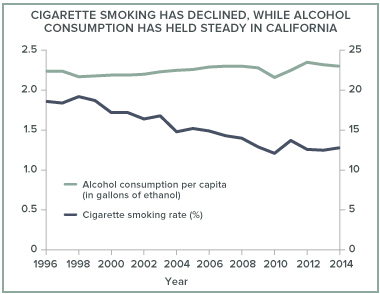
The state reported more than $800 million in tobacco tax revenue in 2014. An additional $2.00 per pack would more than triple the current tax, suggesting a significant jump in total revenue. The Legislative Analyst’s Office estimates that an additional $1 billion to $1.4 billion would be raised should the proposition pass.

Why wouldn’t total tobacco revenue triple? Total revenue will be determined by both the tax rate and the amount of tobacco purchased. If the increase has the desired effect, cigarette smoking will decline in the future. That, combined with the fact that California recently raised its smoking age to 21, should have an impact on total consumption. Indeed, the share of individuals who smoke cigarettes has been declining in California, from 18.6% in 1996 to 12.8% in 2014. In comparison, alcohol consumption has decreased since 1977, but has remained consistent over the past 20 years.

Nationally, California had the second-lowest cigarette smoking rate in 2014 (after Utah). But it’s worth noting that e-cigarette use nearly doubled among California adults from 1.8% in 2012 to 3.5% in 2013, complicating estimates of future revenue. If passed, the tax would also apply to e-cigarettes. If Californians use e-cigarettes as a substitute for cigarettes, then the measure will also capture revenue due to increased e-cigarette use. As we noted in our recent report, the additional revenue generated by taxing marijuana could be as much as $1 billion a year for the state. In the first full year after legalizing recreational marijuana, Colorado raised just over $120 million in state revenue, and Washington collected slightly less than $130 million. Given California’s larger population, the $1 billion figure is in the right ballpark. But since much is still unknown about the marijuana market, any estimate should be treated with caution.

How does California compare with other states?

The proposed taxes would be comparable to those currently in place in other states. If the tobacco tax passes, it would boost per capita revenue from $21 per resident to $50 per resident. This would still be below the national average of $57 per resident, though it would be much closer. For marijuana, the estimate of $1 billion in revenue would translate to about $26 per resident. Though there isn’t a national reference point for marijuana taxes, this number would be higher than the per capita amounts raised in Colorado and Washington. Interestingly, California’s alcohol tax revenue is less than most other states. On a per capita basis, California ranks 40th of the 50 states in alcohol revenue collected. In 2014, California collected only $9 per resident in alcohol taxes compared to the rest of the country, which raised $21 per resident. Doubling this rate—which would still be below the national average—could add another $350 million to state revenues.

Sources: National Institute of Alcohol Abuse and Alcoholism (NIAAA), Centers for Disease Control and Prevention (CDC), US Census, Office of Attorney General (OAG), Legislative Analyst’s Office (LAO).

Notes: Per capita alcohol consumption is taken from the NIAAA, which calculates consumption based on sales and a conversion of gallons in terms of pure alcohol (ethanol). Population data are drawn from the US Census. Cigarette smoking rates are from the CDC.

California’s Arrest Rate Reaches a 50-Year Low

Recently released arrest and crime data from the California Attorney General’s Office reveal some noticeable recent changes. Until last year, California’s felony arrest rate trend had closely mirrored the state’s crime rate trend for 20 years. We would expect the two trends to move in similar ways, since most of the crimes reported and used to calculate the crime rate are felonies. But the trends diverged in 2015 after passage of Proposition 47, which reclassified a number of drug and property crimes from felonies to misdemeanors. The felony arrest rate dropped dramatically in 2015, by 30%, while crime rates went up—the violent crime rate rose by 8.4% and the property crime rate by 6.6%. The drop in felony arrests was partly offset by a very noticeable increase in misdemeanor arrests. Still, the total number of arrests dropped by almost 52,000.

California’s total arrest rate—which has been declining over the past two decades—is now at a historic low of 2,944 per 100,000 residents; this is less than half the peak rate of 6,765 reached in 1989. What is arguably more noteworthy is the even greater drop in the felony arrest rate, which, at 806 per 100,000 residents, is about a third of the 1989 peak rate of 2,052. The 30% drop in the felony arrest rate in just one year, 2014 to 2015, accounts for more than a quarter of the peak-to-bottom decline. Misdemeanor arrests, by contrast, increased from 1,979 to 2,138, or 8%.

The data strongly indicate that Proposition 47 is a major factor in these changes. First, monthly arrest data show abrupt changes in drug and property arrests in November 2014, the month Proposition 47 went into effect. Second, the drop in felony arrests was almost exclusively for drug and property offenses, while the increase in misdemeanor arrests was almost entirely for drug and property offenses. Arrests for motor vehicle theft, which continues to be a felony after Proposition 47, is the only area of increase. Possibly in response to the 13% increase in auto thefts in 2015, motor vehicle theft arrests went up by 26%.

Although the total number of property crime arrests dropped, the decrease in arrests for drug offenses was more significant. Felony drug arrests declined by about 92,000, while misdemeanor drug arrests went up by more than 70,000. The net drop of about 22,000 drug arrests accounts for more than 40% of the total decline.

The new data raise many questions, including whether the recent changes to our criminal justice system are affecting public safety. Also, does the decline in drug arrests mean that drug use has declined or that fewer offenders with substance abuse problems are receiving necessary and effective treatment? Future research needs to address the role of reforms like Proposition 47 on crime, offenders, law enforcement, and counties’ ability to provide necessary treatment and programming.

Commentary: New Law Could Change California’s Electorate

This commentary was published in the Washington Post’s “Monkey Cage” blog today, Monday, July 11, 2016.

Supporters of California’s New Motor Voter Act are right to see its great promise, but how the law is implemented will be far more important than many have suggested.

Read the full commentary on washingtonpost.com.