Video: Californians and Their Government

Less than a year before California’s presidential primary, likely voters who are Democrats or who lean Democratic are divided on strategy: is it more important for the party to nominate the candidate who seems mostly likely to defeat President Trump or the candidate whose positions align most closely their views? But almost all Californians see voting in the 2020 elections as very important. At a lunchtime briefing in Sacramento last Thursday, PPIC researcher Dean Bonner outlined these and other key findings from the latest statewide survey.

Two in three California likely voters say they will definitely or probably choose a candidate other than Trump. There is a huge partisan divide on this question: 93% of Democrats and 66% of independents would definitely or probably vote for another candidate if the election were held today, while 82% of Republicans would definitely or probably vote for Trump.

Most Californians say that the investigation by special counsel Robert Mueller did not clear the president of wrongdoing, and Californians are more likely that the nation as a whole to say impeachment proceedings should begin. But here, too, there is a partisan divide: 66% of Democrats say Congress should begin the process, compared to only 39% of independents and 9% of Republicans.

Other survey highlights:

  • A majority of Californians say their housing costs cause a financial strain; six in ten favor the governor’s plan to allocate $1 billion to address homelessness, and similar shares favor proposed new rules intended to create more affordable housing.
  • Three-quarters of Californians see participation in the 2020 Census as very important—but most have concerns about confidentiality.
  • An overwhelming majority are concerned about rising electricity bills in the wake of the PG&E bankruptcy.
  • Californians are concerned that the recent outbreak of measles could spread; most believe that vaccines are very safe and an overwhelming majority say vaccination against measles and other diseases should be required.

California 2020: Census and Elections Are Important to Californians

The 2020 Census is fast approaching. With political representation and billions in federal funds on the line, the importance of an accurate count cannot be overstated. Californians recognize this, according to our latest survey—but many have concerns about the confidentiality of the information they provide. Even more Californians say that the 2020 elections are important. Both are critical to the future of the state.

California has invested substantially in raising awareness and preparing local communities for what will be a monumental census effort. Governor Gavin Newsom has proposed adding another $54 million toward state census activities, on top of a previous allocation that was just north of $100 million. These funds—along with a sustained effort at building partnerships around the state—are meant to counter California’s particular vulnerabilities when it comes to ensuring an accurate census: large shares of immigrants and other hard-to-count populations.

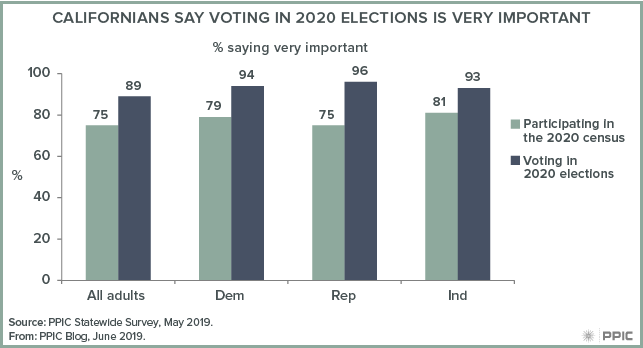
With so much at stake, participation in the census is critical. Are Californians aware of the importance of being counted? Currently, three-quarters of all adults (75%) say it is very important to participate in the 2020 Census. Overwhelming majorities agree across regions, political parties, and all demographic groups—from age, income, and education level to racial/ethnic and citizenship status groups. Naturalized citizens are the most likely to say that participation in the census is very important (80%).

Later this month, the US Supreme Court is expected to rule on the legality of adding a question about citizenship status to the 2020 Census, as the Trump administration has proposed. This question has not been asked on the decennial census since 1950, and opponents argue that it would depress the count among immigrants who might be fearful about revealing their status.

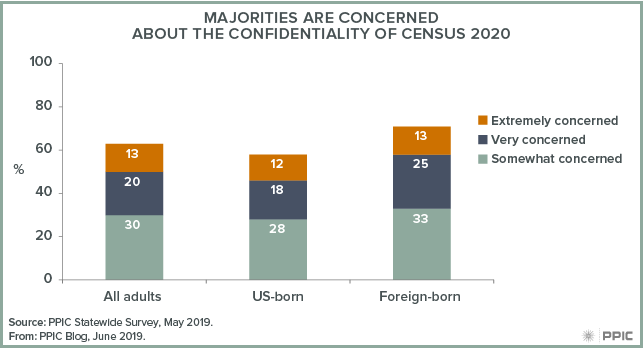
A solid majority of Californians (63%) are concerned that the Census Bureau will not keep 2020 Census answers confidential. This concern is highest among Latinos (74%) and African Americans (70%), followed by Asian Americans (64%) and whites (52%). US-born Californians (58%) are less likely than foreign-born residents (71%) to say that confidentiality is a concern.

figure - Majorities Are Concerned about the Confidentiality of Census 2020

The upcoming census will coincide with another pivotal event—the 2020 presidential election. Election outcomes will have additional lasting effects this cycle, as state legislators (or redistricting commissions) will use the new 2020 Census data to redraw district lines that will last a decade. Today, nearly all Californians recognize the importance of voting next year.

While three in four say it is very important to participate in the census, even more—nine in ten—say that it is very important to vote in the 2020 elections. More than nine in ten across political parties hold this view, as do more than eight in ten across regions and demographic groups.

figure - Californians Say Voting in 2020 Elections Is Very Important

With a presidential primary in California next March and the census in April, Californians are heading toward a consequential season—for the state and the nation. Efforts to boost participation in both of these essential civic events will be critical to ensuring that all Californians are heard—and counted.

The Citizen’s Redistricting Commission: Open for Business

Today marks the first day of the open application period for California’s next Citizens Redistricting Commission (CRC).  The CRC is the state institution vested with the authority to redraw district lines for the state legislature, board of equalization, and Congress. This process occurs after every decennial census to reflect population shifts. The commission’s 14 members will use the new 2020 census data, along with testimony from the public, to draw new districts by August 2021.

If this sounds like the operation of a typical government agency, it is anything but. The CRC is a bold departure from the status quo that was first used in the last redistricting process, in 2011. Most observers felt it worked well the first time around. Today, the state embarks on a second attempt that hinges on a key question: can it work again?

In the past, authority to draw district lines resided with the state legislature. Legislators are of course chosen by the general public in normal elections, where many different issues are always at stake. They are politically connected by definition. When legislators were responsible for drawing the lines, they were not required to (nor did they) hold many public hearings about the redistricting process. Their decisions were subject to few constraints and did not need to be justified or even explained.

The CRC now follows a very different process. The commissioners are chosen through a public application process run by the nonpartisan state auditor. The potential applicant pool is incredibly broad: any registered voter who has been continuously registered with the same political party for five years and has voted in two of the last three statewide elections can apply. (There are a few conflict of interest provisions but they don’t apply to many people.) All the commission’s proceedings must be conducted in public. The lines it draws are subject to a long list of constraints, and the commission is required to produce a report explaining and justifying its decisions.

These rules and constraints may sound good on paper, but the success of the CRC ultimately rests on the quality of the people who serve on it. That requires a deep applicant pool, and the state was fortunate to get one the first time around. The auditor initially received almost 25,000 qualified applications, of which almost 5,000 were willing to fill out a far more detailed follow-up application.

Numbers this large might seem like overkill for a 14-member commission. But a surplus was helpful because the first applicants were not representative of the state as a whole. One of every two initial applicants was a non-Hispanic white male, well out of proportion with their share of the state’s population. Northern California was also overrepresented relative to Southern California, with Sacramento itself producing double the applicants that would be expected from chance alone.

However, with such a large pool to work with, the auditor was able to select a group of final candidates who looked much more like the state as a whole. The final commission was well balanced ethnically, geographically, and politically. Even more than that, the commissioners had a mix of experience and professional backgrounds. The members included a principal, a chiropractor, and a bookstore owner; they also included two civil rights attorneys, several people with experience in city planning, and a former director of the US Census.

The CRC helped to launch a redistricting reform movement that is now sweeping the country.  Four states recently adopted commissions, and the first bill out of the US House this year included a commission reform modeled on the California experience. Many eyes are watching to see if the CRC can work a second time.

Needless to say, success the first time does not guarantee success again. The auditor will need a lot of applicants to create a diverse commission fully representative of the state. Anyone who supports the CRC’s mission and meets the basic requirements should consider throwing their hat into the ring.

The open application period closes on August 19.
2020 Census: Counting California’s Homeless Population

This post is part of a series examining challenges involved in the 2020 Census and what’s at stake for California. 

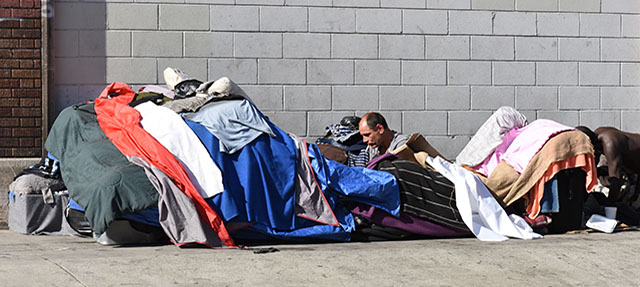
Accurately counting the homeless population is notoriously difficult. People experiencing homelessness can be hard to find—they tend to move around a lot, and at any given time, they might be in a shelter, in a car, outdoors, or couch surfing with family and friends. They may also conceal their living arrangements for privacy reasons or to avoid law enforcement.

The issue is particularly urgent for California as the 2020 Census approaches. California has the most homeless individuals of any state, with 130,000 people living in shelters or outdoors, according to estimates from January 2018. Since this count doesn’t include people staying temporarily with family or friends, it’s almost certainly an underestimate.

Undercounting homeless Californians could affect political representation and lead to reduced federal funding for low-income and homeless families, especially in urban areas with large homeless populations. In addition to determining congressional seats, the census is used to allocate billions of federal dollars for health care, education, and housing programs, including Section 8 housing vouchers for low-income families.

The goal of the census is to count all residents “in the right place,” meaning where they usually live and sleep. People who are couch surfing without a permanent place to live should be included in the household where they’re staying on Census Day (April 1, 2020).

What about people staying in shelters, living outdoors, and residing in other temporary locations? The census bureau has two approaches:

  • Census workers will interview and record responses from people experiencing homelessness at service-based locations or outdoors. These sites include emergency and transitional shelters, soup kitchens, mobile food vans, and targeted outdoor locations (e.g., under bridges, in parking lots, in encampments). This effort will take place from March 30 to April 1, 2020. Census workers in 2010 counted nearly 28,000 Californians in homeless shelters and about 64,000 Californians at other service-based locations and outdoors.
  • Census workers will go to “transitory” locations to collect responses from people who don’t have a usual home elsewhere. These locations include RV parks, motels, campgrounds, racetracks, circuses, carnivals, and marinas. This effort will take place from April 9 to May 4, 2020. Census workers in 2010 collected data from nearly 24,000 transitory locations in California.

The Census Bureau works with local partners to identify service-based and outdoor locations. Input on the latter is particularly important, as California has high shares of homeless individuals who are not living in shelters. The bureau’s new construction program allows governments to submit addresses for new shelters and transitory locations that are expected to be completed by April 1, 2020.

Getting input from local officials and on-the-ground organizations will be critical. They likely have the most up-to-date information about service-based and outdoor locations in their communities, as well as on those who have been displaced due to fire or other disasters. Individuals with experience working directly with the homeless population may also consider applying to be census workers—speaking with a trusted person from the community can help encourage participation among those who might otherwise distrust government officials.

Together, these efforts could go a long way toward motivating homeless individuals to participate in the census, while also ensuring that census workers have accurate information about where to count these Californians.

Californians See Preschool as Important

Early childhood education, a policy priority for Governor Newsom, is viewed as important by an overwhelming majority of Californians. In the April 2019 PPIC Statewide Survey, 78% of Californians and 88% of public school parents said that attending preschool is important to a student’s academic success in kindergarten through grade 12.

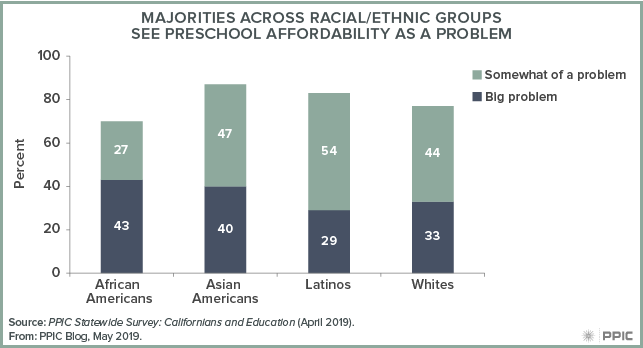
A similar share of Californians (80%) see the affordability of preschool as a problem. Democrats (46%) and Independents (38%) are much more likely than Republicans (25%) to say that it is a big problem. A majority across regions see affordability as a problem, with San Francisco Bay Area residents (42%) most likely to feel that it is a big problem. Across racial/ethnic groups, African Americans and Asian Americans are more likely than whites and Latinos to say that affordability is a big problem.

figure 1 - Majorities across Racial/ethnic Groups See Preschool Affordability as a Problem

Governor Newsom has proposed new funding that would address some of these affordability concerns. In April, we asked Californians if they were in favor of or opposed to the governor’s initial budget proposal from January, which allocated $125 million to expand full-day, full-year preschool to all eligible low-income four-year-olds. A majority of Californians—about two in three adults and three in four public school parents—favored this proposal. In addition, majorities across all demographic groups and regions favored it. In the May budget revision, the proposed funding was reduced to $31 million, which would pay for 10,000 new full-day preschool slots starting April 2020.

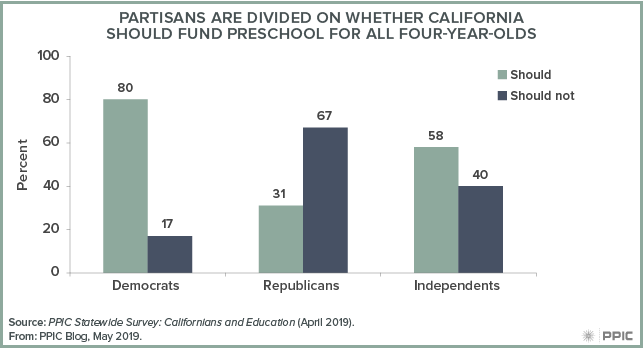
There is slightly less support for state-funded preschool in general: six in ten adults say that the government should fund voluntary preschool programs for all four-year-olds. State-sponsored preschool is a highly partisan issue, with Democrats much more likely than independents or Republicans to express support.

figure 2 - Partisans Are Divided on Whether California Should Fund Preschool for all Four-year-olds

With the release of the governor’s revised spending plan on May 9, the state budget process is well under way; the deadline for enacting the final budget is June 15. PPIC will continue to monitor the governor’s proposed allocations for early childhood education and the opinions of Californians on the issue.

Divided Views on Charter Schools and School Choice

Nearly three decades after California started authorizing charter schools, state lawmakers have renewed the debate over their rules and regulations. Today, there is a package of bills aimed increasing charter oversight moving through the legislature, and the governor has taken steps to address related issues. As the debate continues, the PPIC Statewide Survey has taken an in-depth look at Californians’ views of charter schools and school choice.

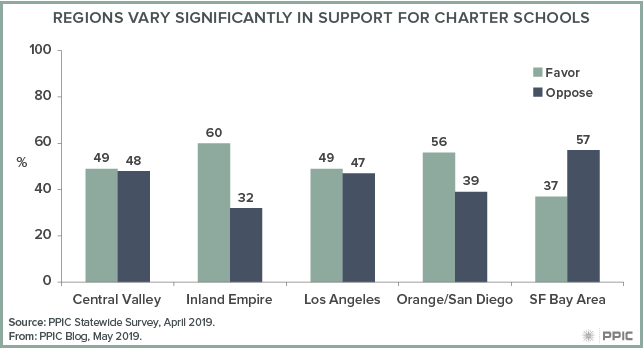
PPIC’s latest survey on K–12 education finds that Californians have mixed views on charter schools overall (49% favor, 46% oppose). Differences across regions and demographic groups are particularly notable. For example, half of Latinos (51%) and whites (50%) are in favor of charters in general, compared to fewer Asian Americans (43%) and African Americans (36%). Regionally, majorities in the Inland Empire and Orange/San Diego are in favor, while those in the Central Valley and Los Angeles are divided; a majority of San Francisco Bay Area residents are opposed.

figure 1 - Regions Vary Significantly in Support for Charter Schools

Looking more closely at charter school issues further highlights regional and racial/ethnic differences. On the question of transparency and accountability, overwhelming majorities across racial/ethnic groups say it is important for charters to operate with the same standards as traditional public schools. This includes 87% of Asian Americans, Latinos, and whites, and 72% of African Americans.

When it comes to charters taking away state funding that would otherwise be available for traditional public schools, seven in ten Los Angeles residents (71%) say they are concerned, compared to about six in ten in the Inland Empire (65%), San Francisco Bay Area (63%), and Orange/San Diego (62%); over half in the Central Valley (55%) express concern.

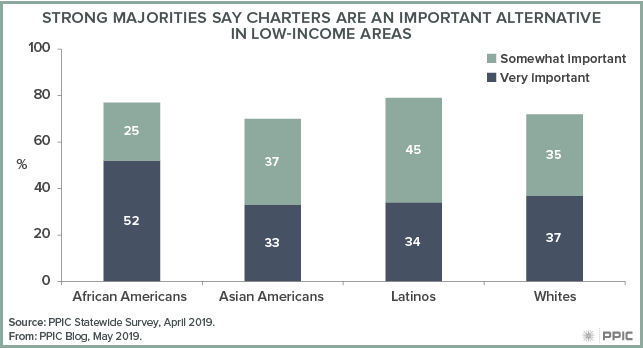
With respect to school choice, African Americans (52%) are much more likely than whites (37%), Latinos (34%), and Asian Americans (33%) to say it is very important for parents in lower-income areas to have the option of sending their children to charters instead of traditional public schools.

figure 2 - Strong Majorities Say Charters Are an Important Alternative in Low-income Areas

Earlier this year, Governor Gavin Newsom commissioned a task force to examine the impact of charter school growth on district budgets. He also signed legislation requiring the state’s 1,300-plus charter schools to follow the same transparency laws that apply to public school districts. As these policies play out, the PPIC Statewide Survey will continue to track Californians’ concerns and preferences on charter school issues.

Video: Californians and Education

Last week in Sacramento, Alyssa Dykman outlined the key findings from PPIC’s 15th annual survey on Californians and K–12 education, which tracks opinions on educational quality and school funding. This month’s survey was the first ever to be conducted with a fully online methodology.

A strong majority of Californians want Governor Newsom to prioritize K–12 public education, and majorities support many of the governor’s education-related budget proposals—including the expansion of special education and full-day preschool and kindergarten. Solid majorities also support teacher strikes for higher pay.

But Californians have mixed views on charter schools: most say they are an important option for parents in low-income areas, but many express concern about charters diverting funding from traditional public schools.

Other survey highlights:

  • Most Californians think the level of state funding for local public schools is not adequate.
  • More than half of residents across regions say teacher salaries in their community are too low.
  • Majorities of adults and likely voters would vote for a ballot measure that would amend Proposition 13 to create a “split roll” property tax system and direct some of the revenue to K–12 education.
  • Many parents think the goal of K–12 public education should be to prepare students for college—but many worry about the affordability of a college education.

New Approaches for the PPIC Statewide Survey

As the polling world knows, times—and survey methods—are changing. The rise of cell phones and decline in landline use has had an enormous effect on telephone polling methods. So have internet surveys. The PPIC Statewide Survey has kept abreast of these changes, evaluating and incorporating best practices throughout our 20-plus years in the business. The most recent update involves using online polling techniques for our next survey.

Online polling was initially viewed with great skepticism by experts in the field. However, significant progress has been made in this area. Today, a rigorous online survey using a random probability sample is widely accepted as an alternative to a rigorous live telephone survey using a random probability sample. Our research into this methodology—including extensive conversations with colleagues at peer organizations who are also using online and live telephone surveys, such as the Kaiser Family Foundation, Langer Research Associates, and the Pew Research Center—has provided us with strong assurances of quality.

Last fall, we conducted a simultaneous online and telephone poll to compare our results. We found that the online method we chose yielded results with the same high quality as our telephone polling (which includes both landline and cellphone participants).

This spring, we are conducting our first fully online-only survey, on the topic of Californians and education. This method will allow us to delve into more issues and in greater depth than we do in a live telephone survey. We are excited about this approach and looking forward to the results.

At the same time, the PPIC Statewide Survey will continue to rely on landline and cellphone polling techniques for the bulk of our work for the forseeable future, given the current limits in random probability samples for large online surveys in California and the reliability and proven track record of live telephone surveys.

As we move toward new frontiers, our survey methods will always place quality first and be completely transparent, with clear methodological explanations and detailed results available on our website. Most important, we will continue to provide a voice for all Californians—voters and nonvoters alike—raising awareness, encouraging discussion, and informing policymakers on critical issues of the day.

Californians and Their Tax Burden

It’s April 15—the perfect day to explore how Californians feel about the state and local tax system and how much they pay in taxes. According to the most recent PPIC Statewide Survey, seven in ten Californians believe that California currently ranks near the top (48%) or above average (22%) in state and local tax burden per capita. The public’s perception is somewhat in line with fiscal facts: California’s state and local tax collections per capita in 2015 were 10th-highest in the nation (Tax Policy Center, September 2018).

Notably, Republicans (65%) are much more likely than Democrats (47%) and independents (48%) to say California’s state and local tax burden is near the top. The share of Californians expressing this view increases with rising income (39% under $40,000, 52% $40,000 to $80,000, 61% $80,000 or more) and this view is more common among whites (57%) than among other racial/ethnic groups (47% Asian Americans, 44% African Americans, 38% Latinos).

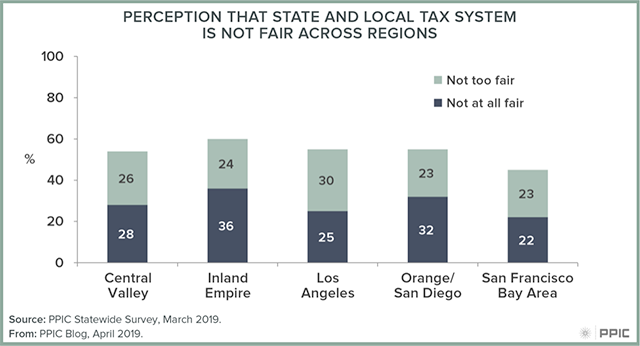
Half of Californians (52%)—a record-high share—say that the state and local tax system is either not too fair (25%) or not at all fair (27%). This marks a 10-point increase since March 2017 and a 21-point increase since the first time we asked this question in June 2003. There are notable differences along partisan lines. More than two in three Republicans (69%) see the state and local tax system as not too or not at all fair, as do nearly six in ten independents (58%), compared to about four in ten Democrats (43%).

The belief that the system is not fair is widely held across regions, ranging from a high of 60% in the Inland Empire to 45% in the San Francisco Bay Area. Lower-income adults (46%) are somewhat less likely than more-affluent adults (60% $40,000 to $80,000, 54% $80,000 or more) to say that the current state and local tax system is not fair.

Figure 1: Perception That State and Local Tax System is Not Fair Across Regions

A record-tying 60% of Californians say they pay much more (39%) or somewhat more (21%) than they should in state and local taxes. The share saying they pay much more than they should is a record high and has increased 13 points since we first asked this question in February 2003. This view is widely held across regions and demographic groups. Notably, Republicans (61%) are more than twice as likely as Democrats (25%) and much more likely than independents (42%) to say they pay much more than they should.

Figure 2 - Shares Saying They Pay Much More in State and Local Taxes Than They Should

That said, California voters have passed tax increases in recent years, including extending the Proposition 30 income tax increases in 2016 and rebuffing an effort to repeal the recently passed increase to the state gas tax in 2018. Further, voters across the state have been more than willing to pass local tax measures. With a new governor and a supermajority of Democrats in the state legislature, are new taxes on the horizon? Stay tuned as the PPIC Statewide Survey gauges public support for any new proposals.

Is Momentum Growing to End California’s Death Penalty?

On March 13, Governor Newsom signed an executive order placing a moratorium on the death penalty for the 737 inmates on death row in California’s prisons. The order suspends executions for the remainder of Newsom’s administration but does not allow for the release of any inmates or alter any convictions or sentences. California joins Colorado, Pennsylvania, and Oregon as the only states where governors have taken executive action to halt the legal use of the death penalty.

Permanently abolishing California’s death penalty would require voter approval. When this question was on the ballot in 2012 and 2016, a slight majority of Californians (52% in 2012 and 53% percent in 2016) voted to uphold the death penalty as the maximum punishment for those found guilty of first-degree murder.

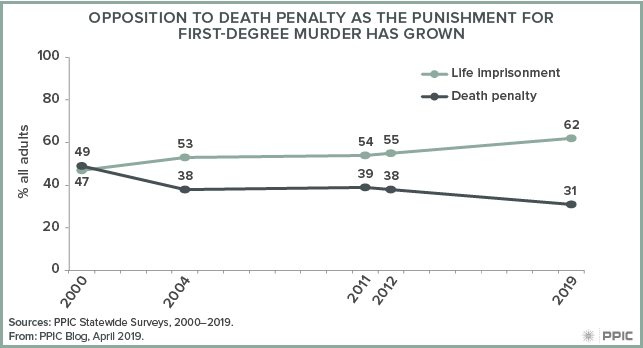
How do Californians view the death penalty today? In our March PPIC survey, a record-high 62% of adults (58% likely voters) prefer life imprisonment with no possibility of parole as the penalty for first-degree murder, compared to 31% of adults (38% likely voters) who prefer the death penalty. The preference for life imprisonment has grown steadily since January 2000, when opinions were divided among Californians (49% death penalty, 47% life imprisonment).

figure - Opposition to Death Penalty as the Punishment for First-Degree Murder Has Grown

The issue is highly partisan: three in four Democrats (76%) and more than half of independents (56%) favor life imprisonment over the death penalty, compared to only one in three Republicans (32%). Since September 2012, when we last asked this question, support for life imprisonment has risen substantially among Democrats (up 9 points) and independents (up 11 points)—but stayed about the same for Republicans (down 1 point).

The preference for life imprisonment has climbed across nearly all age, education, income, and racial/ethnic groups—with the exception of African Americans and Latinos. African Americans are now less likely to favor life imprisonment (67% today versus 75% in 2012), though their support is still high. Among Latinos, 69% prefer life imprisonment, same as in 2012. In contrast, Asian Americans are now much more likely to support life imprisonment (66% today versus 50% in 2012), as are whites (54% today versus 45% in 2012).

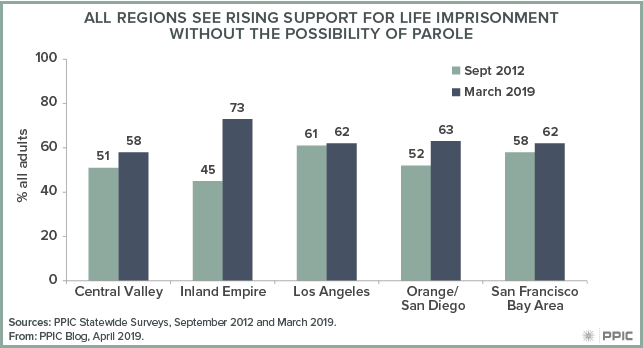
Support has also grown in all major regions of the state, with particularly large shifts in the Inland Empire and Orange/San Diego Counties. In the Inland Empire, 73% of residents favor life imprisonment, up 28 points since 2012. In Orange/San Diego Counties, 63% prefer life imprisonment, up 11 points since 2012.

figure - All Regions See Rising Support for Life Imprisonment Without the Possibility of Parole

Following the governor’s executive order, Assemblymember Marc Levine introduced a constitutional amendment that would abolish the death penalty in California. If approved by a two-thirds vote in the legislature, it will appear before voters on the 2020 ballot. Stay tuned as we continue to monitor Californians’ perceptions and policy preferences on this issue.