Californians Support Actions to Address Climate Change

Today, world leaders converge in New York City for the United Nations Climate Action Summit. The summit comes at a time when the federal government is moving in a different direction than California in the area of climate change and energy policy. Just last week, the Trump administration announced it would rescind the state’s authority to set its own vehicle emission standards—a decision challenged on Friday in a lawsuit filed by California and 22 other states.

Over the past two decades, California has taken a multifaceted approach to reduce greenhouse gas (GHG) emissions, and Californians have consistently shown strong support for the state’s recent actions.

To reduce emissions from the transportation sector—the largest emitter, with 41% of the state’s GHG emissions in 2017—California expanded its vehicle pollution standards to cover smog-forming pollutants and GHG emissions. Other policies include low-carbon fuel standards, a major effort to ramp up electric vehicles, and integrating land-use and transportation investments.

California has also committed to decarbonizing the electricity sector. In 2018, then-governor Jerry Brown issued an executive order that calls for California to provide 100% of its electricity from renewable and carbon-free sources by 2045, and at least 60% by 2030. The state is on its way to meeting this goal, with about a third of electricity provided by renewable sources in 2017.

California was also the first state to enact a cap-and-trade program to reduce GHG emissions, which allows businesses to trade emissions permits. This program now covers 85% of the state’s GHG emissions.

New policies that target the reduction of carbon, methane, and other harmful GHGs are underway. Since carbon dioxide can be removed from the atmosphere by plants and stored in vegetation, soils, and the ocean, the state is developing a strategy to use integrated land-use approaches. These approaches will produce the environmental and economic benefits that traditionally come from natural and working lands, while offering potential carbon storage.

Californians have consistently expressed support for strong climate change policies. A recent PPIC Statewide Survey found 71% of California adults are in favor of the state’s 100% renewable energy goal, including more than six in ten across regions and demographic groups. Two in three residents are in favor of the state law (Senate Bill 32) that requires California to reduce its GHG emissions to 40% below 1990 levels by 2030. Overwhelming majorities of Californians are also in favor of requiring automakers to further reduce greenhouse gas emissions from new cars.
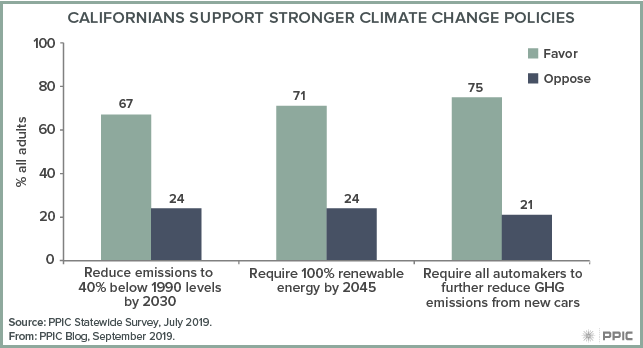
figure - Californians Support Stronger Climate Change Policies

This support will be critical in the state’s ongoing efforts to reduce emissions. In addition, adapting to the new realities brought on by climate change will be essential. Despite California’s goals and policies, some of the effects of a changing climate are already underway—and would persist even if all global emissions ended today. PPIC will continue to track California’s climate change policies and proposals, as well as residents’ opinions about this important issue.

Californians Favor Funds for School Construction

With little time to spare, the legislature last week passed a $15 billion school construction bond. A signature from Governor Newsom will place the bond measure—called the Public Preschool, K–12, and College Health and Safety Bond Act of 2020—on the March 2020 primary ballot. Given Californians’ general support for funding education, how do they feel about bond measures for school construction projects?

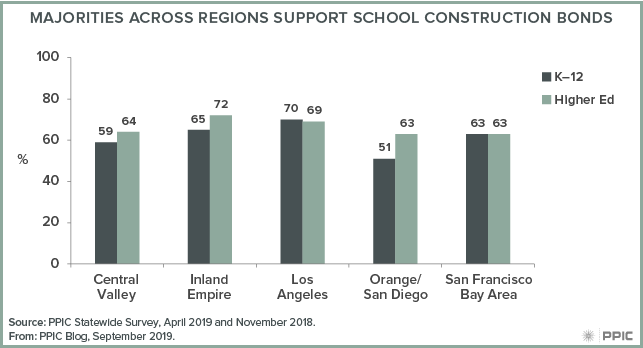
It’s important to note that the PPIC Statewide Survey has not yet asked Californians about this particular measure, which would provide funding across K–12 and higher education systems. However, we have consistently found that Californians are supportive of bonds for each system individually. (We did not ask about specific dollar amounts.)

In our April survey, about six in ten adults (62%) and likely voters (57%) said they would vote yes on a bond for K–12 school construction projects, while in November 2018 two in three adults (66%) and about six in ten likely voters (57%) supported a bond to pay for construction projects in California’s public higher education system. In both surveys, there was majority support across regions and demographic groups—except among whites (47%) for the K–12 bond. For both types of bonds, support was lower among whites than other racial/ethnic groups, and support decreased as age and income levels rose.

figure - Majorities across Regions Support School Construction Bonds

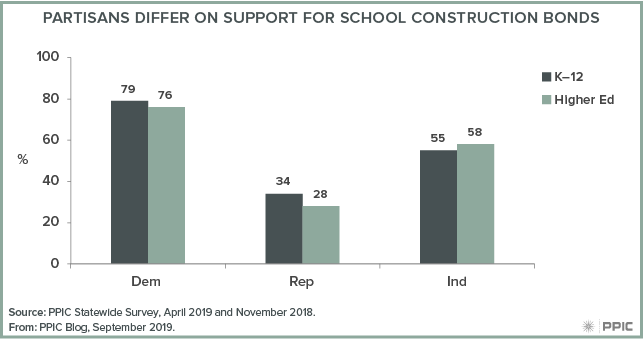
Despite this widespread support for these bonds, we found a significant partisan divide. For both bond questions an overwhelming majority of Democrats as well as smaller majorities of independents have been in favor; far fewer Republicans have been.

figure - Partisans Differ on Support for School Construction Bonds

With California set to play a prominent role in the March Democratic presidential primary—potentially drawing large numbers of Democratic voters—this partisan divide could play a role in passing the bond.

We still don’t know how Californians will perceive this particular bond—in terms of the dollar amount or the joint funding of K–12 and higher education. Stay tuned for more from the PPIC Statewide Survey as we will track support for this bond, as well as many other important 2020 election issues.

Californians and the 2020 Election

This post is excerpted from my opening remarks at PPIC’s annual Sutton Family Speaker Series event, “2020 Election Preview“ earlier today, in Sacramento.

All eyes will be on California when voters make their choices in the upcoming presidential primary on March 3. Last year, California experienced a surge in voter registration and voting. On the heels of record low turnout in 2014, the 2018 election had the highest turnout for a midterm in California since 1982. Still, PPIC colleagues report that turnout is low compared to other states.

To help make sense of the state’s voting patterns, PPIC has just released a new report titled California’s Exclusive Electorate: A New Look at Who Votes and Why It Matters, which analyzes data from the last nine waves of PPIC Statewide Surveys and includes responses from nearly 15,200 California adults. These latest findings, built on a PPIC study that was first published in 2006 and then updated in 2016, help us to set the context for this 2020 election preview event. While much is changing in the electorate, many patterns stubbornly persist.

Growth in political participation has been strong in the wake of significant changes in our state’s election laws and because we live in such interesting times for national politics. However, it is noteworthy that about 5 million California adults are not eligible to vote, while about 5 million eligible adults are not registered and about 7 million registered voters did not cast a ballot in November 2018. If past trends are any indication, only about half of California’s approximately 31 million adults will vote in the November 2020 general election, and far fewer will cast ballots in the March 2020 primary.

Importantly, the demographic makeup of the electorate is not representative of the people of California. Voters in California tend to be white, affluent, college educated, and homeowners. Nonvoters are more likely to be younger, Latino, renters, lower income, less educated, and to self-identify as the “have nots” in society. While some gaps have narrowed, a wide gulf remains between voters and nonvoters.

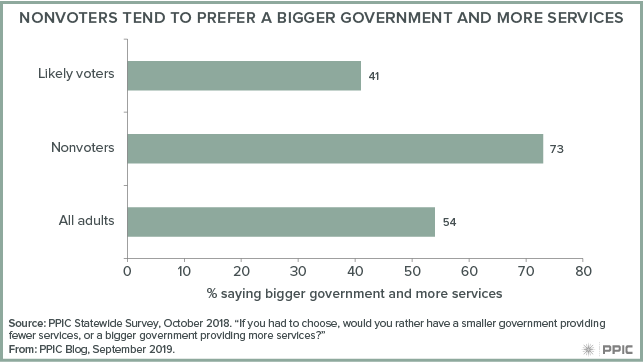
Because of their stark differences, voters and nonvoters are not aligned in their views of the role of government. For instance, only 41 percent of likely voters prefer a bigger government that provides more services, while 73 percent of nonvoters and 54 percent of all adults do so. Preferences vary in similar ways when asked if the government should be doing more to reduce the gap between the rich and the poor, or if the government should do more to make sure that all people have an equal opportunity to get ahead.

figure - Nonvoters Tend To Prefer a Bigger Government and More Services

What would change if more nonvoters turn out for the March primary and November election? Presidential candidates who favor a more expansive government role would get a boost, and so would proponents of state bond measures and citizens’ initiatives to raise taxes on the wealthy. President Trump’s approval rating here is much lower among nonvoters than likely voters (24% to 38%) and, thus, a higher turnout would also help the Democratic candidates in competitive US House races—as it did in 2018.

Expanding the electorate might also inject some idealism into the cynicism and divisiveness of politics today. Nonvoters are more optimistic about the prospect that Americans of different political views can still come together and work out their differences. California still has a long way to go, but the movement toward a more representative electorate that we are starting to see is a step in the right direction for a state that calls on voters to make decisions that impact all of its residents.

In the meantime, PPIC Statewide Surveys will continue to poll all adults so that elected officials can take into account the needs and wants of all of the people they were elected to represent, and not only the likely voters, in a consequential 2020 election year.

Most Californians Favor Requiring Vaccinations

The United States is currently experiencing its worst measles outbreak in more than 20 years, with more than 1,234 people diagnosed with the disease this year—including 67 cases in California. One of the year’s most contentious bills, Senate Bill (SB) 276 addresses this issue by establishing stronger standardization and oversight of medical exemptions from vaccines. (In 2015, California was the first state to repeal religious and personal belief exemptions.) Approved by the assembly and senate and awaiting the governor’s signature, the bill has attracted numerous protests in Sacramento. With public health concerns on one hand and parental choice on the other, how do Californians view vaccinations?

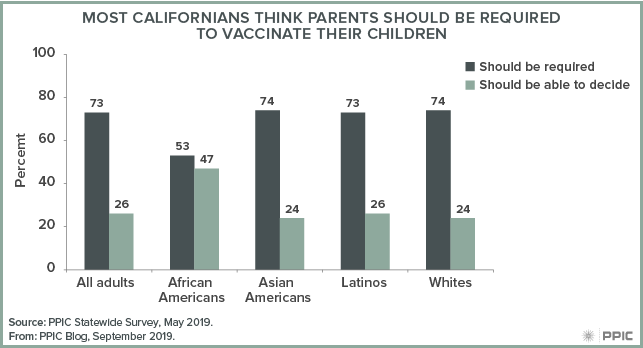
In PPIC’s May Statewide Survey, an overwhelming majority of Californians (73%) said parents should be required to vaccinate their children for diseases like measles, mumps, and rubella. This view is held by at least seven in ten across genders, political parties, and those with and without children in the household. Majorities across demographic groups and regions say vaccinations should be required, as do about three in four Asian Americans, whites, and Latinos—compared to 53 percent of African Americans.

figure - Most Californians Think Parents Should Be Required To Vaccinate Their Children

Vaccine safety has been an ongoing matter of concern, despite assurances from the scientific community. Today, nearly all Californians say that the vaccines given to children are safe (62% very, 27% somewhat). The share that say vaccines are very safe is held by strong majorities across parties, as well as majorities across regions and demographic groups. Notably, among Californians who say parents should be able to decide whether or not to vaccinate their children, 73% say vaccines are safe.

At the same time, eight in ten residents are concerned that measles outbreaks will become more widespread (43% very, 36% somewhat). This view is held by majorities of Californians, although the share who say they are very concerned is higher among older Californians than younger Californians (48% to 34%) and among women than men (48% to 38%).

Even as most Californians support vaccination requirements—and worry about public heath—the discussion around SB 276 remains volatile. PPIC will continue to monitor public opinion as this important issue unfolds.

Democrats View Environmental Policy as Critical in Upcoming Primary

Climate change is becoming a defining issue for voters in next year’s presidential election. According to PPIC’s latest statewide survey on the environment, record-high shares of Californians are concerned about the impacts of global warming, overwhelming majorities disapprove of the way President Trump is handling environmental issues, and most likely voters say presidential candidates’ positions on the environment are important in determining their vote next year.

With California’s presidential primary a little more than six months away, eight in ten likely voters say that the candidates’ positions on the environment are important (44% very, 36% somewhat) in determining their vote. Democratic likely voters (64%) are far more likely than independents (34%) and Republicans (20%) to say candidates’ positions on the environment are very important. In addition to partisan divisions, there are significant generational differences—even within parties, Democratic likely voters age 18 to 44 (76%) are much more likely than those age 45 and older (58%) to say candidates’ environmental positions are very important.

With the environment critical for many Democrats, especially younger voters, whom do they support in the 2020 presidential primary? Among likely voters who are registered Democrats or are Democratic-leaning independents, and who say candidates’ environmental positions are very important, support is greatest for Kamala Harris (19%), Elizabeth Warren (18%), Bernie Sanders (12%), and Joe Biden (11%). (Candidates mentioned are those who polled 10% or higher). Notably, nearly a quarter (24%) of those who say the environment is very important are currently undecided. Here, too, there are differences across age groups. Likely voters age 18 to 44 concerned about the environment name Warren (23%), Sanders (20%), and Harris (15%) as their top primary choices, while those age 45 and older name Harris (22%), Biden (16%), and Warren (15%).

When asked about the Green New Deal, a policy proposal in Congress that aims to address climate change and stimulate economic growth, three in four likely voters who are registered Democrats or are Democratic-leaning independents say that candidates’ positions on the proposal are important in determining their vote (35% very, 39% somewhat). Among those who say positions on the Green New Deal are very important, 20% name Harris and Warren, 14% name Sanders, and 10% name Biden as their preferred candidate. Again of note, 20% of voters who say this is very important are undecided. Likely voters age 18 to 44 interested in the Green New Deal support Warren (27%), Sanders (24%), and Harris (15%), while among those age 45 and older support is greatest for Harris (24%), Warren (16%), and Biden (15%).

figure - Candidates’ Environmental Policies Matter to Democratic Likely Voters

These findings suggest that Californians will place high importance on environmental issues when making choices at the ballot in the coming year. With the next Democratic presidential debate and climate crisis town hall less than a month away, PPIC will be closely tracking the role of climate policies and other salient issues.


Video: A Conversation with Assembly Speaker Anthony Rendon

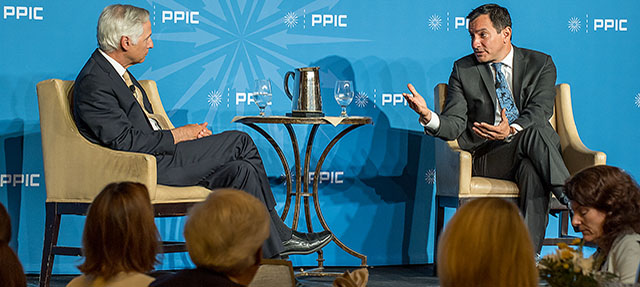
When Anthony Rendon was elected to the California State Assembly in 2012, he thought he would focus on early childhood education. “I came to Sacramento after working in early childhood education for 20 years . . . probably thinking that I would work on that.” However, he continued, “You come here and you realize the extent to which all of these issues impact one another. I think it’s dangerous to isolate any single issues.”

As he noted in his conversation with PPIC’s Mark Baldassare last Thursday, Rendon has focused on many individual measures in this legislative session, including a recently signed bill to modify the criteria for police use of deadly force and a bill to address predatory lending. In the wake of the Gilroy shooting, he has also prioritized a package of gun control bills. He sees these measures as part of a broader focus on improving opportunity for all Californians.

Rendon became Speaker in 2016, when Jerry Brown was governor. At first, he found working with Brown to be “a little frustrating,” but “eventually, we did a lot together. . . . There was a very narrow focus, two or three things—criminal justice reform, climate change, but that was about it. Those are still the things he cares about.” Governor Newsom focuses on a wider range of issues. And, Rendon said, “He’s also more sort of open-ended. He’ll come in and say, ‘Hey, housing, what do you think?’”

One of the issues Newsom cares about is early childhood education—which is still a major priority for Rendon. While Brown “helped us to start down the path” to reinvesting in this area, “now we have a governor who believes that . . . it has a positive impact on families and communities and children.” Newsom’s belief translated into significant funding increases for early childhood education in this year’s budget. “The budget was phenomenal,” said Rendon. Early childhood education is particularly important, in his view, because it’s “not trying to fix something that’s already broken. It’s a way of addressing issues early on, it’s a way of breaking the cycle of poverty.”

Although the Democratic Party controls both the governor’s office and the legislature, Rendon believes it’s important to work with Republicans whenever possible. He sees some common ground on issues such as climate change and education—“the real issues that really impact Californians.” More generally, it is important that state leaders represent all Californians: “I want to be able to tell people . . . ‘I’m working for you.’”


Video: Californians and the Environment

In the wake of the devastating wildfires over the past few years, a record-high share of Californians are very concerned about wildfires becoming more severe as a result of global warming, and majorities support the newly established wildfire insurance fund. At a lunchtime briefing in Sacramento last Thursday, PPIC researcher Alyssa Dykman outlined these and other key findings from the latest statewide survey.

Eight in ten likely voters see environmental issues as very important in the 2020 presidential election. With the California presidential primary seven months away, Kamala Harris (19%), Elizabeth Warren (15%), Bernie Sanders (12%), and Joe Biden (11%) have the highest levels of support among Democratic and Democratic-leaning likely voters; a quarter of these voters are unsure about how they will vote.

More than half of Californians see the state’s leadership on climate change as very important, and majorities support state and federal efforts to address climate change—from renewable energy to land-use and transportation planning that reduces greenhouse gas emissions.

Other survey highlights:

  • Two in three Californians oppose allowing more oil drilling off the coast; seven in ten support offshore wind power and wave energy projects.
  • Majorities view pollution of drinking water as a more serious problem in low-income communities and support the state’s creation of a clean drinking water fund.
  • Many Californians value ocean and beach conditions and say plastics and marine debris are a big problem.
  • There are wide partisan differences on climate change and what the state should do about it.


Motivating Californians to Fill Out the 2020 Census

The 2020 Census will determine the distribution of billions of dollars in federal funds and the accuracy of political representation at the local, state, and federal levels. Emphasizing the benefits to local communities is likely the best way to encourage participation and counteract the concerns many Californians have about confidentiality.

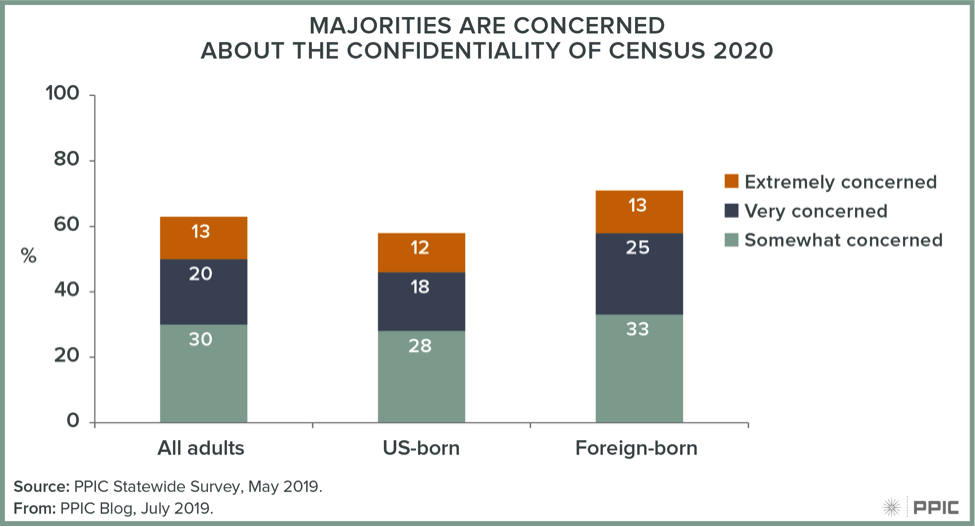
The latest PPIC Statewide Survey shows that 63% of Californians are concerned about whether the Census Bureau will keep their responses confidential, as the law requires. The concern is more acute among Latinos (74%) and African Americans (74%) than among Asian Americans (64%) or whites (52%). Immigrants are also much more likely to be concerned than US-born residents.

Figure: Majorities Are Concerned About the Confidentiality of Census 2020
The Census Bureau conducted an extensive survey and a set of focus groups to identify key reasons for people’s possible reluctance to participate in the census, as well as potential motivating factors that could improve participation. The focus groups revealed that merely informing people of the Census Bureau’s data protection policies was unlikely to assuage concerns.

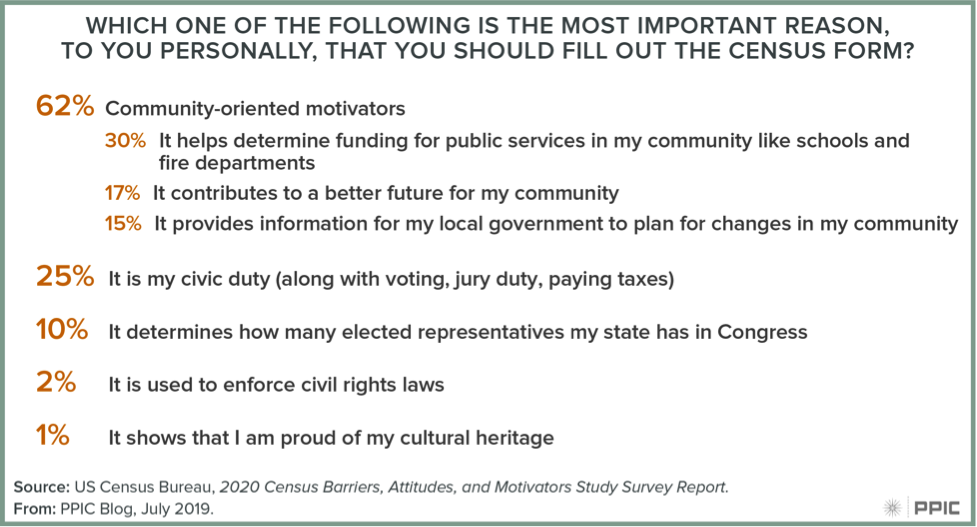
Focus group participants across all demographic groups identified the census’s role in providing federal funding for communities as the main motivator for responding to the census. And 62% of survey respondents said that benefits to the community—determining funding (30%), contributing to a better future for the community (17%), and providing information for local planning (15%)—are the most important reason to fill out the census.

Figure: Most Important Reason to Fill Out the Census Form

But fewer than half of survey respondents knew that the census is used to determine local funding levels, suggesting that this information could go a long way toward motivating participation. Focus group participants—who were chosen from demographic groups deemed likely to respond at low rates—also indicated that hearing directly from trusted voices in their own communities would be important.

Community organizations and elected officials are already acting on this information. On April 1, Los Angeles city and county officials convened a rally to promote the census, emphasizing the link to federal tax dollars for local programs. The Hispanic Federation’s messaging also highlights the census’s role in allocating federal funds.

More efforts are underway. Governor Newsom has pledged an investment of $187 million for outreach activities to boost participation. Meanwhile, the California Complete Count Office has begun issuing grants to help local organizations communicate directly with hard-to-count populations.

Focusing on local funding and community benefits is a promising approach, but a strong outreach strategy will have to go further. A complete and accurate count will likely depend on hard-to-count populations working to develop and deliver the most effective messages for their own communities.

Interview: Citizenship and the 2020 Census

This post is part of a series examining challenges involved in the 2020 Census and what’s at stake for California. 

photo - Eric McGheeAfter a heated legal battle, the Supreme Court has ruled that the Trump administration cannot for now include a question on the 2020 Census asking if residents are US citizens. We spoke with PPIC senior fellow Eric McGhee about what this decision means for California.

PPIC: Why is the citizenship question controversial?

Eric McGhee: First, the question could significantly discourage responses among immigrants, who might fear the data would be used to target them. It didn’t go through the normal testing process for new questions, and many Census Bureau employees recommended against adding it because of concerns about data quality.

Second, the Trump administration says the question is necessary to properly enforce the Voting Rights Act. But advocates for immigrant communities dispute this justification and argue that current citizenship data is sufficient to protect against voting discrimination.

Third, it could have a huge impact on political representation and how congressional and state legislative districts are drawn. Districts are currently drawn based on total population. But this question could make it possible for states to use citizens or voting-eligible residents instead, which would tilt representation in favor of those groups.

PPIC: What does all this mean for California?

EM: Response rates will likely be better if the question is not added. But there’s also concern that the damage has already been done—immigrants still might not be inclined to respond. Immigrants make up about a quarter of California’s population, so we’re particularly vulnerable.

A large undercount could result in less federal funding for California. We’re also the only state at risk of losing a congressional seat from an undercount—other states with high immigrant populations like Arizona and Texas might not gain as many seats, but they probably won’t lose a seat they already have, even if there’s a bad count.

Households with undocumented members are the most likely to be undercounted. PPIC research looked at the possibility of a 10% undercount of these households, a reasonable assumption based on existing research. It would mean missing about half a million Californians.

The reality is that census data is thoroughly protected, even from law enforcement agencies like the FBI and ICE. But our May PPIC survey—conducted before the Supreme Court decision—found 63% of Californians were concerned the Census Bureau will not keep responses confidential. Latinos (74%), immigrants (71%), and African Americans (70%) were especially likely to be concerned.

There are other uncertainties too. The 2020 Census will use a new internet-based approach, which hasn’t been comprehensively tested. And people in general are becoming more reluctant to respond to the census. This means the bureau has to do more follow-up, which is expensive and increases the likelihood of problems arising.

PPIC: What can California do to ensure a complete and accurate count?

EM: California is way ahead of other states in terms of funds it has dedicated to census outreach. The state has already appropriated about $100 million to support a better count, and Governor Newsom has proposed another $50 million or so. Philanthropic organizations have chipped in about $30 million. There’s been a great deal of planning at the state and local levels to get the best count possible.

Addressing concerns about confidentiality could go a long way toward encouraging people to respond. Research also suggests that raising awareness about the census’s role in funding public services like health care, roads, highways, and fire and police departments is another promising approach.

Video: Mobilizing the Inland Empire for the Census—and for the Future

As California’s diverse regions prepare for the 2020 Census, community-based organizations and local leaders are playing key roles. An event last week in Riverside offered insights on the Inland Empire’s outreach strategies for the Census and beyond. Cosponsored by PPIC and the Center for Social Innovation at the University of California, Riverside, the event featured a panel of state and local experts.

The discussion was moderated by Michelle Decker, president and CEO of the Community Foundation. She began by asking Eric McGhee, PPIC senior fellow, to explain the importance of an accurate census count in California. The census helps determine the distribution of federal funding to the states; gathers information about the population that is valuable to policymakers and businesses alike; and is the basis for reapportionment and redistricting. As McGhee pointed out, an undercount of California’s population could be costly in all of these areas.

McGhee noted that California has large shares of “the kinds of groups that tend to be undercounted—Asian Americans, African Americans, Latinos, renters, very young children, noncitizens.” Finally, he outlined concerns about inadequate funding, which has prevented a thorough testing of the process, and the climate of fear in immigrant communities, which could result in lower response rates even if the Supreme Court rules against the inclusion of a question on citizenship later this month.

But there is some good news: “It wouldn’t take that much for California to overcome some of these challenges,” McGhee said. California is arguably more mobilized than any other state, and the Inland Empire is one of the state’s most mobilized regions.

Deborah Phares, Census 2020 project manager at the Community Foundation, sees the census as a great opportunity for policymakers and organizations across Riverside and San Bernardino Counties. The region’s collaborative efforts were galvanized by a state request for information about innovative census outreach strategies. “We decided that we were going to pursue and support and advocate for allocation of resources based on need,” said Phares, adding that the regional plan is designed to avoid overlapping efforts and to integrate data so that organizations could work together “in a very deep way.”

Karthick Ramakrishnan, founding director of the Center for Social Innovation, underscored the significance of a two-county approach to census outreach that draws from a wide range of communities-—geographic sub-regions and demographic groups. “I think the kind of work that’s happening in the Inland Empire is the envy of the rest of the country. . . .We’re building some pretty amazing tools that will stand the test of time.”

Kathleen Kelly Janus, the newly appointed senior advisor on social innovation in the Governor’s Office, agreed: “I think there’s a huge opportunity to invest in capacity building through all these census dollars that are coming in.” She added that the cross-sector approach involving foundations, community-based organizations, policymakers, and other groups “is a model that we can use not just for the census but for all of these other issues that Governor Newsom wants to address.”