
An increasing share of California students are taking the SAT. This is good news for California, suggesting that more and more students are preparing for college. Sixty percent of the high school graduating class of 2015 took the SAT, a much higher share than in the rest of the United States (41%). Moreover, SAT participation has been growing faster in California than in the rest of the nation.
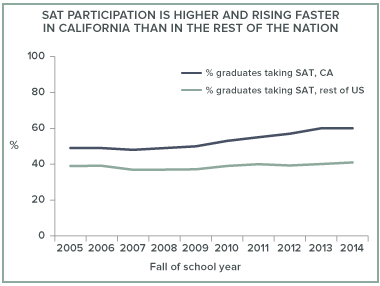 Even though raw scores have declined, once we adjust for the increased share of graduates taking the SAT, the latest scores represent an improvement from a decade ago. On average, California’s graduating class of 2015 scored 1,492 out of 2,400 points on the SAT college admission tests—28 points lower than a decade ago, and 2 points higher than the national average. However, once we factor in the increase in participation over the past decade, California’s 2015 score actually represents an improvement compared to a decade earlier. As participation in the SAT increases, the mix of students taking the exam shifts towards those less academically prepared. In states with high average SAT scores, participation rates are very low, because the only students who participate tend to be very well prepared. On average, a 1 percentage point increase in participation is associated with a 3.4 point decrease in average performance. Given the 11 percentage point increase in participation among California high school seniors over the past decade, we would expect the state’s average SAT score to drop 10 points more than it did.
 Latino students have experienced the largest increase in SAT participation. Over time, SAT participation has increased steadily among all major racial/ethnic groups—including Asian, white, Latino, and African American students. But the largest gain has been among Latino students. For instance, in the 2013–14 school year, 43 percent of Latino graduates took the SAT, up from 35 percent in 2005–06. (Graduation data for 2014–15 has not yet been released.)
Race/ethnicity-related performance gaps are changing. Asian students outperformed white students in the 2014–15 school year by 11 points, reversing a trend in which whites were the higher scorers. The gap between African Americans and whites has narrowed over time. In the 2014–15 school year, white students scored 295 points higher, on average, than African American students and the score gap has decreased from 317 points in the 2005–06 school year. However, the Latino-white gap has increased slightly—not very surprising given the huge increase in Latino students’ participation in the SAT.
 Parental education level, family income matters more now. Parental education and family income are closely related to SAT performance. In 2014–15, students whose parents have bachelor’s degrees scored, on average, 1,601 points—200 points higher than students whose parents have only a high school diploma. Over time this gap has widened, mostly because students whose parents have graduate degrees are scoring higher on the SAT. There is also a widening performance gap connected to gaps in family income, particularly at the upper end of income distribution. For instance, the performance gap between students whose families make more than $200,000 (roughly the top 10 percentile) and those from families earning $60,000 to $80,000 (roughly the median household income) widened from 172 points in 2007 to 251 points in 2014.
The increase in SAT participation, especially among groups that are underrepresented in higher education, is good news for California. At the same time, the continuing gaps in performance represent an ongoing challenge that must be addressed, especially given California’s changing demographics.




 Still, it is instructive to compare the earnings of former students across institutional sectors. The table shows what you would see if you looked up earnings profiles for different types of California colleges. We chose colleges with median earnings that were closest to the median of each sector.
 What the scorecards don’t show is that the difference between colleges is far smaller than the difference within colleges. The figure shows the variation in earnings at the same campuses included in the table above. First, note the tremendous overlap: many students who start at community college end up earning more than some students who started at UC and CSU. The difference in median earnings between the typical CSU and the typical UC is approximately $10,000. But the difference between the 25th percentiles and the 75th percentile of UC Davis student earnings is almost $50,000.
 The fact that most 11th-grade students are not yet ready for college is not necessarily news for California. Since 2004, California students have been able to participate in California’s Early Assessment Program (EAP), which used an optional statewide test to determine college readiness levels of 11th-grade students. The college readiness identification component of the new tests is based on the EAP and informs 11th grade students whether they are ready, conditionally ready, or not ready for college.
  But there is also some good news here for California. For students, new ratings regarding college readiness come early enough for the information to help before they enroll in their 12th-grade classes.
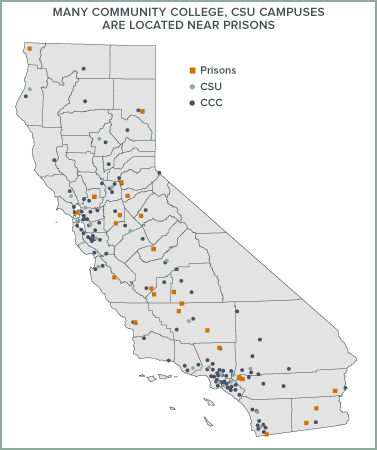 California currently supports community college education for all low-income students, including inmates, through fee waivers. However, these waivers are not available for students who wish to pursue four-year degrees. These students rely on other forms of aid, including federal Pell Grants. The Pell Grant pilot program presents an opportunity for CSU to begin working with CDCR to leverage federal dollars to expand access to high-quality, onsite higher education for inmates in state prison.
 It is easy to see the appeal of completing a bachelor’s degree in three years. For students it has the potential to produce net financial benefits. Three-year graduates are likely to reduce the overall cost of their education despite the additional costs of attending summer sessions and forgoing summer employment. And newly minted graduates can enter the job market one year earlier, presumably with greater earning potential. For schools, reducing the amount of time students take to get degrees allows them to enroll more students.


 The University of California has agreed to bring in more transfer students as part of its budget agreement with the governor. Specifically, UC has committed to enrolling one new transfer student for every two new freshman. This means that one third (33%) of entering students will be transfers system-wide and at each campus (except Merced) by 2017. It also means that unless there is funding to increase enrollment, there may be fewer places for entering freshman.