Should Applying for College Financial Aid Be a High School Requirement?

A majority (58%) of Californians consider affordability at the state’s public colleges and universities a big problem, according to a 2018 PPIC Statewide Survey. Requiring all high school students to apply for financial aid could help more students pay for college.

Currently, around 60% of high school students in California complete the federal application for financial aid (FAFSA)—a student’s gateway to receiving federal grants and loans, as well as state aid. The remainder of students are unlikely to receive aid, even though there’s evidence that many of them would probably have qualified.

Requiring students to apply for aid may result in greater numbers of high school graduates enrolling in college, which could increase California’s college-going rate of 64% (2017–18). Earlier this year, a bill was introduced in the California Legislature that would require students to complete a financial aid application before graduating from high school.

Louisiana was the first state to have such a requirement, starting in 2017–18. The state saw FAFSA completion rates increase from 48% to 84% between 2015 and 2018, and college-going numbers increased by 12.6% (from 22,200 to 25,000) in the same time frame. Texas and Illinois are following suit, with the requirement taking effect in those states in fall 2019 and fall 2020, respectively.

California needs more college graduates to meet the increasing demand for highly skilled workers—and the proposed bill could make a difference if it increases access to college, especially for lower-income students. In addition, better financial support during college can reduce students’ debt load and might help more students complete their programs. Improved access to college and higher graduation rates would set more students up for success in the workforce and benefit the state’s economy.

Californians Favor Funds for School Construction

With little time to spare, the legislature last week passed a $15 billion school construction bond. A signature from Governor Newsom will place the bond measure—called the Public Preschool, K–12, and College Health and Safety Bond Act of 2020—on the March 2020 primary ballot. Given Californians’ general support for funding education, how do they feel about bond measures for school construction projects?

It’s important to note that the PPIC Statewide Survey has not yet asked Californians about this particular measure, which would provide funding across K–12 and higher education systems. However, we have consistently found that Californians are supportive of bonds for each system individually. (We did not ask about specific dollar amounts.)

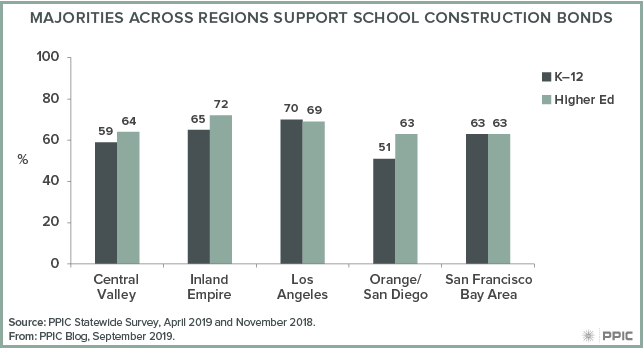
In our April survey, about six in ten adults (62%) and likely voters (57%) said they would vote yes on a bond for K–12 school construction projects, while in November 2018 two in three adults (66%) and about six in ten likely voters (57%) supported a bond to pay for construction projects in California’s public higher education system. In both surveys, there was majority support across regions and demographic groups—except among whites (47%) for the K–12 bond. For both types of bonds, support was lower among whites than other racial/ethnic groups, and support decreased as age and income levels rose.

figure - Majorities across Regions Support School Construction Bonds

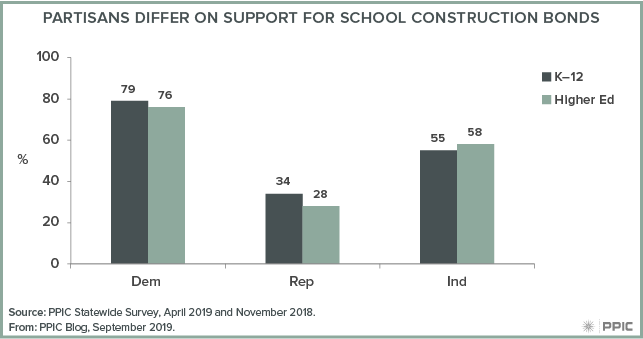
Despite this widespread support for these bonds, we found a significant partisan divide. For both bond questions an overwhelming majority of Democrats as well as smaller majorities of independents have been in favor; far fewer Republicans have been.

figure - Partisans Differ on Support for School Construction Bonds

With California set to play a prominent role in the March Democratic presidential primary—potentially drawing large numbers of Democratic voters—this partisan divide could play a role in passing the bond.

We still don’t know how Californians will perceive this particular bond—in terms of the dollar amount or the joint funding of K–12 and higher education. Stay tuned for more from the PPIC Statewide Survey as we will track support for this bond, as well as many other important 2020 election issues.

Californians and the 2020 Election

This post is excerpted from my opening remarks at PPIC’s annual Sutton Family Speaker Series event, “2020 Election Preview“ earlier today, in Sacramento.

All eyes will be on California when voters make their choices in the upcoming presidential primary on March 3. Last year, California experienced a surge in voter registration and voting. On the heels of record low turnout in 2014, the 2018 election had the highest turnout for a midterm in California since 1982. Still, PPIC colleagues report that turnout is low compared to other states.

To help make sense of the state’s voting patterns, PPIC has just released a new report titled California’s Exclusive Electorate: A New Look at Who Votes and Why It Matters, which analyzes data from the last nine waves of PPIC Statewide Surveys and includes responses from nearly 15,200 California adults. These latest findings, built on a PPIC study that was first published in 2006 and then updated in 2016, help us to set the context for this 2020 election preview event. While much is changing in the electorate, many patterns stubbornly persist.

Growth in political participation has been strong in the wake of significant changes in our state’s election laws and because we live in such interesting times for national politics. However, it is noteworthy that about 5 million California adults are not eligible to vote, while about 5 million eligible adults are not registered and about 7 million registered voters did not cast a ballot in November 2018. If past trends are any indication, only about half of California’s approximately 31 million adults will vote in the November 2020 general election, and far fewer will cast ballots in the March 2020 primary.

Importantly, the demographic makeup of the electorate is not representative of the people of California. Voters in California tend to be white, affluent, college educated, and homeowners. Nonvoters are more likely to be younger, Latino, renters, lower income, less educated, and to self-identify as the “have nots” in society. While some gaps have narrowed, a wide gulf remains between voters and nonvoters.

Because of their stark differences, voters and nonvoters are not aligned in their views of the role of government. For instance, only 41 percent of likely voters prefer a bigger government that provides more services, while 73 percent of nonvoters and 54 percent of all adults do so. Preferences vary in similar ways when asked if the government should be doing more to reduce the gap between the rich and the poor, or if the government should do more to make sure that all people have an equal opportunity to get ahead.
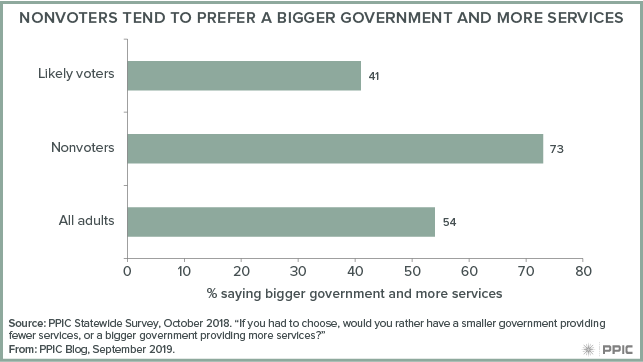
figure - Nonvoters Tend To Prefer a Bigger Government and More Services

What would change if more nonvoters turn out for the March primary and November election? Presidential candidates who favor a more expansive government role would get a boost, and so would proponents of state bond measures and citizens’ initiatives to raise taxes on the wealthy. President Trump’s approval rating here is much lower among nonvoters than likely voters (24% to 38%) and, thus, a higher turnout would also help the Democratic candidates in competitive US House races—as it did in 2018.

Expanding the electorate might also inject some idealism into the cynicism and divisiveness of politics today. Nonvoters are more optimistic about the prospect that Americans of different political views can still come together and work out their differences. California still has a long way to go, but the movement toward a more representative electorate that we are starting to see is a step in the right direction for a state that calls on voters to make decisions that impact all of its residents.

In the meantime, PPIC Statewide Surveys will continue to poll all adults so that elected officials can take into account the needs and wants of all of the people they were elected to represent, and not only the likely voters, in a consequential 2020 election year.

Most Californians Favor Requiring Vaccinations

The United States is currently experiencing its worst measles outbreak in more than 20 years, with more than 1,234 people diagnosed with the disease this year—including 67 cases in California. One of the year’s most contentious bills, Senate Bill (SB) 276 addresses this issue by establishing stronger standardization and oversight of medical exemptions from vaccines. (In 2015, California was the first state to repeal religious and personal belief exemptions.) Approved by the assembly and senate and awaiting the governor’s signature, the bill has attracted numerous protests in Sacramento. With public health concerns on one hand and parental choice on the other, how do Californians view vaccinations?

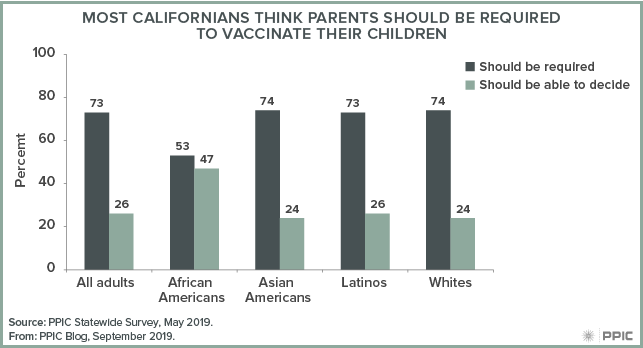
In PPIC’s May Statewide Survey, an overwhelming majority of Californians (73%) said parents should be required to vaccinate their children for diseases like measles, mumps, and rubella. This view is held by at least seven in ten across genders, political parties, and those with and without children in the household. Majorities across demographic groups and regions say vaccinations should be required, as do about three in four Asian Americans, whites, and Latinos—compared to 53 percent of African Americans.

figure - Most Californians Think Parents Should Be Required To Vaccinate Their Children

Vaccine safety has been an ongoing matter of concern, despite assurances from the scientific community. Today, nearly all Californians say that the vaccines given to children are safe (62% very, 27% somewhat). The share that say vaccines are very safe is held by strong majorities across parties, as well as majorities across regions and demographic groups. Notably, among Californians who say parents should be able to decide whether or not to vaccinate their children, 73% say vaccines are safe.

At the same time, eight in ten residents are concerned that measles outbreaks will become more widespread (43% very, 36% somewhat). This view is held by majorities of Californians, although the share who say they are very concerned is higher among older Californians than younger Californians (48% to 34%) and among women than men (48% to 38%).

Even as most Californians support vaccination requirements—and worry about public heath—the discussion around SB 276 remains volatile. PPIC will continue to monitor public opinion as this important issue unfolds.

Predicting California’s Economic Health

After a record expansion, recent signs suggest the nation’s economy may be softening. Unusual patterns in the bond market, signs of slower growth overseas, and the uncertainty of the ongoing trade conflict with China have all raised fears that a downturn may be on the horizon. Yet it is still unclear whether the country is actually headed for a recession. Moreover, all these signs focus on the United States as a whole (or even the whole world). It would be helpful to have more signs for the California economy in particular.

The PPIC Statewide Survey can offer one such sign. The survey has amassed an enormous amount of data on Californians’ views of the economy. For more than 20 years, it has asked survey participants whether they think California will have good or bad economic times in the next 12 months. This question was adapted from the University of Michigan Index of Consumer Sentiment and has been asked of everyone: rich and poor, politically engaged and disaffected, citizen and non-citizen.

Given the broad scope of the survey, in the aggregate these respondents may be good at predicting the direction of the economy. They see what everyone else sees on the news, but they can also report on their own private circumstances and those of close friends and relatives. This might pick up on information that has not yet emerged in official statistics. Indeed, when we look at survey responses alongside recent recessions, an interesting pattern emerges.

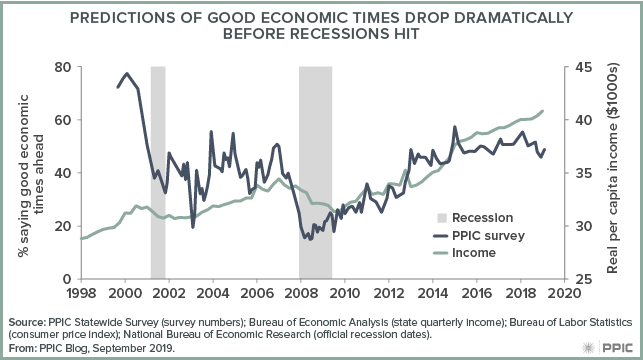
The figure below shows the share of survey respondents who have predicted good economic times for California, and plots it against the state’s per capita income and the periods officially labeled recessions. PPIC respondents appear to have anticipated the last two downturns. The share expecting a good economy plunged a few months in advance of each recession and a slide in state incomes. The drop happened a couple months before the 2001 recession, but as much as nine months before the Great Recession.

figure - Predictions of Good Economic Times Drop Dramatically Before Recession Hit

What do the numbers tell us today? The last few surveys have seen a slight drop in the share expecting good times, but the shift hasn’t yet matched the magnitude seen before the last two recessions. At this point the trend is ambiguous, but well worth watching. It can supplement other California-specific information such as the State Fiscal Health Index from the Legislative Analyst’s Office, but a few months earlier. A sharp and sustained drop in Californians’ optimism about the economy may signal dark storm clouds on the horizon.

A California Dream: Less Plastic in the Ocean

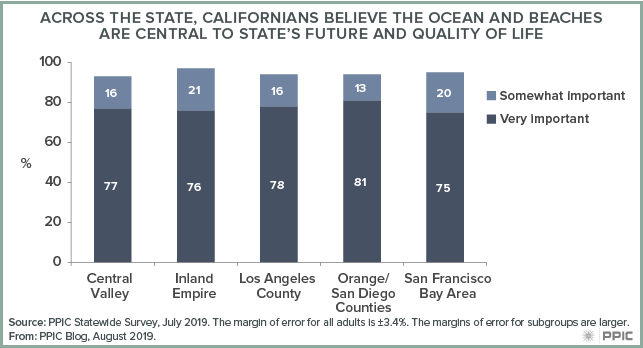
Friday is National Beach Day—an easy day to celebrate in California. The Golden State’s love of beaches is legendary, and as it happens it’s a legend backed by data. The latest PPIC environment survey found that three in four Californians (77%) say the condition of the ocean and beaches is very important to the state’s future economy and quality of life.

figure - Life

Californians are very concerned about a number of threats to their marine environment—including sea level rise, overfishing, and plastic pollution. Overwhelming majorities view plastic and marine debris as a big problem (72%) or somewhat of a problem (18%). Across age, education, income, and racial/ethnic groups, solid majorities say this is a big problem.

figure - Most Californians Say Plastic and Marine Debris along the Coast Closest to Them Are a Problem

The debris comes from diffuse sources. The California Coastal Commission reports that 80% of marine debris comes from land-based sources, such as litter that washes from land to the sea. Rain carries plastic litter of all sizes into the ocean through urban creeks and storm drains.

A growing concern is microplastics, debris that is too small to be caught by existing filters at wastewater treatment plants. This debris can come from personal care products rinsed down drains and synthetic fibers from laundered clothing. It can also come from larger pieces of plastic that end up in the ocean and break down. The most notorious example of this is the Great Pacific Garbage Patch, the eastern part of which is between California and Hawaii.

The problem is particularly acute in California. The San Francisco Estuary Institute reports that San Francisco Bay appears to have more microplastic pollution than other major water bodies in the US. A study by the Monterey Bay Aquarium Research Institute found that Monterey Bay also has high concentrations of microplastics. And scientists are now reporting that microplastics have been detected in Lake Tahoe for the first time, demonstrating the reach of the problem. Plastic is a problem across California’s waters.

Legislators are taking notice, with several bills currently aimed at tackling this issue. The goals are ambitious—for example, Senator Ben Allen and Assemblywomen Lorena Gonzales, both representing coastal areas of the state, have proposed bills that would slash single-use plastic waste in California by 75% by 2030.

While the outcome of such efforts remain to be seen, Californians’ concern about this problem—and their love of the ocean—is sure to drive momentum in the search for solutions.


Democrats View Environmental Policy as Critical in Upcoming Primary

Climate change is becoming a defining issue for voters in next year’s presidential election. According to PPIC’s latest statewide survey on the environment, record-high shares of Californians are concerned about the impacts of global warming, overwhelming majorities disapprove of the way President Trump is handling environmental issues, and most likely voters say presidential candidates’ positions on the environment are important in determining their vote next year.

With California’s presidential primary a little more than six months away, eight in ten likely voters say that the candidates’ positions on the environment are important (44% very, 36% somewhat) in determining their vote. Democratic likely voters (64%) are far more likely than independents (34%) and Republicans (20%) to say candidates’ positions on the environment are very important. In addition to partisan divisions, there are significant generational differences—even within parties, Democratic likely voters age 18 to 44 (76%) are much more likely than those age 45 and older (58%) to say candidates’ environmental positions are very important.

With the environment critical for many Democrats, especially younger voters, whom do they support in the 2020 presidential primary? Among likely voters who are registered Democrats or are Democratic-leaning independents, and who say candidates’ environmental positions are very important, support is greatest for Kamala Harris (19%), Elizabeth Warren (18%), Bernie Sanders (12%), and Joe Biden (11%). (Candidates mentioned are those who polled 10% or higher). Notably, nearly a quarter (24%) of those who say the environment is very important are currently undecided. Here, too, there are differences across age groups. Likely voters age 18 to 44 concerned about the environment name Warren (23%), Sanders (20%), and Harris (15%) as their top primary choices, while those age 45 and older name Harris (22%), Biden (16%), and Warren (15%).

When asked about the Green New Deal, a policy proposal in Congress that aims to address climate change and stimulate economic growth, three in four likely voters who are registered Democrats or are Democratic-leaning independents say that candidates’ positions on the proposal are important in determining their vote (35% very, 39% somewhat). Among those who say positions on the Green New Deal are very important, 20% name Harris and Warren, 14% name Sanders, and 10% name Biden as their preferred candidate. Again of note, 20% of voters who say this is very important are undecided. Likely voters age 18 to 44 interested in the Green New Deal support Warren (27%), Sanders (24%), and Harris (15%), while among those age 45 and older support is greatest for Harris (24%), Warren (16%), and Biden (15%).

figure - Candidates’ Environmental Policies Matter to Democratic Likely Voters

These findings suggest that Californians will place high importance on environmental issues when making choices at the ballot in the coming year. With the next Democratic presidential debate and climate crisis town hall less than a month away, PPIC will be closely tracking the role of climate policies and other salient issues.


Californians Favor Stronger Efforts to Reduce Greenhouse Gas Emissions

Last month, California officials reached a groundbreaking deal with four major auto manufacturers to toughen greenhouse gas emissions. According to PPIC’s latest survey, an overwhelming majority of Californians (75% adults, 76% likely voters) favor requiring all automakers to reduce the emissions of greenhouse gases from new cars. Californians express strong support for other efforts to reduce emissions as well.

The new emissions standards are more stringent than those proposed by the Trump administration and counter the administration’s efforts to restrict states’ ability to set emissions guidelines. Under the agreement, automakers will increase the fuel economy of their new vehicles by improving fuel efficiency and selling more electric vehicles and hybrids. While the stricter standards only apply to California, the automakers said the agreement is meant to show general support for a national emissions standard.

While most Californians favor requiring automakers to reduce emissions from new cars, support is slightly lower than it was when we first asked this question in 2002 (81% adults, 79% likely voters). Today, Democrats (90%) are much more likely than independents (73%) and Republicans (49%) to favor this policy. Strong majorities (at least seven in ten) across regions and demographic groups are in favor.

A strong majority of Californians (74%, 68% likely voters) also express support for encouraging local governments to change land use and transportation planning so that people can drive less. Support has declined somewhat since this question was first asked in July 2008 (81% adults, 79% likely voters). Today, Democrats (87%) are nearly twice as likely as Republicans (45%) to favor the proposal, and three in four (75%) independents express support. Majorities across racial/ethnic groups are in favor, but Asian Americans, Latinos, and African Americans express the highest levels of support. Strong majorities across regions favor the proposal.

figure - Strong Majorities across Racial/Ethnic Groups Favor Efforts to Reduce Emissions

While three in four Californians favor these specific policy approaches, slightly fewer adults (67%) and likely voters (63%) support Senate Bill 32, the state law requiring California to reduce its greenhouse gas emissions to 40% below 1990 levels by 2030. Although partisans are deeply divided, majorities across regions and demographic groups are in favor, with Asian Americans (77%), San Francisco Bay Area residents (76%), and college graduates (76%) expressing the strongest support.

figure - Partisans are Divided on the Reduction of Greenhouse Gas Emissions Required by SB 32

Earlier this year, Senator Scott Wiener introduced legislation (Senate Bill 50) that would require local governments to change zoning for new developments from single-family to multi-family housing near transit and jobs centers—one goal of the bill is to encourage less driving. In our May survey, 62% of Californians (57% likely voters) favored this proposal. Although the bill failed to advance out of a key committee, it is likely to be reconsidered in the 2020 legislative session.

As California’s leaders continue to pursue a variety of climate change and energy policies, PPIC will monitor emerging legislation on greenhouse gas emissions as well as the views of Californians on these proposals.

Video: Californians and the Environment

In the wake of the devastating wildfires over the past few years, a record-high share of Californians are very concerned about wildfires becoming more severe as a result of global warming, and majorities support the newly established wildfire insurance fund. At a lunchtime briefing in Sacramento last Thursday, PPIC researcher Alyssa Dykman outlined these and other key findings from the latest statewide survey.

Eight in ten likely voters see environmental issues as very important in the 2020 presidential election. With the California presidential primary seven months away, Kamala Harris (19%), Elizabeth Warren (15%), Bernie Sanders (12%), and Joe Biden (11%) have the highest levels of support among Democratic and Democratic-leaning likely voters; a quarter of these voters are unsure about how they will vote.

More than half of Californians see the state’s leadership on climate change as very important, and majorities support state and federal efforts to address climate change—from renewable energy to land-use and transportation planning that reduces greenhouse gas emissions.

Other survey highlights:

  • Two in three Californians oppose allowing more oil drilling off the coast; seven in ten support offshore wind power and wave energy projects.
  • Majorities view pollution of drinking water as a more serious problem in low-income communities and support the state’s creation of a clean drinking water fund.
  • Many Californians value ocean and beach conditions and say plastics and marine debris are a big problem.
  • There are wide partisan differences on climate change and what the state should do about it.


Record-High Share of Californians Worried about Climate-Fueled Wildfires

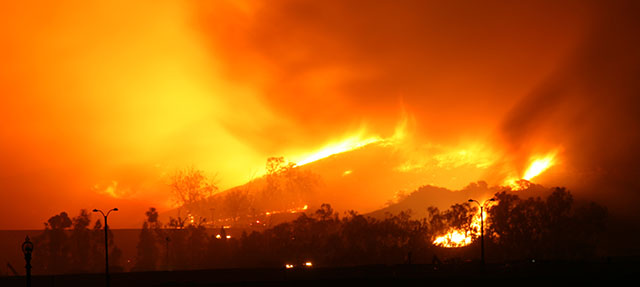
Two devastating wildfire seasons have put Californians on edge about future fire risk. Their concern is reflected in PPIC’s latest Californians and the Environment survey.

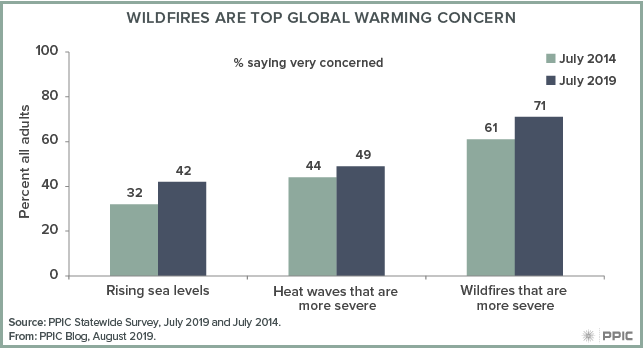
A record-high share of Californians (71%) report that they are concerned about wildfires becoming more severe as a result of global warming. This is an increase of 15 points since 2011 and 9 points since 2018. Concern over climate-fueled wildfires is significantly higher than concern about other potential global-warming impacts—this year it’s 29 points higher than concern over rising seas, and 22 points more than concern over worsening heat waves.

figure - Wildfires Are Top Global Warming Concern

About six in ten Californians (63%) say that global warming has contributed to recent wildfires, a share that has remained steady in recent years. Today, residents of Los Angeles (71%) and the San Francisco Bay Area (69%) are the most likely to hold this view.

Overwhelming majorities of Democrats (85%) and independents (70%), and about half of Republicans (45%), say they are very concerned about more-severe wildfires. Women (77%) are more likely than men (65%)—and young Californians (78% age 18 to 34) are more likely than older residents (66% age 55 and older)—to hold this view.

Back-to-back years of destructive wildfires brought attention to a lack of funding for post-fire recovery, especially following the Camp Fire, when PG&E faced record-high wildfire liabilities and filed for bankruptcy protection. Governor Newsom recently signed into law a $21 billion wildfire fund that will reimburse investor-owned utilities for payments they make to victims of wildfires caused by their equipment. The fund will be paid for evenly by utility investors and ratepayers.

PPIC’s survey found that the governor’s wildfire fund is favored by a majority of Californians (57%). Support is much higher in the San Francisco Bay Area (67%) than elsewhere. The plan is also popular among minority groups, with 73% of African Americans and 68% of Latinos in favor, compared to Asian Americans (55%) and whites (49%).

Post-fire recovery funding does not address the need to reduce wildfire risk factors, however. Our report Improving the Health of California’s Headwater Forests outlines reforms to ensure long-term forest health is a top priority for guiding agency rules, policies, and management practices in one of the more fire-prone areas of the state. It also describes ways to make the most of available funds for forest treatment needs.

The state has been taking steps in recent years to manage wildfire risks. In 2018 the legislature appropriated $1 billion for fire prevention and fuel reduction activities over five years. In April, the governor declared a state of emergency throughout the end of this fire season to spur proactive forest management, especially near high-risk communities.

This year’s state budget allocated significant financial resources to mitigate the funding gap in forest management as well. And the state just added 393 more firefighters to its ranks. Changes at the federal level in 2018 are also helping to reduce wildfire risk on federal lands. These changes give California a chance to increase the pace and scale of ongoing wildfire risk-reduction efforts and to prepare for a new wildfire reality.