Fostering Sustainability in the San Joaquin Valley

California’s largest farming region faces two linked challenges: balancing groundwater supply and demand in overdrafted basins, and addressing water quality in the region’s aquifers. We talked to Ashley Boren, executive director of Sustainable Conservation, about tackling these issues in the San Joaquin Valley.

photo - Ashley Boren

PPIC: Talk about your organization’s efforts in groundwater recharge.

Ashley Boren: We’re focused on trying to get stakeholders in the San Joaquin Valley to think about doing more recharge―and expanding recharge approaches―to make a dent in the overdraft problem. Climate forecasts show that California will have fewer but more intense big storms in the future, with a lot of water coming at once. When that water comes out of the Sierra, we need to let it spread out across the land—including on suitable farmland that can handle large volumes of water and has good soils for recharging groundwater. There’s a lot of opportunity to do more recharge.

We’ve definitely seen an uptick in interest among farmers in recharging on their land—the state’s Sustainable Groundwater Management Act has been a huge driver for that. We’re trying to provide tools to help farmers and irrigation districts recharge as much as possible. For example, we’ve got some demonstration sites where we help growers who accept water onto their land to measure the results and impacts. We use our findings for education and outreach with other farmers. And with our partner the Earth Genome, we’ve created a tool that runs scenarios on how landowners and water agencies can optimize recharge using a combination of dedicated recharge basins, fallowed land, and active cropland. It combines publicly available information on things like soil types with water agencies’ proprietary information on canal capacity and location. It’s cloud-based and easy to use.

We’ve also joined the Department of Water Resources’ Flood-Managed Aquifer Recharge effort, which explores ways to marry flood management with groundwater recharge and habitat creation to achieve multiple benefits. There are more than 200 stakeholders involved so far.

PPIC: What needs to happen to scale up recharge?

AB: Several things need to happen. Improving conveyance infrastructure is the big one, so we can move water to where it’s needed most and where conditions for recharge are suitable. We need more landowners willing to accept water on their land, and also more recharge basins. And we need to figure out how much water is available for recharge by watershed, so water agencies know what they’re working with and how much they can capture.

We’re collaborating with the State Water Board to enhance current regulations that would greatly boost recharge efforts, and exploring ways to expedite permitting while ensuring existing water rights are honored and environmental water needs are covered.

PPIC: You’re also working with dairies to help them address water quality issues. What are key lessons from this work?

AB: We’ve been working with San Joaquin Valley dairies on how to manage manure to protect water quality for nearly 20 years. We’re helping dairies apply nutrients more precisely to their feed crops in order to reduce nitrate leaching into groundwater. But reducing the use of manure on croplands means dairy farmers have a lot of leftover manure. Manure is a valuable resource, so the industry is trying to figure out how to create products with excess manure that can be exported off farms to avoid nitrate leaching. Studies indicate we will have to export up to 40% of the valley’s manure to comply with water quality laws. The good news is the industry is actively working to figure out the market for manure products.

We’re also really excited about a partnership with the irrigation company Netafim, supported by the USDA, which allows dairies to apply their nutrient-rich wastewater very precisely to their feed crops to limit leaching of the excess nitrogen into groundwater. So far we’ve seen up to 40% less water and up to 75% less nitrogen applied to fields at our demonstration projects. An added bonus is this system also reduces nitrous oxide emissions into the air by 90%. If dairies could get credit for reducing this very harmful greenhouse gas, it could help pay for installation of the systems.

Watch a video with Ashley Boren and other panelists discussing how to prepare California’s water management system for the impacts of climate change.


California’s Growing Demand for Recycled Water Has Ripple Effects

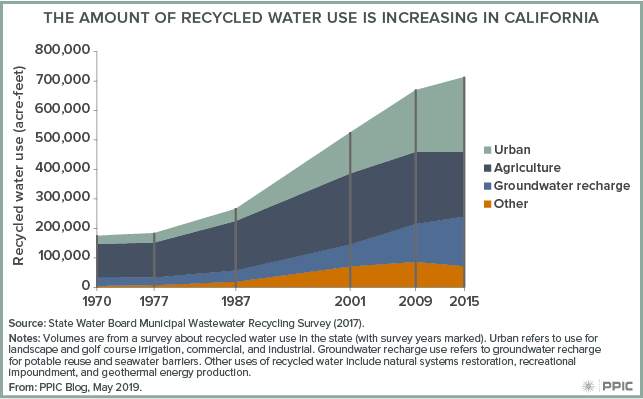
Wastewater agencies produce highly treated water that is increasingly being reused as a water supply. While it’s still only a small portion of overall water use, the use of recycled water has nearly tripled since the 1980s―and is continuing to rise as water agencies seek to meet the demands of a growing population and improve the resilience of their water supplies.

Recycled water production is closely related to water use and wastewater management. It also directly influences flows for ecosystems and downstream water users in some watersheds. As its use expands, weighing the trade-offs involved will help avoid conflict. Meeting current and future demands requires careful consideration of several issues, including the impact of water use on wastewater management, changing types of demand for recycled water, and the needs of ecosystems and downstream users.

Recycled water production is affected by reductions in water use. In other words, recycled water is not completely “drought proof.” The drought of 2012‒16 provides a clear example of this. The rapid reduction of urban indoor water use in this period resulted in a reduced quantity and quality of wastewater for most of the state’s wastewater agencies. In a survey conducted by the PPIC Water Policy Center, just over 40% of wastewater agencies that recycle wastewater reported that their ability to produce recycled water was impaired during the drought. The long-term efficiency of water use and related declines in wastewater quality may also affect recycled water production in the future. For example, as households become more water-efficient, the wastewater they discharge to sewers can have higher concentrations of salts, which are not removed in most treatment processes. Saltier water may not be suitable for outdoor irrigation of golf courses or lawns—common uses of recycled water. If this issue grows in severity, agencies may be forced to incorporate desalination into wastewater treatment, which is likely to add cost and complexity.

Demand for recycled water is growing and changing. Recycled water is increasingly being used in urban areas for public landscape irrigation, golf courses, industrial cooling, and groundwater recharge. Replenishing sources of drinking water is the biggest growth opportunity for water recyclers. New state rules allowing replenishment of groundwater and surface water storage with recycled water—and eventually the direct connection of recycled water to drinking water infrastructure—will create opportunities for recyclers to cost-effectively meet growing demands well into the future. This will require close coordination between water suppliers and wastewater agencies. Some wastewater agencies will also need to increase their treatment capacity to meet the higher water quality standards required for potable reuse.

figure - The Amount of Recycled Water Use Is Increasing in California

Expanding use of recycled water may reduce flows of treated wastewater in rivers, streams, and estuaries. Treated wastewater is an important water source for some ecosystems and downstream water users. Watersheds where wastewater makes up a significant amount of the flow that supports ecosystems and downstream users are especially vulnerable to conflict. For example, a proposal to increase the use of recycled water in Coachella Valley would decrease flows to the already shrinking and vulnerable Salton Sea. Managing recycled water so that it avoids harm to ecosystems and downstream users will require additional collaboration and thoughtful planning.

Closer coordination between wastewater agencies and water suppliers can help minimize impacts from changing patterns of water use on wastewater quantity and quality. Regional planning can also help agencies make smart recycled-water investments that take advantage of opportunities to more directly replenish drinking water supplies. New projects should be based on a careful consideration of local demands and costs, and also how well the investment fits into the overall regional supply of water for both human and environmental uses. Taking such steps now can help water managers in this growing sector make the most of this once-maligned resource.


California’s Dairy Industry Faces Water Quality Challenges

Contaminated groundwater is an ongoing problem in some of the state’s poorest rural communities, particularly in the San Joaquin Valley. One big threat is nitrate, caused mainly by many decades of crop fertilization with chemical fertilizers and dairy manure. For dairy farms, solutions are especially difficult and expensive. We talked to Anja Raudabaugh of Western United Dairymen about what can be done to address these challenges.

photo - Anja Raudabaugh

PPIC: What is the relationship between the San Joaquin Valley dairy industry and water quality?

Anja Raudabaugh: The entire valley faces significant water quality problems. Arsenic, which occurs naturally, is the number one contaminate. The second most widespread problem is nitrate. We’ve had these issues for many decades. Animal agriculture, aging wells, certain soil types, and heavy reliance on groundwater all add to the problem.

We recognize that the dairy industry is part of the problem—and we also want to be part of the solution. The public perception is that our manure lagoons are particularly problematic, but most lagoons in the valley are heavily lined and can’t affect groundwater. It’s also important to note that the industry’s manure management requires a state permit—we’re regulated as to how much nitrogen we can apply and how we store it. California’s standards for operating a dairy are the strongest in the nation.

With the help of studies by UC Davis, monitoring from the Regional Water Board, and industry-designated monitoring wells, we’ve found that 94% of the nitrate pollution surrounding dairies is coming from applying manure to land. Manure is collected in lagoons, diluted with water, and then applied to row crops that feed our cows.

PPIC: What are some promising approaches to help address these water quality problems?

AR: This is a big, statewide challenge, and all parties need to be at the table to work on comprehensive solutions. The dairy industry has been working on solutions to nitrate for about a decade. For the short term we need to use less manure on lands where nitrate leaching is a problem. And we must ensure communities have access to clean drinking water.

New technologies can help. For example, a new filtration system that can remove a lot of nitrate out of lagoons has been installed on 100 valley dairies so far. We’re also working with Sustainable Conservation on some promising biological solutions―including a pilot project to use high quantities of earthworms to decompose nitrate coming from manure. The worms digest up to half the nitrogen and leave a very pure fertilizer. But it’s an expensive solution―a million earthworms is costly. It’s been installed on four dairies, but they haven’t yet been able to scale it. We’re also trying to build markets and incentives to move organic manure off dairies to other farms where it can be used.

Agriculture alone can’t afford to bear the full costs of permanent long-term water quality solutions to the range of contaminants in the state’s water. There remains an overarching need for public funding to address these problems, such as covering costs for operation and maintenance of small water systems in disadvantaged communities. A 2012 report discussed two ways to remediate nitrate in groundwater: pump and treat the water, then reinject it into the ground; or treat it in place. Both approaches are very costly.

We believe the proposed “safe and affordable drinking water fund” is the most elegant and fairest solution proposed so far. This fund spreads the costs out across the whole state. Agriculture would pay a significant portion but not all of it. This type of fund is the blueprint for how we get there—and would ensure the dairy industry is able to participate and still remain a viable financing partner into the future.

PPIC: What gives you hope for the dairy industry?

AR: The state’s dairies are producing some of the most sought-after agricultural products in an environmentally sustainable fashion.

Our dairy families want to produce healthy products, and want to work and live in healthy communities. This is our drinking water, too―99% of the valley’s dairies are family owned, and these folks are raising their families in these communities. Clean drinking water is a moral issue for this organization. I’m really proud of the dairy men and women who’ve stepped up to work on this problem. I’m optimistic because our industry is proactively helping to deliver solutions to these problems.

Watch a video of Anja Raudabaugh and other panelists discussing water quality management in the San Joaquin Valley.

What Does the Colorado River Drought Plan Mean for California?

A much-anticipated plan to address chronic water shortages in the Colorado River Basin was recently signed into law by President Trump. This drought contingency plan (DCP) aims to slow the long-term decline in Lake Mead’s water levels caused by over-allocation of Colorado River water and 19 years of drought, as well as address future water shortages in the basin.

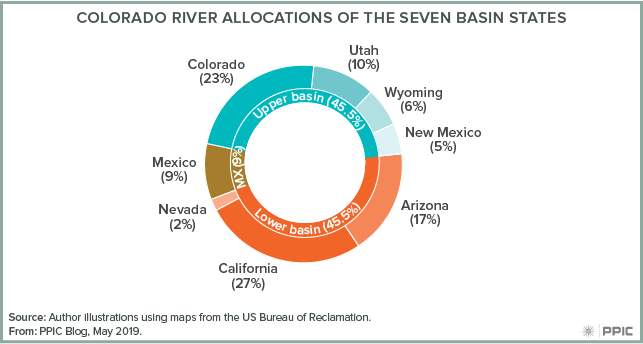
The DCP is the fruit of a decade of negotiations among the seven basin states to resolve the over-allocation problem through cuts and water storage. (Mexico receives water from the river but is not part of this plan.) California has the largest share of the Colorado, with senior rights to more than a quarter of the river’s average annual flow.

figure - Colorado River Allocations of the Seven Basin States

Lake Mead is a water source for 600,000 acres of farmland and 19 million people in Southern California. California agencies can also store up to 250,000 acre-feet of water in Lake Mead.

Without the DCP, Lake Mead’s water level could drop too low to allow releases from Hoover Dam. As the lake nears this threshold, senior water right-holders in California might be tempted to withdraw their water before it becomes inaccessible. While such a move would be permissible, it would accelerate the drop in the lake level and affect future deliveries for junior water right-holders in the other lower-basin states.

The DCP eliminates this concern and delivers an orderly and mutually agreed upon method to manage shortages until 2026. It provides assurance against curtailments for water stored behind the dam. This is especially important for the Southern California water agencies, whose ability to store water in Lake Mead is crucial for managing seasonal demands.

Some significant challenges must still be addressed, however. The Imperial Irrigation District, the largest Colorado River water user, opted out of the plan due to a dispute over funding to restore the shrinking Salton Sea. The district also filed a lawsuit that calls for the DCP to be suspended until an environmental review of the plan is completed.

The lawsuit alleges that the Metropolitan Water District (MWD), which would contribute most of the water required to fulfill California’s obligations under the DCP in times of system-wide shortage, unlawfully approved the DCP. IID claims that MWD did not consider the “sources of water that would be necessary for [it] to fulfill its commitment and the environmental effects associated with obtaining water for those sources.” The outcome of this lawsuit is uncertain.

Currently, the Colorado supplies about a third of all water used in Southern California’s urban areas. The region’s water agencies are taking steps to develop more local supplies and increase water efficiency to help them meet water demand if DCP cuts are triggered during a future water shortage.

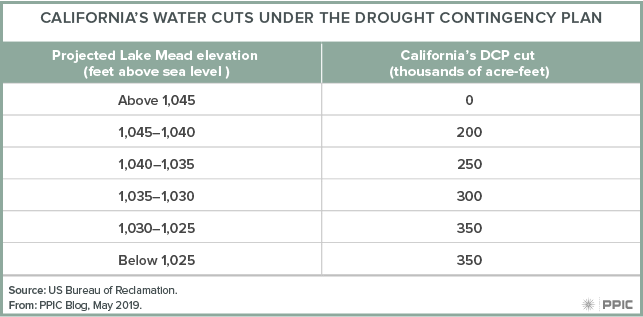
The plan won’t cause immediate water cuts. This year’s wet winter means that Lake Mead’s elevation, currently 1,090 feet above sea level, may remain above the 1,045-foot threshold at which the mandate is triggered for California. But the basin states now have a plan in place to address the next dry spell.

table - California’s Water Cuts Under the Drought Contingency Plan

Commentary: How Better Wastewater Management Can Help California Adapt to Climate Change

This commentary was published on CALmatters on May 9, 2019.

Our public health relies on wastewater management to treat sewage and remove pollutants coming from our homes and businesses.

This system is fundamental to protecting our health. In California, treated wastewater also is a critical source of water for the environment, and, increasingly, a source for recycled water. Climate change is worsening water scarcity and flood risks. Advancements in engineering and technology can help prepare wastewater agencies for a changing climate. But significant shifts in policy and planning are needed to address these challenges.

Wastewater agencies must reliably remove pollutants even as the quantity and quality of the water they treat declines during droughts, and when large storms push their equipment to the breaking point.

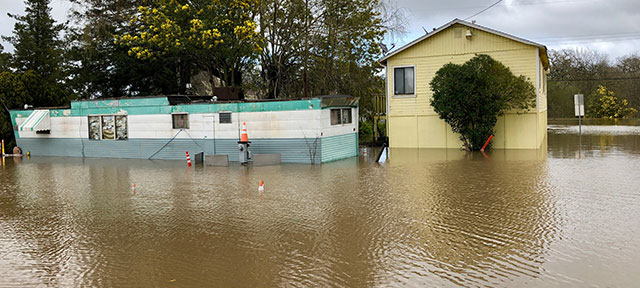
In February, an atmospheric river storm—the type that is expected to become more common as the climate warms―inundated Healdsburg’s wastewater treatment facility and pushed more than five times the normal flow of wastewater and runoff into Santa Rosa’s treatment plant.

In a drought, reduced flows to wastewater plants can hamper agencies’ ability to comply with treatment standards, damage equipment, increase costs, and shrink revenue. Lower inflows also reduce the volumes available for recycled water, often considered a “drought-proof” supply.

The drought of 2012–16 brought all of these problems to the fore. Many wastewater agencies are now changing their operations, infrastructure, or finances in response to the challenges they experienced. Our new study recommends sector-wide changes in three areas to help build the sector’s climate resilience:

  • Maintain water quality in the face of reduced indoor water use. Short-term water conservation during droughts and longer term reductions in water use from indoor efficiency measures challenge wastewater management. All wastewater agencies should assess their vulnerability to major climate pressures, and plan for future droughts. Better coordination and information sharing with suppliers about indoor water conservation and efficiency efforts are also key.
  • Make smart recycled water investments. Coordination among wastewater and water supply agencies is needed to address the demand for recycled water. Regional planning for recycled water projects can result in investments that are more responsive to changing water use and an increasingly volatile climate, bringing financial and environmental benefits.
  • Balance conflicting objectives within watersheds. Many wastewater treatment plants discharge treated water into inland watersheds.

Meeting increased demand for recycled water may fuel conflict over the use of treated discharge to support ecosystems and downstream users. Rivers and streams are expected to experience lower flows and higher temperatures, which will heighten threats to aquatic ecosystems. Resources are needed to identify areas most at risk of conflict over the use of treated wastewater, and to develop tools to evaluate the impacts of water recycling projects on the environment and downstream water users.

The state can help wastewater managers make these adaptations, which are critical to building a more integrated and resilient water system. The State Water Board should align its policies on water use, wastewater, recycled water, and environmental protection to better manage for these multiple objectives.

Forging new partnerships to tackle the full range of climate-related risks will help wastewater agencies determine the best adaptations and improvements needed to prepare wastewater management—and California’s water system as a whole—for a more volatile future.


Testimony: Water Supply and Quality Challenges in the San Joaquin Valley

Ellen Hanak, director of the PPIC Water Policy Center, testified today (April 30, 2019) before the Assembly Subcommittee on Water, Parks and Wildlife, at a hearing on balancing water needs into the future in the San Joaquin Valley. Here are her prepared remarks. View her presentation.

The San Joaquin Valley produces more than half of California’s agricultural output. Irrigated farming is the region’s main economic driver and predomi­nant water user. The region is also ground zero for many of the state’s most difficult water management problems―including long-term depletion of groundwater reserves, lack of safe drinking water in many rural communities, and accumulation of a variety of groundwater contaminants.

Over the past three years, the PPIC Water Policy Center has worked with an interdisciplinary team of researchers from Fresno State, Point Blue Conservation Science, UC Davis, and UC Merced to examine these challenges and identify promising solutions. Today, I’ll provide you with some highlights from our latest report, Water and the Future of the San Joaquin Valley, including areas where the California Legislature can be most helpful in facilitating progress. Two of my coauthors on this study—Sarge Green from Fresno State and Thomas Harter from UC Davis—are also here to answer your questions.

I’ll touch on four priority areas for action: balancing water supplies and demands; ensuring safe and reliable drinking water supplies; managing groundwater quality for the long-term; and fostering beneficial water and land use transitions.

Balancing water supplies and demands

Chronic groundwater overdraft—pumping in excess of the amount that is replenished—averages nearly 2 million acre-feet per year in the San Joaquin Valley, or roughly 11 percent of the region’s net water use. The consequences include dry wells, sinking lands, damaged infrastructure, and reduced reserves to cope with future droughts.

In light of these problems, the valley is on a fast track to implement the Sustainable Groundwater Management Act (SGMA), which requires groundwater users to bring water supplies and demands into balance by the 2040s. The first local sustainability plans must be finalized and launched in early 2020.  Although attaining balance will benefit the valley’s economy over the long-term, it will entail some near-term costs.

To end overdraft, local groundwater sustainability agencies (GSAs) will have to augment supplies, reduce demands, or use some combination of these approaches. We estimate that about a quarter of the historical deficit can be filled with new supplies at prices farmers can afford.  The balance will likely need to be met by managing farm water demand—with the idling of at least 500,000 acres of irrigated cropland (about 10% of current acreage).

On the supply side, the most promising options are to capture and store more local runoff in groundwater basins, and to increase water imports by managing the system differently. On the demand side, increasing water trading—both within and across groundwater basins—can significantly mitigate the economic impacts of reducing water use, by allowing farmers to maintain the crops that generate the most revenue, GDP, and jobs. Reducing overdraft gradually between now and 2040—the “glide path” approach to implementing SGMA—can also lessen the costs of adjustment by giving farmers more time to adapt.

Priority actions to facilitate the adoption of an optimal supply and demand portfolio approach include:

  • Assessing which new infrastructure investments—including conveyance—are warranted to support more recharge and water trading.
  • Incentivizing recharge on farmland—one of the most cost-effective ways to store water.
  • Developing transparent and equitable local water trading rules, including for groundwater.
  • Clarifying how much additional high winter and spring runoff is available for recharge.
  • Facilitating state and federal approvals for water trading and groundwater banking projects.
  • Coordinating both within and across groundwater basins to maximize benefits.

Although local and regional water users and agencies will need to take the lead on many of these actions, both the state and federal governments can play vital roles. The state can be especially helpful in clarifying how much water is available for recharge, facilitating approvals for water trading and groundwater banking projects, and working with local partners to assess infrastructure needs.

Ensuring safe and reliable drinking water

The valley’s most urgent water issue is addressing chronic problems of unsafe and unreliable drinking water in rural communities, most of which rely on groundwater. The region is a hot spot for unsafe drinking water. With just 10 percent of the state’s population, it is home to more than half of all community water systems that have persistently contaminated tap water. Contamination is also a problem for very small water systems that are regulated by counties and for homes served by domestic wells. Some groundwater contaminants—such as arsenic and uranium—occur naturally. Others are caused by human activity. For instance, agriculture is the primary source of nitrate, a serious contaminant that is widely present in shallow wells.

The region is also a hot spot for unreliable drinking water supplies in communities that depend on shallow wells. During the latest drought, roughly half of the 150 small water systems that sought emergency assistance from the state were in the valley, as were nearly 80 percent of all residents who reported dry domestic wells. Without concerted action, this vulnerability will persist. Several thousand additional drinking water wells are vulnerable if groundwater levels fall another 30 feet—something that could easily happen during the next drought, or if local groundwater sustainability plans allow continued overdraft under a glide path approach and fail to mitigate the problem.

In recent years, various legal and administrative changes have helped address the drinking water crisis. But there is still an urgent need to build a robust, comprehensive framework for tackling it. Affected communities will require technical, financial, and managerial assistance. Here are some top priorities:

  • Consolidating or aggregating systems to provide economies of scale to small water systems.
  • Providing technical support.
  • Planning for shortages and developing rapid response procedures to mitigate dry wells.
  • Ensuring funding support for both capital investments and ongoing operations and maintenance.

A variety of local parties—including counties, urban water suppliers, irrigation districts, groundwater sustainability agencies, pollution dischargers, and NGOs—will need to play a major role in helping to address this problem. But the state must take leadership in developing funding solutions and ensuring there’s a comprehensive plan for addressing both quality and supply vulnerabilities in a timely manner.

Managing groundwater quality for the long-term

Valley farmers and other dischargers of contaminants must also meet new requirements for protecting groundwater and soils from the long-term buildup of nitrate and salts. California has been a national leader in seeking to address these problems, with a suite of new regulations adopted over the past decade. The Salt and Nitrate Control Program (SNCP)—adopted by the Central Valley Regional Water Quality Control Board in 2018 and pending approval by the State Water Board—provides an umbrella framework for addressing these challenges. SGMA also requires GSAs to protect water quality while balancing groundwater supplies and demands.

Nitrate in drinking water wells, which originates primarily from inorganic nitrogen fertilizer and manure used in farming, poses significant public health risks. Dairies face special challenges in managing manure efficiently, and solutions have remained elusive.

Salinity is a growing threat to local agricultural productivity. Roughly 250,000 acres of cropland have already been retired due to salinity in soils, and another 1.5 million acres are considered impaired.

But managing for these contaminants is costly. The SCNP seeks to find a balance between protecting water and land resources for the long run and maintaining the viability of agricultural production in the present, while also ensuring safe drinking water solutions.

Here are some top priorities for action:

  • Coordinating water quality and quantity management. This will be especially important for managing groundwater recharge, which under some circumstances can accelerate the migration of chemicals in the soil (especially nitrate) into the aquifer and impair drinking water quality, at least for a time.
  • Implementing new technologies to manage pollutants. This will be especially important for dairies, which need to remove excess manure and transform it for other uses.
  • Providing regulatory flexibility. This includes flexibility to allow some continued loading of nitrogen and salt as long as impacts on drinking water supplies are mitigated, as proposed under the SNCP.

While local water managers, farmers, and the agricultural industry will need to take the lead in addressing these issues on the ground, the state can play a major role in providing effective and responsible regulatory flexibility, and in supporting research and development (R&D).

Fostering beneficial water and land use transitions

Finally, the valley will need to plan for and manage the changing landscape as some cropland is idled—both to avoid negative consequences from dust, pests, and weeds, and to get the most value from these lands in other uses. Pursuing approaches that seek multiple benefits on this land can support the regional economy, public health, and the environment. There are numerous stewardship options: healthy soils, habitat, wildlife-friendly solar, recharge, flood protection, and recreation.

There are already some models of how this can work. For instance, the Kern Water Bank provides thousands of acres of upland habitat for San Joaquin desert species and abundant intermittent wetlands, while also serving as a major groundwater storage site. But to date, there is no serious planning effort to see how lands coming out of production might be used most productively, and how to provide the right incentives to realize this potential.

Here are some top priorities for action:

  • Initiating broad-based, inclusive planning. For many issues—ranging from determining the best areas for habitat investments to coordinating recharge and managing salinity—taking a valley-wide perspective will be key.
  • Implementing flexible regulatory approaches to make it easier to implement multi-benefit restoration projects.
  • Providing incentives and funding to support activities on the ground.
  • Boosting technical support and R&D.

Again, local and regional parties will need to take the lead on many aspects of this work. But state and federal agencies can facilitate good outcomes by providing regulatory flexibility, financial incentives, and support for technical assistance and R&D.

How can the Legislature be most helpful now?

The valley is at a pivotal moment, and there are many ways in which the state can assist the region’s residents implement efficient, equitable, and sustainable solutions to their water-related challenges. Here are some final thoughts on how the Legislature can be most helpful in the near-term:

First, ensure a robust, comprehensive framework for safe and reliable drinking water solutions. This is an urgent public health issue and needs urgent attention. The framework should include reliable funding, as well as a sound, timely approach to providing technical and managerial solutions on the ground.

Second, support the building blocks for the region’s transition to groundwater sustainability. Planning for sustainable groundwater management is well underway, but this transition won’t happen overnight. Early actions to promote forward momentum will be especially valuable in the next few years.

To create the preconditions for success, the state should accelerate its own efforts to provide regulatory clarity, consistency, and flexibility. Key areas include how much water is available for recharge, how to recharge in ways that are acceptable from a water quality perspective, and how to implement broad-based, multi-benefit restoration projects that put land coming out of production to best use.

Support for local and regional initiatives can also make a difference. Key areas include assistance with the assessment of smart infrastructure investments, pilot efforts to implement innovative approaches on the ground, technical support and R&D for water quality and land stewardship solutions, and broad-based planning to develop regional approaches for multi-benefit management of water and land.

California has long been a model for others in the management of natural resources. Many are now looking to see how we tackle the tough challenges of providing safe drinking water to all residents and managing our groundwater resources sustainably for the long term. The San Joaquin Valley is on the front line for addressing both of these challenges. The region’s farmers and residents have a history of creatively adapting to difficult and changing conditions, and constructive solutions are in reach. The state can provide vital support to help ensure success.

Video: Managing Wastewater in a Changing Climate

California’s wastewater sector plays a key role in protecting public health and the environment. It is also the source of recycled water—a growing part of the water supply. But as climate change increases the risks of water scarcity and creates other new challenges, the sector is at a turning point. A recent event brought together PPIC researchers and a panel of experts to explore how wastewater management can adapt to a more volatile future.

Caitrin Chappelle, associate director of the PPIC Water Policy Center, outlined findings from a new report on climate risks to the sector and strategies needed to manage them. She noted that drought—as well as ongoing efforts to conserve water—can have unintended consequences for the sector. Less water flowing into treatment plants affects treatment processes and can harm infrastructure. Less treated water flowing out of these plants reduces supplies for downstream users, ecosystems, and recycled water uses.

Chappelle noted that cooperation is a key strategy for building resilience: “Local wastewater agencies will need to work closely with one another, with water supply agencies, and with the state to build a more resilient future.”

Identifying tradeoffs and understanding the unintended consequences of water conservation and the use of treated wastewater are key to developing good policy, noted the panel’s moderator, Kurt Schwabe, a professor at the University of California, Riverside, and an adjunct fellow at the PPIC Water Policy Center.

The three panelists—Jelena Hartman of the California State Water Board, Adam Link of the California Association of Sanitation Agencies, and Nina Hawk of the Santa Clara Valley Water District—discussed the interactions between water use and wastewater, lessons learned from the latest drought, and ways to improve coordination and information sharing with water suppliers going forward.

Hartman noted that with the 2012‒16 drought emergency behind us, “it’s a good opportunity to talk about what worked, what didn’t work” for managing future low-flow situations. “We need to plan, adapt, and be prepared, because the next drought will come,” she added.

Hawk said her agency is fully behind efficient water use but also recognizes that conservation can have impacts on wastewater management and recycled water supplies. “We really have to step back and take a planning look at it,” she said. Collaboration between water suppliers and treatment agencies is key to managing wastewater for multiple uses, she noted.

Link highlighted the difficulty in planning for future capital improvements for both sanitation and recycled water in a changing climate. “If you’re not sure how low your flows will go, how do you plan for a plant that will be useful 30 years from now?” This may require more creative planning for capital investments to ensure that new infrastructure is flexible enough for changing conditions—for example, connecting recycled water plants to groundwater and surface storage to help them weather drought.

We invite you to watch the video from the event.


A New Reality for Federal Flood Insurance

Flood damages have been rising around the country―most recently in the Midwest. The National Flood Insurance Program provides coverage to more than 5 million households and small businesses across the United States, including more than 229,000 in California. The program has been hard hit by payouts from major flood disasters in recent years and is heavily in debt. The Federal Emergency Management Agency (FEMA), which houses the program, has recently announced significant changes. We talked to Carolyn Kousky, a flood insurance expert at the Wharton Risk Center at the University of Pennsylvania and a member of the PPIC Water Policy Center’s research network, about the program.

PPIC: How is the national flood insurance program changing?

CAROLYN KOUSKY: FEMA is modernizing how it prices flood insurance policies, drawing on best practices in risk modeling. The changes are scheduled to roll out in October 2020. One big change is that new rates will be property-specific and based on factors like how close a property is to a river or its elevation. Higher-risk properties will have higher rates. Previously, everyone in a high-risk zone paid the same rates, regardless of the level of actual risk. This change should be easier to understand for residents, which is an important improvement. Economists have been calling for such an approach for a long time.

These changes will also mean that rates vary more smoothly across a community. FEMA flood maps designate so-called “100-year” floodplains. In the old system, if your house was just outside that line your rates dropped dramatically—it was like a cliff between rates. Neighbors might have differences of $1,000 or more, but of course the risk between neighboring houses was almost never that big. This new system should eliminate that cliff.

The new pricing won’t help low-income families afford insurance, so there will still be a need for an affordability program. But the new pricing will eliminate another inequity. The previous rates didn’t always take into account the value of the structure being insured. That meant that higher-value structures were paying less than they should, and lower-value ones were paying too much. So to the extent that the value of a house reflects income, poorer households were being penalized. This problem is now being fixed.

PPIC: The federal government has acknowledged that most of its flood maps don’t reflect rising risk, and now some communities have created stricter standards to help them prepare for floods in a changing climate. Will this new approach help the program prepare for climate change?

CK: In some ways, yes. One important thing the new pricing does is add flood risk from rainfall. Previously the program’s pricing largely only reflected risks from coastal storm surge and rivers overflowing their banks. Rainfall risk is increasing with climate change, so this is a very positive change in the program. We saw the damage that rainfall flooding can produce in an extreme way with Hurricane Harvey.

These annual insurance policies only price for next year’s risk―and this is how it should be. It wouldn’t make sense for property owners to have to pay today for risks 50 years down the road. So the rating changes are not about managing climate changes. But we do need to think about increasing climate risk when planning new development and infrastructure and making other longer-term investments.

PPIC: Do you think these changes will make the program fiscally sustainable for the long term?

CK: As I understand it, these changes are about making sure the prices better reflect current risks. Based on what FEMA has released so far, there’s no way to know how it will affect the program’s revenue.

This new pricing is definitely fairer and more reflective of risk. If Congress coupled that with forgiving the program’s existing debt—which is still in the tens of billions―the program could use this as a re-set on its fiscal sustainability. There is a bill in the House right now that would do this. But thinking about the long-term fiscal soundness of the program in the face of new urban development and a changing climate would likely require more than just rating changes.

That said, there are so many benefits to making these changes in the insurance program. It’s a great first step to modernizing the system.

Video: State and Federal Experts Discuss San Joaquin Valley’s Water Future

How can state and federal agencies help California’s largest agricultural region address its difficult water management problems? This was the theme of an event last week that brought together PPIC experts with top officials working on issues related to water, agriculture, and natural resources.

Ellen Hanak, director of the PPIC Water Policy Center, launched the event by summarizing findings from a new report on the valley’s water- and land-management challenges and outlining some strategies for addressing them.

Groundwater overdraft is the valley’s key water challenge. A state mandate to bring groundwater use to sustainable levels will have broad effects on valley agriculture and the regional economy—most likely including some permanent idling of farmland to balance water budgets. Hanak noted that only about a quarter of the valley’s groundwater deficit can be filled with new supplies at prices farmers can afford.

According to Hanak, the most promising solutions fall into three buckets: “Ways to increase flexibility in how we manage water and related land resources; ways to provide incentives so that growers, who are some of the key decision makers on the ground, can do this so it makes business sense to them; and ways to stack benefits so you get more than one thing out of it—maybe you get groundwater recharge and wetland habitat, for example.”

The three panelists—Wade Crowfoot of the California Natural Resources Agency, Karen Ross of the California Department of Food and Agriculture, and Thomas Hedt of the Natural Resources Conservation Service’s California office―discussed key issues and ways their agencies can partner with local stakeholders to ease the process of replenishing groundwater in coming years.

Crowfoot highlighted the importance of working with local communities, governments, and water agencies to address water challenges. “State government doesn’t actually have the solutions. We have the resources and the power of making new laws, but the solutions that are going to help limit disruption as it relates to water are going to be found on the ground,” he said. “The question is what can we do at the state level to empower the locals to find those solutions.”

Ross said multi-benefit approaches will be critically important, particularly for reaping environmental benefits when land is fallowed. “New partnerships and unusual allies” are key to achieving such benefits and finding durable solutions, she noted.

For example, she added, “the environmental justice community and agriculture community continue to partner to find drinking water solutions”—a process that “also bodes well for what we can do on the land.”

Hedt described new federal pilot projects to improve wildlife habitat and promote groundwater recharge. He noted that a key federal farm program has been made more flexible to allow broader partnerships that can enable habitat conservation on farmlands and address other challenges more efficiently.

We invite you watch the video from the event.

This was the second public event about this research; the first was held in Fresno in February.

Testimony: Upgrading California’s Water Grid to Meet 21st Century Needs

Ellen Hanak, director of the PPIC Water Policy Center, testified today (April 2, 2019) before the House Subcommittee on Water, Oceans, and Wildlife, at a hearing on the state of western water infrastructure and innovation. Here are her prepared remarks.

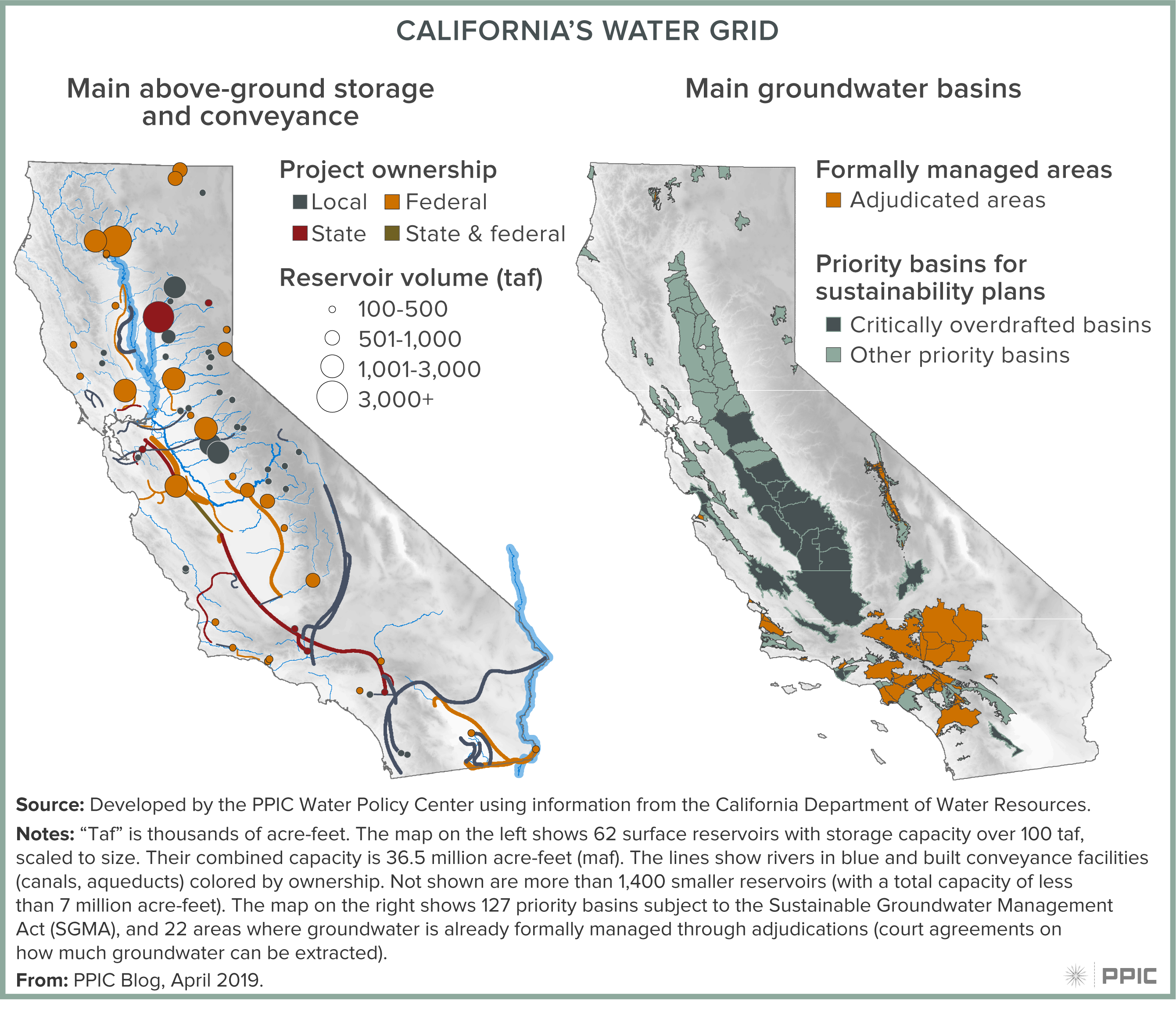
Most western states rely on water “grids”—networks of above- and below-ground water storage and conveyance systems—to manage their water supplies. California’s water grid is unusually extensive and connects most water use in the state. It is also complex, with different elements owned and managed by a wide array of local, state, and federal entities.

California’s water grid provides numerous services: it stores water, reduces flood risk, generates electricity, helps maintain downstream ecosystems, and provides recreation. But various factors are putting stress on this system. As the 2017 Oroville Dam crisis showed, the state’s above-ground infrastructure is aging—much of it is more than 50 years old. And in many areas, groundwater basins are being depleted, making wells go dry, raising pumping costs, harming ecosystems, and causing lands to sink and damage vital infrastructure. The changing climate is compounding these pressures.

figure - California's Water Grid

The PPIC Water Policy Center put together a team of experts in climate science, hydrology, ecology, engineering, economics, and law to review the weak points in California’s water system and recommend actions to build the system’s climate resilience. Our 2018 report Managing Drought in a Changing Climate found that five climate pressures—warming temperatures, shrinking snowpack, shorter and more intense wet seasons, more frequent extreme wet and dry years, and rising seas—will greatly challenge water management in coming decades.

Indeed, many of these effects are already occurring. Warmer, more intense droughts—such as the one California experienced from 2012–16—increase pressures to draw down groundwater reserves. Warmer, more intense storms add stress to surface reservoirs, making it harder to meet sometimes competing objectives of supplying water and protecting people and property from harmful floods.

California’s water grid is not prepared to handle these mounting pressures. Yet it is also the state’s most valuable asset for adapting to the changes in store. What’s needed is a more robust, better-integrated water grid. This will require investments to modernize not only the infrastructure, but also the way the system is managed. Here are some top priorities:

  • Enhancing groundwater storage. Groundwater is a vital drought reserve, and many California basins have considerable potential to affordably store more water. But the lack of active management—including tracking groundwater use—has been an obstacle to these investments. One very positive outcome of the latest drought was the enactment in 2014 of the Sustainable Groundwater Management Act, which requires local water users to develop and implement sustainability plans. The first plans are due in early 2020, and many will focus on new recharge efforts. In addition to expanding dedicated recharge ponds, some farmers and irrigation districts are experimenting with new methods, such as flooding suitable cropland during the winter months.
  • Repairing and upgrading dams, canals, and aqueducts. Addressing infrastructure weaknesses and gaps is essential for both flood protection and water supply. Expanding conveyance capacity will be key for getting water from winter and spring storms to where it’s needed for replenishing groundwater storage. This can also facilitate water trading—an important way to increase the flexibility of water supply and reduce the costs of water scarcity during droughts.
  • Rethinking infrastructure operations. California will be able to store more water if it manages surface and groundwater as a system to increase their combined potential. For instance, moving more water out of surface reservoirs and into aquifers in the fall can free up room in reservoirs to capture winter and spring storms. As another example, promising efforts are underway in some watersheds—including the Russian River, the American River, and the Santa Ana River—to update dam operations using advanced weather forecasting technology. More accurate forecasts can help managers decide whether they need to release water to protect downstream areas from flooding, transfer water to groundwater basins, or keep water in storage for later use.

There are many ways the federal government can help update the grid to meet 21st century needs in California and throughout the West. Here are a few priorities:

  • Assessing and improving system capacity. As owners and operators of major surface water infrastructure, federal agencies—especially the US Bureau of Reclamation and the Army Corps of Engineers—will be essential partners in assessing system capacity issues and the potential for new investments and operational changes to improve the grid’s performance and resilience.
  • Providing essential data. A variety of federal agencies—including the US Geological Survey and the National Oceanic and Atmospheric Administration—are key providers of data needed to better manage the grid under changing conditions. This includes essential metrics such as stream flows, weather forecasts, groundwater models, and space-based imagery to measure water use. These agencies also provide crucial biological data to help manage the grid sustainably. Some of these efforts have faced budget cuts in recent years, dampening their usefulness.
  • Supporting groundwater reform. To date, the federal government has been less engaged on the key issue of groundwater management—an underappreciated part of the grid whose importance will grow as the climate warms and water stored in the mountain snowpack diminishes. California is in the midst of a major, locally driven groundwater reform that will provide valuable lessons for improving the management of this vital resource across the western US and beyond. As owner and operator of the Central Valley Project, the US Bureau of Reclamation can support this effort by making it easier for its local water customers and others to recharge groundwater in suitable areas. As the regulator and manager of flood control systems throughout California, the Army Corps of Engineers can help local flood control agencies capture storm runoff and increase groundwater recharge. And as a major source of funding and technical assistance to farmers, USDA’s Natural Resource Conservation Service could help spur innovation by recognizing groundwater depletion as a resource concern, making it eligible for support.

California, like all western states, is facing major water management challenges as the climate warms and population grows. Weather extremes over the past decade have given us a glimpse of what the future holds. The best way to adapt to these changes is to modernize water grids. The federal government has been an essential partner in developing and operating these grids for more than 100 years. Given the challenges ahead, it is time to modernize this partnership, not just the grid itself.  This includes integrating federal support, operations, and technical expertise into all phases of water management, particularly groundwater.  From our many conversations here at PPIC with state and local water managers, California appears ready for an improved state-federal partnership.  I encourage members of this subcommittee to engage in finding ways to help modernize this relationship.