How Climate Change Drives Disaster Cascades

California has had a devastating series of natural disasters recent years, prompting questions about the role of climate change in worsening fires, droughts, and floods. We talked to Amir AghaKouchak—an associate professor of civil and environmental engineering at UC Irvine―about how a warming climate is affecting natural hazards.
PPIC: Can you talk about how climate change is causing chains of extreme events?

Amir AghaKouchak: Climate warming can compound hazardous events. For example, this sequence of events led to devastating compound impacts in California: (1) severe drought in 2012‒16 weakened or killed many trees and vegetation; (2) record winter precipitation in 2017 caused epic growth of fine fuels like grass; (3) a warm, dry spring and summer dried out vegetation, leading to record-low moisture levels in this vegetation, (4) Diablo winds in Northern California and Santa Ana winds in Southern California set records for low humidity and sustained wind velocities; (5) record-setting fires occurred (e.g., the Thomas Fire in December 2017); and  (6) intense rainfall near Santa Barbara in January 2018 created the most deadly debris flows in history.

Cascading events are a special form of compound events. Sometimes the drivers involved in a cascading event are physically independent (e.g., a wildfire in summer and a rainfall event that winter), but they are linked through their impacts. The Thomas fire in Southern California didn’t cause the related mudslide. But the order of these events—they were about a month apart—had an extreme impact. Models show that a warming climate will bring more wildfires to California, which means a higher chance of future mudslides and debris flows.

We know, for example, that drought and heat waves are connected. It’s widely acknowledged that California’s climate is warming. But what’s striking is that our droughts appear to be warming much faster than the overall average. Heat waves often have atmospheric origins, but they can also be worsened by dry conditions. The way soil cools down is similar to what our bodies do—we sweat and are cooled by its evaporation. The land’s surface cools the same way. But when there’s little or no moisture for evaporation, the sun’s radiation warms the surface and intensifies heat waves. A hotter future will bring drier soil, which can lead to more intense heat waves.

PPIC: What can be done to better manage future extreme events?

AA: Historically, we have usually ignored the relationships among the variables used to assess risk. For example, US Geological Survey guidelines for flood risks in coastal areas do not consider the dynamics of the oceans. Sea level rise brings a greater chance of flooding in coastal areas due to higher tide and surge baselines. We need to develop methods that allow us to do more comprehensive risk analysis for floods, wildfires, mudslides, etc. On the science side, we need better methods to analyze the risks of related events. More public education and outreach about these types of events are also very important. Moderate rainfall may not worry you, but if it’s after a wildfire it could lead to extreme risks. We need to make sure people understand that moderate events can potentially lead to an extreme disaster cascade.

PPIC: What are some changes we should start making now to boost resilience for these “disaster cascades”?

AA: Policy change isn’t easy. But California is very progressive and has even formed a committee, which I’m a member of, to assess how climate change information can be used for improving engineering design and management of infrastructure. Our report identifies gaps and challenges, and offers nine major recommendations for making the state’s infrastructure “climate safe.” For example, we call for updating design and maintenance codes to enhance resilience. We also recommend funding collaborative efforts between state infrastructure agencies and climate scientists to develop tools for improving resilience.

Addressing these gaps won’t be easy. The good news is that the working group has had representation from all the major state agencies―including the Department of Water Resources, Caltrans, and the California Energy Commission. The agencies are interested in working together to improve resilience down the road. This is a very promising sign for the future.

Governor’s Budget Targets Safe Drinking Water, Wildfires, Healthy Soils

Governor Newsom’s first proposed state budget, released earlier this month, addresses several critical water and natural resource management challenges. Here are highlights from his plans to mitigate problems with safe drinking water, improve forest health and reduce the risk of wildfires, and encourage healthy soils to reduce greenhouse gas emissions and increase drought resilience.

Safe and affordable drinking water: The governor’s budget proposal revives last year’s failed legislative proposal to tap urban water customers, agricultural fertilizer users, and dairies to pay for safe drinking water projects in small, disadvantaged communities with water quality challenges.

The proposed budget also includes a one-time capital investment of $168.5 million (compared to $93 million enacted in the previous budget) to fund safe drinking water and wastewater infrastructure projects in disadvantaged communities. The funds will come from Proposition 68—a $4 billion bond approved by voters in June 2018 for investments in water, parks, the environment, and flood protection. The proposed spending represents the remaining two-thirds of the $250 million in Proposition 68 funds for safe drinking water projects.

In addition, the governor proposes allocating $10 million from the General Fund for a State Water Board program that provides technical, operational, and managerial assistance to water systems serving disadvantaged communities. This funding will be used to implement the Board’s relatively new authority to hire third-party administrators to help water systems comply with safe drinking water standards—including tasks such as project planning and grant procurement. This authority was granted by SB 552 in 2016.

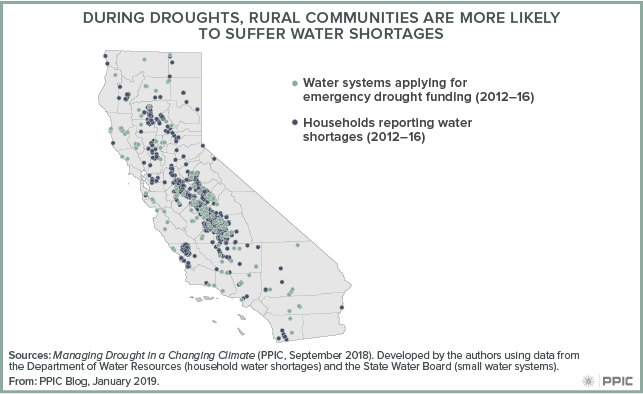
The budget also allocates $10 million from the General Fund for water supply emergencies in disadvantaged communities. During the latest drought, more than 2,500 domestic wells ran dry and nearly 150 small water systems requested emergency support. Many rural, disadvantaged communities still do not have reliable supplies, and these funds could provide emergency drinking water, extend water service lines, and repair groundwater wells.

Forests and wildfires: The budget calls for $415 million for programs to improve the health of forests and fight wildfires. Of this sum, $200 million will be sourced from the Greenhouse Gas Reduction Fund (GGRF). This is consistent with a legislative requirement from last year to spend $1 billion from the GGRF over five years for forest health, fire prevention, and fuel reduction activities. These funds will largely be allocated to Cal Fire’s grant programs for forest management projects on private and federal forest lands. The remaining half of the $415 million in proposed spending will go toward upgrading firefighting equipment and increasing firefighting capacity.

Healthy soils: The budget allocates $18 million to the California Department of Food and Agriculture to expand the Healthy Soils Initiative—a $3 million increase from its 2018 budget. Funded by the state’s cap-and-trade revenues, the program incentivizes farmers to adopt sustainable practices and increase their soils’ capacity to sequester more carbon. Activities might include installing riparian forest buffer, composting, and planting cover crops and wind barriers. Such practices can also improve crop yields, drought and flood tolerance, and air and water quality. The funding is projected to enable the sequestration of 5.3 million tons of CO2 on 500,000 acres by 2030, which is equivalent to nearly 2% of California’s annual emissions in 2016.

The proposed budget will be revised by May—and ultimately finalized and passed by the legislature in June.

A Momentous Water Year

California was bookended by extreme events last year―from the Southern California mudslides in January to the disastrous wildfires north and south in November, and in between, a bout of record-breaking heat in Los Angeles. These events are all connected to policy challenges that California water managers and decision makers are grappling with—issues that are front and center in our work at the PPIC Water Policy Center.

  • Climate change is bringing multiple climate pressures that affect the state’s water supplies and complicate water management. We assembled a team of 30 experts in climate science, hydrology, ecology, engineering, economics, and law to review the weak points in the state’s water system and recommend actions to build its climate resilience. Our new report―published as Governor Brown’s Global Action Climate Summit kicked off in September―provided an accessible analysis of how climate change will affect droughts and summarized reforms needed to better manage future droughts and adapt the state water system to a more volatile climate. Next up is a research project on how to manage wastewater as the climate changes.
  • Two years of tragic, extreme fires stirred debate on how best to address this growing risk, and productive change is already underway. Our ongoing work has guided the development of significant reforms to improve forest health and reduce wildfire risk. Governor Brown directed state agencies to increase forest management in accordance with some of our recommendations. And a new law reflects a number of our suggested reforms to help headwater landowners better manage their forests. New federal and local policy changes will also help. We’ve begun a deeper dive into the benefits—and beneficiaries—of improved forest management as a next step to identifying durable funding solutions.
  • The San Joaquin Valley―California’s largest agricultural region—faces major challenges in managing its groundwater, a critical drought reserve. Our research on recharging groundwater basins laid out key problems that must be addressed to capture more water for underground storage and described what can be done to advance recharge efforts. Next month we’ll release a comprehensive review of solutions to the San Joaquin Valley’s many water and land management challenges that will help the valley continue on a prosperous path for the next century.
  • We hosted a large public event in November to identify water priorities for the new governor. A group of 16 experts discussed how the Newsom administration can promote water policies and practices that benefit the state’s people, economy, and environment. We also updated and expanded our policy briefing kit, California’s Water, to inform newly elected leaders on key water issues—including a new brief on providing safe drinking water. We look forward to working with the new administration to develop meaningful, lasting, forward-looking water policies.

As we move into our fifth year, the PPIC Water Policy Center looks forward to being part of the effort to find creative and collaborative solutions to California’s most difficult and pressing water challenges. And as always, we thank our supporters who enable this important work.

With best wishes for 2019,

Ellen Hanak

P.S. You can sign up for our weekly blog post. And you can learn more about how to support the center’s work.

Reducing Drought Risks in Rural Communities

Disadvantaged rural communities are disproportionately exposed to drinking water risks in California. Too many experience insecure supplies and contamination of their water sources. While there are growing efforts by policymakers to address water contamination, many communities will need further help to prepare for future droughts. Improved planning efforts could help avert water shortages.

Rural residents are more vulnerable to running out of water during droughts because they are more likely to rely solely on groundwater from small community wells or domestic wells. These wells tend to be relatively shallow, so they are susceptible to running dry when pumping lowers groundwater levels. During the 2012‒16 drought, farmers and cities pumped extra groundwater to make up for surface water shortages. Thousands of wells went dry―mostly domestic drinking water wells in rural communities, especially in the San Joaquin Valley. And roughly 150 small community water systems sought emergency assistance to keep the taps flowing.

Although the state’s Sustainable Groundwater Management Act (SGMA) is expected to lead to balanced groundwater use and reduce over-pumping in the long term, California’s highly variable climate means that groundwater levels will still drop during droughts. This could result in more drinking water wells going dry. In a recent submission to the California Water Data Challenge, several colleagues from UC Davis and I found that a drought similar to the latest one could cause more than 4,000 domestic wells to go dry in the Central Valley.

A recent PPIC report on managing drought in a changing climate offers two ideas for reducing these risks:

  • Develop drinking water plans for rural communities and identify durable funding sources. Small rural systems do not have the financial capacity for drought planning and mitigation. State and local partners should use their experience from the recent drought to identify communities at highest risk, connect them to larger systems where feasible, and devise drought response programs for the others with reliable funding sources. The newly formed groundwater sustainability agencies, working with local partners such as counties and agricultural and urban dischargers, could help coordinate actions and streamline funding mechanisms.
  • Ensure groundwater sustainability plans include mitigation actions for dry drinking wells. Sustainability plans should describe preparation for groundwater drawdowns during severe drought similar to the one in 2012‒16. For instance, as groundwater sustainability agencies develop their plans, mapping drinking water wells that might be at risk for different drought scenarios and proposing mitigation actions that proactively decrease the risks are both imperative.

Studies of institutional responses to the latest drought largely find that planning for drought response and recovery paid off. Making an action plan to avoid further water-supply risks in disadvantaged rural communities―as well as identifying reliable funding mechanisms to implement it―should be top priorities for California policymakers.

Commentary: Peace in California’s Water Wars is Within Grasp

This commentary was published in CALmatters on December 19, 2018.

Dare we say it? The outlines of a truce in California’s unending water battles began to come into focus last week, though not everyone is willing to sign the treaty. The State Water Board adopted the first phase of a far-reaching revision to the Water Quality Control Plan for the Sacramento‒San Joaquin Delta and its watershed.

This is an effort to improve conditions for dwindling populations of endangered native fish such as salmon and steelhead. It also means an increase in water scarcity for farms and cities.

The mere adoption of the plan was significant. But something else happened in the board meeting that may in fact be more important and longer-lasting: state officials presented the framework of a peace treaty for Central Valley water wars.

With support from Governor Jerry Brown and Governor-Elect Gavin Newsom, most of the combatants negotiated the outlines of a comprehensive settlement agreement.

The Natural Resources Agency—including the Department of Water Resources and the Department of Fish and Wildlife—spent countless hours over several years convincing water users to develop a voluntary approach to improve ecosystem conditions for native fishes.

The approach state officials presented to the board would increase flows in rivers and the Delta and make major investments in habitat. And perhaps most important, it would create sustainable funding for these efforts (including fees on water diversions), while improving scientific research on and governance of restoration efforts.

To be clear, a framework was presented, not an actual settlement. But the framework contains commitments of water, habitat restoration and funding.

It also includes timelines for action from water users across the greater Sacramento–San Joaquin River watershed, and a willingness to get this settlement completed by the end of 2019. A few districts—such as the Oakdale, South San Joaquin and Merced Irrigation Districts—balked at the framework and are threatening litigation. But most of the watershed has signed on.

If this settlement is achieved and adopted by the board, it will be a major step forward in water management in the Central Valley. But a lot of work lies ahead. Water and habitat commitments—along with sources of funding—need further negotiation, and a robust governance and science program still needs to be designed. Additionally, many of the non-governmental environmental organizations that were mostly left out of negotiations need to be more involved.

Finally, the federal government can either be a partner or a roadblock to this effort. Federal representatives actively participated in negotiations and helped spur innovative approaches along the way.

But after the State Water Board’s vote, the US Bureau of Reclamation threatened litigation, and the Trump administration is seeking to roll back environmental standards in the Delta. Both actions have the potential to undo the settlements.

Despite these hurdles, there’s reason for optimism that there can be a truce in California’s water wars. What’s clear is that negotiated solutions to water conflicts are fairer and longer-lasting than top-down regulatory solutions or, worse yet, litigated solutions where judges end up trying to manage water.

Incoming Governor Newsom’s support and involvement will be essential to carry this effort to a positive conclusion. It should be a priority for his new administration.

Adapting to an Uncertain Water Future

As the world’s biggest climate meeting continues in Poland this week, the growing threats from climate change―and the lack of large-scale action to match the risks―have been much in the news. Global, national, and statewide assessments all point to severe consequences if greenhouse gas emissions are not greatly reduced. Evidence is growing that climate change is a “threat multiplier,” increasing the frequency and intensity of natural disasters worldwide and here in California. And just this past week, the Global Carbon Project reported that emissions are rising rapidly, making it even more difficult to meet the goals of the Paris Agreement and heightening the possibility of more-frequent and more-damaging climate impacts.

These reports all point to the same policy direction for California. While it is important that the state continue its leadership on reducing greenhouse gas emissions, it is time to greatly increase efforts at adaptation.

Water is where climate change is having its most direct and measurable impact in California. A recent PPIC report found that five climate pressures—warming temperatures, shrinking snowpack, shorter wet seasons, more volatile precipitation, and rising seas—affect all aspects of water. We recommended a suite of integrated reforms to adapt to these changes. These include better planning for water use in cities and farms, and for the environment; upgrading the state’s water management infrastructure; improving the way the state allocates water; and coming up with innovative new funding mechanisms.

Although all of the reforms are important, two—upgrading infrastructure and providing adequate funding—are the most critical. California’s water management infrastructure is vast and complex. Nearly 1,500 dams and reservoirs provide numerous services, some of which are at cross purposes with each other: they store water, reduce flood risk, generate electricity, help maintain downstream ecosystems, and provide recreation. Large volumes of existing and potential storage occur in more than 500 groundwater basins.

The above- and below-ground storage is linked from far-northern California to the suburbs of San Diego by a network of thousands of miles of canals and aqueducts, as well as rivers that function as aqueducts. California could not function without this networked “grid.” This grid is the state’s most valuable asset for adapting to an uncertain climate future.

We recommend that this grid be upgraded. A top priority includes repairing or strengthening dams, canals, and aqueducts—most of which were designed and built more than 50 years ago using outdated hydrology that doesn’t reflect a changing climate. Another upgrade is adding connections to the grid so that water can be conveyed more easily to where it’s needed for replenishing groundwater storage or to support water trading. And integrating operations of the grid, possibly involving a wholesale change in the way it is managed and governed, should also be prioritized.

But talk about upgrading the grid will be insufficient if the state does not find a way to pay for it. The defeat of the statewide water bond, Proposition 3, in November may be an indication of “bond fatigue.” Instead, the burden for paying for this upgrade is likely to fall upon local communities, who already shoulder about 85% of the costs for water management every year. This will be a contentious but necessary public debate. Without new resources, upgrading the grid will be very difficult.

The climate is changing, and the direction of change poses great challenges for California water management. But the state has a very large portfolio of assets to help adapt to this change. If these assets are managed well—and California makes well-funded investments in upgrades and focuses on sustainability—the state can weather these changes with minimal social and economic disruptions.

Video: Water Advice for Governor-Elect Newsom

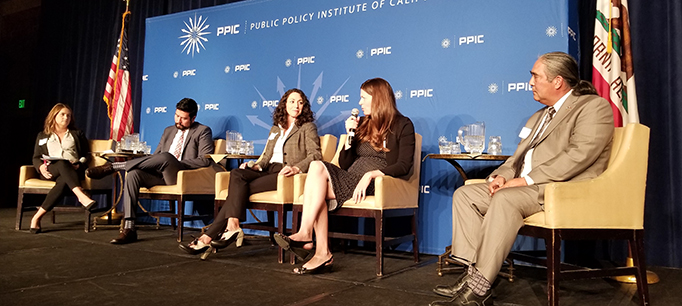
Each fall, the PPIC Water Policy Center hosts a public event to review water policy priorities for the coming year. This year’s panel discussions focused on ways the new administration can promote water policies and practices that benefit the state’s people, economy, and environment. A diverse group of experts on three panels discussed the intersection of water policies with California’s most pressing economic issues; innovations in policy, practice, and technology that offer solutions for key water problems; and steps needed to adapt the state’s water systems to a changing climate.

Each panelist was given an opportunity to make a short “elevator pitch” on water priorities for the governor-elect. Topics included the nexus between water and housing, the challenge of bringing groundwater into balance in the San Joaquin Valley, and improving water management with better data and information technology.

Watch the video to see which water issues these 12 experts think Gavin Newsom should prioritize when he takes over from Jerry Brown in January. And here’s a playlist of all videos from the event.

Local Measures Address Water, Fire in the Midterm Elections

The biggest water news from the recent election was the failure of the $8.9 billion statewide water bond, Proposition 3. This was the first time voters have rejected a statewide water bond since 1990. But this wasn’t the only story for water-related measures on Californians’ ballots. The midterms saw 33 local measures go to the voters that addressed issues ranging from flood protection to fire resilience. Here we summarize a few key votes.

In Los Angeles County, Measure W passed. This measure allows the county to collect a parcel tax of 2.5 cents per square foot of impermeable surfaces (such as concrete sidewalks and pavement) to fund rain and stormwater capture and clean-up projects, in addition to projects addressing water quality and groundwater recharge. The measure exempts permeable surfaces from the tax, which could incentivize developers to incorporate more green solutions into development and renovation projects.

In the Bay Area, San Francisco and San Jose both passed local bonds to modernize infrastructure. San Francisco easily passed Measure A, which will issue $425 million in bonds to strengthen the Embarcadero seawall to better withstand earthquakes and rising sea levels. San Jose’s Measure T will allocate $650 million in bonds to repair the city’s aging infrastructure. Although almost half of this bond is dedicated to repaving streets, the measure also includes $85 million for flood protection—a response to the 2017 Coyote Creek flood that caused $100 million in property damage. The bond will fund “green infrastructure” projects in the local floodplain to reduce the risks of future floods and groundwater contamination.

Across the state, the rise in devastating wildfires resulted in nine measures addressing fire protection and intervention services in communities, to be paid for through utility taxes, sales taxes, and parcel taxes. Four of these measures passed, while five failed.

Sonoma County’s newly adopted park and ecosystem restoration bill―Measure M, a one-eighth cent sales tax increase―will collectively fund wildfire prevention, ecosystem restoration, and projects to safeguard water supplies, including rivers and streams. Measure FF passed in Alameda and Contra Costa Counties; it extended an existing parcel tax to fund wildfire prevention and water quality activities on East Bay Regional Park District lands, as well as park maintenance. But voters didn’t approve Measure P in Laguna Beach (Orange County), which proposed a sales tax to pay for wildfire safety measures. It would have funded projects such as undergrounding overhead power lines.

Although the failure of Proposition 3 caught some by surprise, it’s important to remember that state bonds play a relatively minor role in funding California’s water needs. Local revenues—from water and sewer bills to taxes—provide 85% of water funding. The newly passed ballot measures carry on that tradition, with Californians across the state voting to address their communities’ needs and priorities for water, fire safety, and the environment.

Working with California Tribes on Upper Watershed Restoration

“Fish are very important to me, to my family, my culture.”

“It’s surprising how much you rely on traditional foods if you’re in a community like we are. You don’t necessarily realize it until you don’t have it . . . especially salmon.”

“If the water quality got better, rivers and creeks would be much better and it would bring back the fish.”

These are the voices of youth from the Karuk tribe in the Klamath River watershed, as heard in a new video that explores the connections between ecosystem health and tribal well-being. Healthy local waterways and the traditional foods they support are considered irreplaceable by indigenous peoples. A new program is seeking to tap into tribal understanding of natural resources to ensure their voices are being heard and to provide a more expansive approach to how state and tribal programs can align in the management of rivers, fisheries, and forests.

As part of this effort, the state is participating in a series of “forest gatherings,” which bring people working on natural resource issues to local watersheds in events hosted by a tribe from that place. “Place matters,” said Debbie Franco, community and rural affairs advisor in the Governor’s Office of Planning and Research. “Gathering in a watershed with tribal people who have been managing that place for thousands of years is a way to more deeply understand their perspective that forests, fish, water, and food are by nature integrated and connected.”

The gatherings are an opportunity for those in attendance to explore questions such as: How can the traditional land management practices of indigenous peoples inform how we can work better together in managing the land? What ecological ideal should we strive for? How do we connect the work of indigenous peoples with statewide policy discussions?

Each gathering is designed by a team with members from local NGOs, county and US Forest Service representatives, state representatives, and the host tribe. Invitees have included academics, policy experts, local governments, indigenous people, logging interests, and regional and state agencies.

“The idea is to find the people whose relationships are necessary to do good upper watershed management and to bring them together to build relationships and create a voluntary learning environment,” said Franco.

In addition to sharing ideas, participants may find themselves physically connecting with the watershed. An upper watershed gathering this August, for example, had participants rafting the Klamath River with a tribal person and stopping at a tributary along the way to help create better environmental conditions for spawning salmon.

Franco noted that indigenous knowledge can bring new solutions to problems facing watersheds today. “It goes well beyond what we know from our 150 years here. These forest gatherings are bringing more people to the understanding that the answers to our water challenges lie in the connections between us and our natural systems.”

Commentary: A Chance to Solve the Delta Quandary

This commentary was published in CALmatters on November 18, 2018.

It is imperative to improve the health of the greater Delta watershed, a major source of water for cities and farms across the state. And various stakeholders have a chance to achieve that goal in the coming weeks while protecting important economic interests. A delay in setting new water quality standards for the San Joaquin River will give time to develop voluntary agreements regarding the amount of water to be allocated to protect fish.

Read the full commentary on calmatters.org