Drought Watch: The End of the Rainy Season

This is part of a continuing series on the impact of the drought.

California’s rainy season is pretty much over. Most years, 85% of the wet season’s rain and snow has already fallen by late March. While rain often falls in April and May, it is rarely enough to make a big difference in the overall water picture, and the forecast is now quite dry.

That means California’s water managers now have a good idea how much water will be available in the state’s reservoirs, snowpack, and groundwater basins.

The news is not heartening. While parts of the north coast did fairly well, the rest of California did not. The Sierras received about half of annual average precipitation. And as the record warm temperatures of last year have persisted, the snowpack is at an all-time low (now 8% of average). As California’s struggling ski area operators know all too well, most precipitation fell as rain, rather than snow.

Statewide, reservoir storage is about half of capacity. However, the almost non-existent snowpack provides no prospect for improvement in storage this spring—something water managers count on in most years.

This fourth consecutive dry year have led to some dire, even apocalyptic predictions, including that California will run out of water within a year. While managing this drought will be difficult, even painful in some regions, the state is not going to run out of water and there is no need to panic. Rather, prudent adjustments to water scarcity that began earlier in the drought will continue and intensify. These include:

  • Increased urban conservation. Californians cut their per capita water use last year, but they can do more. In particular, there is ample room to reduce outdoor watering, which makes up roughly half of urban water use. The State Water Resources Control Board has tightened restrictions on outdoor water use, and many municipalities will increase their conservation efforts.
  • Increased water trading. Robust water markets, involving willing sellers and buyers, are an effective way to manage scarcity. The Australians found this to be helpful during their crippling Millennium Drought. California’s water market helped many farmers keep their orchards alive in 2014. This year, cities with dwindling drought reserves are also looking to buy water – as illustrated by the recent deal between Sacramento Valley rice farmers and Metropolitan Water District, Southern California’s large water wholesaler. As demand for trading increases, so will water prices.
  • Increased use of groundwater. Groundwater pumping has grown since the drought’s onset, but California’s reserves of groundwater remain large—particularly compared to surface storage. Groundwater will continue to make up shortfalls in surface water this year. Unfortunately, past failures to manage groundwater have lowered the water tables in many basins, making water more expensive to extract and often requiring drilling new, deeper wells. The new Sustainable Groundwater Management Act will eventually address this problem, but not soon enough for this drought.

In short, California is not running out of water, just cheap water. A fourth consecutive year of drought will make both water scarcity and management possibilities increasingly apparent.

Legislators Talk Next Steps on Water Policy

Four key legislators yesterday discussed their water policy priorities for the current session, agreeing that their top one is overseeing the implementation of Proposition 1, the state water bond passed in November. At a Sacramento gathering sponsored by PPIC and focused on managing drought, the four also agreed that the bond is just a down payment in addressing a long list of water policy challenges.

Assemblymember Anthony Rendon, who represents parts of southeastern Los Angeles County, noted that the water bond’s lack of earmarks, or “pork,” helped secure the voters’ approval—and will require strong legislative oversight to make sure the money is well spent.

Echoing the theme of legislative oversight, Assemblymember Marc Levine, who represents parts of Marin and Sonoma Counties, said it is important to review past investments—such as Proposition 1E, passed in 2006 to fund flood control projects—to make sure that money is spent strategically and builds voters’ trust in government.

Asked about other policy priorities, Senator Lois Wolk, who represents much of the Sacramento–San Joaquin Delta, mentioned water infrastructure. It is wearing out, expensive to replace, and the federal government is no longer financing it. That makes funding a challenge for the state.

How can the state build drought resilience? Senator Jean Fuller, who represents parts of Kern, Tulare, and San Bernardino Counties, said ensuring a predictable water supply is critical.

“People do not know—especially the farmer—when they’re going to get their water, if they’re going to get it in August, if they’re going to get it in July, how much it’s going to cost at that point.”

By building more certainty in the system, water markets can be managed for the benefit of all, she said.

Hundreds of people attended the PPIC event Managing Drought, and hundreds more watched the online webcast. PPIC will post videos of the full event soon.

Drought Watch: What’s in Proposition 1?

This is part of a continuing series on the impact of the drought.

California voters are deciding the fate of Proposition 1—a $7.5 billion water bond. If Prop 1 passes, the water sector will get a big boost in funding. Prop 1 contains $7.12 billion in new debt (the remaining $400 million dollars is money that would be re-authorized from previously passed bonds).

So what kind of water projects will be funded if Prop. 1 passes? The bond focuses mainly on water supply ($3.6 billion) with the majority ($2.7 billion) designated as matching funds for storage projects. These matching funds are intended to support up to half the costs of projects that store water either in surface reservoirs or underground aquifers, and they can only be used to fund “public benefits.” Public benefits include, among other things, better flood protection and recreation opportunities, as well as improved environmental conditions. For instance, expanding surface reservoirs makes it possible to store more cold water, which can be released during warm months to support salmon habitat. Likewise, expanding ponds to recharge groundwater basins can create bird habitat.

The California Water Commission will determine which storage projects receive these funds through a competitive process. The rest of the water supply dollars are mainly for matching funds for water recycling and desalination projects ($725 million), with $100 million each for water conservation and groundwater sustainability planning.

Proposition 1 also has funds for the five areas PPIC has identified as critically underfunded “fiscal orphans” in our recent study of water system finance: ecosystems, drinking water quality, flood protection, stormwater pollution management, and integrated water resources management. Of the funds designated for water quality improvements, $520 million is intended for disadvantaged communities and $800 million is for cleaning up groundwater basins that have been contaminated with industrial and agricultural chemicals. Just over half a billion dollars is designed to encourage agencies to collaborate on water management priorities, with funds going to different regions for priority projects in Integrated Regional Water Management plans. These projects would overlap with the previously mentioned categories, and they would need to improve regional self-reliance and help adapt to the effects of climate change.

Since 2000, California voters have approved six water bonds, totaling nearly $20 billion dollars. These bonds looked a little different than Prop 1. Ecosystem improvement and flood protection were the main priorities, with smaller amounts for drinking water quality, integrated management, stormwater, and water supply projects (these bonds also had large amounts for parks and public access). While these bonds provided welcome support to these areas, they also came with fiscal tradeoffs: bonds are repaid with general fund tax dollars that also support other state programs.
The current drought is likely helping the bond’s chances of passage: according to the most recent PPIC Statewide Survey a record-high 68% of all adults say that the supply of water is a big problem in their part of the state. In this context, it is important to keep in mind that while continued investments in our water system will help us be better prepared for future droughts, this bond is not designed to provide immediate relief from the current one. Most water projects take time to design and build. And, whether or not Proposition 1 passes, the state’s water system will face significant challenges that require funding sources more reliable than a bond can provide.

Drought Watch: California as a Testing Ground

This is part of a continuing series on the impact of the drought.

An international consortium of water economists gathered at the World Bank headquarters in Washington, D.C. earlier this fall for two days of meetings on water policy research. The timing was opportune, as the World Bank – which provides financial and technical assistance to developing economies around the globe – recently reorganized to provide a new emphasis on water resources. The conference theme was the economics of water conservation and efficiency, with researchers looking at the role of technology, pricing, and institutions to effectively and efficiently manage water resources under conditions of increasing scarcity. In light of the national and international attention to California’s ongoing drought, I was asked to give keynote remarks about lessons from California for other regions of the world.

I highlighted four central ideas. (My presentation is 22 minutes into this video.) First, urban areas the world over can improve drought resilience by diversifying their water portfolios, rather than relying on a single source of water. Second, although conservation is important, policymakers should be mindful that improved irrigation efficiency is not a panacea to cope with drought, because much of the water “saved” is already being reused by others downstream.

Third, sustainable groundwater basin management—the approach now called for under California’s historic groundwater legislation—is an invaluable drought management tool because it means more groundwater will be available to help get through dry times. But getting there can imply costly trade-offs in basins that rely heavily on groundwater, requiring institutional and financial support to help water users make the transition.

And fourth, like California, many regions can benefit from repurposing their storage and conveyance infrastructure to better cope with droughts and the growing water scarcity expected with climate change. In particular, storing more water for dry years in groundwater basins, and using surface reservoirs for seasonal storage and flood protection, can be cost-effective ways to adapt to an increasingly variable climate.

Drought Watch: Video Seminars

This is part of a continuing series on the impact of the drought.

A series of videos available online is a great resource for water wonks and newcomers alike. Researchers and cooperative extension specialists from the University of California’s Division of Agriculture and Natural Resources, with support from the California Department of Water Resources, have put together these video seminars on drought-related water management issues. You can bone up on topics ranging from drought impacts on wildlife and groundwater basins, to the latest research on California’s climate in centuries past (and the mega-drought we experienced in medieval times), to tips for managing crops and rangeland when water is in short supply.

I contributed to the series with an overview of how water marketing and groundwater banking can help mitigate the worst economic impacts of droughts, drawing on PPIC’s ongoing research on this issue. The series is being updated regularly with new videos.

California’s New Leaders Focus on Poverty

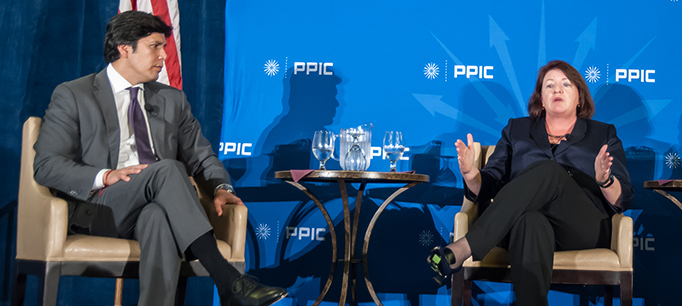
Assembly Speaker Toni Atkins and Senator Kevin de León, who will take over as senate president pro tem later this month, each told a Sacramento audience about growing up in poverty and the role it has played in their shared view of the state’s responsibility to those in need.

“We share similar values and similar stories that have made us care about the values and the issues that we’re talking about today,” said Atkins, who was raised in a poor, rural Virginia family and now represents the San Diego area. De León, who was born in San Diego and represents Los Angeles, said he is the youngest child of a single immigrant mother and the only family member to graduate from high school. Atkins and de León, both Democrats, were elected by their respective legislative chambers earlier this year to serve as leaders.

Both lawmakers cited a recent PPIC report — Child Poverty and the Social Safety Net in California by Caroline Danielson and Sarah Bohn — that said about 50% of California children live in poverty or near-poverty. The remarks, part of the PPIC 2014 Speaker Series, were made to a capacity audience of about 400 in the ballroom of the Sheraton Grand Hotel. The discussion was moderated by PPIC President Mark Baldassare and streamed live to hundreds more.

The wide-ranging conversation touched on a number of major issues—including health care, the drought, immigration, and taxes. Both leaders said that they believe the state should talk about changes to the state tax structure and consider whether to extend the temporary taxes that voters passed in Proposition 30. Atkins cautioned that it will be difficult to gain support from voters for an extension of the taxes.

De León expressed strong support for affirmative action, which he credited for his ability to attend college and become a legislator. He also said California should continue to lead on immigration issues because the federal government has been unable to pass a reform plan. And he noted that polls suggest Californians support health coverage for undocumented residents.

Atkins, meanwhile, encouraged more cities to follow San Francisco and San Jose, which recently increased the minimum wage. Both leaders also said they have worked together in the past and believe they will have a good working relationship going forward.

Drought Watch: Crises as Catalyst for Policy Change

This is part of a continuing series on the impact of the drought.

Today Governor Brown signed three bills that require portions of the state to start managing groundwater sustainably. These bills are historic. Until today, California was the only western state that did not regulate groundwater, typically the source of more than one-third of the state’s supply, and much more during dry years.

Why, after a century of failing to address much-needed reform, has the state finally acted on this problem? It’s the drought.

The problem of groundwater overuse is nothing new in California. Calls for reform began as far back as the early 1900s, when severe excess pumping in many groundwater basins began to cause problems. Chronic overdraft—taking more out of the ground than nature puts back in—has left many basins severely depleted.

When the current drought arrived and communities and farms turned to groundwater to make up for shortages in surface water supply, a century of neglect—the hydrologic equivalent of deficit spending—caught up with California. The groundwater that, managed well, should have been cheap and plentiful, became expensive and scarce, leading to an economic and social crisis. The well-publicized effects of unsustainable pumping include sinking ground, dry wells, crumbling canals and roads, intense competition to drill deeper (and more costly) wells, the fallowing of more than 410,000 acres of farmland, and losses of more than $2 billion in farm revenues and more than 17,000 farm-related jobs. These factors combined to create pressure to tackle what had been, up to now, off limits to reform.

In our 2011 book, Managing California’s Water: From Conflict to Reconciliation, we note that significant advances in state water policy are often tied to droughts and floods, along with the inevitable lawsuits that follow. Extreme events like the current drought reveal fundamental weaknesses in California’s water management policies and practices. Perhaps more importantly, they create pressure on government to respond.

This is the silver lining of water crises in California: they are often the way we get things done. (The comprehensive reform of flood management enacted in 2007 was spurred on by the graphic images of Hurricane Katrina two years earlier, for example.) Indeed, one strategy for advancing water management reform is to plan and prepare for the inevitable, and then take advantage of a crisis to push ahead on needed reforms.

This year’s groundwater package is indeed historic, but California still has a long way to go in improving the way it manages water. With our changing climate, we should expect more frequent droughts and floods (and lawsuits)—so there will be no shortage of opportunities to tackle other problems in the future.

Drought Watch: Regional Solutions

This is part of a continuing series on the impact of the drought.

Across California, local water agencies are scrambling to apply for new state matching grants authorized under February’s emergency drought legislation. The program aims to accelerate the use of remaining state bond funds for integrated regional water management: activities in which local agencies team up to generate mutual benefits. One example—water suppliers and stormwater agencies that work together to incorporate captured stormwater into local water supplies. Such projects can simultaneously enhance water supply reliability and the quality of water in rivers and coastal areas.

Regional integration has already led to some significant successes, most notably the enhanced ability of urban water suppliers in Southern California and the Bay Area to cope with the current drought. Successes include ramping up water conservation and recycled wastewater storage to increase supplies in storage, and building new connections between local water systems to enable emergency sharing. Outside funds are often needed to jump start these collaborations, both to encourage innovation and to enable some partners—such as stormwater agencies – to participate even if they don’t have the necessary funds.

But as we showed in our study Paying for Water in California, integrated regional water management is on the brink of fiscal failure because state bond funds are running out. Both the legislature and local water agencies have pushed the idea that bonds should continue to provide these dollars, and the major bond proposals under consideration include substantial new funds for this purpose.

But there might be a better way: adding a small statewide surcharge on water use to support regional projects. Local water agencies have often rejected this idea, arguing that if they send money to Sacramento they won’t see it again. But what if the funds go directly to the regions?

Here’s how we think this could work. The legislature (or state voters) would pass the surcharge and set broad criteria for funding eligibility. The funds would be apportioned to the state’s 12 principal hydrologic regions—the large basins that are already used to divvy up bond funds. But rather than having state agencies award the grants, this task would go to new Regional Water Commissions—regional counterparts to the California Water Commission, the state body tasked with awarding matching grants for storage projects under most bond proposals.

Though more politically tricky to pass than a bond, the statewide water surcharge would have numerous advantages. The revenues would be more reliable than bond funds. And relying on Regional Water Commissions to allocate these dollars could encourage broader collaborations than we have seen from the state-sponsored grant program, which has nearly 50 planning regions, often too small to reap the real benefits of integration. Many groundwater basins, for instance, have different boundaries than the current planning regions, and groundwater agencies could use assistance from these regional funds to support better management.

Finally, this statewide option is preferable to creating local or regional surcharges, which can be difficult to raise without approval of two-thirds of local voters. To raise $200 million annually—the amount that’s been available through bonds—a surcharge 7.5 cents/1,000 gallons on urban water bills would suffice. This would increase the average cost of tap water by just 2.8 percent, while creating a valuable incentive fund that helps local water managers enhance the quality and reliability of regional water supplies. As part of a package with a new bond devoted to areas of true statewide need, a statewide water surcharge would help ensure that our water system can support a healthy economy, society, and environment.

Drought Watch: Groundwater, Our Hidden Asset

This is part of a continuing series on the impact of the drought.

The drought has brought the term storage to the forefront of political debate over how to manage water in California. Water scarcity during this drought is perceived by many, including prominent elected officials, as a failure of government to build sufficient storage.

For most, storage refers to water kept in reservoirs behind dams. People tend to forget that we also store water underground, in the state’s many aquifers. And during a drought, this groundwater storage is usually much more important.

Managed well, groundwater is the state’s best hedge against drought. The volume of potential groundwater storage in California is several times greater than surface storage. On average, about 35 percent of annual water use for cities and farms comes from groundwater, and 60 percent or more in some important agricultural regions such as the Tulare Basin and the Central Coast. During a severe drought such as this one, when groundwater pumping increases, this share can go up significantly. But groundwater is not easing the effects of this drought as much as it could because we don’t manage it as drought storage.

A fundamental principle of sustainable groundwater management is that you allow water to accumulate in aquifers during wetter years so that you can pump it out during the dry years when surface water sources are insufficient. In most of California’s main agricultural areas—especially the southern Central Valley and parts of the Central Coast—the total water demands are so great that we have stopped allowing groundwater levels to recover during the wetter years. Instead, we are “mining” groundwater, treating it like oil and gas, extracting it as if it was a non-renewable resource never to be replaced.

This mining—or overdraft—reduces the available supply of groundwater during dry years. It raises the costs of remaining supplies, as wells need to be drilled deeper and electricity bills rise because water has to be pumped from deeper depths. Unsustainable pumping also creates a host of other problems, including dewatering of rivers and wetlands that support fish and wildlife as well as land sinking—or subsidence—that damages roads, bridges, canals, and flood control infrastructure.

Some of California’s large urban areas—including much of Southern California and Silicon Valley—provide valuable lessons on how to move toward more sustainable management of groundwater basins. In these areas, acute groundwater overdraft spurred groundwater users—often with the aid of the courts or the state legislature—to develop management schemes that work. These groundwater basins are overseen by court-appointed water masters or special management agencies that can collect fees, monitor use, and allocate pumping rights. Most important, they can compel users to store water during wet times, so it is available when drought strikes.

A silver lining of the current drought is that it has brought focus to how we manage groundwater, the other water storage in California. Innovative proposals for comprehensive reform are coming from the Brown administration and from grassroots efforts orchestrated by the Association of California Water Agencies and the California Water Foundation. These proposals have the common goal of creating sustainable groundwater management by

  • providing local agencies the tools necessary to manage groundwater sustainably, and
  • giving the state the power to ensure that these standards are achieved if local agencies fail to act.

Now is the time to move forward on this issue, while the consequences of groundwater overdraft are at the center of debate and impacting so many.

Drought Watch: Funding Sustainable Groundwater Management

This is part of a continuing series on the impact of the drought.

Although droughts have many downsides, they can also spur lasting improvements in water management. Unsustainable groundwater use has long plagued California’s rural areas, and the current drought is providing much needed impetus to pursue reform.

California is one of the only western states that does not regulate groundwater use under state law. Except for a few dozen basins where local agencies have special oversight authority (mainly in urban Southern California and the Bay Area), local groundwater management remains largely voluntary and somewhat precarious. Despite some recent advances in basin monitoring and replenishment programs, these agencies have been unable to prevent damaging declines of groundwater supply and quality. As recent headlines on water scarcity point out, overtaxed basins are unable to effectively serve one of groundwater’s most important roles: as a buffer against drought.

In late March, the Governor’s Office held a workshop to seek input from local managers and other experts on a proposal that would empower local agencies to better manage groundwater—and commit the state to step in as an emergency backstop if locals fail to come through. Today’s post on the California Water blog, coauthored by an interdisciplinary team from PPIC, UC Davis, UC Hastings, Stanford, and elsewhere, walks through important funding considerations for this reform.

To be effective, local entities must have sufficient authority and flexibility to raise the money they need to track water levels and make key investments—both in infrastructure and in new water supplies for replenishing their basins. In addition, these agencies should have the ability to enact special surcharges to prevent excessive pumping. Right now, that power is only granted to a handful of agencies.

Extending and strengthening the funding and oversight authorities available to local agencies across the state will better prepare us for the next time we need to look to the ground, instead of the sky, for our water needs.