Video: Broadening California’s Exclusive Electorate

Californians who vote tend to be older, white, college educated, affluent, and homeowners. When asked to choose, these “likely voters” identify themselves as “haves” rather than “have nots.” Nonvoters tend to be younger, Latino, less likely to be college educated and less affluent than likely voters, and renters; they generally identify with the have nots.

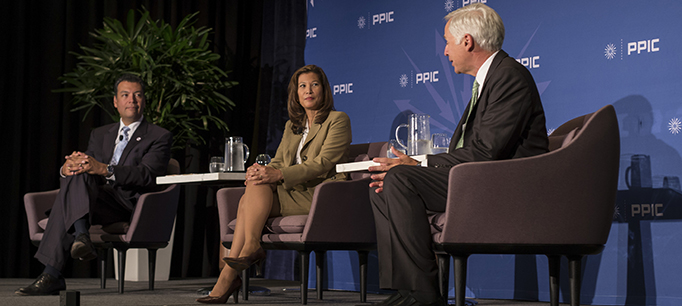
This divide has particular significance in California, where voters make important policy decisions through the initiative process—and at a time when economic inequality is a major theme, according to Mark Baldassare, author of a new report, California’s Exclusive Electorate: Who Votes and Why It Matters. Baldassare is PPIC president, CEO, and director of the PPIC Statewide Survey. He presented an overview of his report before a Sacramento audience this week.

The report concludes that, in addition to electoral process reforms that will make voting easier, broader changes are needed to expand the electorate. Among them: citizenship drives to engage foreign-born residents, increased economic mobility, and changes in federal immigration policies.

An expert panel took up these issues in a discussion moderated by John Myers, Sacramento bureau chief of the Los Angeles Times. Myers asked if there a ’secret sauce’ to motivate people to vote.”

Mindy Romero, founder and director of the California Civic Engagement Project at UC Davis, said that there’s no single solution. But civics education is important, she said, and so is targeted outreach that recognizes the unique experiences and needs of underrepresented groups.

Matthew Harper, state assembly member, used his involvement in Junior State to illustrate the importance of nonprofit organizations in showing young people how they can affect government.

Ben Allen, state senator, noted the shrinking number of reporters in Sacramento and said that more engaged media coverage would help bring issues home to voters.

Myers pointed out the vicious cycle at work in many elections. Campaigns spend their resources targeting the relatively small pool of likely voters, who will reliably turn out to support them. A much broader group of potential voters is not engaged and—as expected—this group fails to vote.

But, Allen said, in this presidential election we could be seeing the flip side of the low-turnout election that draws only the most involved voters. “Donald Trump and Bernie Sanders are driving new people to the polls that folks have not traditionally reached out to and engaged with,” he said. This presents “a scary but exciting set of possibilities” for reaching out to new sections of the electorate.

Video: California’s Voter Turnout Problem

Voter turnout in California has been declining—it reached record lows last year, raising concerns about the state’s democratic process. PPIC research fellow Eric McGhee told a Sacramento audience last week that turnout in California has not only dropped in absolute terms but has fallen behind that of other states. While participation in fall presidential elections has been holding steady, turnout is on the decline in midterm elections—when the state elects a governor and other statewide officials—and, to some extent, in presidential primaries.

A big part of the problem is California’s voter registration rate, said McGhee, who coauthored the new report Putting California’s Voter Turnout in Context. It has not changed significantly, though it should have been climbing, as it has in other states.

California has been working hard to make the voting and registration processes as easy as possible, and other policy changes are under discussion. Will they result in higher turnout? They may help, but they aren’t panaceas, McGhee said. Ongoing mobilization efforts will be needed to motivate more people to cast a ballot.

Would Making Voting Easier Increase Turnout?

In the wake of record-low turnout in both the primary and general elections in 2014, efforts to improve voter participation are under way. The senate is set to consider one reform—SB 450—that would require county election officials to mail ballots to every registered voter. Voters could return the ballots by mail or drop them off at vote centers that would be open during regular business hours for 28 days before elections. The PPIC Statewide Survey looked at the impact this reform might have on voter turnout.

We asked registered voters who do not always vote how likely they would be to do so in this scenario. Two in three (66%) said they would be very likely to vote. Strong majorities across parties concurred (72% Democrats, 67% independents, 65% Republicans), as did majorities across age, income, and education groups.

But this view is less frequently expressed among groups who are historically less likely to vote: Latinos (60%), voters age 18 to 34 (62%), those with only a high school diploma (59%), and those with household incomes under $40,000 (59%).

Attitudes about government matter as well. Those who say they have a great deal or a fair amount of interest in politics are much more likely than those with little or no interest to say they are very likely to vote (73% to 57%). And 69 percent of those who agree with the statement that voting gives “people like me some say in what government does” said they are very likely to vote. Among those who disagree with that statement, 60 percent said they are very likely to vote.

Overall, nearly half of registered voters who report that they vote part of the time, seldom, or never say this reform would make them very likely to vote (48% compared to 77% of frequent voters). These findings sugges
t that while this reform may not be a cure all, it could encourage Californians who say they don’t always vote to cast ballots more often.

Video: PPIC Survey Examines Election Landscape

As California heads into an election year, the PPIC Statewide Survey looks at residents’ views on a broad range of issues that are already flashpoints in the presidential primary races and will likely surface in statewide campaigns next year.

PPIC research associate Lunna Lopes presented the survey’s key findings at a Sacramento briefing last week. She was joined by Mark Baldassare, PPIC president and CEO, for a question and answer session afterward. He noted a link between Californians’ “modestly optimistic view of the economy,” their belief that there is income inequality in the state, and their attitudes about which ballot issues are important. Twice as many residents say that increasing the state minimum wage is very important than say legalizing marijuana is very important.

“In California, the belief that this state is divided into the haves and have-nots—and the feeling among many Californians that they are among the have-nots—are going to be driving forces in the election,” he said. The survey briefing was held just after the mass shooting in San Bernardino, and the briefing touched on Californians’ views about gun laws. PPIC research associate David Kordus provided findings from the September survey on this issue: Compared to adults nationwide, Californians are more likely to favor stricter laws than we have now. Most also say that controlling gun ownership is more important than protecting the right of Americans to own guns.

Commentary: California Leads in Voting Reform

When Gov. Jerry Brown recently signed Assembly Bill 1461, the New Motor Voter Act, he ushered in a new chapter of California electoral history. The law seeks to boost California’s recent record-low election turnout rates with a new system of automated registration.

Under existing law, citizens must register to vote before they can cast a ballot. The new law all but eliminates this step by registering anyone who applies for a new driver’s license, renews an old one or updates an address with the DMV, unless they opt out. With the stroke of a pen, California is now at the vanguard of American voting reform.

(Continue reading on sacbee.com.)

Inspiring Civic Engagement

Many eligible Californians don’t register to vote, turnout in statewide elections has reached record lows, and PPIC surveys show many residents are disengaged from state government. What can be done to increase participation in elections and engage residents more broadly in all aspects of civic life? Tani G. Cantil-Sakauye, California’s chief justice, and Alex Padilla, California secretary of state, offered their responses last week in Los Angeles at an event co-sponsored by PPIC and the California Community Foundation.

In a conversation with Mark Baldassare, PPIC president and CEO, both emphasized the contribution schools can—and should—make to civic engagement.

Cantil-Sakauye noted that her teen-agers were taught civics in the second semester of his senior year in high school. “Now, think back where you were mentally in your second semester of senior year,” she told the audience. “Not the best place.”

She described Power of Democracy, a judicial branch initiative that includes Padilla and is an effort to elevate the status of civics education. Rather than focusing on teaching civics as a stand-alone subject, the group helps to integrate it into all school subjects, school projects, and community service. Partnering with Tom Torlakson, state superintendent of public instruction, as well as organizations and school districts, Power of Democracy provides schools the resources to do so, she said.

Padilla and Cantil-Sakauye each described personal experiences that sparked their interest in government and the people who had been influential along the way. Padilla said that after his freshman year at MIT, he returned to Los Angeles and visited his high school government teacher, who told his former student, “You’re 18 years old now. Have you registered to vote?” Then the teacher pulled out a voter registration form from his desk. “He wouldn’t let me leave until I filled it out,” said Padilla. That teacher, Alex Reza, was in the Los Angeles audience at last week’s event.

Cantil-Sakauye said she developed an interest in how decisions are made and who makes them after hearing adults in the Filipino community talk about their frustrations with government. When she was 9 years old, her family lost their home in an eminent domain proceeding. Cantil-Sakauye said her mother went to court and came back feeling “disrespected and humiliated.” Later on, her mother took her to see the pioneering Filipina lawyer, Gloria Megino Ochoa. “My mom threw me an elbow and said, you could do that!”

Testimony: Four Important Questions about Voting in California

PPIC research fellow Eric McGhee was invited to testify about voter turnout in California last week before a joint hearing of the Senate Committee on Elections and Constitutional Amendments and Assembly Committee on Elections and Redistricting. Here are his prepared remarks.


California’s voter turnout in 2014 hit record lows in both the primary and the general elections. I’d like to put that turnout in broader context, and give some thoughts on potential solutions. In doing so, I’m going to briefly answer four questions:

  1. Who votes, and who doesn’t?
  2. What does California’s turnout look like over time and compared to the rest of the country?
  3. What are some of the reforms that have been tried in the past, and how well have they worked?
  4. What are the other possible reforms out there that have yet to be tried in California?

Who votes and who doesn’t?

California’s electorate does not look like the state as a whole. Compared to non-voters, California’s voters are older, whiter, more educated, less likely to have recently moved, more likely to be homeowners, and more partisan. They are also wealthier, though most of the difference in income between voters and non-voters is a function of the more powerful effects of other factors such as age and education. And, PPIC research by Mark Baldassare has shown that non-voters have different opinions on important policy issues. In particular, they tend to be more supportive of a larger role for government.

These differences are very similar to what one would find in the rest of the country, but California’s profile on all of these dimensions is at one extreme. The state is relatively young, relatively mobile, with an especially large non-white population.

Beyond all these demographic and attitudinal issues looms citizenship. Citizenship is a much more important issue in California than in other states, given the large non-citizen population we have here. It particularly affects the Latino and Asian American communities. That said, it is becoming a less important issue over time, since virtually all the population growth in these communities is now among native-born citizens.

What does California’s turnout look like over time and compared to the rest of the country?

California’s turnout has dropped between 10 and 20 points in the last 30 years. It’s important to break this problem into two separate parts: the registration rate among those who are eligible to vote, and turnout among the registered population. Identifying which is the bigger problem will help us know which problem to target first.

Compared to other states, California’s registration rate has been slipping. By contrast, turnout among the registered has been consistently higher than in other states, and has been holding up better over time. These numbers are not yet available for 2014, and California’s turnout will likely be low relative to other states that year. But overall, California lags other states in registration, not turnout.

That’s not to say that turnout among the registered is without problems. It has been declining in absolute terms, at least outside of fall presidential elections. But if we are going to tackle one problem in particular, registration may be a good place to start. In addition to being a problem more specific to California, it may be more amenable to broad reform. It amounts to little more than an administrative hurdle, and as detailed below, it is certainly the easiest one to take permanently off the table through more sophisticated data management.

What are some of the reforms that have been tried in the past, and how well have they worked?

In a report last year, I explored the effect on turnout and registration of two reforms to the registration process that California recently adopted to make the process easier. The first was online registration, which allows voters to conduct the entire registration process online without ever needing to mail in a paper form. The second is conditional registration, which allows voters to register and vote simultaneously in a single trip to the county registrar, and to do so after the official close of registration, up to and including Election Day. Online registration was used for the first time in the middle of the 2012 campaign season, so my analysis was about evaluating a reform that had already been implemented. Conditional registration, on the other hand, will probably not be implemented until 2017, so my analysis was about examining the effect of similar reforms in other states.

Online registration was wildly popular, accounting for over half the new registrants in the last month of the 2012 fall registration period. However, the results of the analysis of online registration suggested that the vast majority of these people likely would have registered to vote anyway. They probably got excited by the new system and registered earlier than they might have, but that didn’t significantly increase the total volume of registrations.

Conditional registration (often called “same day” or “Election Day” registration in other states) has been heavily used in the other states that have adopted it. There are often huge surges of use right before Election Day. As with online registration, however, almost all of these people would have registered anyway. The conditional registration system simply allowed them to register later. In terms of getting new voters to the polls, the policy has had more mixed results, with high-end estimates of an increase in turnout of about 4 percentage points.

The challenge for California is that even if all the users of conditional registration would have registered anyway, there will still be a lot of those people. That makes for a late surge in registrations that must be processed, and on a scale that other states have not faced. Elections are administered at the county level, and California has six of the 20 most populous counties in the country. Los Angeles County by itself is 40 percent larger than the largest state that has adopted a conditional registration system up to this point (Wisconsin). Thus, California will have to handle a significant portion of its conditional registrants through a small number of very large counties. The state needs to be prepared.

What are the other reforms that have yet to be tried?

Probably the biggest reform to registration that has not yet been tried in California is automatic registration. This is a system where voters who engage with government in some other capacity (usually by getting a drivers’ license at the DMV) and provide enough information to be registered are put on the voter rolls by default. They would then be given the option to remove themselves if they wanted but would otherwise remain registered.

Though automatic registration would be a big change, it is not quite as radical as it sounds. The state already tries to give residents the option to register at the DMV and other agencies (not always with perfect success), so automatic registration would just be a more insistent and systematic form of the same policy. Moreover, the drivers’ license and voter registration lists are on the verge of being linked already, thus easing many of the potential technical hurdles.

Would automatic registration solve California’s turnout problem? No, because low registration is about more than administrative hurdles. Many of the people who do not register are expressing a deeper disengagement from politics and public life. For example, North Dakota has no voter registration at all but falls far short of 100 percent turnout. Thus, automatic registration would need to be followed up with constant engagement to truly leverage the new system. What it would do is ensure that something closer to 100 percent of California citizens would be available for engagement without any further administrative steps along the way.

Automatic registration could also help the state deal with the surges of late registrants it will likely see under the conditional registration system. With voters added to the rolls throughout the year as they acquired or updated drivers’ licenses, there would be far fewer voters who would need to use the conditional registration system at the eleventh hour, making it more manageable for county registrars.

In the end, automatic registration is only one potential solution to voter turnout problems in California. Many others can and should be considered, and after all stakeholders have weighed in, an automatic registration itself may not prove to be the best fit for California. A bill proposing an automatic registration system has been introduced by Assemblywoman Lorena Gonzalez, so there will be a real opportunity to have a robust debate on the issue. That alone will be a healthy step forward for California.
Can Preregistering Teens Boost Voter Turnout?

California has been struggling lately with voter engagement. Turnout in the 2014 statewide elections, both in the primary and the general, set record lows. Turnout among young voters was especially bad. A recent report from Mindy Romero of the California Civic Engagement Project showed that an abysmal 8% of 18 to 24 year olds cast a ballot in 2014. As Paul Mitchell of Political Data Inc. dryly noted, “In California, an 18- or 19-year-old was more likely to be arrested this year than actually vote in one of the statewide elections.”

In this environment, California has been exploring and adopting all sorts of policy changes to improve turnout. One of these is preregistration: the practice of allowing voters who are not yet old enough to vote to place a flag in the system that will activate their registration as soon as they come of age. California has had preregistration for 17-year-olds since 2009, and for 16-year-olds since last year. However, neither reform will go into effect until the state completes work on a new voter registration database in 2016.

Most of the conversation around this reform has focused on making it easier to get more young people registered by expanding the window of opportunity for doing so. Yet interesting new research suggests there may be more to the reform than meets the eye.

In a recent paper in the prestigious American Journal of Political Science, John Holbein and Sunshine Hillygus of Duke University find that young people who enter the voter rolls through preregistration vote at higher rates than young people who register the traditional way. Depending on how it is measured, the boost in youth turnout is anywhere from a modest 2% to a whopping 13%. While theirs is not the first research to suggest an impact from preregistration (see, for example, this report by Michael McDonald of the University of Florida), Holbein and Hillygus go to great lengths to isolate the causal impact of the reform itself. Thus, we can be pretty confident that the effect they find is real.

This is a very intriguing result. It suggests that there is something about the act of preregistration that makes young people more likely to follow through and cast a ballot. Even more amazing, the boost in turnout measured by Holbein and Hillygus came years after the young people first signed up.

What could be producing this effect? Though the authors can’t say for sure, they speculate that it may have something to do with the way young people participate in the preregistration program. Preregistration often occurs at special school events where there is a certain fanfare around the process. Such fanfare is likely to impact teenagers with extra force, since they are actively shaping their own political identities. In other words, this paper may tell us as much about the potential benefits of civic education in high school as it does about preregistration itself.

More generally, the research also reminds us that total turnout is not a good way of assessing the performance of reforms. California’s turnout has been horrible lately, and any single reform is not likely to alter that basic truth. But if we can identify reforms that improve matters at the margins, then enough of them might add up to a more substantial effect.

A Move to Raise Turnout in LA

Turnout in the most recent Los Angeles City Council election was almost impossibly low: slightly less than 9% of registered voters, or about 150,000, cast ballots. Governance of a city of almost four million was in the hands a group that could squeeze into the Rose Bowl.

And yet this same select club did something on Election Day that all but guaranteed their membership will grow. The days of the “Rose Bowl electorate” are numbered.

LA City Council races fall in the spring of odd-numbered years and don’t coincide with state and federal elections. The City Council races also have voter turnout that is 20 or 30% lower than in state and federal races in neighboring years. The explanation for the difference is not complicated. Visibility and excitement are powerful drivers of turnout. Elections that receive attention across multiple media outlets—such as those for Congress and the presidency—create a buzz that voters find harder to ignore. To expect a similar buzz for stand-alone local races is to require a volume of coverage that those races almost never receive.

What makes the most recent City Council election so unusual is that two extraordinary measures, City Charter Amendments 1 and 2, were also on the ballot. They proposed moving City Council and school district elections to coincide with the federal and state elections that draw more voters to the polls. Even more amazing, the small, dedicated group who voted on these measures passed them by a 3-1 margin, effectively taking a step to end their own privileged position in city and school district politics.

Will this actually increase participation in these local races, or will voters get “ballot fatigue” and opt out when they get to the end of longer ballots? In a 2002 Public Policy Institute of California report, Zoltan Hajnal, Paul Lewis, and Hugh Louch concluded that about half the difference between local and federal turnout can be attributed to election timing. That suggests that the timing change will prompt most voters to weigh in on local elections, even if they are drawn to the polls by higher profile congressional or presidential contests.

The problem of low turnout in LA will not be solved by this policy change. There are clearly other factors driving turnout down, factors that consistently place LA County near the bottom of the turnout list in all elections. But in passing Charter Amendments 1 and 2, voters in LA have taken an important step toward encouraging higher participation in city elections, one that deserves serious consideration by other cities as well.